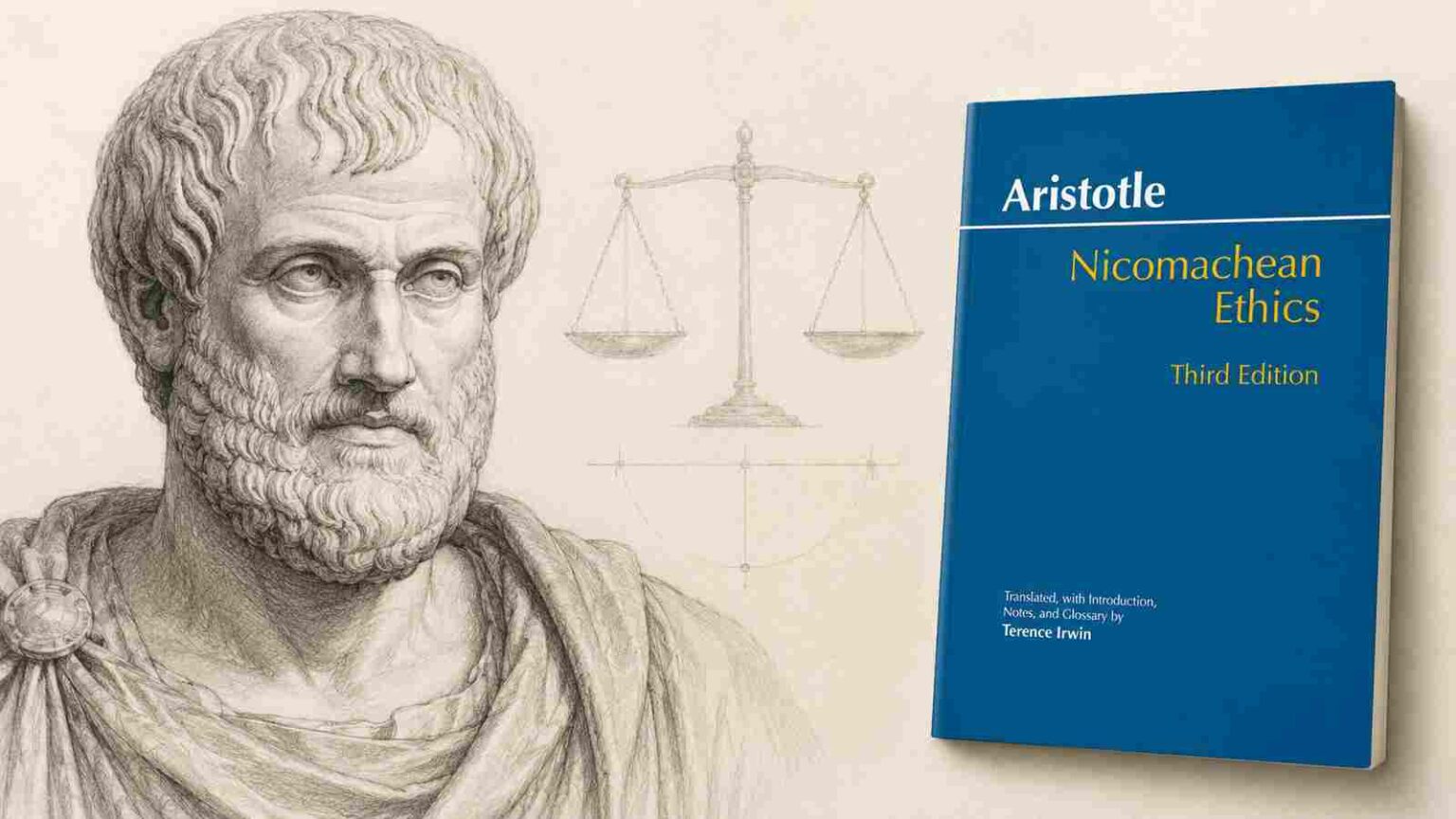
The “Doctrine of the Mean” is not a separate Aristotelian essay. The Doctrine of the Mean in Nicomachean Ethics is found in Book II, above all chapter 6 (1106b36–1107a8), with the full argument extending through chapters 5–9. For most readers, Terence Irwin’s 2019 third-edition Hackett translation is the best single volume: complete, carefully annotated, and equipped with a glossary and related Aristotelian selections.

DIRECT ANSWER
Where the Text Appears
Collection: Nicomachean Ethics, Third Edition
Translator: Terence Irwin
Publisher and year: Hackett Publishing, 2019
ISBN: 9781624668159 (paperback)
Text location: Book II, chapters 5–9; defining formulation in II.6, 1106b36–1107a8
Completeness: Complete ten-book treatise
Main advantage: Revised modern translation, argument headings, explanatory notes, expanded glossary, and an appendix of related Aristotelian selections
Best for: Most first-time readers, seminar students, and independent scholars
Where the Doctrine of the Mean in Nicomachean Ethics First Appears
There was no ancient work entitled “The Doctrine of the Mean.” The phrase is a later editorial and pedagogical label for Aristotle’s treatment of ethical virtue in Book II of Ἠθικὰ Νικομάχεια (Ethika Nikomacheia). Aristotle first distinguishes virtue from feelings and capacities in II.5, defines it as a chosen state concerned with an intermediate in II.6, maps individual virtues between excess and deficiency in II.7–8, and closes with practical advice for finding the intermediate in II.9. Reading only the famous definition severs it from the account of habituation that begins Book II.
The safest locator is therefore NE II.5–9, 1105b19–1109b26, with II.6, 1106b36–1107a8 as the central citation. Bekker numbers are stable across serious editions, while page numbers are not. The Stanford Encyclopedia of Philosophy’s account of Aristotle’s ethics also stresses that the “mean” is relative to the agent and circumstances, not an arithmetic midpoint or a prescription for mildness.
The treatise belongs to the fourth century BCE and is usually associated with Aristotle’s later teaching in Athens, although no exact composition date can be recovered. Its present title is itself post-Aristotelian: Aristotle refers to ethical writings, but does not call the two surviving treatises “Nicomachean” and “Eudemian.” The text is best understood as a school treatise shaped by lecture and editorial transmission, not as a short work first issued independently.
For publication history in the print era, the fifth volume of the Aldine Greek Aristotle of 1498 included the Nicomachean Ethics. The earliest complete English book-form version verified here is John Gillies’s two-volume Aristotle’s Ethics and Politics of 1797. Neither milestone created a separate “Doctrine of the Mean” text; both transmitted the passage within the whole ethics.
The Main English Collections and Editions
The choice is not between complete and incomplete editions so much as between translation philosophies and editorial apparatus. All four volumes below contain the full ten-book work. Irwin offers the strongest all-purpose reading edition; Bartlett and Collins make Greek terminology unusually visible; Crisp is compact and lucid; Ross, revised by Lesley Brown, preserves the most influential twentieth-century English lineage.
SCHOLARLY EDITION
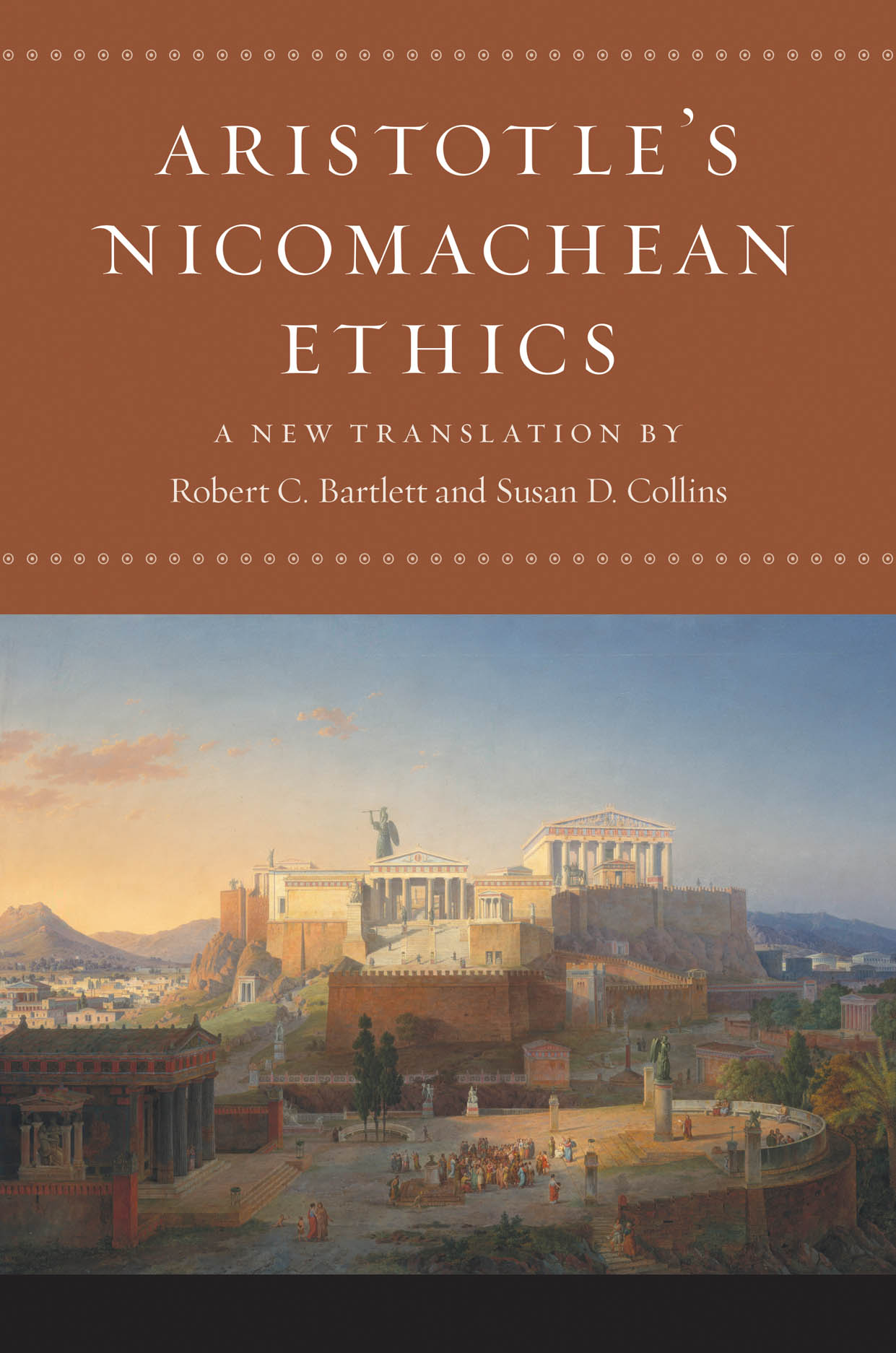
Aristotle’s Nicomachean Ethics: Greek Terms Kept in View
Translators: Robert C. Bartlett and Susan D. Collins
Publisher and year: University of Chicago Press, 2011
ISBN: 9780226026749 (cloth)
Text location: Book II, especially chapters 5–9
Main advantage: Close lexical consistency, notes, interpretive essay, English–Greek glossary, and key Greek terms
Best for: Close reading and advanced seminar work; the prose is more demanding than Irwin or Crisp
ALTERNATIVE MODERN TRANSLATION
Aristotle: Nicomachean Ethics: Compact and Readable
Editor and translator: Roger Crisp
Publisher and year: Cambridge University Press, second edition, 2014
ISBN: 9781107612235 (paperback)
Completeness: Complete, with introduction, glossary, index, and Greek line numbers
Main advantage: A readable yet deliberately literal translation in a concise course edition
Best for: First readings, undergraduate courses, and readers who want less apparatus

HISTORICALLY INFLUENTIAL TRANSLATION
The Nicomachean Ethics: The Ross Tradition, Lightly Revised
Translator: David Ross; revised with introduction and notes by Lesley Brown
Publisher and year: Oxford World’s Classics, 2009
ISBN: 9780199213610 (paperback)
Completeness: Complete ten-book text
Main advantage: Familiar Ross phrasing with selected terminology updated and modern notes added
Best for: Readers following scholarship or courses that cite the Ross translation
The publishers’ pages for Irwin, Bartlett and Collins, Crisp, and Ross–Brown confirm the distinctions in apparatus and format. Brown’s revision is usefully assessed in the Bryn Mawr Classical Review.
| Edition | Translation profile | Apparatus | Best for |
|---|---|---|---|
| Irwin, 2019 | Current, philosophically explicit | Extensive notes and glossary | Best overall |
| Bartlett–Collins, 2011 | Lexically close to Greek | Essay, notes, Greek terms | Close study |
| Crisp, 2014 | Readable and literal | Compact introduction and glossary | Courses and first reads |
| Ross–Brown, 2009 | Classic Ross, selectively updated | Introduction, notes, glossary | Ross-based scholarship |
Why the English Title or Translation Changes
“Doctrine of the Mean,” “mean between extremes,” “intermediate,” and the popular “golden mean” usually point to the same Book II argument. None is the title of an Aristotelian subsection. Editors supply headings, and translators must decide how consistently to render meson (μέσον) and mesotēs (μεσότης). “Mean” preserves the historical English vocabulary; “intermediate” more clearly blocks the mistaken idea that virtue is mediocrity.
Other choices matter as much. Hexis may appear as “state,” “disposition,” “state of character,” or “active condition”; prohairesis as “choice,” “decision,” or “rational choice”; phronēsis as “practical wisdom” or “prudence.” Irwin uses glossary and notes to make a coherent philosophical vocabulary; Bartlett and Collins foreground lexical structure; Crisp balances literalness with readability. Ross remains familiar, while Brown updates selected key terms without replacing its recognizable voice. These are translation differences, not competing versions of the doctrine.
Legal Online and Library Access
The current Irwin, Crisp, Bartlett–Collins, and Ross–Brown editions remain copyrighted. No authorized free full text of those exact editions was located. Complete older translations are legally available, however, and they are adequate for locating the Doctrine of the Mean in Nicomachean Ethics. A catalogue entry identifies an edition; it does not by itself provide the text.
FREE FULL TEXT
MIT Internet Classics Archive
Complete W. D. Ross translation; the Book II page gives immediate access to the relevant sequence.
FREE FULL TEXT
Project Gutenberg
Complete public-domain D. P. Chase translation. Its Victorian diction is dated, but the work is intact.
GREEK AND ENGLISH
Perseus Digital Library
H. Rackham’s English with navigable Greek text and Bekker references; especially useful for checking terminology.
INSTITUTIONAL ACCESS
Loeb Classical Library
Rackham’s Greek–English edition is available through many subscribing libraries; access conditions depend on the institution.
For downloadable public-domain reading, the Standard Ebooks edition of F. H. Peters is the cleanest modern digital presentation. For text-critical checking, use the Perseus Greek page at 1106b alongside a current translation.
Which Edition Should You Choose?
For most readers: Irwin’s third edition gives the best balance of current English, philosophical precision, notes, and navigability. For a compact first reading: Crisp is lighter to carry through a course and remains close to the Greek. For advanced close reading: Bartlett and Collins is the strongest English aid when terminology itself is under examination. For historically continuous citation: Ross–Brown is the sensible choice when a syllabus or secondary literature uses Ross.
Academic work should identify translator, edition, book, chapter, and Bekker number—for example, NE II.6, 1106b36–1107a8. Scholars making an argument from a single Greek term should consult the Greek text as well as at least two translations. No modern English edition makes page numbers transferable to another printing.
Recommended edition
Choose Terence Irwin’s Nicomachean Ethics, third edition (Hackett, 2019), when you want one complete and practical volume for reading, teaching, and following the Doctrine of the Mean in Nicomachean Ethics through its full Book II context.
What Else Is in the Recommended Collection?
Irwin’s volume is worth obtaining because Book II is only the architecture of character virtue. Book I establishes happiness and the human function; Book III examines voluntariness, responsibility, and decision; Book VI explains practical wisdom, without which the mean cannot be intelligently found. Books VIII–IX treat friendship as a condition of flourishing, while Book X returns to pleasure and the contemplative life.
The third edition also expands Irwin’s introduction, notes, and glossary and adds translated selections from related Aristotelian texts. That apparatus helps the reader follow recurring terms rather than treating the mean as a detachable maxim. The chief value of the collection is continuity: it shows how habituation, deliberate choice, practical judgment, friendship, and happiness belong to one ethical inquiry.
Frequently Asked Questions
What book contains Aristotle’s “Doctrine of the Mean”?
It appears within Nicomachean Ethics, Book II. It is not a separately titled essay. Read chapters 5–9 for the complete argument, especially chapter 6, where Aristotle gives the formal definition of virtue as a chosen state concerned with an intermediate relative to us.
Is the passage only in Book II, chapter 6?
Chapter 6 contains the central formulation, but chapters 5 and 7–9 supply its logical and practical setting. A quotation from 1106b36–1107a8 is accurate for the definition; a serious reading should cover 1105b19–1109b26.
Did Aristotle call it the “golden mean”?
No. “Golden mean” is a popular later expression. Aristotle writes of the intermediate and the mean state, using meson and mesotēs. The later phrase can be useful shorthand, but it should not be presented as the ancient title of a passage.
What is the best English translation?
Irwin’s 2019 third edition is the best overall choice for its revised translation, notes, glossary, and related selections. Crisp is the best compact alternative. Bartlett and Collins is preferable when lexical fidelity and Greek terminology are central to the assignment.
Is a complete legal version available online?
Yes, in older public-domain translations. MIT hosts Ross, Project Gutenberg hosts Chase, Standard Ebooks offers Peters, and Perseus supplies Rackham with Greek. These are complete legal texts, but they are not free copies of the current copyrighted editions.
How should the doctrine be cited?
Cite the treatise, book, chapter, and Bekker numbers, plus the translator and edition in your bibliography. The defining passage is normally cited as Aristotle, Nicomachean Ethics II.6, 1106b36–1107a8. Do not rely on a page number without naming the edition.
Related BookInLight Reading Guides
Editorial research and authorship: This guide was researched and written by the BookInLight Department of Philosophy and Intellectual History, with bibliographical review, edition comparison, source verification, and editorial fact-checking by the BookInLight research team. Readers who identify a factual correction, an overlooked edition, a translation observation, or a valuable source are warmly invited to share constructive comments and suggestions.
Art direction and rights: The editorial art direction, visual composition, cover selection, and presentation of images were developed by the BookInLight Art Department. Individual book covers remain the property of their respective publishers, designers, artists, and rights holders and are credited below. Complete republication, reproduction, translation, or reuse of this article, in print or digital form, requires prior written authorization from BookInLight.
Sources and Further Reading
Text and Publication History
Aristotle, “Nicomachean Ethics, Book II,” MIT Internet Classics Archive — complete Ross text and passage sequence.
Aristotle, Greek text at 1106b, Perseus Digital Library — terminology and Bekker location.
Richard Kraut, “Aristotle’s Ethics,” Stanford Encyclopedia of Philosophy — title history, treatise relationship, and interpretation of the mean.
Edward Worth Library, “Aristotle” — the 1498 Aldine printed Greek corpus.
John Gillies, Aristotle’s Ethics and Politics (1797) — early complete English book-form witness.
Modern Editions and Translation
Hackett Publishing, Nicomachean Ethics, Irwin third edition — edition description, apparatus, and extent.
Exact 2019 Irwin paperback record — ISBN and cover correspondence.
University of Chicago Press, Aristotle’s Nicomachean Ethics — translators, contents, apparatus, and 2011 edition data.
Cambridge University Press, Roger Crisp second edition — translation profile, ISBN, pagination, and publication date.
Oxford University Press, Ross–Brown Nicomachean Ethics — revision status, contents, ISBN, and date.
Bryn Mawr Classical Review of the Ross–Brown edition — historical translation lineage and revision assessment.
Legal Digital Access
Project Gutenberg, D. P. Chase translation — complete public-domain English text.
Standard Ebooks, F. H. Peters translation — downloadable public-domain edition.
Loeb Classical Library, H. Rackham edition — Greek–English institutional access record.
Image Credits
Nicomachean Ethics, third edition, translated by Terence Irwin, Hackett Publishing, 2019. Cover displayed from the exact-edition product record; cover rights remain with the publisher and designer.
Aristotle’s Nicomachean Ethics, translated by Robert C. Bartlett and Susan D. Collins, University of Chicago Press, 2011. Cover from the official edition page.
Aristotle: Nicomachean Ethics, second edition, translated by Roger Crisp, Cambridge University Press, 2014. Cover from the official edition page.
The Nicomachean Ethics, translated by David Ross and revised by Lesley Brown, Oxford World’s Classics, 2009. Cover from the official edition page.