The best books on the Taiping Rebellion make the conflict legible as more than a failed millenarian revolt. They reveal a struggle over sacred authority and Qing sovereignty, a civil war entangled with foreign power, and a catastrophe remembered through bodies, ruins, testimony, and doctrine. These five books work best in sequence: broad war history first, then leader, theology, reinterpretation, and aftermath.
The Short Answer
For most readers, the best place to begin is Stephen R. Platt’s Autumn in the Heavenly Kingdom. It supplies the military and international frame; Jonathan D. Spence then brings Hong Xiuquan’s religious imagination into focus, Reilly and Kilcourse explain Taiping theology in different ways, and Meyer-Fong shows what civil war meant after victory and defeat ceased to be the only questions.
Taken together, the best books on the Taiping Rebellion form an argumentative rather than strictly chronological route. No single explanation—religious fanaticism, class revolt, ethnic conflict, dynastic decay, or Western intervention—can bear the full weight of the event. The strongest reading sequence changes scale repeatedly: battlefield, biography, scripture, ritual, household, corpse, archive.
Why the best books on the Taiping Rebellion refuse a single cause
The Taiping conflict of 1850–64 was simultaneously a revolutionary state-building project, a religious movement, a challenge to Manchu Qing rule, and one of the nineteenth century’s most destructive civil wars. Its extraordinary theology can make the movement appear exotic, while the scale of killing can reduce it to a casualty statistic. Both shortcuts obscure the harder question: how did a new sacred language become capable of organizing sovereignty, armies, social rules, and mass allegiance?
The historiography has therefore moved across very different archives. Older document-centered scholarship established political chronology and institutional structure; later work recovered the Taipings’ theological logic, the international politics of intervention, and the moral worlds of survivors. The breadth is visible in the field mapped by the Cambridge bibliography on nineteenth-century China. That is why the best books on the Taiping Rebellion should disagree: the disagreement is evidence that the historical object changes when the question changes.
Sovereignty, Scripture, and the Human Cost of Civil War
Read these books with one distinction in mind: the Taiping Heavenly Kingdom was both an interpretation of sacred history and an attempt to rule. Religious claims about God, kinship, kingship, demons, idols, and moral purification were not a decorative ideology attached to a conventional rebellion. They shaped political legitimacy and social practice. Yet theology alone cannot explain military mobilization, Qing regional armies, foreign intervention, or the devastation of Jiangnan. The most revealing history begins where these explanatory languages overlap rather than where one of them claims exclusive authority.
Author: Stephen R. Platt
Recommended edition: Vintage paperback, 2012, ISBN 9780307472212
Best for: A first narrative of the war and foreign intervention
Difficulty: General to Intermediate
Intellectual role: The military and international frame
BookInLight Rating: ★★★★★
Platt is the strongest entry point because he makes the civil war intelligible before asking readers to master its doctrinal vocabulary. His narrative concentrates especially well on the later conflict, setting Hong Rengan’s reforming ambitions against Zeng Guofan’s regional military power while following British and other Western actors whose claims of neutrality became increasingly difficult to sustain. The result is not a total history of Taiping origins; it is a lucid account of how rebellion became war, diplomacy, and international choice.
Author: Jonathan D. Spence
Recommended edition: W. W. Norton paperback, 1997, ISBN 9780393315561
Best for: Hong Xiuquan’s intellectual and visionary world
Difficulty: General to Intermediate
Intellectual role: Charisma, revelation, and biography
BookInLight Rating: ★★★★★
Spence narrows the lens to Hong Xiuquan and demonstrates why the Taiping religious world cannot be dismissed as an eccentric pretext for rebellion. Dreams, examinations, Christian tracts, biblical interpretation, family language, and demonology become components of political imagination. That biographical concentration is also the book’s limit: Hong can occupy more of the story than institutions, ordinary followers, or postwar survivors. Read after Platt, however, the apparent strangeness of Taiping belief becomes historically consequential rather than merely picturesque.
Author: Thomas H. Reilly
Recommended edition: University of Washington Press hardcover, 2004, ISBN 9780295984308
Best for: Religion as a challenge to imperial legitimacy
Difficulty: Intermediate
Intellectual role: Scripture, Shangdi, and sovereignty
BookInLight Rating: ★★★★☆
Reilly asks what happens when biblical translation enters an already saturated Chinese language of sacred kingship. His central insight is that the Taiping use of Shangdi made theology politically explosive: imperial claims could appear not merely corrupt but blasphemous. The argument brings Protestant translation history, classical Chinese religious vocabulary, and the first commandments into the history of sovereignty. Its concentrated thesis necessarily leaves military and social questions elsewhere, which is precisely why it works so well beside Platt and Spence.
Author: Carl S. Kilcourse
Recommended edition: Palgrave Macmillan hardcover, 2016, ISBN 9781137543141
Best for: A close reconsideration of Taiping Christianity
Difficulty: Advanced
Intellectual role: Localization, ritual, and religious translation
BookInLight Rating: ★★★★☆
Kilcourse pushes beyond the older question of whether the Taipings possessed an orthodox or distorted Christianity. He instead studies how Christian materials were localized through Chinese ethical, ritual, and cosmological categories. The shift matters: religious borrowing becomes an act of production rather than evidence of imperfect transmission. Read beside Reilly, the book creates a productive tension between political theology and religious localization. It is the most specialized volume here, but also the strongest corrective to treating the Taipings as failed Western Christians.
Author: Tobie Meyer-Fong
Recommended edition: Stanford University Press paperback, 2013, ISBN 9780804792066
Best for: Survivors, memory, burial, and postwar moral reconstruction
Difficulty: Intermediate
Intellectual role: The human and cultural aftermath
BookInLight Rating: ★★★★★
Meyer-Fong changes the moral scale of the subject. Instead of asking primarily why the Taipings rose or why they lost, she examines how people lived among the consequences: marked bodies, unburied remains, ruined places, commemorative writing, loyalty claims, and the obligations of survivors. Her archive makes civil war persist after military chronology ends. The Johns Hopkins overview of the book rightly emphasizes reconstruction as both physical and moral work.
How These Books Speak to One Another
Platt and Spence begin from opposite scales. Platt’s civil war is a contest among armies, political projects, and international interests; Spence enters through the visionary biography that helped make one of those projects imaginable. Reilly then sharpens a question latent in Spence: why could Hong’s religious vocabulary attack the Qing order at the level of legitimacy rather than simply condemn bad rulers?
Kilcourse complicates that answer by asking readers not to measure Taiping religion against an imported standard of doctrinal purity. Meyer-Fong makes a different intervention altogether. Her survivors are often concerned less with the intellectual coherence of either side than with burial, loyalty, loss, and rebuilding. Read in sequence, the books move from the problem of making a revolution believable to the problem of making a shattered world inhabitable.
The Reading Map
| Book | Difficulty | Rating | Why It Matters |
|---|---|---|---|
| Autumn in the Heavenly Kingdom | General to Intermediate | ★★★ ★★ | War and intervention |
| God’s Chinese Son | General to Intermediate | ★★★ ★★ | Hong’s visionary world |
| The Taiping Heavenly Kingdom | Intermediate | ★★★ ★☆ | Scripture and sovereignty |
| Taiping Theology | Advanced | ★★★ ★☆ | Localized Christianity |
| What Remains | Intermediate | ★★★ ★★ | Survival and memory |
Where to Begin
- Entry point — Autumn in the Heavenly Kingdom. Use several focused sessions to establish the war, major actors, and foreign involvement.
- Move inward — God’s Chinese Son. Shift from armies and diplomacy to Hong Xiuquan’s visions, texts, and sacred genealogy.
- Interrogate sovereignty — The Taiping Heavenly Kingdom. Follow the language of Shangdi and biblical command into the politics of imperial legitimacy.
- Complicate the theology — Taiping Theology. Read slowly across several focused sessions and ask what “localization” changes.
- Finish with the survivors — What Remains. Let the reading path end not with Nanjing’s fall but with burial, memory, ruins, and reconstruction.
The Last Margin
The best books on the Taiping Rebellion are strongest when they make one another incomplete. Platt provides the best balance of accessibility and historical range, so he remains the first recommendation. Spence then explains why belief mattered; Reilly and Kilcourse prevent that belief from being reduced either to madness or borrowed doctrine; Meyer-Fong restores the people who had to live after explanation itself offered little consolation.
Read together, the five books reveal something larger than the rise and destruction of the Heavenly Kingdom. They show civil war as a contest over the authority to name the sacred, organize political obedience, enlist foreign power, record suffering, and decide what the dead would mean to those who remained.
Related BookInLight Reading Guides
This article was researched and prepared by the BookInLight Department of History and Historiography. The editorial process included bibliographical review, edition-level source verification, comparison with major Taiping scholarship, and factual checking of names, dates, publication information, and historical claims. Factual corrections, overlooked scholarly sources, interpretive suggestions, and constructive editorial ideas are welcome.
The BookInLight Art Department is responsible for editorial art direction, visual composition, exact-edition cover selection, and image presentation. Rights in the displayed book covers remain with the respective publishers, designers, artists, and other rights holders. Complete republication, reproduction, translation, or reuse of this article requires prior written permission from BookInLight.
Sources and Further Reading
Core Editions
Stephen R. Platt, Autumn in the Heavenly Kingdom. Vintage paperback, 2012. Penguin Random House. Used for edition data, chronology, the late-war narrative, Western intervention, Hong Rengan, and Zeng Guofan.
Jonathan D. Spence, God’s Chinese Son: The Taiping Heavenly Kingdom of Hong Xiuquan. W. W. Norton. Google Books record. Consulted for Hong Xiuquan’s biography, visions, religious texts, and the Taiping sacred world.
Thomas H. Reilly, The Taiping Heavenly Kingdom: Rebellion and the Blasphemy of Empire. University of Washington Press, 2004. University of Washington Press. Supports the discussion of Shangdi, biblical translation, iconoclasm, kingship, and imperial legitimacy.
Carl S. Kilcourse, Taiping Theology: The Localization of Christianity in China, 1843–64. Palgrave Macmillan, 2016. Springer Nature. Used for the analysis of localized Christianity, ritual practice, ethics, and religious translation.
Tobie Meyer-Fong, What Remains: Coming to Terms with Civil War in 19th Century China. Stanford University Press, 2013. exact paperback record. Used for postwar survival, bodies, burial, commemoration, writing, and loss.
Historiography and Historical Context
Tobie Meyer-Fong, Johns Hopkins University faculty-book record for What Remains. Consulted for the book’s emphasis on survivor testimony and reconstruction.
Tobie Meyer-Fong, What Remains. JSTOR scholarly record. Used to cross-check the work’s structure and scholarly framing.
C. A. Curwen, ed., Taiping Rebel: The Deposition of Li Hsiu-ch’eng. Cambridge University Press. Google Books record. Consulted as an important participant-centered source tradition against which later narrative histories can be read.
C. A. Curwen, ed., Taiping Rebel. Cambridge University Press front matter. Used to verify publication history and the modern Cambridge printing.
Jen Yu-wen, The Taiping Revolutionary Movement. Yale University Press, 1973. Open Library edition record. Consulted as a major earlier synthetic study of Taiping institutions and revolutionary development.
Franz H. Michael, with Chung-li Chang, The Taiping Rebellion: History and Documents. University of Washington Press. Google Books record. Consulted for the foundational document-based historiography of the movement.
The Cambridge History of China, nineteenth-century bibliography. Cambridge Core. Consulted to situate the selected books within the wider scholarship on the Taiping and late Qing China.
The Journal of Asian Studies review of Taiping Rebel. Consulted when assessing the value and limitations of participant testimony in the candidate pool.
Open Library record for Taiping Theology. Used to cross-check the 2016 Palgrave Macmillan edition, pagination, and print ISBN.
Stanford Scholarship Online record for What Remains. Consulted for publication data, chapter organization, and the book’s treatment of postwar memory and material remains.
Image Credits
Autumn in the Heavenly Kingdom — Vintage paperback, 2012, Penguin Random House, ISBN 9780307472212. Cover asset supplied by the Penguin Random House public image server; authoritative edition page. The same verified asset appears in both the hero shelf and the book module.
God’s Chinese Son — W. W. Norton paperback, ISBN 9780393315561. Cover asset supplied through VitalSource’s public cover service; edition correspondence cross-checked against bibliographical records. Edition record. The same verified asset appears in both the hero shelf and the book module.
The Taiping Heavenly Kingdom — University of Washington Press, 2004, ISBN 9780295984308. Cover asset supplied through VitalSource’s public cover service; University of Washington Press edition page. The same verified asset appears in both the hero shelf and the book module.
Taiping Theology — Palgrave Macmillan hardcover, 2016, ISBN 9781137543141. Cover asset supplied through VitalSource’s public cover service; Palgrave Macmillan / Springer Nature edition page. The same verified asset appears in both the hero shelf and the book module.
What Remains — Stanford University Press paperback, 2013, ISBN 9780804792066. Cover asset supplied through Indigo’s public book-image CDN; exact paperback edition record. The same verified asset appears in both the hero shelf and the book module.
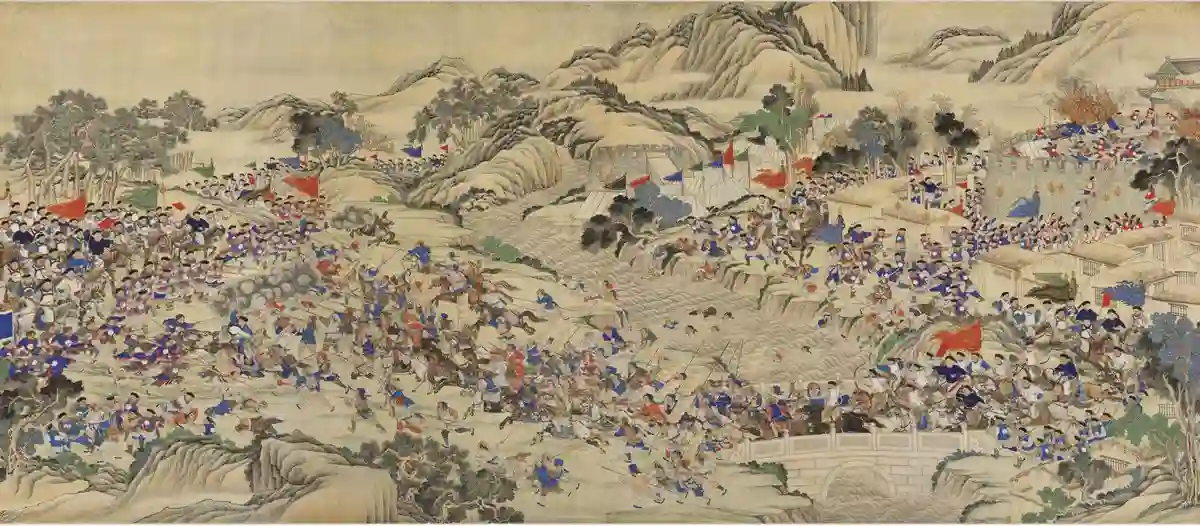
Image credit: Wu Youru — Source: Wikimedia Commons — License: Public Domain (Public Domain Mark 1.0)