The best books on the Opium Wars do more than recount battles between Britain and Qing China. Read together, these seven histories expose the deeper machinery of the conflicts: narcotics and commerce, merchant lobbying, imperial decision-making, military asymmetry, domestic Qing politics, the second war, and the later transformation of defeat into national memory.
The Short Answer
For a first encounter, begin with Stephen R. Platt’s Imperial Twilight. It makes the world before the shooting intelligible: Canton commerce, missionaries, diplomats, smugglers, Qing officials and British political pressure all appear before war becomes inevitable in retrospect.
The best books on the Opium Wars show that there was no single Opium War story. Platt is the strongest entry point; Chen explains how British merchants helped manufacture the case for intervention; Fay follows the western networks and campaign; Mao and Polachek reconstruct Qing decision-making; Wong carries the argument into the Arrow War; Lovell explains how later memory transformed defeat into political myth.
The sequence below is therefore argumentative rather than merely chronological. It moves from contingency to causation, from battlefield narrative to the internal logic of the Qing state, then from the second conflict of 1856–60 to the much longer afterlife of the wars in modern Chinese political consciousness.
Why the Best Books on the Opium Wars Disagree
The familiar shorthand—Britain sold opium, China resisted, Britain attacked and imposed unequal treaties—is morally clarifying but historically insufficient. The drug trade was indispensable to the story, yet explanation also requires the East India Company’s Indian revenue world, private British merchants at Canton, arguments over sovereignty and diplomatic equality, Qing administrative routines, provincial military realities, information failures, and the political uses later generations made of defeat.
The First Opium War of 1839–42 and the second Anglo-Chinese conflict usually called the Arrow War or Second Opium War of 1856–60 were connected without being identical. The first culminated in the Treaty of Nanjing and a new treaty-port order. The second emerged from disputes over treaty enforcement and British and French pressure for wider access, ending with a far more invasive settlement and the occupation of Beijing.
That is why no single volume should be treated as definitive. The historiography changes when the archive changes. Merchant correspondence reveals one set of motives; Qing memorials another; military records expose operational weakness; studies of political memory show that the wars continued to acquire meanings long after the cannons stopped.
Read the Wars as Collisions of Information, Power, and Memory
A productive reading strategy is to resist the search for one master cause. Opium mattered materially; imperial coercion mattered politically; assumptions about civilization and diplomatic hierarchy shaped negotiation; and Qing institutions conditioned what officials could know and do. The final layer is retrospective: later Chinese nationalism turned a complicated nineteenth-century catastrophe into an origin story of foreign humiliation. These books become most revealing when those levels are kept distinct and then compared.
Central Question
How did a dispute inseparable from narcotics commerce become a wider struggle over sovereignty, trade and international order?
Historical Pressure
Commercial expansion, Qing fiscal and administrative strain, British naval power, conflicting diplomatic assumptions and the politics of imperial credibility.
Why These Books
Each alters the scale of explanation: prewar society, merchant knowledge, western participants, Qing command, court politics, the second war and national memory.
Imperial Twilight
Stephen R. Platt
Recommended edition: Vintage paperback, 2019, ISBN 9780345803023
Best for: The first book to read
Difficulty: General
Intellectual role: Reconstructing the world before war
BookInLight Rating: ★★★★★
Platt’s great strength is temporal. Rather than beginning with Lin Zexu’s suppression of opium and racing toward British gunboats, he spends hundreds of pages inside the preceding Anglo-Chinese encounter. Canton appears as a crowded institution rather than a static symbol: merchants, intermediaries, missionaries, officials and would-be diplomats all operate with imperfect information. The result makes the war look less preordained without minimizing British responsibility for choosing coercion.
BookInLight note: Read Platt for contingency. Its narrative accessibility is precisely why it should come first, before more specialized arguments make the causal landscape denser.
Merchants of War and Peace
Song-Chuan Chen
Recommended edition: Hong Kong University Press hardback, 2017, ISBN 9789888390564
Best for: Understanding how intervention was argued into existence
Difficulty: Intermediate
Intellectual role: Merchant knowledge and political lobbying
BookInLight Rating: ★★★★☆
Chen challenges explanations that reduce British policy to a simple mixture of opium profits, national honor and cultural collision. His subject is the production of “knowledge” about China among the British commercial community at Canton. Competing merchant factions did not merely react to Qing policy; they described China in ways designed to make particular British responses appear rational. The pro-intervention argument thus becomes an intellectual construction as well as an economic interest.
BookInLight note: Pair this with Platt. Platt supplies the human landscape; Chen shows how selected descriptions of that landscape travelled into political argument.
Hong Kong University Press edition page · Oxford Academic scholarly record
The Opium War, 1840–1842
Peter Ward Fay
Recommended edition: University of North Carolina Press paperback with a new preface, 1998, ISBN 9780807847145
Best for: A detailed western-facing narrative of trade and campaign
Difficulty: General to Intermediate
Intellectual role: Western participants and the mechanics of conflict
BookInLight Rating: ★★★★☆
First published in 1975, Fay’s study remains useful precisely because its archive and angle are so visible. It follows opium from production in India toward the China trade, gives missionaries an unusually substantial place, and reconstructs the foreigners clustered around Canton before and during the campaign. The later literature has corrected the imbalance created by reliance on western sources, but Fay still provides an unmatched sense of how merchants, naval officers and missionaries understood their own world.
BookInLight note: Do not let Fay stand alone. Its value increases sharply when followed by Mao and Polachek, whose Qing-centered archives disturb the perspective from the foreign factories and fleet.
The Qing Empire and the Opium War
Mao Haijian
English text: Joseph Lawson; translated with Peter Lavelle and Craig Smith; introduction by Julia Lovell
Recommended edition: Cambridge University Press hardback, 2016, ISBN 9781107069879
Best for: Qing strategy, administration and military defeat
Difficulty: Advanced
Intellectual role: Reconstructing the conflict from inside Qing decision-making
BookInLight Rating: ★★★★★
Mao asks the hardest operational question: why was the Qing empire defeated so badly? His answer rejects retrospective caricature. Officials who later seem irrational are restored to the moral expectations, administrative conventions and information environment in which they acted. Chapters on Qing military power, alternating suppression and conciliation, regional battles and treaty negotiations make this the most demanding book here, but also one of the most corrective.
BookInLight note: Mao is best read after a narrative history. Once the chronology is familiar, his reconstruction converts apparently comic bureaucratic failure into a serious problem of institutions, intelligence and command.
Exact Cambridge University Press edition record · Cambridge bibliographical record
The Inner Opium War
James M. Polachek
Recommended edition: Council on East Asian Studies, Harvard University, 1992, ISBN 9780674454460
Best for: The domestic politics behind Qing foreign policy
Difficulty: Advanced
Intellectual role: Literati politics and factional pressure
BookInLight Rating: ★★★★☆
Polachek relocates part of the crisis from the coast to the political world of Qing elites. Foreign policy emerges from domestic struggles among officials and literati rather than from a unified court confronting a unified Britain. That makes the celebrated figure of Lin Zexu harder to read simply as a farsighted national hero. Political constituencies, reputations and ideological commitments shaped the range of policies that could be defended in Beijing.
BookInLight note: The book is specialized, but its method matters enormously. It warns against projecting the later nation-state backward and assuming that nineteenth-century Qing actors understood the conflict through categories later historians inherited.
Deadly Dreams: Opium and the Arrow War (1856–1860) in China
J. Y. Wong
Recommended edition: Cambridge University Press paperback, 2002, ISBN 9780521526197
Best for: The Second Opium War
Difficulty: Intermediate
Intellectual role: Connecting opium, imperial economics and renewed war
BookInLight Rating: ★★★★★
Readers often know the first war far better than the second. Wong corrects that imbalance. Beginning from the Arrow incident, he examines the pretexts, personalities, rhetoric and economic pressures that pushed Britain toward renewed coercion. Opium remains central, but the argument reaches beyond a moral history of narcotics to the financial and imperial structures surrounding the China trade.
BookInLight note: This is where a one-war interpretation breaks down. The renewed conflict demonstrates that the settlement of 1842 had not resolved the underlying struggle over access, diplomatic status and the reach of western power.
The Opium War: Drugs, Dreams and the Making of China
Julia Lovell
Recommended edition: Picador Collection paperback, 2026, ISBN 9781035091324
Best for: War, public memory and modern Chinese nationalism
Difficulty: General
Intellectual role: Connecting nineteenth-century defeat to later political memory
BookInLight Rating: ★★★★★
Lovell combines an energetic history of the conflict with a second question: what happened to the Opium War after it ended? The answer takes the reader into nationalism, education, political rhetoric and changing representations of the West. Rather than treating collective memory as a transparent survival of nineteenth-century experience, Lovell asks how later governments and intellectual climates selected and reorganized the past.
BookInLight note: It is tempting to start here because the prose is accessible. It is even better as the final book: after Mao, Polachek and Wong have complicated the event itself, Lovell shows how complexity can be compressed again into usable national memory.
How These Books Speak to One Another
Platt and Chen produce the first productive tension. Platt emphasizes a crowded world of encounters in which different outcomes remained imaginable; Chen narrows attention to the political work performed by British commercial knowledge. Together they prevent both fatalism and innocence: war was not automatic, but powerful actors actively worked to make coercion thinkable.
Fay then supplies the texture of western participation that Mao and Polachek force the reader to decenter. Mao’s institutional reconstruction is especially valuable against older depictions of Qing officials as simply ignorant or absurd. Polachek complicates the picture further by locating foreign policy inside domestic elite competition. The Qing state stops looking like one mind facing Britain.
Wong extends the chronology and exposes the inadequacy of treating 1842 as closure. Lovell then changes the object of inquiry altogether. Her subject is partly the event, partly its political afterlife. Read last, she makes a crucial distinction visible: the history of the wars and the history of remembering the wars are related, but they are not the same history.
The Reading Map
| Book | Difficulty | Rating | Why It Matters |
|---|---|---|---|
| Imperial Twilight | General | ★★★ ★★ | Best entry point |
| Merchants of War and Peace | Intermediate | ★★★ ★☆ | Merchant lobbying |
| The Opium War, 1840–1842 | General to Intermediate | ★★★ ★☆ | Western participants |
| The Qing Empire and the Opium War | Advanced | ★★★ ★★ | Qing command |
| The Inner Opium War | Advanced | ★★★ ★☆ | Court politics |
| Deadly Dreams | Intermediate | ★★★ ★★ | Second war |
| The Opium War | General | ★★★ ★★ | Memory and nationalism |
Where to Begin
- Entry point — Imperial Twilight. Give it several focused sessions and learn the Canton world before reducing the crisis to a slogan.
- Causation — Merchants of War and Peace. Follow Platt with Chen to see how commercial interest became political knowledge and lobbying.
- Campaign and foreign actors — Fay’s The Opium War, 1840–1842. Use it as a detailed narrative from the western-facing archive.
- Qing reconstruction — The Qing Empire and the Opium War. This is the demanding center of the route and rewards slow reading.
- Read in parallel — The Inner Opium War. Put Polachek beside Mao when you want court politics to complicate military and administrative explanation.
- Extend the chronology — Deadly Dreams. Do not stop at the Treaty of Nanjing; carry the problem into 1856–60.
- Finish with memory — Lovell’s The Opium War. Only after reconstructing the conflicts themselves turn to the question of what later China made of them.
The Past the Cannons Did Not Settle
Among the best books on the Opium Wars, Platt offers the best balance of accessibility, breadth and historical judgment for a first reader. Mao offers the deepest corrective once the basic chronology is secure. Wong is indispensable if “the Opium War” has previously meant only 1839–42, while Lovell is the strongest final step because she distinguishes historical defeat from its later political reconstruction.
The complete sequence reveals something that a single narrative cannot. These wars were at once narcotics conflicts, commercial confrontations, imperial wars, diplomatic crises, institutional failures and later objects of memory. Their historical significance lies partly in what happened on the Chinese coast and partly in what succeeding generations decided those events meant.
Related BookInLight Reading Guides
Five Books on the Boxer Rebellion: History, Empire, and Memory — a natural continuation into late-Qing foreign intervention, violence, popular action and the politics of remembering imperial crisis.
Seven Best Books on the Meiji Restoration — useful for comparing how another East Asian state confronted the nineteenth-century strategic pressures produced by western imperial expansion.
The BookInLight Department of History and Historiography researched and prepared this article through comparative reading, bibliographical review, edition checking, source verification and historical fact-checking. Factual corrections, overlooked scholarship, interpretive suggestions and constructive proposals for strengthening the guide are welcome.
The BookInLight Art Department is responsible for the editorial art direction, visual composition, exact-edition cover selection and image presentation used here. Rights in the published book covers remain with the respective publishers, designers, artists and other rights holders. Complete republication, reproduction, translation or reuse of this article requires prior written permission from BookInLight.
Sources and Further Reading
Primary Book Records and Editions
Stephen R. Platt, Imperial Twilight. Vintage, 2019. Penguin Random House. Used for edition data and the book’s reconstruction of the prewar Anglo-Chinese world.
Song-Chuan Chen, Merchants of War and Peace. Hong Kong University Press, 2017. Hong Kong University Press. Supports the discussion of merchant factions, knowledge production and interventionist argument.
Chen, Merchants of War and Peace, scholarly edition record. Oxford Academic. Used to cross-check publication data and chapter structure.
Peter Ward Fay, The Opium War, 1840–1842. University of North Carolina Press paperback with new preface, 1998. UNC Press. Used for edition details and Fay’s treatment of the opium chain, missionaries and western participants.
Mao Haijian, The Qing Empire and the Opium War. Cambridge University Press, 2016. Google Books exact edition record. Supports discussion of Qing military power, official reasoning and the causes of defeat.
Cambridge University Press bibliographical information for Mao Haijian. Cambridge University Press. Used to verify the English edition, translators, introduction and ISBN.
James M. Polachek, The Inner Opium War. Council on East Asian Studies, Harvard University, 1992. JSTOR. Supports the analysis of literati politics and internal Qing political pressures.
J. Y. Wong, Deadly Dreams. Cambridge University Press paperback, 2002. Open Library exact edition record. Used for edition verification and the transition to the Arrow War.
Julia Lovell, The Opium War. Picador Collection, 2026. Pan Macmillan. Supports the treatment of war, historical memory and modern Chinese nationalism.
Historiography and Wider Context
Yue Du, review of Song-Chuan Chen’s Merchants of War and Peace. The Journal of Asian Studies 77, no. 4 (2018). Cambridge Core. Used to contextualize Chen within recent scholarship.
Zheng Yangwen, The Social Life of Opium in China. Cambridge University Press. Consulted for the longer social history of opium beyond wartime diplomacy.
Timothy Brook and Bob Tadashi Wakabayashi, eds., Opium Regimes: China, Britain, and Japan, 1839–1952. University of California Press, 2000. Consulted for the wider comparative history of narcotics regimes and empire.
Cambridge scholarship on nineteenth-century Chinese economic history. Consulted to situate the wars against Qing fiscal pressures, foreign commerce and the forced opening of treaty ports.
Cambridge scholarship on British imperial warfare under Queen Victoria. Consulted for the broader military and imperial context of the Anglo-Chinese conflicts of the 1840s and 1850s.
Image Credits
Imperial Twilight — Vintage paperback, 2019, Penguin Random House. Cover asset supplied through the publisher’s public image server; authoritative edition page: Penguin Random House. The same edition asset appears in the hero shelf and book module.
Merchants of War and Peace — hardback, Hong Kong University Press, 2017. Edition verified through Hong Kong University Press; cover delivery uses the corresponding Google Books ISBN asset. The same edition asset appears in the hero shelf and book module.
The Opium War, 1840–1842 — paperback with new preface, University of North Carolina Press, 1998. Authoritative edition page: UNC Press; cover delivery uses the corresponding ISBN asset. The same edition asset appears in the hero shelf and book module.
The Qing Empire and the Opium War — Cambridge University Press hardback, 2016. Edition record: Google Books / Cambridge University Press record; public cover asset supplied by Indigo’s ISBN image service. The same edition asset appears in the hero shelf and book module.
The Inner Opium War — Council on East Asian Studies, Harvard University, 1992. Authoritative scholarly edition record: JSTOR; cover asset supplied through Harvard University Asia Center’s public image service. The same edition asset appears in the hero shelf and book module.
Deadly Dreams — Cambridge University Press paperback, 2002. Exact edition record: Open Library; public cover asset supplied by Indigo’s ISBN image service. The same edition asset appears in the hero shelf and book module.
The Opium War — Picador Collection paperback, 2026, Pan Macmillan. Cover asset supplied through Pan Macmillan’s public image service; authoritative edition page: Pan Macmillan. The same edition asset appears in the hero shelf and book module.
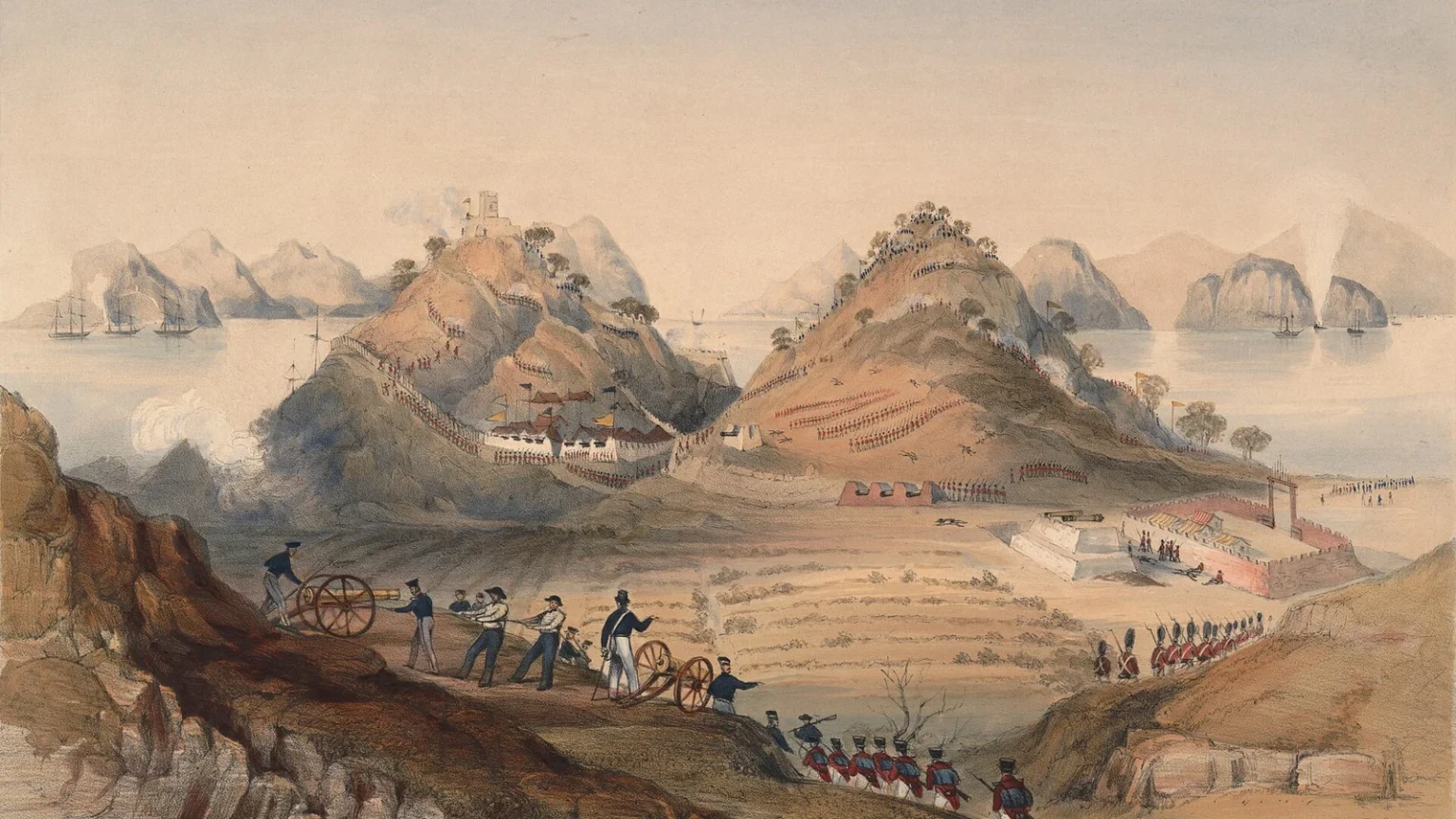
Image credit: Lt. Frederick J. White, Royal Marines; lithograph by Dickinson — Source: Wikimedia Commons — License: Public Domain