The best books on the Easter Rising do not simply retell six days of fighting. They explain how cultural revival, labour militancy, wartime crisis, and republican conspiracy converged—and how military defeat acquired political force through execution, remembrance, and later revolution. Read in sequence, these five works move from event to participants, generation, everyday experience, and national symbol.
The Short Answer
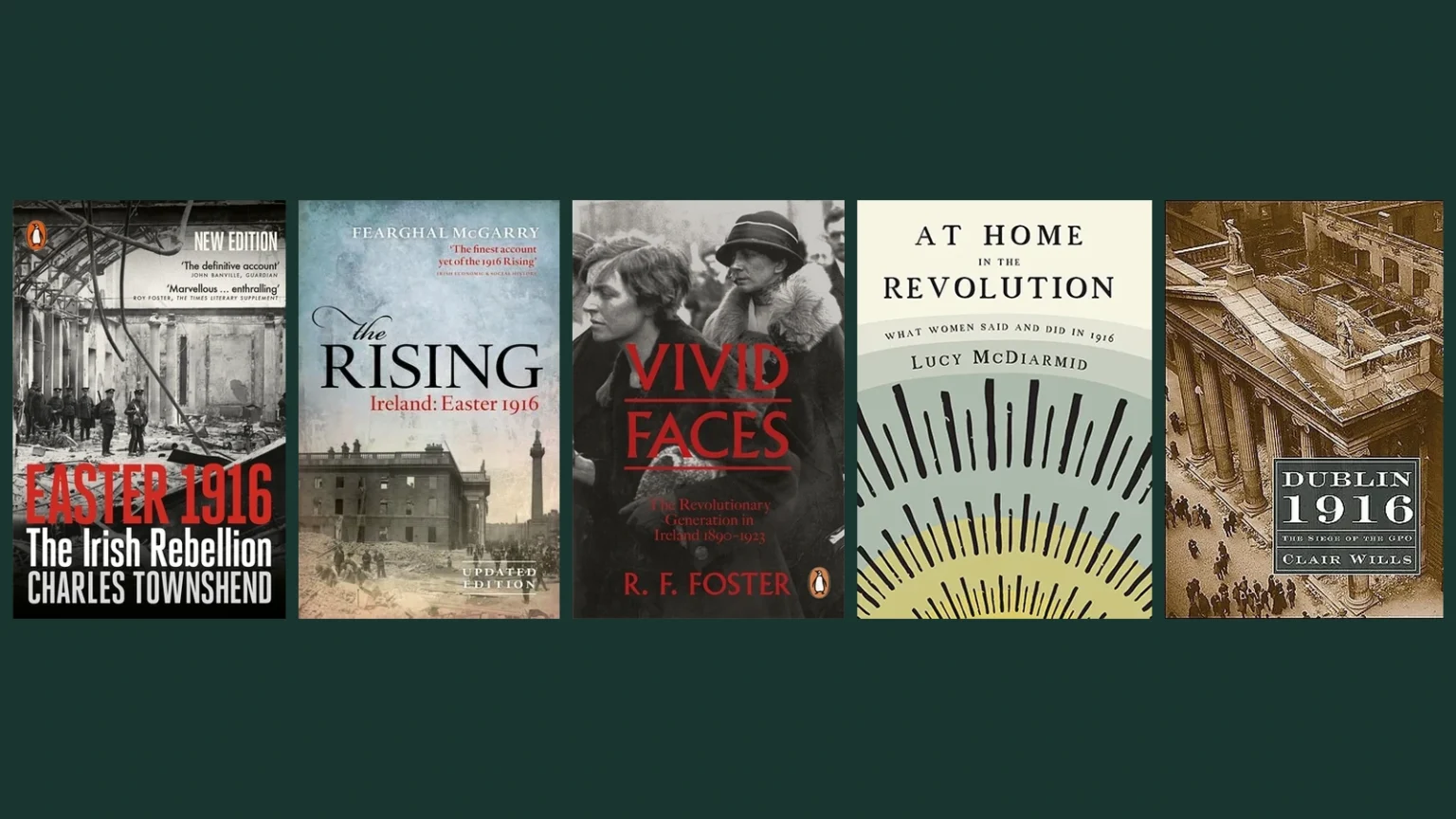
Begin with Charles Townshend for the clearest account of planning, combat, British response, and political consequence. Then read Fearghal McGarry for the rank and file, R. F. Foster for the revolutionary generation, Lucy McDiarmid for women’s everyday testimony, and Clair Wills for the GPO’s transformation from occupied building into contested national icon.
The sequence is argumentative rather than strictly chronological: event, participation, cultural formation, gendered experience, and memory. Together, the books explain why the Rising cannot be reduced either to heroic sacrifice or to a doomed military adventure.
Why the Best Books on the Easter Rising Resist a Single Story
The Easter Rising lasted from 24 to 29 April 1916, but its meaning formed across a longer interval. Fighting, civilian deaths, urban destruction, courts-martial, executions, arrests, and deportations produced no immediate, uniform national response. The political turn that followed was shaped by world war, the 1918 conscription crisis, electoral change, and the wider Irish Revolution. The National Library of Ireland’s 1916 exhibition and Military Archives collections preserve that layered chronology.
Popular narratives smuggle inevitability into the story: the seven signatories stand for everyone who acted, and the GPO eclipses other garrisons and civilian worlds. These books resist that compression through military-political synthesis, testimony from below, generational history, feminist microhistory, and cultural memory. Their disagreements make the history more, not less, intelligible.
The Reading Lens
Read the Rising as Event, Generation, and Memory
The Rising becomes clearer when three kinds of explanation remain in tension. First comes contingency: confused orders, uneven mobilization, local decisions, military weakness, and state reaction. Next comes formation: the schools, theatres, unions, language movements, friendships, militias, and political subcultures that shaped revolutionary actors. Last comes remembrance: the retrospective testimony, commemorative ritual, architecture, and national symbolism through which Easter Week was repeatedly rewritten. The five books below are strongest when read across those levels rather than treated as rival claims to finality.
Central Question
How did a militarily defeated insurrection become a durable claim on political legitimacy?
Historical Pressure
World war, delayed Home Rule, labour conflict, cultural nationalism, imperial coercion, and generational revolt.
Why These Books
They move from command and combat to ordinary participants, social worlds, gendered experience, and commemorative afterlife.
1 · The Event
Easter 1916: The Irish Rebellion
Author: Charles Townshend
Recommended edition: Penguin paperback, 2015; ISBN 9780141982472
Best for: A first full account of decisions, fighting, repression, and aftermath
Difficulty: General to Intermediate
Intellectual role: Military-political foundation
BookInLight Rating: ★★★★★
Townshend is the strongest first book because he keeps several perspectives in view: the Military Council’s intentions, rebel capacity, British decision-making, and civilian experience. He prevents hindsight from becoming explanation. The insurrection looks neither inevitable nor nonsensical, but like a gamble shaped by contradictory orders, weak communications, symbolic ambition, and the Great War.
Its cool institutional register is useful at the start, though it gives less room than McGarry to ordinary participants’ emotional worlds. Read the maps closely: they reveal a dispersed urban struggle, not a drama confined to the GPO.
BookInLight note: Use Townshend to establish the difference between the rebels’ political logic and their limited military capacity.
2 · The Participants
The Rising: Ireland, Easter 1916
Author: Fearghal McGarry
Recommended edition: Updated Oxford University Press paperback, 2017; ISBN 9780198732358
Best for: Rank-and-file motives and the felt experience of rebellion
Difficulty: Intermediate
Intellectual role: History from within and below
BookInLight Rating: ★★★★★
McGarry asks how ordinary people became revolutionaries. Using Bureau of Military History witness statements, he reconstructs politicization through family, friendship, workplaces, clubs, militias, cultural organizations, and world war. The result is a social history of commitment in which ideology matters alongside loyalty, fear, excitement, and local authority.
The archive is rich and necessarily retrospective. Veterans narrated 1916 after independence, civil war, and decades of commemoration; McGarry uses their testimony without treating recollection as transparent. The 2017 preface also situates the centenary within Ireland’s commemorative politics.
BookInLight note: Read this beside the Bureau of Military History collection; the archive clarifies both the book’s evidentiary power and its methodological caution.
3 · The Generation
Vivid Faces: The Revolutionary Generation in Ireland, 1890–1923
Author: R. F. Foster
Recommended edition: Penguin paperback, 2015; ISBN 9780241954249
Best for: The cultural and generational roots of revolution
Difficulty: Intermediate
Intellectual role: Genealogy without inevitability
BookInLight Rating: ★★★★☆
Foster makes Easter Week one episode in the formation of a revolutionary generation. His protagonists meet in language schools, feminist circles, theatres, newspapers, student societies, labour organizations, and armed groups. The Rising did not spring from doctrine alone; it emerged from networks joining art, romance, self-fashioning, and generational impatience.
This is not a battle narrative. It is the book to read once narrative cleanliness becomes suspicious. Foster shows how the plural futures imagined before independence narrowed after victory. His “generation” can feel overly coherent, but the method powerfully resists nationalist teleology.
BookInLight note: Foster explains why cultural history is not decorative background to political history; it is part of the mechanism by which rebellion became thinkable.
4 · The Everyday
At Home in the Revolution: What Women Said and Did in 1916
Author: Lucy McDiarmid
Recommended edition: Royal Irish Academy paperback, 2015; ISBN 9781908996749
Best for: Women’s testimony, domestic space, and revolutionary microhistory
Difficulty: General to Intermediate
Intellectual role: Gendered correction to public and military narratives
BookInLight Rating: ★★★★★
McDiarmid changes what counts as historical action. Diaries, letters, memoirs, and witness statements by nationalist and unionist women turn doors, kitchens, bedrooms, improvised hospitals, clothing, food, harassment, and argument into evidence of authority negotiated in real time.
The point is not to append women to a complete male story. It is to show that “combatant,” “civilian,” “home,” and “public” were unstable categories. Her microhistories expose what institutional narratives screen out: access, bodily vulnerability, social permission, and the mundane labour sustaining armed politics.
BookInLight note: Read this immediately after Foster. His networks explain revolutionary sociability; McDiarmid shows how those networks worked at the scale of rooms, gestures, and contested thresholds.
5 · The Symbol
Dublin 1916: The Siege of the GPO
Author: Clair Wills
Recommended edition: Harvard University Press hardcover, 2009; ISBN 9780674036338
Best for: The GPO as battlefield, ruin, reconstruction, and national icon
Difficulty: Intermediate
Intellectual role: Spatial history and the making of public memory
BookInLight Rating: ★★★★☆
Wills closes the sequence with the building that came to stand for the whole Rising. She reconstructs occupation and siege through testimony, diaries, and newspapers, then follows the GPO through destruction, rebuilding, commemoration, and literary afterlife. Architectural space organizes the week; later memory reorganizes the space.
The focus leaves other garrisons at the margins, so the book works best last. Once Townshend and McGarry restore the Rising’s dispersed geography, Wills can show how one site achieved symbolic dominance: how a ruin becomes proof, shrine, stage, and argument.
BookInLight note: Pair the book with the National Museum of Ireland’s “Proclaiming a Republic” exhibition to compare textual memory with material culture.
Harvard University Press edition details Amazon product page
How These Books Speak to One Another
Townshend and McGarry form the essential first pairing. The former explains conception, command, containment, and punishment; the latter asks how participants acquired motives strong enough to rebel. Institutional analysis emphasizes constraint and miscalculation, while testimonial history restores conviction, fear, and local meaning. Neither scale cancels the other.
Foster shows why conspiracy alone cannot explain 1916: revolutionary actors emerged from cultural scenes whose ambitions exceeded the later state. McDiarmid examines permissions and exclusions within those networks—who could enter a garrison, tend a body, occupy a room, or be remembered as political. “Civilian” becomes a field of action and danger, not a residual category.
Wills reveals the retrospective pressure on all four histories. The GPO condensed a dispersed, heterogeneous rebellion into one legible image—making national memory powerful while concealing complexity. The best books on the Easter Rising therefore expand from machinery to people and social worlds, move inward to intimate experience, and return to the symbol through which later generations saw the event.
The Reading Map
| Book | Difficulty | Rating | Why It Matters |
|---|---|---|---|
| Easter 1916 | General to Intermediate | ★★★★★ | Best full orientation. |
| The Rising | Intermediate | ★★★★★ | Restores ordinary actors. |
| Vivid Faces | Intermediate | ★★★★☆ | Explains revolutionary culture. |
| At Home in the Revolution | General to Intermediate | ★★★★★ | Reframes action and gender. |
| Dublin 1916 | Intermediate | ★★★★☆ | Tracks event into memory. |
Where to Begin
- Entry point: Read Easter 1916 over several focused sessions for the event’s political and military architecture.
- Human scale: Move to The Rising; its testimony will complicate the categories Townshend establishes.
- Historical background: Give Vivid Faces a short introductory week and follow its people across organizations rather than reading only for chronology.
- Corrective lens: Read At Home in the Revolution next, attending to rooms, bodies, permissions, and unofficial labour.
- Memory and symbol: Finish with Dublin 1916, when you are ready to ask why one building came to represent a much larger and less orderly history.
The Unfinished Republic
Townshend remains the best first book; McGarry offers the finest balance of documentary depth and human scale. Reading beyond both is decisive. Foster recovers social and cultural worlds the later state could not fully inherit; McDiarmid shows how gender and domestic space structured participation; Wills explains why national memory compressed a dispersed event into the GPO.
The best books on the Easter Rising leave a republic neither born complete in 1916 nor explained by later victory. Easter Week joined empire, war, constitutional frustration, social radicalism, cultural invention, armed discipline, improvisation, and sacrifice. The sequence makes that collision harder to commemorate neatly, but easier to understand historically.
Related BookInLight Reading Guides
What to Read Before Ulysses?
Dublin’s political, literary, and urban histories form a necessary background to Joyce’s modernist city.
Seven Books on the Paris Commune
A comparative route through failed insurrection, urban warfare, massacre, feminist history, and revolutionary memory.
Six Best Books on the Algerian War of Independence
Extends the inquiry into anti-colonial violence, state repression, competing national narratives, and contested remembrance.
Editorial Note
This article was researched and prepared by the BookInLight Department of History and Historiography. Book selection, edition identification, bibliographical review, source verification, contextual checking, and historical fact-checking were completed before publication. Factual corrections, overlooked sources, interpretive suggestions, and constructive editorial ideas are welcome.
The BookInLight Art Department provided editorial art direction, visual composition, exact-edition cover selection, and image presentation. Rights in the original cover designs and artwork remain with their publishers, designers, artists, and other rights holders. Complete republication, reproduction, translation, or reuse of this article requires prior written permission from BookInLight.
Sources and Further Reading
Primary Texts and Editions
Charles Townshend, Easter 1916: The Irish Rebellion, Penguin, 2015 paperback. Used for the event’s military, administrative, and political architecture.
Fearghal McGarry, The Rising: Ireland, Easter 1916, updated edition, Oxford University Press, 2017. Used for rank-and-file experience and retrospective testimony.
R. F. Foster, Vivid Faces, Penguin, 2015 paperback. Used for generational method and pre-revolutionary cultural networks.
Lucy McDiarmid, At Home in the Revolution, Royal Irish Academy, 2015. Used for women’s accounts, domestic space, and “small behaviours.”
Clair Wills, Dublin 1916: The Siege of the GPO, Harvard University Press, 2009. Used for occupation, destruction, reconstruction, and commemoration.
Archives and Historical Context
National Library of Ireland, 1916 Exhibition. Documentary context for organizations, personalities, chronology, and public memory.
National Library of Ireland, 1916 Reading List. Consulted for bibliographical orientation and major historical studies.
Military Archives, Bureau of Military History, 1913–1921. Primary witness-statement archive central to McGarry’s method.
The National Archives, “Ireland and the Easter Rising, 1916”. Guide to British administrative and military records.
Century Ireland, Easter Rising archive. Used for day-by-day chronology and contemporary press context.
National Museum of Ireland, “Proclaiming a Republic”. Used to connect narrative history with objects and material remembrance.
Scholarly Studies and Critical Reception
English Historical Review assessment of McGarry’s The Rising. Consulted for the book’s place in historiography and its testimonial method.
History Ireland review of At Home in the Revolution. Used to evaluate its treatment of gender, authority, and intimate evidence.
Scholarly review of Clair Wills’s Dublin 1916. Consulted for reception of the book’s spatial and commemorative method.
University College Cork, “The Leaders of the 1916 Rising”. Used to check leadership context while resisting leader-centred reduction.
Image Credits
Easter 1916: The Irish Rebellion, Penguin paperback, 2015, ISBN 9780141982472. Cover asset served by Penguin’s official image infrastructure; authoritative edition page. The same verified asset appears in the hero shelf and book module.
The Rising: Ireland, Easter 1916, updated Oxford University Press paperback, 2017, ISBN 9780198732358. Cover asset served by Kennys’ exact-ISBN image platform; authoritative Oxford University Press edition page. The same verified asset appears in the hero shelf and book module.
Vivid Faces: The Revolutionary Generation in Ireland, 1890–1923, Penguin paperback, 2015, ISBN 9780241954249. Cover asset served by Penguin’s official image infrastructure; authoritative edition page. The same verified asset appears in the hero shelf and book module.
At Home in the Revolution: What Women Said and Did in 1916, Royal Irish Academy paperback, 2015, ISBN 9781908996749. Cover asset served by the author’s Squarespace CDN; authoritative author book page. The same verified asset appears in the hero shelf and book module.
Dublin 1916: The Siege of the GPO, Harvard University Press hardcover, 2009, ISBN 9780674036338. Cover asset served by iMusic’s exact-ISBN image CDN; authoritative Harvard University Press edition page. The same verified asset appears in the hero shelf and book module.