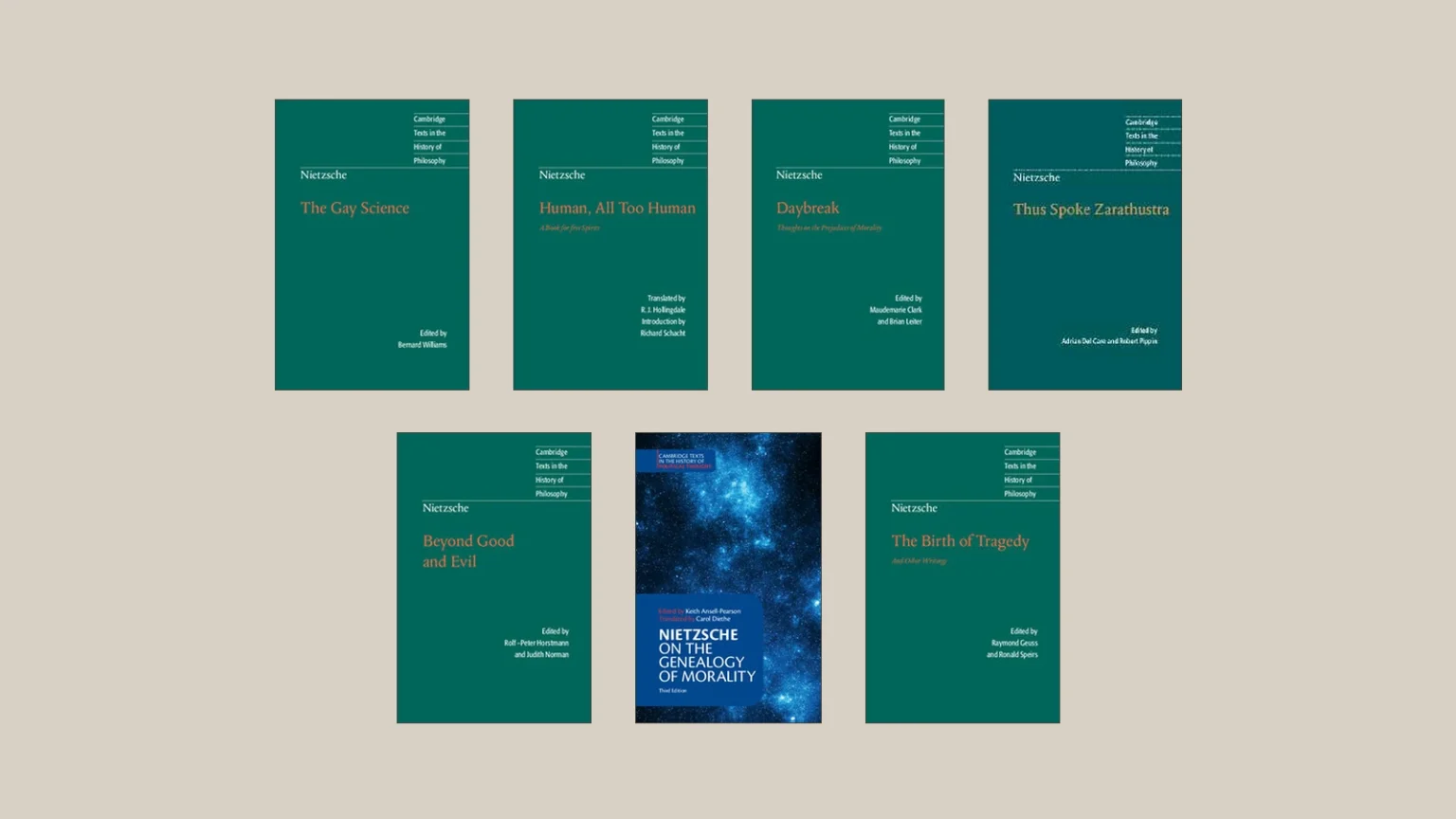
A sound Nietzsche reading order should not be strictly chronological. Nietzsche repeatedly rewrote the meaning of his earlier books, and his most inviting work sits in the middle of his career. Begin with The Gay Science, move backward briefly to the free-spirit writings, then advance through Zarathustra, Beyond Good and Evil, and On the Genealogy of Morality. Save the youthful Wagnerian book and the explosive works of 1888 for retrospective reading.
Target text
The Gay Science: the best gateway, not the first chronologically
Author: Friedrich Nietzsche
Translator or editor: Translated by Josefine Nauckhoff; poems translated by Adrian Del Caro; edited by Bernard Williams
Edition: Cambridge Texts in the History of Philosophy, paperback, 2001; ISBN 9780521636452
Dependency level: Strongly recommended
Why this edition: It contains the expanded 1887 text, a philosophically exact translation, the verse, and Bernard Williams’s unusually lucid introduction.
Main limitation: Its notes are selective; readers doing close textual work will still want the German critical edition.
The Short Answer
Start with Books I–IV of The Gay Science; sample Human, All Too Human and read Daybreak; continue through Thus Spoke Zarathustra, Beyond Good and Evil, and On the Genealogy of Morality; then return to The Gay Science Book V before reading The Birth of Tragedy and the works of 1888. Do not begin with The Will to Power.
This Nietzsche reading order starts from the complete expanded text represented by the Cambridge edition of The Gay Science, while delaying its mature 1887 Book V until the reader has crossed Zarathustra and Beyond Good and Evil.
That sequence is neither pure chronology nor a greatest-hits list. It follows the growth of Nietzsche’s central problem: how values arise, what happens when inherited values lose authority, and whether a post-Christian culture can affirm life without replacing one dogma with another. The Gay Science introduces that problem with enough wit, lyricism, and conceptual variety to teach the reader how Nietzsche writes. The “free spirit” books then disclose the psychological method beneath it. Zarathustra dramatizes the constructive ambition; Beyond Good and Evil and the Genealogy sharpen its philosophical and historical instruments.
The central judgment is practical. A first-time reader does not need Kant, Schopenhauer, Greek tragedy, Christianity, evolutionary theory, and nineteenth-century German history in full before opening Nietzsche. What matters first is a modest chronology, a distinction between published works and notebooks, and six or seven concepts held provisionally. The books themselves should supply most of the education. Preparation becomes counterproductive when it postpones the encounter or makes later interpreters speak in Nietzsche’s place.
Why Nietzsche’s Major Works Are Difficult: The Nietzsche Reading Order Problem
Nietzsche’s difficulty is rarely a matter of formal argument alone. He writes in aphorisms, songs, polemics, parables, prefaces written years after the books they introduce, and personae whose claims are not always his settled conclusions. The Stanford Encyclopedia of Philosophy’s account of Nietzsche rightly treats this stylistic discontinuity as philosophically consequential. An aphorism is not a detachable quotation tile. It has neighbours, a rhetorical target, a place in a book, and often an unresolved tension with other passages.
Chronology helps, but it also misleads. The Birth of Tragedy is first among the major books, yet it is a poor first meeting: its Wagnerian hopes, Schopenhauerian metaphysics, and confident reconstruction of Greek culture belong to a position Nietzsche later criticized. Conversely, Ecce Homo is late and retrospective, but reading it too early lets Nietzsche’s theatrical self-interpretation dictate how every earlier page must be understood. His corpus is developmental without forming a single linear system.
There is also a bibliographical trap. Nietzsche left notebooks, plans, drafts, and posthumous fragments, but he did not publish a finished book called The Will to Power. Earlier editions assembled selections from the Nachlass into an apparent system. Modern scholarship, grounded in the Colli–Montinari critical edition, restores the fragments to a chronological and textual context. A reliable reading order therefore ranks Nietzsche’s authorized books above editorial constructions from his papers.
Finally, familiar slogans arrive before their arguments. “God is dead,” “will to power,” “eternal recurrence,” “master and slave morality,” and the Übermensch are often encountered through popular summaries. Nietzsche’s books complicate every one of them. The right sequence does not promise a final doctrine behind the masks. It creates enough continuity for the reader to recognize when a phrase is diagnostic, experimental, ironic, aspirational, or polemical.
The Dependency Map at a Glance
Essential Before Reading
Essential before reading No earlier philosopher or complete Nietzsche book is indispensable. What is indispensable is a textual distinction: published work, authorized revision, abandoned plan, and notebook entry are not equivalent forms of evidence. The open scholarly platform Nietzsche Source presents the German critical edition edited by Giorgio Colli and Mazzino Montinari, including works, fragments, and letters without pretending that every surviving note belongs to a finished system.
That distinction changes the route immediately. Read the books Nietzsche prepared for readers before treating the Nachlass as philosophical evidence. Use posthumous notes to trace experiments, variants, and abandoned formulations, not to overrule the published corpus. In particular, postpone The Will to Power, an editorial compilation whose apparent architecture is not a book Nietzsche completed. This is the only bibliographical warning a beginner truly must absorb in advance.
Essential before reading Learn the shape of the career in five minutes: youthful philology and Wagnerian cultural criticism; the free-spirit turn; the middle period of experiment and gaiety; the constructive drama of Zarathustra; the mature critique of morality; the concentrated books of 1888. This outline is enough. Dates should orient interpretation, not turn reading into a museum procession.
Strongly Recommended Background
The best preparation is internal to Nietzsche’s corpus. After Books I–IV of The Gay Science, make a controlled backward movement. The two “free spirit” books reveal how much of the later philosophy grows from patient psychological observation: moral feelings have histories; apparently selfless motives can conceal drives; convictions may be symptoms; inherited oppositions can dissolve under analysis. This is the workshop in which genealogy is invented before it receives that name.
Strongly recommended
Human, All Too Human: the decisive break with metaphysical comfort
Author: Friedrich Nietzsche
Translator or editor: Translated by R. J. Hollingdale; introduction by Richard Schacht
Edition: Cambridge Texts in the History of Philosophy, second edition, 1996; ISBN 9780521567046
Dependency level: Strongly recommended
Why it matters: It replaces the youthful appeal to art and metaphysics with historical psychology, scepticism, and the discipline of the free spirit.
How much to read: The prefaces and a representative third of the aphorisms are sufficient on a first route; do not turn selection into random quotation-hunting.
The Cambridge edition of Human, All Too Human is serviceable and durable, but the book need not be read straight through before proceeding. Its value is developmental. Notice the cooling of Wagnerian enthusiasm, the suspicion of metaphysical “backworlds,” and the preference for small explanations over grand redemptive wholes. Once that movement is clear, continue.
Strongly recommended
Daybreak: the bridge from moral psychology to genealogy
Author: Friedrich Nietzsche
Translator or editor: Translated by R. J. Hollingdale; edited by Maudemarie Clark and Brian Leiter
Edition: Cambridge Texts in the History of Philosophy, second edition, 1997; ISBN 9780521599634
Dependency level: Strongly recommended
Why it matters: Nietzsche begins the sustained “campaign against morality” he later claimed started here, while retaining the open, experimental temper of the middle period.
How much to read: Read the complete book if possible; its cumulative rhythm matters more than any single famous aphorism.
The Clark–Leiter edition of Daybreak is the stronger full-book commitment. It prepares the reader to see morality as a complex product of drives, habits, punishments, social utility, misinterpretation, and forgotten coercion. Yet its tone is less prosecutorial than the later Genealogy. That difference matters: Nietzsche’s critical project begins as experimentation before it hardens into polemic.
Once the free-spirit method is visible, return to Nietzsche’s constructive problem. Zarathustra should now feel less like a storehouse of mystical pronouncements. It becomes a dramatic trial of whether new values can be created after the collapse of inherited guarantees.
Strongly recommended
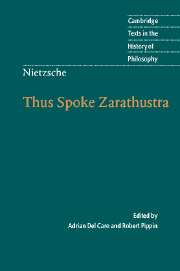
Thus Spoke Zarathustra: read as drama before doctrine
Author: Friedrich Nietzsche
Translator or editor: Translated by Adrian Del Caro; edited by Robert B. Pippin
Edition: Cambridge Texts in the History of Philosophy, hardback, 2006; ISBN 9780521841719
Dependency level: Strongly recommended
Why it matters: It transforms the death of God, self-overcoming, recurrence, and value-creation into a sequence of speeches, failures, temptations, and returns.
How much to read: Read all four parts, slowly. Track images and repeated phrases; do not demand a proposition from every parable.
The mistake is to treat Zarathustra as Nietzsche’s transparent spokesman. The character teaches, revises, withdraws, performs, and repeatedly fails to find an audience. The Übermensch is not a biological master race, and “self-overcoming” is not a motivational slogan. Read the book’s voices and scenes before abstracting a theory. Del Caro’s translation and Pippin’s introduction preserve that literary-philosophical ambiguity better than editions that smooth it into scripture.
Then move to the mature expository pair. Beyond Good and Evil reopens many questions from Zarathustra in a more argumentative register; the Genealogy gives three concentrated historical-psychological inquiries into moral valuation. The former should precede the latter because the Genealogy identifies itself as a supplement and clarification to the project announced in Beyond Good and Evil.
Strongly recommended
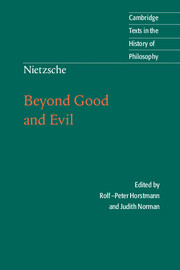
Beyond Good and Evil: the mature philosophical overture
Author: Friedrich Nietzsche
Translator or editor: Translated and edited by Judith Norman; edited by Rolf-Peter Horstmann
Edition: Cambridge Texts in the History of Philosophy, paperback, 2001; ISBN 9780521779135
Dependency level: Strongly recommended
Why it matters: It joins the critique of philosophers’ prejudices to perspectivism, moral typology, rank, psychology, and the future task of value-creation.
How much to read: Read the whole book, but pause after Parts One, Five, and Seven to consolidate the argument.
Strongly recommended
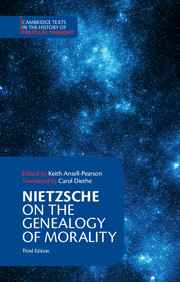
On the Genealogy of Morality: the concentrated test case
Author: Friedrich Nietzsche
Translator or editor: Translated by Carol Diethe; edited by Keith Ansell-Pearson
Edition: Cambridge Texts in the History of Philosophy, third edition, 2017; ISBN 9781316602591
Dependency level: Strongly recommended
Why it matters: Its three essays make Nietzsche’s accounts of noble and slave valuation, guilt and bad conscience, and the ascetic ideal available in their most sustained form.
How much to read: Read the preface and all three essays; reread the preface after finishing.
Between Beyond Good and Evil and the Genealogy, return to the 1887 preface and Book V of The Gay Science. This is the hinge most reading lists omit. The expanded material belongs to the mature period and lets the reader hear Nietzsche revisit gaiety after Zarathustra, naming the “long plenitude and sequence of breakdown, destruction, ruin, and cataclysm” that follows the death of God. The middle book has become a retrospective bridge.
Helpful but Optional Context
Nietzsche’s debts to Schopenhauer and Wagner matter, but full prior study is inefficient. Learn three points. Schopenhauer treats striving as the source of suffering and gives art a temporary redemptive function. Wagner imagines modern music drama as a cultural renewal. The young Nietzsche fuses these hopes with a speculative account of Greek tragedy. Later he rejects the metaphysical consolation and turns Wagner into a case study in decadence, theatricality, and modern desire.
Helpful background
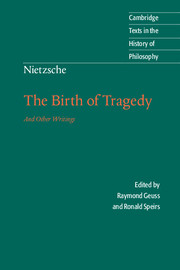
The Birth of Tragedy: read the beginning from the vantage of the end
Author: Friedrich Nietzsche
Translator or editor: Translated by Ronald Speirs; edited by Raymond Geuss and Ronald Speirs
Edition: Cambridge Texts in the History of Philosophy, paperback, 1999; ISBN 9780521639873
Dependency level: Helpful background
Why it matters: It exposes the aesthetic, philological, and metaphysical premises Nietzsche later abandoned, while preserving his lifelong concern with suffering and affirmation.
How much to read: Read the 1886 “Attempt at Self-Criticism” first, then the complete 1872 text; compare the two voices.
Christianity is more than an object of abuse in the late works. Nietzsche’s accounts of guilt, conscience, pity, truthfulness, ascetic discipline, and the value of suffering presuppose a long Christian moral history. A first reader needs the distinction between sin and guilt, the ideal of self-denial, the redemptive meaning assigned to suffering, and the Pauline elevation of faith. Selected New Testament passages and a concise history of Christian ethics are enough. Reading Augustine or Luther in full is enriching, not preparatory.
Classical philology is likewise helpful but not a gate. Nietzsche trained as a philologist; Greek agon, tragedy, pre-Socratic thought, and the contrast between Socrates and tragic culture recur throughout his work. Yet the mature books often use “the Greeks” typologically, as a counter-image to modernity, rather than as neutral historical description. Readers should know that his claims about antiquity are interventions in nineteenth-century German culture as much as reconstructions of Greece.
The sciences of Nietzsche’s century supply another optional layer. He read physiology, psychology, evolutionary debate, and theories of heredity and degeneration. These sources sharpen his naturalistic explanations, but they do not turn the books into early neuroscience or Darwinism. Historical science clarifies the vocabulary of drives, types, health, sickness, and adaptation; present-day scientific validation is a separate question.
Concepts to Learn First
Nihilism and the death of God
The death of God is a cultural event, not merely Nietzsche’s declaration of atheism. The highest inherited values lose their binding force, while the habits, institutions, and moral expectations formed by them persist. Nihilism names the resulting crisis of value and direction. Learn this distinction before reading, but allow The Gay Science and Zarathustra to show its emotional and historical range.
Genealogy
Genealogy investigates how values came to seem self-evident and what functions they serve. It is not a simple search for one origin, nor a claim that exposing a history automatically refutes a value. Nietzsche combines etymology, psychology, social conflict, institutional memory, and functional transformation. The decisive question is evaluative: what forms of life does a value express, protect, or inhibit?
Perspectivism
Perspectivism rejects the fantasy of a view from nowhere. Knowing is situated, selective, affectively organized, and shaped by interests. It does not follow that every claim is equally good. Nietzsche values the capacity to multiply perspectives, discipline affects, compare interpretations, and bring more of an object into view. Treating perspectivism as casual relativism makes his praise of intellectual conscience unintelligible.
Will to power
Will to power can describe the organization, discharge, interpretation, and contest of forces; it can illuminate psychology, valuation, and social relations. Whether Nietzsche intended a comprehensive cosmological doctrine remains disputed, especially because some of the strongest formulations occur in notebooks. Do not reduce the concept to domination, ambition, or positive thinking, and do not decide its metaphysical status before reading the published works.
Ressentiment, guilt, and bad conscience
Ressentiment is reactive valuation: blocked hostility becomes creative by reversing the values of an opponent. Guilt develops through the creditor–debtor relation and later moralization; bad conscience names the inward turning of aggressive forces under social constraint. These are related mechanisms, not synonyms, and Nietzsche’s genealogies are hypotheses with rhetorical and evidential vulnerabilities, not neutral chronicles.
Eternal recurrence and amor fati
Eternal recurrence appears as a cosmological possibility, an existential test, a dramatic burden, and an image of maximal affirmation. Amor fati—love of fate—names the aspiration to affirm necessity without wishing reality otherwise. Their exact relation is contested. A beginner should resist resolving the doctrine into either physics or metaphor before seeing how it operates across The Gay Science, Zarathustra, and Ecce Homo.
The Texts You Do Not Need to Read First
You do not need Schopenhauer’s The World as Will and Representation in full. A dependable account of pessimism, will, individuation, compassion, and aesthetic contemplation will make the youthful Nietzsche legible. The complete work belongs in a specialist route, especially for readers studying The Birth of Tragedy or Nietzsche’s later anti-Schopenhauerian self-definition.
You do not need Kant, Hegel, Plato, or the pre-Socratics entire. Nietzsche’s targets are often compressed, stylized, and filtered through nineteenth-century debates. Read primary passages when a question becomes important: Kant on autonomy and disinterested judgment, Plato on the philosopher and the suprasensible, Heraclitean fragments on becoming. Preparatory mastery of their systems delays more than it clarifies.
You should not begin with Heidegger, Deleuze, Derrida, Foucault, or a totalizing intellectual biography. These readers are powerful because they reorganize Nietzsche around questions of being, force, difference, genealogy, discourse, or modernity. Their frameworks can become invisible lenses. Encounter the primary sequence first, then ask what each inheritor selects, amplifies, or suppresses.
Most decisively, do not use The Will to Power as the destination toward which the published books supposedly advance. Specialists may study the notebooks through a critical chronological edition, and the history of the compilation is itself important. A first reader, however, gains a more accurate Nietzsche from the works he released, revised, prefaced, and arranged for publication.
The Full Scholarly Preparation Route
- Establish the text. Learn the history of the Colli–Montinari edition, consult the digital critical edition, and compare significant German terms across translations. Keep published writings, preparatory notes, and later editorial arrangements distinct.
- Reconstruct the youthful constellation. Read selected Schopenhauer on will, suffering, art, and compassion; study Wagner’s cultural programme; review Aeschylus, Sophocles, and Euripides; then read The Birth of Tragedy and the four Untimely Meditations.
- Follow the free-spirit emancipation. Read Human, All Too Human with its supplements, then Daybreak. Add the French moralists—La Rochefoucauld especially—and a study of nineteenth-century psychology and historical criticism.
- Study the middle-period invention. Read both the 1882 and expanded 1887 strata of The Gay Science. Track the death of God, intellectual conscience, artistic self-fashioning, recurrence, and the transformation of scepticism into experimental affirmation.
- Read the constructive and mature sequence. Complete Zarathustra, Beyond Good and Evil, and On the Genealogy of Morality. Compare their genres instead of harmonizing them prematurely. Add scholarship on naturalism, normativity, agency, truth, and moral psychology.
- Close with 1888. Read The Case of Wagner, Twilight of the Idols, The Anti-Christ, and Ecce Homo, followed by the Dionysus Dithyrambs and selected letters. Use the Cambridge late-writings volume to keep the works’ distinct forms visible.
This route is justified for graduate research, translation, or a project focused on Nietzsche’s development. It is not the morally superior way to read. The extra context earns its place only when it sharpens a textual question; otherwise erudition becomes another defence against being addressed by the books.
Recommended Companions While Reading
Jeremy Fortier’s The Challenge of Nietzsche is the most directly relevant companion to the problem of order. It takes Nietzsche’s retrospective prefaces and self-commentaries seriously without simply surrendering to them. Read it alongside the sequence or immediately after a first pass. Its strength is developmental architecture; its limitation is that no single architecture can neutralize Nietzsche’s local tensions.
For the constructive side, Bernard Reginster’s The Affirmation of Life offers a powerful account of nihilism, suffering, will to power, and affirmation. It is argumentatively demanding and best used after The Gay Science and Zarathustra, not before. Maudemarie Clark’s Nietzsche on Truth and Philosophy remains indispensable for questions of truth and perspectivism, though later scholarship has revised parts of its developmental story.
Brian Leiter’s Nietzsche on Morality gives a clear naturalistic reconstruction of Nietzsche’s critique of morality. It is especially useful beside Beyond Good and Evil and the Genealogy, but readers should remember that Nietzsche’s relation to normativity, agency, and higher types remains disputed. Christopher Janaway’s Beyond Selflessness is the better close-reading companion to the Genealogy; it attends to affects, rhetoric, and readerly involvement that a purely reconstructive approach can understate.
A companion should answer a question raised by the primary text. Do not read three interpretations after every aphorism. Finish a substantial unit, write down the problem in your own terms, then consult one scholar whose method fits that problem. This preserves Nietzsche’s capacity to surprise while still making scholarly disagreement available.
Suggested Reading Sequence
- Orientation: chronology, published works versus notebooks, and a provisional concept sheet.
- First encounter: The Gay Science, prelude and Books I–IV. Stop before Book V on the first pass.
- Backward clarification: selected Human, All Too Human, followed by all of Daybreak.
- Constructive experiment: Thus Spoke Zarathustra, read as a literary drama of teaching, solitude, failure, and return.
- Mature critique: Beyond Good and Evil; then return to the 1887 preface and Book V of The Gay Science.
- Genealogical concentration: On the Genealogy of Morality, with one close-reading companion only after each essay.
- Retrospective beginning: The Birth of Tragedy, preceded by the 1886 self-criticism, plus selected Untimely Meditations.
- Late compression: Twilight of the Idols, The Anti-Christ, and The Case of Wagner.
- Self-interpretation last: Ecce Homo, followed by a return to the prefaces and passages that now look different.
This Nietzsche reading order is deliberately recursive. It places the reader inside the corpus before asking earlier and later books to explain one another. It also separates Ecce Homo from the role of introductory autobiography. The book becomes far more illuminating once the reader can test its retrospective claims against remembered texts.
What to Read Afterward
Better read afterward Begin with the interpreters who changed what “Nietzsche” could mean. Heidegger’s lectures make Nietzsche the consummation of Western metaphysics; Deleuze organizes him around force, sense, and active versus reactive life; Foucault turns genealogy into a historical practice of descent, emergence, and power; Derrida foregrounds style, undecidability, and the instability of philosophical mastery. None is a neutral guide. Each is an event in Nietzsche’s afterlife.
Then read major critics. Feminist scholarship has challenged the misogyny of numerous passages while asking whether Nietzschean critique, embodiment, and self-transformation can be used against gender hierarchy. Political readers dispute the relation between aristocratic ranking, anti-egalitarianism, perfectionism, democracy, and Nietzsche’s contempt for nationalism and antisemitism. Postcolonial and race-critical work tests the scope and exclusions of his European genealogies. These debates should not be quarantined as external objections; they expose where the diagnostic method may reproduce what it claims to diagnose.
Finally, return to the notebooks through the critical edition. After the published corpus, fragments can reveal alternative paths, working hypotheses, and the labor behind finished aphorisms. The reader is then less likely to mistake an abandoned plan for a hidden masterwork. The after-reading route expands Nietzsche without replacing his books by a reconstructed system.
Related BookInLight Reading Guides
Editorial research and authorship: This reading guide was researched and written by the BookInLight Department of Philosophy and Intellectual History, with bibliographical review, source verification, and editorial fact-checking by the BookInLight research team. Readers who identify a factual correction, an overlooked source, an interpretive suggestion, or another constructive possibility are warmly invited to share it with the editors.
Art direction and rights: The editorial art direction, visual composition, cover selection, and presentation of images were developed by the BookInLight Art Department. Individual book covers remain the property of their respective publishers, designers, artists, and rights holders and are credited below. Complete republication, reproduction, translation, or reuse of this article, in print or digital form, requires prior written authorization from BookInLight.
Sources and Further Reading
Primary Texts and Critical Editions
Nietzsche Source. Digital critical edition of Nietzsche’s works, posthumous fragments, and correspondence, based on the Colli–Montinari editions. Used for textual status, chronology, and the distinction between published works and Nachlass.
Nietzsche, Friedrich. The Gay Science. Edited by Bernard Williams; translated by Josefine Nauckhoff; poems translated by Adrian Del Caro. Cambridge University Press, 2001. Anchor edition and evidence for the 1882/1887 structure.
Nietzsche, Friedrich. Human, All Too Human. Translated by R. J. Hollingdale; introduction by Richard Schacht. Cambridge University Press, second edition, 1996. Supports the free-spirit transition.
Nietzsche, Friedrich. Daybreak. Edited by Maudemarie Clark and Brian Leiter; translated by R. J. Hollingdale. Cambridge University Press, second edition, 1997. Supports the moral-psychological bridge.
Nietzsche, Friedrich. Thus Spoke Zarathustra. Edited by Robert B. Pippin; translated by Adrian Del Caro. Cambridge University Press, 2006. Supports the literary-philosophical reading of the constructive middle.
Nietzsche, Friedrich. Beyond Good and Evil. Edited by Rolf-Peter Horstmann; translated and edited by Judith Norman. Cambridge University Press, 2001. Supports the mature sequence.
Nietzsche, Friedrich. On the Genealogy of Morality and Other Writings. Edited by Keith Ansell-Pearson; translated by Carol Diethe. Cambridge University Press, third edition, 2017. Supports genealogy, guilt, bad conscience, and asceticism.
Nietzsche, Friedrich. The Birth of Tragedy and Other Writings. Edited by Raymond Geuss and Ronald Speirs; translated by Ronald Speirs. Cambridge University Press, 1999. Supports the youthful and retrospective stages.
Nietzsche, Friedrich. The Anti-Christ, Ecce Homo, Twilight of the Idols, and Other Writings. Edited by Aaron Ridley and Judith Norman; translated by Judith Norman. Cambridge University Press, 2005. Supports the late-work sequence and edition details.
Scholarly Orientation and Interpretation
Anderson, R. Lanier. “Friedrich Nietzsche.” Stanford Encyclopedia of Philosophy. Used for philosophical overview, genre, and major interpretive disputes.
Fortier, Jeremy. The Challenge of Nietzsche: How to Approach His Thought. University of Chicago Press, 2020. Used for developmental order and Nietzsche’s retrospective self-commentary.
Reginster, Bernard. The Affirmation of Life: Nietzsche on Overcoming Nihilism. Harvard University Press, 2006. Supports the account of nihilism, suffering, will to power, and affirmation.
Leiter, Brian. Nietzsche on Morality. Second edition. Routledge, 2015. Supports the naturalistic reconstruction of Nietzsche’s critique of morality.
Janaway, Christopher. Beyond Selflessness: Reading Nietzsche’s Genealogy. Oxford University Press, 2007. Supports the account of affect, rhetoric, agency, and reader involvement in the Genealogy.
Clark, Maudemarie. Nietzsche on Truth and Philosophy. Cambridge University Press, 1990. Supports the discussion of truth, perspectivism, and development.
Pippin, Robert B. Introductions to Nietzsche. Cambridge University Press, 2012. Supports the literary and philosophical framing of Zarathustra and the mature works.
Gemes, Ken, and John Richardson, editors. The Oxford Handbook of Nietzsche. Oxford University Press, 2013. Consulted for the range of contemporary disputes concerning naturalism, value, politics, psychology, and influence.
Image Credits
The Gay Science, Cambridge Texts in the History of Philosophy paperback, 2001. Cover image supplied by Cambridge University Press; authoritative edition page.
Human, All Too Human, Cambridge Texts in the History of Philosophy paperback, second edition, 1996. Cover image supplied by Cambridge University Press; authoritative edition page.
Daybreak, Cambridge Texts in the History of Philosophy paperback, second edition, 1997. Cover image supplied by Cambridge University Press; authoritative edition page.
Thus Spoke Zarathustra, Cambridge Texts in the History of Philosophy hardback, 2006. Cover image supplied by Cambridge University Press; authoritative edition page.
Beyond Good and Evil, Cambridge Texts in the History of Philosophy paperback, 2001. Cover image supplied by Cambridge University Press; authoritative edition page.
On the Genealogy of Morality and Other Writings, Cambridge Texts in the History of Philosophy paperback, third edition, 2017. Cover image supplied by Cambridge University Press; authoritative edition page.
The Birth of Tragedy and Other Writings, Cambridge Texts in the History of Philosophy paperback, 1999. Cover image supplied by Cambridge University Press; authoritative edition page.