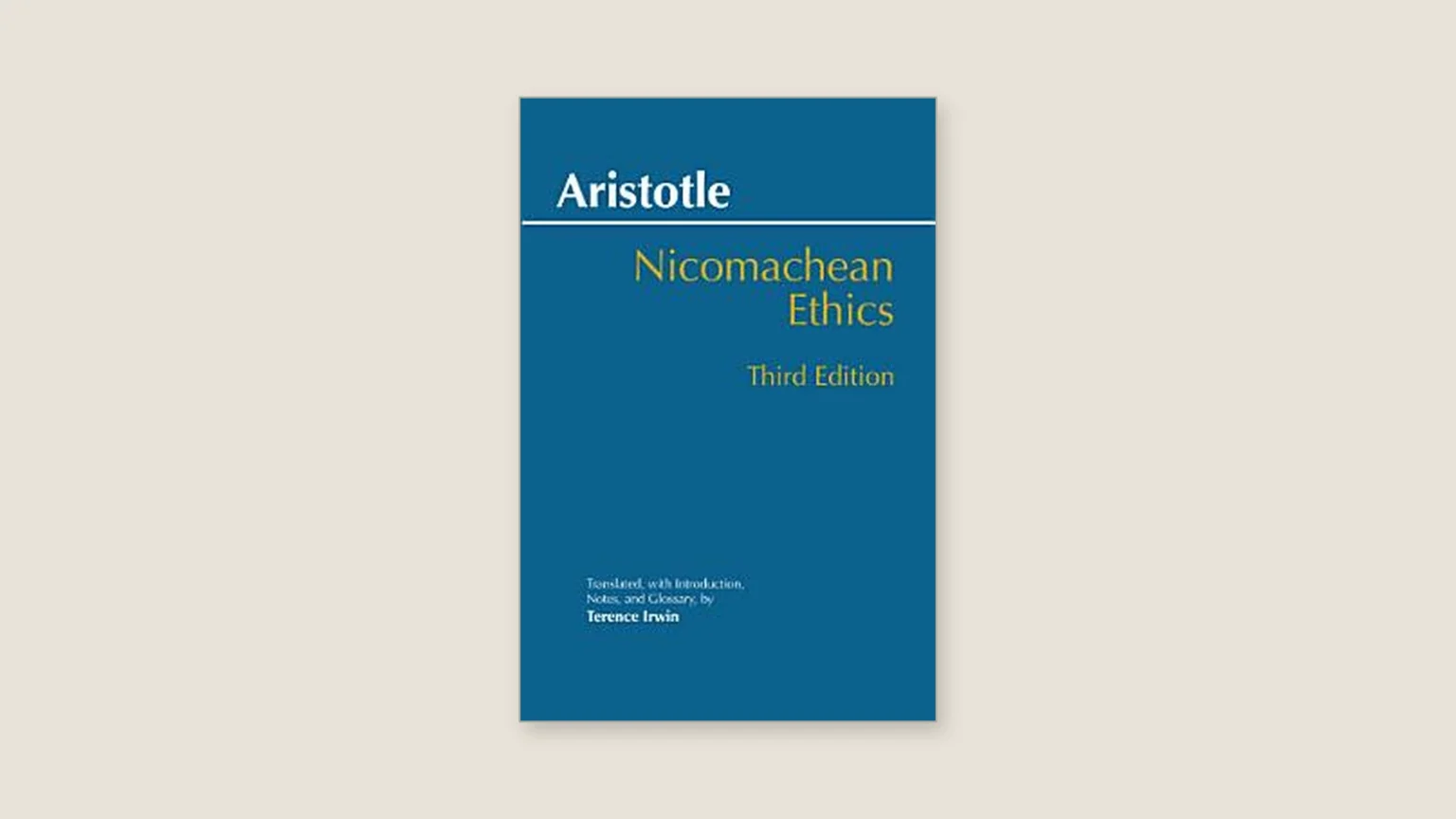
Aristotle’s “Function Argument” is not a separate essay. It is the modern name for a passage in Nicomachean Ethics I.7, most precisely 1097b22–1098a20. For readers asking Where to Read Aristotle’s Function Argument, Terence Irwin’s third-edition Hackett translation is the best all-purpose choice: complete, carefully signposted, and supported by unusually useful notes and a glossary.

DIRECT ANSWER
Where the Text Appears
Collection: Nicomachean Ethics, Third Edition
Translator and editor: Terence Irwin
Publisher and year: Hackett Publishing, 2019
ISBN: 9781624668159 (paperback)
Exact location: Book I, chapter 7, 1097b22–1098a20
Completeness: The full ten-book treatise. Irwin’s revised translation, argument headings, expanded notes, glossary, and appendix make it the most practical single volume for first reading and serious coursework.
Where to Read Aristotle’s Function Argument—and Where It First Appears
The familiar title is editorial shorthand. Aristotle did not publish a work called “The Function Argument,” nor does the Greek manuscript tradition preserve that heading. The passage belongs to Ἠθικὰ Νικομάχεια (Ēthika Nikomacheia), the Nicomachean Ethics. After arguing that happiness is final and self-sufficient, Aristotle asks whether the human good can be clarified by identifying the distinctively human ergon: a “function,” “work,” or “task.”
The secure locator is NE I.7, 1097b22–1098a20. The argument begins with examples of flute players, sculptors, craftspeople, bodily parts, and their characteristic work. It then excludes nutrition and perception as distinctively human, identifies a life involving reason, and concludes that the human good is activity of soul in accordance with excellence or virtue, over a complete life. Chapter and page numbers vary in some older layouts; Bekker numbers do not.
No modern-style first-publication venue can be assigned. The treatise was composed or assembled in the fourth century BCE and is commonly associated with Aristotle’s teaching in Athens, but its exact date and editorial formation remain uncertain. It circulated as part of the ethical treatise, not as a separately delivered lecture. In print history, the 1498 Aldine Greek Aristotle included the Nicomachean Ethics.
English transmission also requires care. John Wilkinson’s 1547 Ethiques of Aristotle was an early English digest based on an Italian abridgment, not a complete direct translation from Greek. The first complete English book-form translation from Greek verified here is John Gillies’s two-volume Aristotle’s Ethics and Politics of 1797. Neither edition presents the function argument as an independent work.
The Main English Collections and Editions
All four editions below contain the complete argument within the complete Nicomachean Ethics. Their differences lie in translation policy, explanatory apparatus, and ease of citation—not in whether the passage is present.
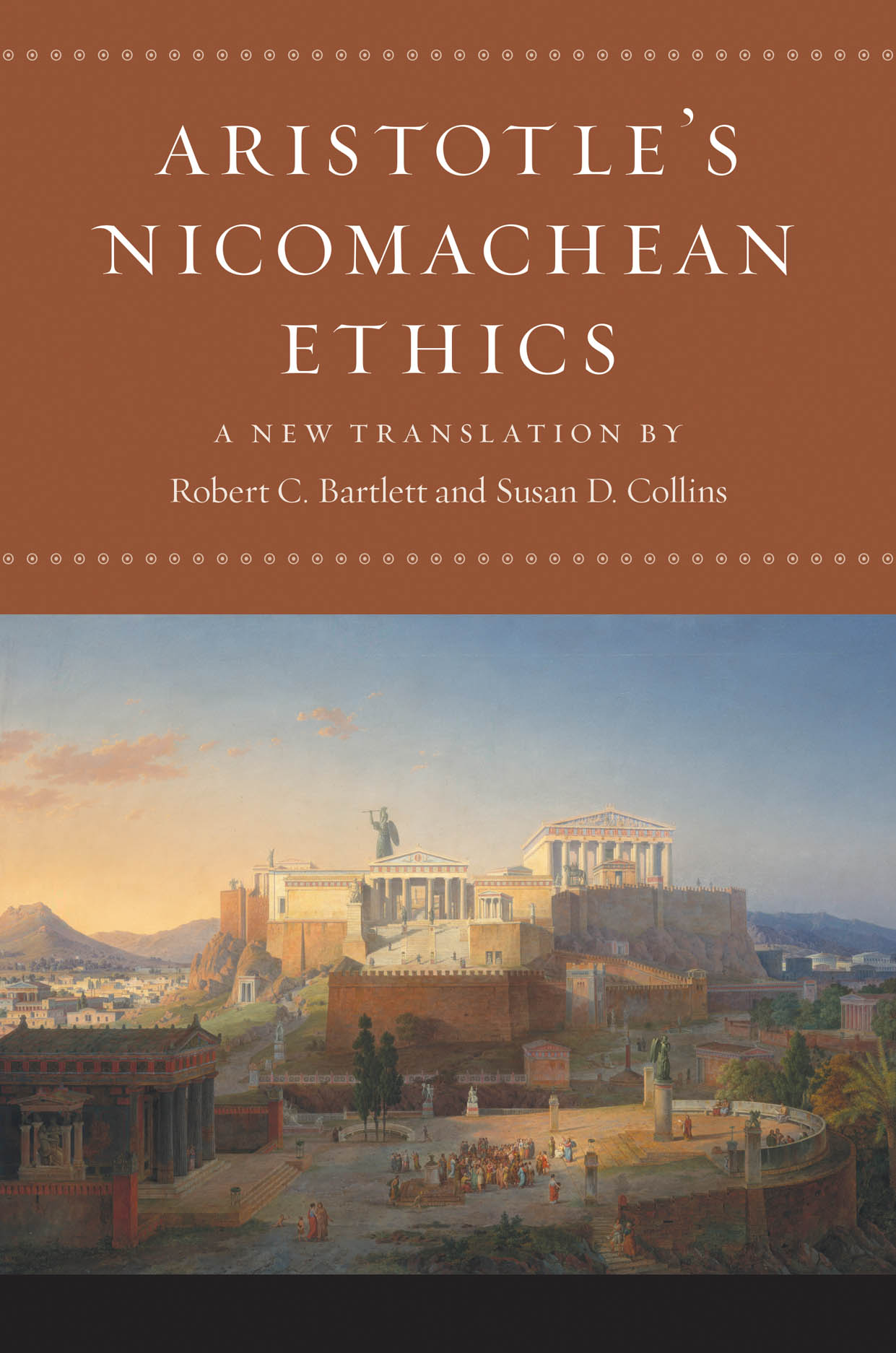
SCHOLARLY CLOSE-READING EDITION
Aristotle’s Nicomachean Ethics
Translators: Robert C. Bartlett and Susan D. Collins. University of Chicago Press, 2011. ISBN 9780226026749 (cloth cover shown).
Its lexical consistency, interpretive essay, notes, English–Greek glossary, and list of key Greek terms make it especially valuable when the meaning of ergon, energeia, or aretē is itself under examination. The trade-off is denser English than Crisp or Irwin.
ALTERNATIVE MODERN TRANSLATION
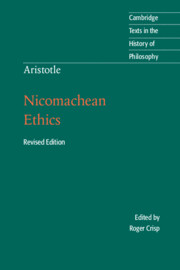
Aristotle: Nicomachean Ethics
Editor and translator: Roger Crisp. Cambridge University Press, revised second edition, 2014. ISBN 9781107612235.
Crisp provides a compact, readable, deliberately close translation with an introduction, glossary, index, and Greek line numbers. It is the cleanest option for a first uninterrupted reading, though it carries less commentary than Irwin.

HISTORICALLY INFLUENTIAL TRANSLATION
The Nicomachean Ethics
Translator: David Ross; revised, introduced, and annotated by Lesley Brown. Oxford World’s Classics, 2009. ISBN 9780199213610.
This edition preserves the recognizable Ross translation while updating selected terms and supplying modern notes. It is the sensible choice when a syllabus or secondary literature quotes Ross, but it is not automatically the clearest edition for a new reader.
| Edition | Profile | Main advantage | Best for |
|---|---|---|---|
| Irwin, 2019 | Revised, explicit | Notes and glossary | Best overall |
| Bartlett–Collins, 2011 | Lexically close | Greek terms visible | Close study |
| Crisp, 2014 | Compact, readable | Light apparatus | First reading |
| Ross–Brown, 2009 | Classic, revised | Citation continuity | Ross-based work |
Why the English Title and Translation Change
A search for “Where to Read Aristotle’s Function Argument” often returns detached excerpts. “Function Argument,” “human-function argument,” and “ergon argument” name the same passage. They are scholarly labels, not rival Aristotelian titles. An anthology may print only 1097b22–1098a20 under one of them; that excerpt can contain the argument, but it is not a separate work and should not be cited as though Aristotle titled it.
The more consequential variation lies inside the translation. Ergon can mean function, work, task, or characteristic activity. Energeia may be rendered activity, active exercise, or actualization; aretē as virtue or excellence; logos as reason, rational principle, or an account; eudaimonia as happiness or flourishing. These choices alter emphasis without creating different versions of the Greek text.
Irwin is strongest when readers need the inferential steps made explicit. Bartlett and Collins are especially useful when English consistency must reveal recurring Greek vocabulary. Crisp preserves speed and readability. Ross remains historically central. For an argument about a single term, compare at least two translations with the Greek text in the Scaife Viewer.
Legal Online and Library Access
The current Irwin, Bartlett–Collins, Crisp, and Ross–Brown editions are copyrighted; no authorized free full text of those exact editions was identified. Complete older translations are available through established public-text and institutional platforms; copyright status may vary by jurisdiction. A library catalogue record confirms an edition’s existence and holdings, but it is not itself full-text access.
FREE FULL TEXT
MIT Internet Classics Archive
Complete freely accessible Ross translation; Book I contains the passage.
DOWNLOADABLE
Project Gutenberg
Complete D. P. Chase translation in several formats.
GREEK AND ENGLISH
Perseus at 1097b
Rackham’s English beside navigable Greek and Bekker references.
INSTITUTIONAL ACCESS
Loeb Classical Library
H. Rackham’s Greek–English volume through subscribing libraries.
Which Edition Should You Choose?
For most readers and students: choose Irwin’s 2019 third edition. For the easiest compact first reading: choose Crisp. For lexical and philosophical close work: choose Bartlett–Collins and consult the Greek. For continuity with twentieth-century scholarship: use Ross–Brown.
RECOMMENDED EDITION
Use Terence Irwin’s Nicomachean Ethics, third edition (Hackett, 2019), when one volume must serve for reading, seminar discussion, terminology, and citation. Cite the passage by book, chapter, and Bekker number rather than by page alone.
What Else Is in the Recommended Collection?
Irwin’s volume supplies the whole architecture that the excerpt presupposes. Book I.1–6 establishes the inquiry into the highest human good and the criteria of finality and self-sufficiency. Book I.13 and Book II develop the structure of the soul and the formation of character virtue, showing what “activity in accordance with virtue” requires.
Book VI explains practical wisdom and the intellectual virtues; without it, “in accordance with reason” remains too vague. Books VIII–IX place flourishing within friendship and shared life. Book X.6–8 returns to happiness and contemplation, creating the interpretive pressure that has generated much scholarship on whether Aristotle’s final account is inclusive or intellectualist. The third edition’s appendix of related Aristotelian selections further connects the ethical vocabulary to Aristotle’s wider corpus.
Frequently Asked Questions
What book contains Aristotle’s “Function Argument”?
It is in Nicomachean Ethics, Book I, chapter 7. The safest exact citation is 1097b22–1098a20. “Function Argument” is a modern scholarly label, not the title of a separate Aristotelian essay.
Is the argument complete if I read only the excerpt?
The standard excerpt contains the core argument, but its premises come from the preceding discussion of happiness, finality, and self-sufficiency. Read at least all of I.7; for the broader case, read Book I through chapter 13.
What is the best English translation?
Irwin is the best overall study edition; Crisp is the smoothest compact alternative; Bartlett–Collins is strongest for close attention to Greek terminology; Ross–Brown is preferable when established scholarship uses Ross.
Where to Read Aristotle’s Function Argument legally online?
MIT provides the complete Ross translation, Project Gutenberg provides Chase, and Perseus supplies Rackham with Greek. These are established legal-access platforms, though copyright status can vary by jurisdiction; none is a free copy of a current edition.
How should the passage be cited?
Name Aristotle, the Nicomachean Ethics, translator and edition in the bibliography, then cite NE I.7, 1097b22–1098a20. Bekker numbers allow readers using different editions to find the same Greek passage.
Final Recommendation
Most readers should read the complete passage in Irwin’s 2019 Hackett edition, beginning at NE I.7, 1097b22 and continuing through 1098a20. Scholars should cite Bekker numbers and compare Bartlett–Collins or the Greek when a claim turns on ergon, energeia, aretē, or logos. Freely accessible older translations are available on established platforms. Do not mistake an anthology headed “The Function Argument” for an independently authored work; the full Nicomachean Ethics is worth obtaining because Books I, II, VI, and X reveal what the excerpt alone leaves compressed.
Related BookInLight Reading Guides
Happiness Is a Public Practice: Rereading the Nicomachean Ethics — a sustained interpretation of why Aristotle’s happiness is an activity embedded in a shared political and material world.
The Mean in Its Proper Place: Aristotle’s Doctrine in Book II — the companion locator for the virtue-as-a-mean argument that follows the function argument’s account of excellent activity.
Aristotle’s Four Causes, Precisely Located: Physics II.3 and the Editions That Matter — another guide to locating a famous modern label inside Aristotle’s actual textual architecture.
Editorial research and authorship: This article was researched and written by the BookInLight Department of Philosophy and Intellectual History. Its preparation included bibliographical review, edition comparison, source verification, translation checking, and editorial fact-checking. Readers are invited to submit factual corrections, overlooked editions, source suggestions, translation observations, and constructive ideas.
Art direction and rights: The BookInLight Art Department developed the editorial art direction, visual composition, cover selection, and image presentation. Individual cover rights remain with the relevant publishers, artists, designers, institutions, and other rights holders. Complete republication, reproduction, translation, or reuse of this article requires prior written authorization from BookInLight.
Sources and Further Reading
Text and Publication History
Aristotle, “Nicomachean Ethics, Book I,” MIT Internet Classics Archive — complete Ross text and the immediate passage context.
Perseus Catalog, Ethica Nicomachea — Greek editions, including Bywater and Bekker.
Edward Worth Library, “Aristotle” — the 1498 Aldine Greek printing.
Database of Early English Playbooks, “The Ethics of Aristotle” — Wilkinson’s 1547 abridged English transmission.
John Gillies, Aristotle’s Ethics and Politics (1797) — early complete English translation from Greek.
Editions and Translation
Hackett Publishing, Irwin third edition — revision status, apparatus, ISBNs, and publication data.
University of Chicago Press, Bartlett–Collins edition — translators, contents, glossary, and 2011 edition data.
Cambridge University Press, Crisp revised edition — translation profile, ISBN, date, and extent.
Oxford University Press, Ross–Brown edition — revision, contents, ISBN, and date.
Argument and Scholarly Context
Richard Kraut, “Aristotle’s Ethics,” Stanford Encyclopedia of Philosophy — ergon, rational activity, and the passage at 1097b22–1098a20.
Christine M. Korsgaard, “Aristotle’s Function Argument”, in The Constitution of Agency — a major modern reconstruction of the argument.
Richard Kraut, “The Peculiar Function of Human Beings” — classic discussion of what makes the human function distinctive.
Legal Access
Project Gutenberg, D. P. Chase translation — complete freely available English text; readers should observe local copyright law.
Loeb Classical Library, H. Rackham edition — Greek–English institutional access record.
Image Credits
Nicomachean Ethics, third edition, translated by Terence Irwin, Hackett Publishing, 2019. Cover displayed through the exact Google Play edition record; cover rights remain with the publisher and designer.
Aristotle’s Nicomachean Ethics, translated by Robert C. Bartlett and Susan D. Collins, University of Chicago Press, 2011. Cover from the official edition page.
Aristotle: Nicomachean Ethics, revised second edition, translated by Roger Crisp, Cambridge University Press, 2014. Cover from the official edition page.
The Nicomachean Ethics, translated by David Ross and revised by Lesley Brown, Oxford World’s Classics, 2009. Cover from the official edition page.