Background for Reading Plato’s Republic is less a syllabus than a set of bearings: the Socratic manner of inquiry, the civic wounds of classical Athens, the authority of Homeric poetry, and the Greek vocabulary of justice and soul. A serious beginner does not need to complete the ancient canon first. The right preparation is selective, because the dialogue itself is designed to educate its reader.

Target text
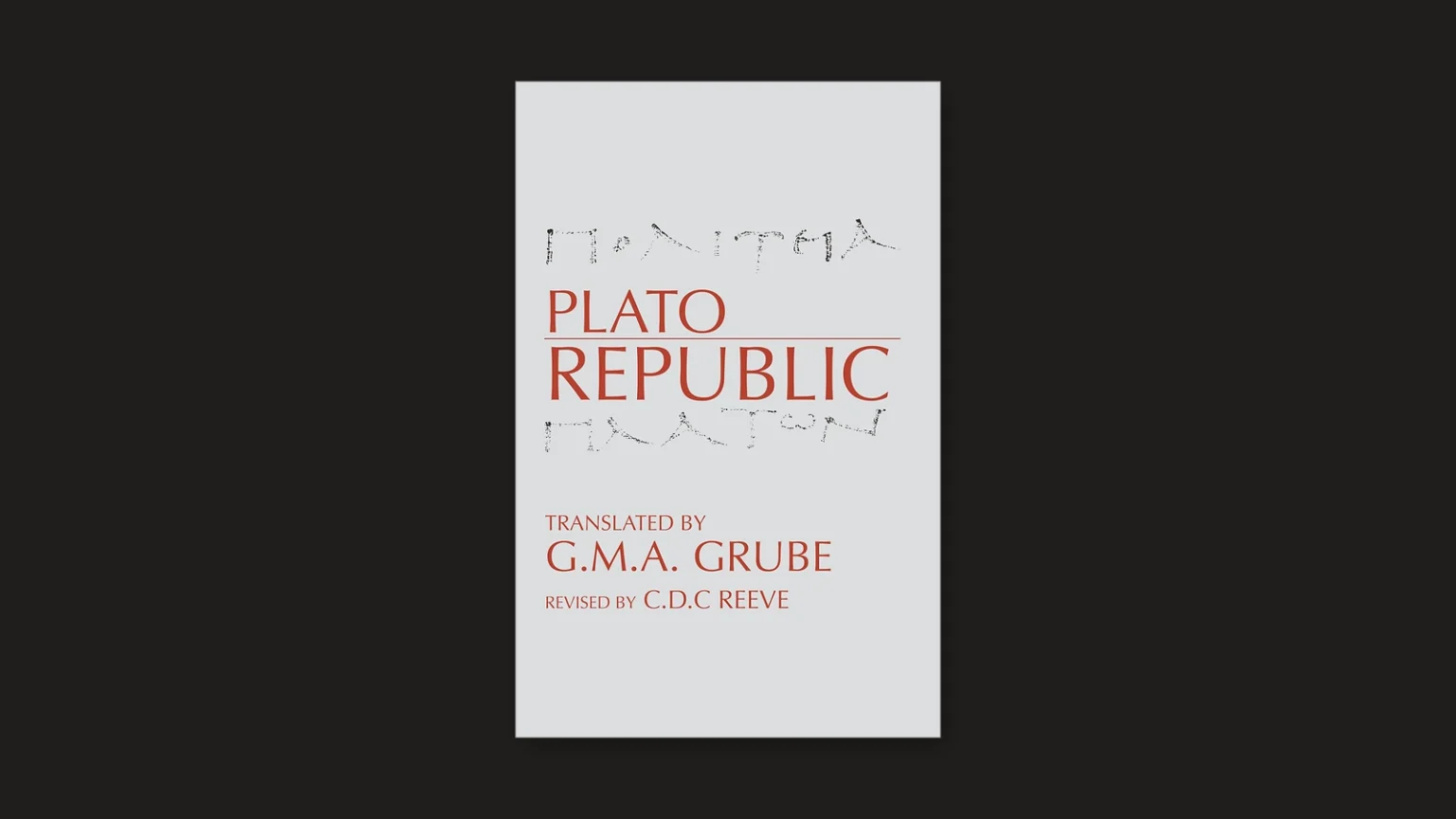
Republic: The best all-purpose philosophical edition
Author: Plato
Translator or editor: Translated by G. M. A. Grube; translation revised by C. D. C. Reeve
Edition: Hackett Publishing, second edition, 1992; paperback ISBN 9780872201361
Dependency level: Essential before reading
Why it matters: The Grube–Reeve text is unusually dependable for sustained argument: clear without becoming colloquial, consistent in recurring philosophical vocabulary, and compact enough to annotate heavily.
Why this edition: It gives serious first-time readers a stable philosophical vocabulary and a concise apparatus without placing a long interpretation between them and the dialogue.
Main limitation: Readers seeking a more literary English voice may prefer Robin Waterfield; readers working with Greek will eventually need a facing-text or critical Greek edition.
Best suited to: Independent readers, university courses, and anyone planning to compare arguments across all ten books.
The Short Answer Background for Reading Plato’s Republic
You can begin Plato’s Republic after one short Socratic dialogue, a concise account of Athens from the Peloponnesian War to Socrates’ execution, and a working grasp of justice, virtue, soul, city, knowledge, and craft. Homer, the sophists, and selected Thucydides deepen the experience, but no complete preparatory canon is required.
The central mistake is to treat the book as either a modern policy proposal or a free-standing sequence of famous doctrines. It is a dramatic argument about whether justice makes a life better, staged through competing speakers and pursued by constructing a city “in speech” so that justice may become easier to see. Political institutions matter, but they serve an ethical and psychological investigation as much as a constitutional one. The Stanford Encyclopedia account of Plato’s ethics and politics rightly begins from the challenge that justice must be shown superior to injustice for the person who possesses it.
The minimum foundation is therefore modest: know what Socratic questioning feels like; know why Athenian democracy, oligarchy, empire, and civil conflict were not abstractions for Plato; and resist translating every Greek term into its most familiar modern English equivalent. Extensive advance reading can become counterproductive. The dialogue introduces the tripartite soul, philosopher-rulers, Forms, the Good, the divided line, the cave, regime decline, and the Myth of Er in its own carefully staged order. Those concepts should be learned with the argument that generates them.
Why Republic Is Difficult
The prose is not the chief obstacle. In a competent translation, most sentences are clear. The difficulty comes from scale and genre. Book I resembles an early Socratic dialogue: definitions are proposed, tested, and broken. Book II restarts the inquiry when Glaucon and Adeimantus demand a defense of justice stripped of reputation and reward. The city is then built as an enlarged image of the soul; education leads into metaphysics; metaphysics authorizes political rule; political decline becomes psychological decline; poetry returns at the end; and the argument closes with a myth. A reader who expects one continuous modern treatise may mistake these changes of register for digressions.
The work is also dialogical in a stronger sense than the typography suggests. Socrates speaks most, yet Plato does not append a note saying when the fictional speaker, the dramatic situation, and the author’s considered view coincide. Thrasymachus performs aggression as well as advancing the claim that justice serves the stronger. Glaucon’s challenge is intentionally more formidable than his own settled belief. Adeimantus repeatedly worries about the social formation of character. Even silences and abrupt agreements matter. The Internet Encyclopedia of Philosophy guide to the Republic is useful for orientation, but the reader must still hear argument as conversation rather than extract propositions alone.
Historical distance creates a second layer. The dialogue belongs to a fourth-century BCE world still marked by the Peloponnesian War, the oligarchic coups, the Thirty Tyrants, democratic restoration, and Socrates’ trial in 399 BCE. Plato does not write a coded newspaper editorial about any one event. Yet debates about expertise, civic education, faction, imperial desire, public persuasion, and political corruption carry the weight of lived institutional failure. A concise overview of this setting is indispensable; a complete narrative history is not.
Finally, translation can conceal dependencies. Dikaiosynē is conventionally rendered “justice,” but it ranges across right order, conduct, and character. Aretē is “virtue” in the older sense of excellence. Psychē is “soul,” though it names the living and desiring principle of a person, not merely an immaterial religious object. Polis is a civic community, not simply a state bureaucracy. The dialogue becomes distorted when these words are silently forced into contemporary legal, theological, or administrative categories.
The Dependency Map at a Glance
Essential Before Reading
1. Recognize the Socratic project
The one genuinely useful prior Platonic text is the Apology. Its Socrates does not offer a doctrine to memorize. He tests claims to wisdom, distinguishes care of reputation from care of the soul, and accepts civic danger rather than pretend to know what he does not know. That posture governs the Republic, even when the later dialogue becomes more constructive. Without it, the philosopher-ruler can look like a technical manager who happens to possess superior information. With it, philosophy appears as a conversion of desire and judgment: rulers are qualified because they have learned not to treat rule as private advantage.
The Stanford Encyclopedia biography and overview of Plato is enough to establish the caution needed here: Plato writes dialogues, not signed treatises, and the relation between Socrates as character, the historical Socrates, and Plato’s own commitments requires interpretation. Read the Apology, notice the method, and stop. A chronological tour through every “early” dialogue is not a prerequisite.

Essential prerequisite
Five Dialogues: Meet the Socratic voice before the city in speech
Author: Plato
Translator or editor: Translated by G. M. A. Grube; revised by John M. Cooper
Edition: Hackett Publishing, second edition, 2002; paperback ISBN 9780872206335
Dependency level: Essential before reading
Why it matters: The Apology supplies the clearest short encounter with Socratic examination, civic friction, and the claim that care of the soul outranks reputation. That orientation prevents the Republic from looking like an impersonal constitutional blueprint.
How much to read: Read the Apology in full. Add the Crito if you want the problem of law and civic obligation; the other three dialogues may wait.
2. Know the political sequence from war to trial
Readers need a compact chronology. Athens and Sparta fought the Peloponnesian War from 431 to 404 BCE. Athenian defeat was followed by the oligarchic regime known as the Thirty, whose violence implicated men connected to Plato’s social world; democracy was restored in 403; Socrates was tried and executed in 399. These facts do not yield a simple equation—democracy killed Socrates, therefore Plato rejected democracy—but they explain why the dialogue subjects every regime to psychological diagnosis and asks whether political competence can exist without moral formation.
A good account should also mention empire, assembly politics, public litigation, civic education, and the unstable prestige of rhetoric. The point is not antiquarian atmosphere. When Thrasymachus identifies justice with the advantage of the stronger, when democracy is portrayed as multiplying desires without order, and when tyranny grows from the demand for unrestricted freedom, Plato is thinking about institutions through habits of soul. The Cambridge chapter “Plato in His Context” provides a responsible scholarly frame without pretending that each dramatic detail can be dated with certainty.
3. Learn a small Greek conceptual vocabulary
Before beginning, write six terms on one page: dikaiosynē (justice or right order), aretē (excellence), psychē (soul), polis (civic community), technē (craft or expertise), and epistēmē/doxa (knowledge/opinion). These are not passwords. They are reminders that the English word is an interpretive decision. Add paideia, formation through education and culture, once the guardian curriculum begins.
No Greek grammar is required. Notice repeated terms, check a glossary, and let the sequence of arguments give them force; Background for Reading Plato’s Republic becomes counterproductive when vocabulary study replaces reading.
Strongly Recommended Background
Homer and the authority of poetry
For archaic and classical Greeks, Homer was not merely entertainment. Epic supplied models of courage, honor, divine action, grief, leadership, and speech; it was woven into education. Plato’s quarrel with poetry is therefore a quarrel over moral formation and political authority. In Books II–III, stories about gods and heroes are judged by what they cultivate in future guardians. In Book X, imitation is criticized again from a different epistemic and psychological angle. The debate is severe because poetry is powerful.
Read enough of the Iliad to encounter Achilles’ anger, Agamemnon’s authority, the gods’ partiality, heroic competition, lament, and reconciliation. Anthony Verity’s Oxford version, documented on the exact-edition Google Books record, is direct and supported by Barbara Graziosi’s concise apparatus. The Odyssey is enriching, especially for disguise, self-mastery, and storytelling, but it is not required before the Republic.

Strongly recommended
The Iliad: The heroic moral world Plato is rewriting
Author: Homer
Translator or editor: Translated by Anthony Verity; introduction and notes by Barbara Graziosi
Edition: Oxford World’s Classics, 2012; ISBN 9780199645213
Dependency level: Strongly recommended
Why it matters: Plato’s arguments about education, imitation, courage, honor, grief, and the gods address a culture schooled by epic. Without some Homer, the censorship debate in Books II–III and the return to poetry in Book X lose their pressure.
How much to read: Books I, VI, IX, XVIII, XXII, and XXIV are enough for preparation. Read the whole poem only if epic is itself one of your main interests.
The sophists, rhetoric, and the nature–convention dispute
Thrasymachus does not represent a single historical “sophist doctrine,” and Plato’s literary treatment is not neutral reportage. Still, Book I belongs to a wider fifth-century dispute about whether justice rests on nature, convention, advantage, or rhetorical success. Sophistic teachers developed techniques of argument and public speech; critics accused them of selling verbal victory; some surviving positions expose the contingency of law, while others explore civic virtue. A reader who knows only that sophists were “bad relativists” misses the seriousness of the challenge.
The shortest responsible route is a modern scholarly reconstruction. The Google Books record for G. B. Kerferd’s The Sophistic Movement identifies its scope: language, relativism, the nomos–physis antithesis, and political thought. Read selectively. The fragments of Protagoras, Gorgias, Antiphon, and Callicles’ speech in Plato’s Gorgias belong to the fuller route.
Strongly recommended
The Sophistic Movement: Recover the debate behind Thrasymachus
Author: G. B. Kerferd
Translator or editor: No translator; scholarly monograph
Edition: Cambridge University Press, 1981 paperback; ISBN 9780521283571
Dependency level: Strongly recommended
Why it matters: Kerferd reconstructs sophistic arguments about convention, nature, rhetoric, power, and moral language without reducing every sophist to a cynical caricature. It clarifies why Book I begins as an intellectual contest, not a simple lesson.
How much to read: Read the introduction and the chapters on nomos and physis, language, and political theory. The full monograph belongs to the scholarly route.
Thucydides and the experience of civic breakdown
Thucydides is not a sourcebook for Plato’s hidden opinions. He is valuable because his speeches and narratives dramatize the collision among power, necessity, justice, persuasion, fear, honor, and interest. The Mytilenean Debate shows a democracy arguing about punishment and advantage. The Melian Dialogue strips imperial reasoning to its hardest form. The Sicilian expedition reveals desire magnified by collective confidence and rhetorical manipulation. These episodes make the Republic’s psychology of cities feel less schematic.
The publisher’s page for The Landmark Thucydides records the edition’s maps, appendices, and revised Crawley translation. Use those aids to read episodes rather than march through the entire war. Plato should not be held hostage to Thucydides’ length.

Strongly recommended
The Landmark Thucydides: Athens under pressure
Author: Thucydides
Translator or editor: Richard Crawley translation, revised; edited by Robert B. Strassler; introduction by Victor Davis Hanson
Edition: Free Press, 1998; ISBN 9780684827902
Dependency level: Strongly recommended
Why it matters: The war history supplies the political atmosphere behind Plato’s suspicion of imperial ambition, demagoguery, civic volatility, and the gap between public speech and actual motive. Its maps and headings make selective reading practical.
How much to read: Read the Funeral Oration and plague, the Mytilenean Debate, the Melian Dialogue, and an account of the Sicilian expedition. Do not postpone Plato until all eight books are finished.
Helpful but Optional Context
Greek tragedy sharpens several themes: conflict between household and city, the blindness of rulers, inherited violence, and the limits of practical judgment. Sophocles’ Antigone can deepen the question of law and kinship; Aeschylus’ Oresteia dramatizes the movement from vengeance toward civic adjudication. Neither is a dependency in the strict sense. Plato’s criticism of imitation becomes richer if the reader has felt tragedy’s moral authority, but the argument remains intelligible without a complete tragic education.
A brief account of Sparta helps: guardian training, discipline, and limits on wealth have Spartan resonances, but Plato’s city is not a disguised Spartan constitution. Detailed comparison belongs to specialists.
In Books VI–VII, mathematics trains attention toward stable intelligibility before dialectic. No Greek proofs are required. Pythagorean parallels in number, harmony, and communal discipline are illuminating but historically difficult to specify.
Finally, the dialogue’s dramatic setting deserves attention after, not before, the first reading. It begins with a descent to Piraeus, unfolds in the house of Cephalus, and includes figures whose historical associations create ironies for informed readers. These resonances are real, but scholarship disagrees about how much interpretive weight each should bear. Consult the Stanford Encyclopedia survey of ancient political philosophy for disciplinary orientation, then return to specialist work only if the drama itself becomes your subject.
Concepts to Learn First
Justice as a condition of person and city
Modern readers often begin with distributive fairness, legal equality, or rights. Those questions are not absent from Greek political thought, but the dialogue’s governing problem is broader: what does justice do to the person who is just? The city is constructed to make an ordering principle visible on a larger scale. When justice is later defined as each part doing its own work, the claim concerns functional order in the city and psychic harmony in the person. It should be tested, not paraphrased into “everyone stays in their place.”
The city–soul analogy
The city in speech enlarges justice before the inquiry returns to the person. The analogy is neither casual metaphor nor mechanical identity. Track where Plato argues the parallel, extends it, and lets it strain.
Craft, expertise, and rule
A technē is expertise directed toward a characteristic good. Socrates says medicine serves the patient and genuine rule the subject; Thrasymachus attacks that idealization. The dispute prepares philosopher-rule without yet proving political expertise.
Soul and psychic partition
The soul becomes tripartite—reason, spirit, appetite—to explain conflicting motivations. Thymos, or spirit, includes anger, pride, competitiveness, and indignation; it may ally with reason or appetite. Learn the model in Book IV, then test it in Books VIII–IX.
Knowledge, opinion, and Forms
Plato distinguishes knowledge from opinion and links knowledge to what fully is. Forms such as the Just itself are intelligible structures, not mental pictures. Resist importing a finished textbook system: learn what Books V–VII need for philosophers, education, and rule, then compare other dialogues. The Platonic Foundation’s complete translation provides a free second rendering.
The Good, the sun, the line, and the cave
The Good makes knowledge and truth possible as the sun makes sight possible. The line orders cognition; the cave dramatizes painful reorientation and return. They overlap without becoming one diagram. Escape is not private self-expression: the educated person must return.
Education as formation
Paideia joins stories, music, exercise, mathematics, dialectic, habit, and selection. Plato asks which pleasures and models shape desire before argument governs it. Hence poetry is central, and laws alone cannot reform unformed character.
The Texts You Do Not Need to Read First
You do not need all of Plato. Reading every dialogue chronologically can delay the central encounter and gives false confidence that the chronology is settled. The Apology is sufficient preliminary orientation; the Gorgias, Meno, Phaedo, Symposium, Phaedrus, Statesman, and Laws are better used afterward to compare rhetoric, knowledge, desire, method, and political judgment.
You do not need the Presocratics in full. Heraclitus, Parmenides, and Pythagorean traditions matter to Plato’s intellectual environment, but a first reading of the Republic rarely turns on reconstructing their fragments. A concise history of early Greek philosophy is enough. Nor must you master Greek mathematics, Athenian legal procedure, or Spartan constitutional detail before beginning.
Do not read Aristotle’s Politics as a preface. Its criticism is so influential that it can make Plato’s communal proposals appear already defeated before their function in the dialogue has been understood. The same warning applies to Karl Popper’s The Open Society and Its Enemies, Leo Strauss’s interpretive tradition, feminist reconstructions, psychoanalytic readings, and modern debates about totalitarianism. These works ask important questions, but they should encounter a reader who has first encountered Plato.
Finally, a full commentary is unnecessary on the first pass. Line-by-line apparatus can turn a designed movement of thought into a sequence of local puzzles. Use notes for names, institutions, and textual uncertainty; postpone interpretive adjudication until you can see how Book I, the central images, the regime sequence, and Book X answer one another.
The Full Scholarly Preparation Route
- Socratic foundations. Read the Apology, Crito, Gorgias, and Meno. Track examination, law, rhetoric, virtue, and the problem of knowledge. Do not force these dialogues into a rigid developmental chronology.
- Poetic education. Read the Iliad substantially, then selected tragedy. Ask what kinds of character are praised, how divine action is represented, and why imitation can educate emotion before reason.
- Sophistic and political argument. Study Protagoras, Gorgias, Antiphon, and the nature–convention debate through Kerferd or another reliable collection. Add Plato’s Gorgias to compare Callicles with Thrasymachus without treating them as identical.
- Historical Athens. Read selected Thucydides, an account of the oligarchic revolutions and restoration, and scholarship on Socrates’ trial. Distinguish historical causation from dramatic resonance.
- The primary text with textual control. Read the Grube–Reeve translation, marking Stephanus numbers and recurring Greek terms. Compare disputed passages with Waterfield, Griffith, or a Greek-facing edition; record differences rather than choosing by fluency alone.
- Argumentative reconstruction. After each book, write the question, conclusion, and unresolved premise. Pay special attention to the transition from justice in the city to justice in the soul, the necessity of philosopher-rule, and the movement from the Good to political return.
- Interpretive plurality. Only after completion, read Annas, Reeve, the Ferrari companion, and specialist essays representing different approaches to unity, drama, politics, psychology, metaphysics, gender, and poetry.
Recommended Companions While Reading
Julia Annas remains the best single issue-centered companion for readers who want philosophical pressure rather than paraphrase. Her chapters clarify the relation among justice, happiness, knowledge, and political structure. The limitation is precisely her strength: she presents a forceful account of what the argument is doing. Read Plato first, then use Annas to discover where your reconstruction is weak.
Recommended companion
An Introduction to Plato’s Republic: The strongest issue-by-issue guide
Author: Julia Annas
Translator or editor: No translator; philosophical study
Edition: Oxford University Press, 1981; paperback ISBN 9780198274292
Dependency level: Helpful background
Why it matters: Annas keeps justice, happiness, knowledge, education, and political authority in a single argumentative field. She is lucid and exact, especially when the dialogue’s transitions tempt readers to treat its famous images as detachable doctrines.
How much to read: Use after completing each major cluster of books, not as a substitute for them. Her firm interpretive line is a strength during rereading and a possible constraint before first contact.
Sean McAleer’s Plato’s Republic: An Introduction is the most practical open-access companion. It follows the dialogue closely, poses reconstructive questions, and respects its literary form. It is particularly useful for self-directed readers who need an instructor’s prompts without a classroom. Its scale is substantial, so consult the chapter corresponding to the book you have just read.
G. R. F. Ferrari’s edited Cambridge Companion to Plato’s Republic is better treated as a collection of interventions than a linear guide. Its range—politics, psychology, epistemology, poetry, and reception—makes it valuable after a first reading or during advanced coursework. C. D. C. Reeve’s monograph is narrower but more unified: it asks whether the philosopher-kings are the culmination of one integrated argument. Neither should determine a beginner’s first impression.

Specialist text
Philosopher-Kings: Test the unity of the argument
Author: C. D. C. Reeve
Translator or editor: No translator; interpretive monograph
Edition: Hackett Publishing, 2006 reprint; ISBN 9780872208148
Dependency level: Relevant only for specialists
Why it matters: Reeve argues with unusual discipline that the dialogue’s psychology, epistemology, education, and politics form one sustained defense of philosopher-rule. It is a valuable antidote to reading the middle books as a gallery of unrelated set pieces.
How much to read: Read after a complete first pass, or consult selectively when writing on the philosopher-rulers. It is too architecturally decisive to serve as a neutral preface.
Suggested Reading Sequence
- Orient yourself: read the Apology, a short historical account, and the term sheet.
- Read Book I without a companion: identify Cephalus’, Polemarchus’, and Thrasymachus’ accounts of justice; note what Socrates refutes and what remains unproved.
- Read Books II–IV: follow the renewed challenge, the construction of the city, guardian education, the virtues, and the return to the soul. Pause to diagram the analogy.
- Read Books V–VII slowly: separate the three “waves,” then connect philosopher-rule to knowledge, the Good, mathematics, dialectic, and compulsory return to the cave.
- Consult a companion: read Annas or McAleer on the middle books; compare one second translation where the argument seems to hinge on a word.
- Read Books VIII–IX as one psychological sequence: trace how political constitutions correspond to dominant desires and why tyranny completes the defense of justice.
- Read Book X without treating it as an appendix: connect poetry, psychic vulnerability, immortality, choice, and the Myth of Er to the dialogue’s opening problem.
- Only then widen the field: revisit Homer, read Aristotle, and enter modern debates over authoritarianism, gender, utopia, irony, and philosophical education.
What to Read Afterward
Begin within Plato. The Gorgias offers a harsher contest among philosophy, rhetoric, pleasure, and political power. The Statesman complicates political expertise and law; the Laws replaces philosopher-rule with an elaborate second-best legal order. The Phaedo and Symposium reframe soul, desire, ascent, and philosophical life. Reading these afterward reveals variation inside Plato rather than forcing the Republic to stand for a fixed system.
Aristotle is the decisive early critic. In the Politics, he challenges excessive political unity and Plato’s proposals concerning property, family, and guardians; he also develops a comparative vocabulary of constitutions and practicability. Yet he shares the premise that politics concerns the formation of character and the human good. Reading him after Plato makes disagreement and inheritance visible at once.
Better read afterward
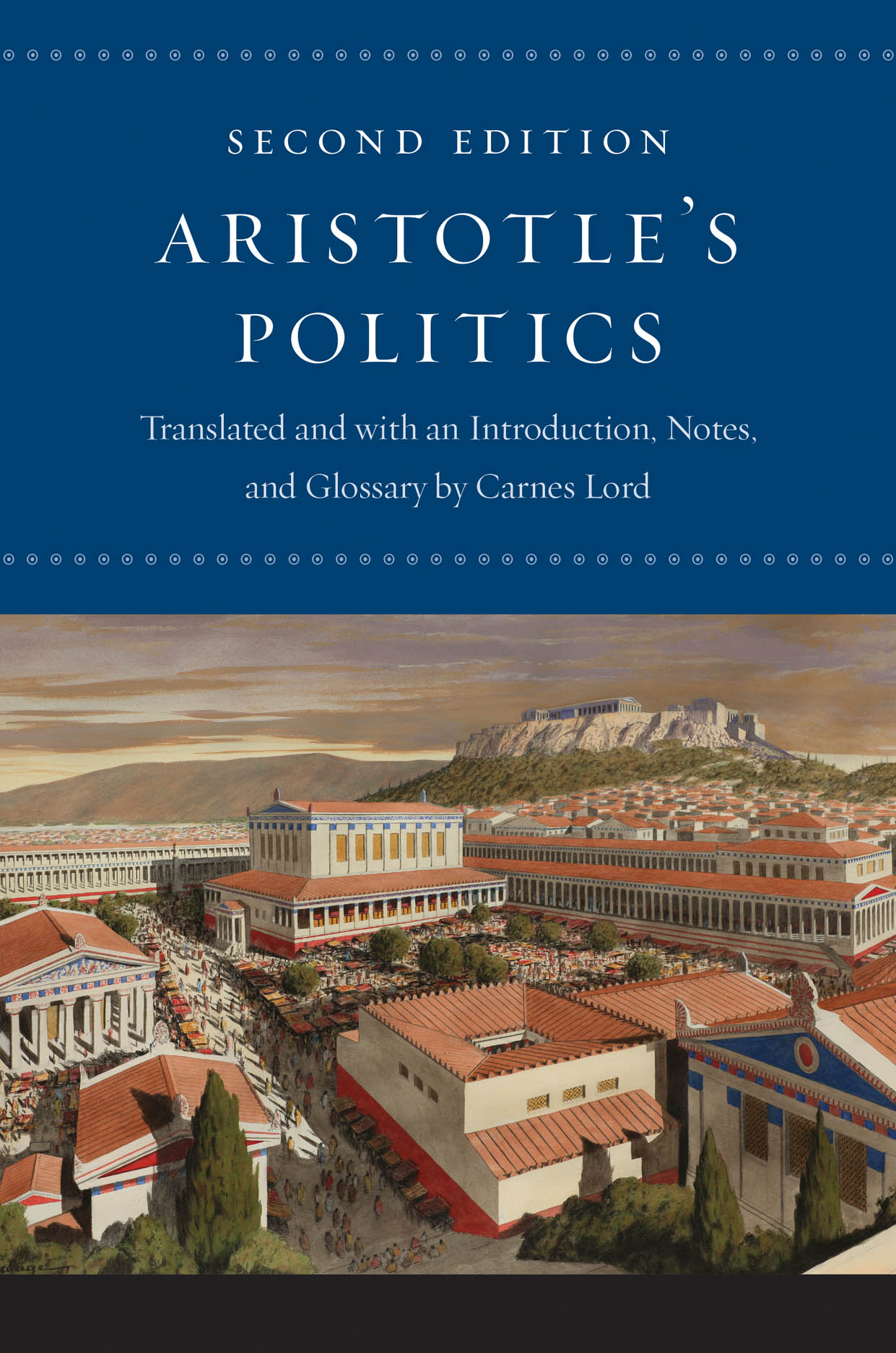
Politics: The first great argument back
Author: Aristotle
Translator or editor: Translated, with introduction, notes, and glossary, by Carnes Lord
Edition: University of Chicago Press, second edition, 2013; ISBN 9780226921839
Dependency level: Better read afterward
Why it matters: Aristotle examines Plato’s proposals about unity, property, family, education, and constitutional form while replacing the single ideal city with a more comparative inquiry into regimes and practicable arrangements.
How much to read: After the Republic, read Books II–III first, then I and VII–VIII. Reading Aristotle too early can make Plato answer questions framed by his successor.
Sequence modern afterlives by question. Pair Popper’s indictment with scholarship challenging its historical assumptions; use feminist work on guardian women to test the terms of equality; approach Straussian irony as a contested method; and use utopian studies to ask whether the city is proposal, paradigm, or provocation.
End with comparative rereading: revisit Thrasymachus after Book IX, poetry after the Myth of Er, and the cave after Aristotle. Afterlives matter when they reopen Plato rather than replace him.
Related BookInLight Reading Guides
Editorial research and authorship: This reading guide was researched and written by the BookInLight Department of Philosophy and Intellectual History, with bibliographical review, source verification, and editorial fact-checking by the BookInLight research team. Readers who identify a factual correction, an overlooked source, an interpretive suggestion, or another constructive possibility are warmly invited to share it with the editors.
Art direction and rights: The editorial art direction, visual composition, cover selection, and presentation of images were developed by the BookInLight Art Department. Individual book covers remain the property of their respective publishers, designers, artists, and rights holders and are credited below. Complete republication, reproduction, translation, or reuse of this article, in print or digital form, requires prior written authorization from BookInLight.
Sources and Further Reading
Primary Texts and Editions
Plato. Republic, second edition. Translated by G. M. A. Grube; revised by C. D. C. Reeve. Hackett, 1992. The principal English text used for edition judgment and argumentative terminology.
Plato. Five Dialogues, second edition. Translated by G. M. A. Grube; revised by John M. Cooper. Hackett, 2002. Source for the recommended Apology and Crito preparation.
Plato. Republic, Volume I. Edited and translated by Christopher Emlyn-Jones and William Preddy. Loeb Classical Library, 2013. Greek-facing comparison and textual reference.
Homer. The Iliad. Translated by Anthony Verity; introduction and notes by Barbara Graziosi. Oxford World’s Classics, 2012. Epic education and poetic authority.
Thucydides. The Landmark Thucydides. Edited by Robert B. Strassler. Free Press, 1998. Historical episodes, maps, and political speeches.
Aristotle. Aristotle’s Politics, second edition. Translated by Carnes Lord. University of Chicago Press, 2013. Principal early critique and comparative aftermath.
Historical and Intellectual Context
“Plato.” Stanford Encyclopedia of Philosophy. Used for biography, dialogue form, chronology cautions, and the Socratic problem.
“Plato’s Ethics and Politics in The Republic.” Stanford Encyclopedia of Philosophy. Used for the justice challenge, city–soul argument, philosopher-rule, and interpretive disputes.
“Ancient Political Philosophy.” Stanford Encyclopedia of Philosophy. Used to situate the dialogue within Greek arguments about citizenship, constitutions, virtue, and rule.
“Plato: The Republic.” Internet Encyclopedia of Philosophy. Used as an accessible structural and argumentative cross-check.
Debra Nails. “Plato in His Context.” In The Cambridge Companion to Plato. Used for historical setting, dramatic persons, and limits on contextual inference.
G. B. Kerferd. The Sophistic Movement. Cambridge University Press, 1981. Used for rhetoric, relativism, language, and the nomos–physis debate.
Companions and Interpretive Studies
Julia Annas. An Introduction to Plato’s Republic. Oxford University Press, 1981. Used for issue-centered analysis of justice, happiness, knowledge, and political order.
C. D. C. Reeve. Philosopher-Kings: The Argument of Plato’s Republic. Hackett reprint, 2006. Used for the unified-argument interpretation and philosopher-rule.
G. R. F. Ferrari, ed. The Cambridge Companion to Plato’s Republic. Cambridge University Press, 2007. Used for the spectrum of contemporary debates across politics, psychology, metaphysics, and poetry.
Sean McAleer. Plato’s Republic: An Introduction. Open Book Publishers, 2020. Used as an open-access, book-by-book companion and pedagogical cross-check.
Image Credits
Plato, Republic, Hackett second edition (1992), cover image supplied through a stable retail image asset; exact edition details: Google Books exact-edition record. Cover rights remain with the publisher and relevant designer.
Plato, Five Dialogues, Hackett second edition (2002), cover image delivered by VitalSource; exact-edition source page. Cover rights remain with Hackett and relevant rights holders.
Homer, The Iliad, Anthony Verity translation, Oxford World’s Classics (2012), cover image supplied through a stable retail image asset; exact-edition record.
G. B. Kerferd, The Sophistic Movement, Cambridge University Press paperback (1981), cover image delivered by The Nile; exact-edition record.
Thucydides, The Landmark Thucydides, Free Press (1998), cover image delivered by VitalSource; Simon & Schuster exact-edition page.
Julia Annas, An Introduction to Plato’s Republic, Oxford University Press (1981), cover image delivered by eCampus; exact-edition record.
C. D. C. Reeve, Philosopher-Kings, Hackett reprint (2006), cover image delivered by a stable bookseller asset; Google Books exact-edition record.
Aristotle, Aristotle’s Politics, Carnes Lord second edition, University of Chicago Press (2013), cover image delivered by the University of Chicago Press. Cover rights remain with the press and relevant designer.