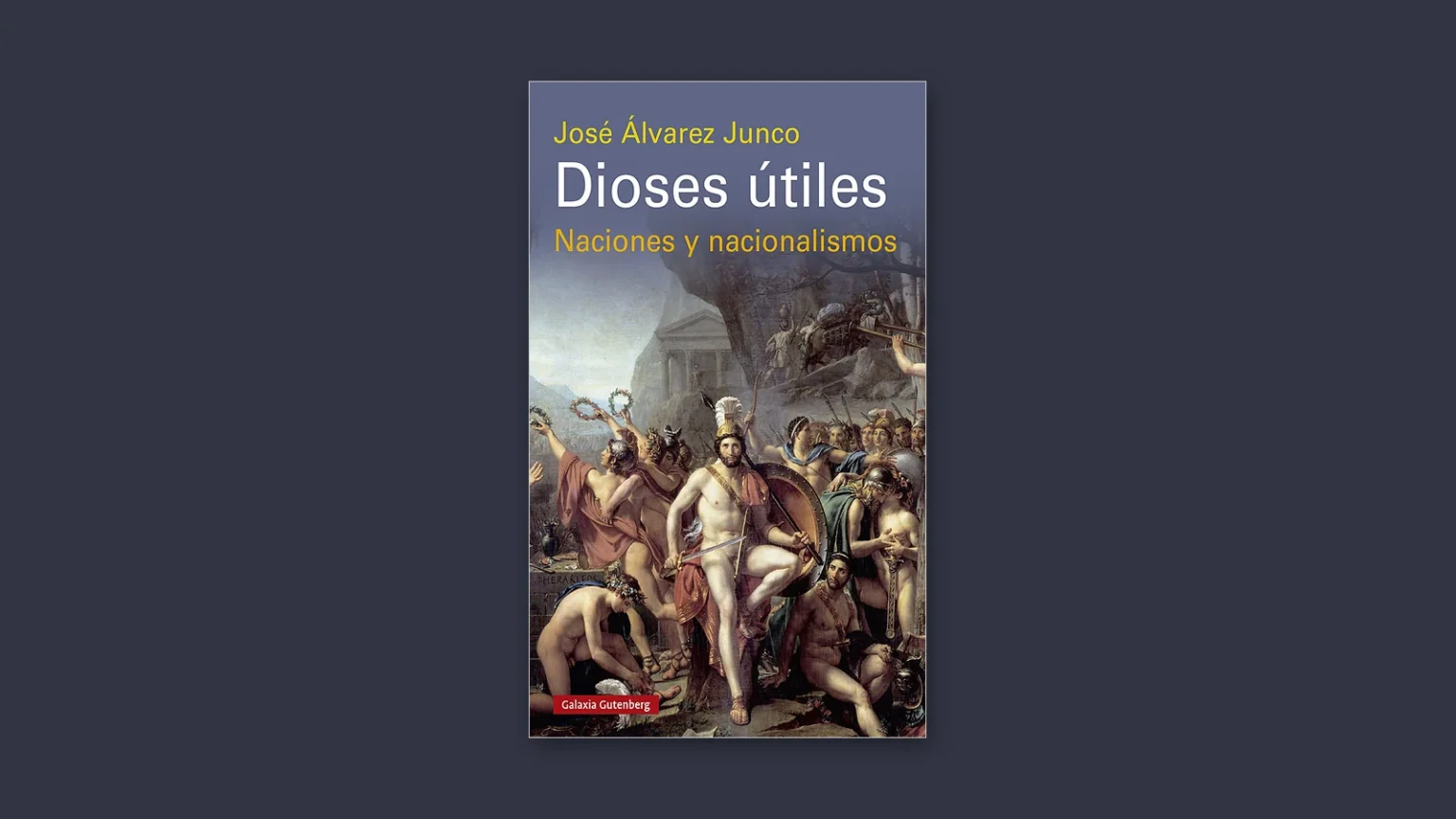
Dioses útiles. Naciones y nacionalismos, José Álvarez Junco’s 2016 Spanish study of how nations are made, became a conspicuous work of public history in Spain and a durable university reference. No complete English translation was located as of 2 September 2026; Galaxia Gutenberg’s current 2025–26 rights catalogue still lists a Spanish manuscript and an English sample rather than an English edition. A Dioses útiles English Translation would give Anglophone readers a sharp Iberian counterpart to the modernist canon of nationalism studies.
Book at a Glance
Book at a glance
Original title: Dioses útiles. Naciones y nacionalismos
Author: José Álvarez Junco
Original language: Spanish
Country: Spain
Original publisher: Galaxia Gutenberg
First published: 2016
Current edition: Galaxia Gutenberg, 2022 paperback; ISBN 9788419075796; listed by Marcial Pons as 7th edition
Format and length: Paperback, 336 pages
Current price: €18.90 publisher/list price, checked 2 September 2026
Introducing the Book
Dioses útiles is a comparative history of nationalism written against one of the most combustible habits in political argument: treating one’s own nation as ancient, self-evident and exceptional while recognizing other nations as historical constructions. Álvarez Junco instead asks readers to compare cases, define terms and separate the emotional force of national identity from claims about its antiquity.
The timing mattered. Published in Spain in 2016, after years of intensifying Catalan sovereignty politics and during a broader European revival of nationalist and populist movements, the book moved scholarship associated with Ernest Gellner, Benedict Anderson, Eric Hobsbawm and related modernist approaches into a Spanish public debate. Its title deliberately evokes Edward Gibbon’s famous observation about politically “useful” sacred beliefs: nationhood can command quasi-religious loyalty without being timeless.
What the Book Is About
The argument unfolds in four broad movements. First, Álvarez Junco surveys the modern scholarly shift away from primordial nations toward nations as historically produced communities, clarifying concepts that political speech often leaves strategically vague. “Constructed” does not mean imaginary in the everyday sense: national identities become socially real because institutions, memories, symbols and political projects make them consequential.
Second comes comparison. England, France, Germany, Italy, Russia, the Ottoman Empire, the United States and Hispanic America show different routes by which states, elites, wars, education, language, religion and communications help nationalize populations. The point is not a single recipe, but the recurrence of political and cultural mechanisms across cases usually narrated as unique.
The third movement turns to Spain. Spanish identity, Álvarez Junco argues, is neither an immemorial essence nor a mere recent fraud. It is a contingent historical construction whose successes, failures and institutional supports become clearer when set beside other European experiences. The final movement widens the Iberian lens to Portugal and to Catalan, Basque, Galician and Andalusian identities, again refusing both providential national stories and easy exceptionalism.
The book’s central discipline is comparison: national identities may be historically constructed, but their political power is real, and explaining that power requires studying institutions, contingencies and mobilization rather than repeating national myths.
About the Author

José Álvarez Junco, born in Viella, Lérida, in 1942, is a Spanish historian whose work centers on political and social movements, national identity and the cultural construction of modern Spain. Trained in law and political science, he completed a doctorate on Spanish anarchist political thought and became professor of history at Madrid’s Complutense University.
From 1992 to 2000 he held the Prince of Asturias Chair at Tufts University and directed the Iberian Studies Seminar at Harvard’s Center for European Studies. He later directed Spain’s Center for Political and Constitutional Studies. Mater Dolorosa. La idea de España en el siglo XIX received Spain’s National Essay Prize in 2002 and the Royal Spanish Academy’s Fastenrath Prize in 2003. Dioses útiles distills decades of that work on political myth, nationalization and Spanish identity into a comparative synthesis.
Why the Book Matters
Its value is less a new archival discovery than an act of intellectual translation inside Spanish public life. Álvarez Junco takes a mature international literature on nationalism and uses it to unsettle mutually reinforcing myths: that Spain possesses an eternal national essence, or that rival Iberian nationalisms are uniquely authentic because Spain itself is artificial. The comparative method makes both positions harder to sustain.
The book also travelled beyond specialist debate. El Cultural later described it as the best Spanish essay of 2016 according to its critics; Publishers Weekly placed it second on a Spanish nonfiction bestseller list in May 2016; and Galaxia Gutenberg’s 2025–26 rights catalogue reports more than 10,000 Spanish-language copies sold. In 2026 the University of Granada still lists it as fundamental bibliography for a course on nineteenth- and twentieth-century nations and nationalisms. That combination of public reach and continued classroom use is precisely what makes the absence of a full English edition noticeable—and makes a Dioses útiles English Translation more than an archival curiosity.
How the Book Was Received
Spanish reviewers largely welcomed the book’s clarity, comparative scale and resistance to nationalist exceptionalism. The recurrent reservation was equally consistent: as a synthesis for a broad audience, it sometimes moves quickly across cases, leaves comparisons implicit, and gives limited space to empire, race, gender and colonial feedback. Six substantial discussions capture that range.
EL CULTURAL / EL ESPAÑOL
Reviewer: Rafael Núñez Florencio
Assessment: Núñez Florencio reads the book as a rational, social-scientific counterweight to the political instrumentalization of identity. He emphasizes the appropriateness of the “useful gods” metaphor and situates the book as the mature intervention of a leading historian of Spanish nationalism.
POLÍTICA Y SOCIEDAD
Reviewer: Carmen López Alonso
Assessment: López Alonso praises the combination of history, social science and political philosophy, especially the comparative perspective and accessible prose. She also identifies productive points for disagreement, including the treatment of memory and responsibility and the relatively limited role assigned to geography.
HISTORIA Y POLÍTICA
Reviewer: Scott Eastman
Assessment: Eastman admires the breadth of the case studies and Álvarez Junco’s command of Spanish political and cultural history. His strongest reservation is the comparatively thin treatment of empire, Spanish America, race and gender—dimensions that could complicate a mainly European story of nationalization.
REVISTA ESPAÑOLA DE CIENCIA POLÍTICA
Reviewer: Álvaro López-Osuna
Assessment: López-Osuna highlights the global comparative panorama and the effort to bring analytic precision to politically overloaded concepts. He judges the synthesis highly useful while questioning whether its historicist emphasis can understate longer continuities in Spanish political community and state formation.
REVISTA ESPAÑOLA DE INVESTIGACIONES SOCIOLÓGICAS
Reviewer: Fernando Ramírez de Luis
Assessment: Ramírez de Luis values the book’s accessibility without simplification: its theses are illustrated with concrete examples rather than slogans. His account stresses how disputes over power and hegemony repeatedly precede the cultural justifications later presented as ancient national necessities.
SECUENCIA
Reviewer: Salvador Lima
Assessment: Lima offers the clearest limitation: the book is not original archival research and specialists may find familiar material. Yet he concludes that its erudite, clear synthesis is valuable for students, general readers and historians seeking a coherent framework, even when some cross-case comparison is left to the reader.
Why It Should Be Translated into English
The case for a Dioses útiles English Translation is not that Anglophone scholarship lacks theories of nationalism; it has an unusually rich canon. What it lacks is this synthesis from within Spain: a historian using that canon to compare Spain with European and Atlantic cases, then turning the same analytical pressure on Spanish, Catalan, Basque, Galician, Andalusian and Portuguese narratives.
An English edition would be useful in courses on nationalism, modern Spain, European history, comparative politics and memory because it shows what happens when “constructed nation” theory leaves the abstract seminar and enters a live territorial conflict. It would also invite productive criticism from postcolonial and imperial historians, precisely where reviewers such as Eastman found the Spanish edition thinnest.
As of 2 September 2026, Galaxia Gutenberg’s 2025–26 foreign-rights catalogue still lists the book as a Spanish manuscript with an English sample available. No complete English edition was located. The strongest reason to translate it is its comparative Iberian perspective: familiar nationalism theory is made politically concrete in a case Anglophone readers often encounter only through crisis reporting.
English-Language Publishers That Should Consider It

Candidate 1
Bloomsbury Publishing / Bloomsbury Academic
Country: United Kingdom
Why it fits: A strong teaching-and-research list in nationalism, European history and political identity.
Relevant catalogue comparison: Derek Hastings, Nationalism in Modern Europe.
Best edition type: Academic paperback and ebook with a contextual introduction.
Likely readership: History, politics, sociology and nationalism-studies courses.
Possible limitation: An academic positioning could underplay the book’s public-essay voice.

Candidate 2
Verso Books
Country: United Kingdom / United States
Why it fits: Verso has a durable readership for accessible political theory, history and translated European intellectual work.
Relevant catalogue comparison: Benedict Anderson, Imagined Communities.
Best edition type: Serious-trade paperback with translator’s note and a brief updated afterword.
Likely readership: General political readers, historians, students and readers of nationalism theory.
Possible limitation: Its list may create expectations of a sharper ideological polemic than Álvarez Junco’s deliberately cool synthesis offers.

Candidate 3
Princeton University Press
Country: United States
Why it fits: Princeton publishes scholarly-crossover work on nations, states and global political history.
Relevant catalogue comparison: Eric Storm, Nationalism: A World History.
Best edition type: Scholarly-crossover hardback/ebook followed by paperback, with an Anglophone introduction.
Likely readership: Comparative historians, political scientists and advanced students.
Possible limitation: The press may expect a stronger claim to original research unless the edition clearly frames the book’s value as comparative synthesis and Spanish intellectual intervention.
Sources
Bibliographic and publisher sources
- Dioses útiles: naciones y nacionalismos, Dialnet — verifies author, 2016 publication, language, country, original ISBN and review record.
- José Álvarez Junco presenta el libro Dioses útiles, Spanish Ministry of Culture — verifies 2016 context and the four-part intellectual structure.
- Dioses útiles, Galaxia Gutenberg — current publisher page, 336 pages, June 2022 listing and €18.90 price.
Price and edition sources
- Dioses útiles, ISBN 9788419075796, Marcial Pons — verifies 2022 seventh edition, paperback format, 336 pages and €18.90. The Galaxia product page retains an earlier ISBN in its metadata, so the current trade ISBN is reported from this exact edition record.
Author sources
- José Álvarez Junco, Colegio Libre de Eméritos — verifies biography, academic career and prizes attached to Mater Dolorosa.
Reviews and critical reception
- “Dioses útiles”, El Cultural / El Español — Rafael Núñez Florencio’s 2016 review.
- “José Álvarez Junco: El nacionalismo es miedo a salir al mundo”, El Cultural / El Español — documents the magazine’s critics naming the book the best Spanish essay of 2016.
- “International Bestsellers: May 2016”, Publishers Weekly — records the book at no. 2 on a Spanish nonfiction bestseller list.
- “Naciones y Nacionalismos en los Siglos XIX y XX” course guide, University of Granada — lists the book as fundamental bibliography in 2026.
- Alvarez Junco, J. (2016). “Dioses útiles. Naciones y nacionalismo”, Política y Sociedad — Carmen López Alonso’s review.
- José Álvarez Junco: Dioses útiles, Historia y Política / CEPC — Scott Eastman’s review.
- Dioses útiles. Naciones y nacionalismos, Revista Española de Ciencia Política — Álvaro López-Osuna’s 2017 review.
- Dioses útiles, naciones y nacionalismos, REIS — Fernando Ramírez de Luis’s review in no. 160 (2017).
- Dioses útiles. Naciones y nacionalismos, Secuencia — Salvador Lima’s 2021 review.
English-translation verification sources
- Nonfiction Catalogue 2025–26, Galaxia Gutenberg Foreign Rights — lists Dioses útiles as “Manuscript in Spanish” with “English sample available,” and reports more than 10,000 Spanish-language copies sold.
- Dioses útiles: naciones y nacionalismos, Google Books — corroborates the 2016 Spanish original record and original ISBN.
Amazon edition sources
- 2022 Spanish paperback, ISBN-10 8419075795, Amazon España — exact current-edition product page.
Publisher-comparison sources
- Nationalism in Modern Europe, Bloomsbury Academic — demonstrates an active comparative nationalism list.
- Imagined Communities, Verso Books — demonstrates a foundational nationalism-studies readership.
- Nationalism: A World History, Princeton University Press — demonstrates current comparative, global history of nationalism publishing.
Image Credits
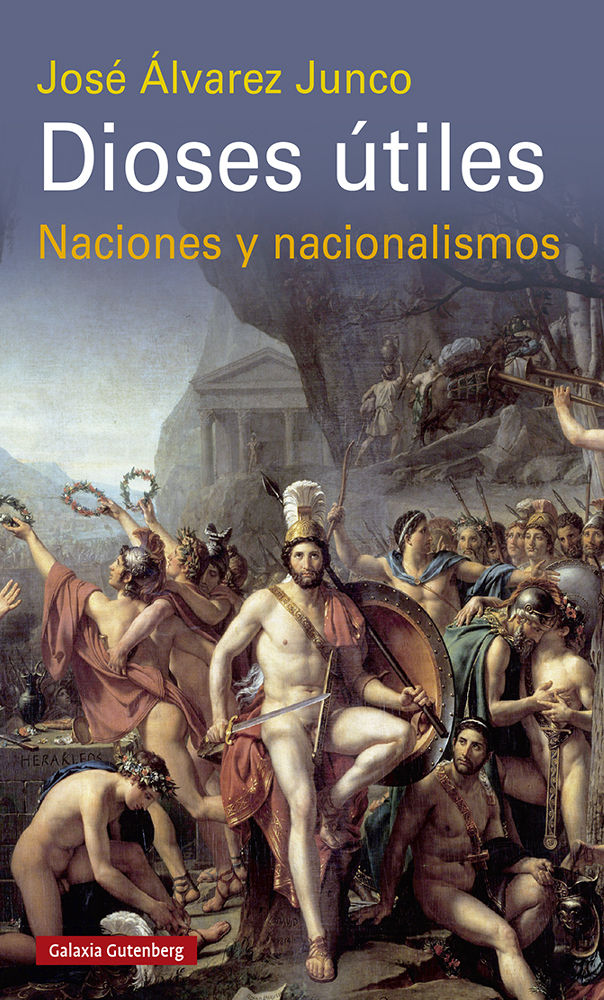
- Main cover: 2022 Spanish paperback of Dioses útiles. Naciones y nacionalismos, Galaxia Gutenberg; image verified via Tipos Infames exact-edition page.
- José Álvarez Junco portrait: Colegio Libre de Eméritos; photographer not credited on the source page.
- Bloomsbury Publishing logo: Bloomsbury Publishing official website; current official wordmark.
- Verso Books logo: Wikimedia Commons file page; logo traced to the Verso Books site header.
- Princeton University Press logo: Wikimedia Commons file page; publisher logo file.
Photo credit: Cover artwork — Jacques-Louis David, Léonidas aux Thermopyles, 1814 — Source:
Musée du Louvre