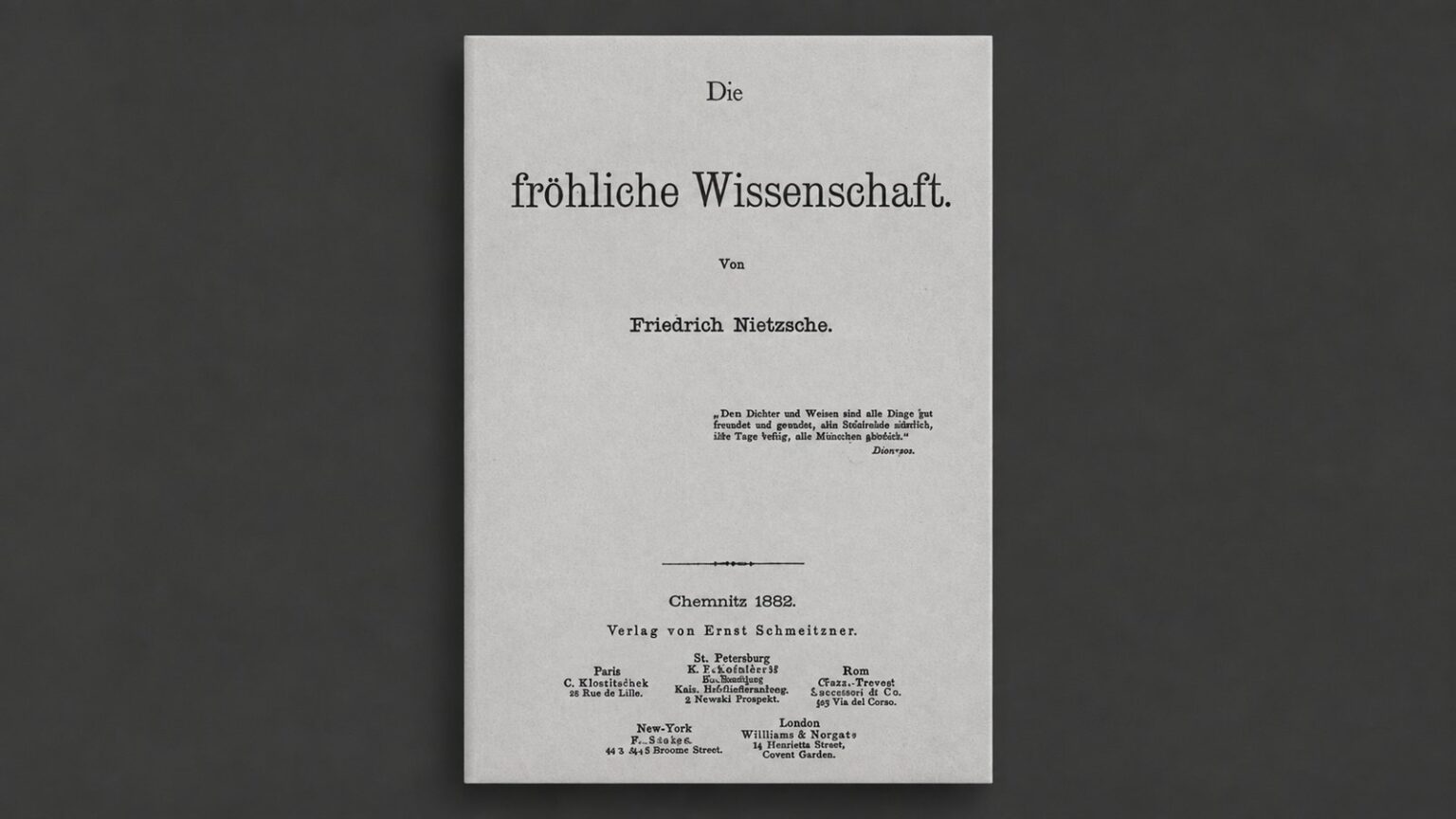
Friedrich Nietzsche’s “The Greatest Weight” is not a standalone essay: it is §341 of Book IV in The Gay Science (Die fröhliche Wissenschaft), first published in 1882. For readers asking Where to Read “The Greatest Weight”, the best all-purpose English edition is the 2001 Cambridge translation by Josefine Nauckhoff, edited by Bernard Williams. The confusion comes from translators changing both the book title and the heading of §341; the section number is the safest locator.
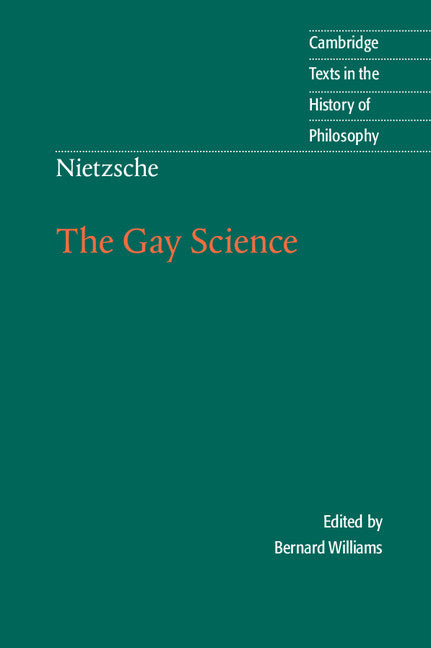
Where the Text Appears
Collection: Friedrich Nietzsche, The Gay Science: With a Prelude in German Rhymes and an Appendix of Songs.
Translation and editing: Josefine Nauckhoff; poems translated by Adrian Del Caro; edited by Bernard Williams. Cambridge University Press, 2001. Paperback ISBN 9780521636452.
Location: Book IV, “St Januarius,” §341. In this translation the heading is “The heaviest weight.” The text is complete within the expanded 1887 form of the book.
Why choose it: modern translation, strong notes and introduction, stable section numbering, and a complete text. It is the best single edition for most serious readers and ordinary university citation.
Where to Read “The Greatest Weight”: Where Nietzsche’s §341 First Appeared
Nietzsche’s German heading is Das grösste Schwergewicht (modern spelling: Das größte Schwergewicht). The passage is a numbered aphorism, not a lecture, periodical essay, letter, or independently published tract. It first appeared inside the 1882 first edition of Die fröhliche Wissenschaft, published in Chemnitz by Ernst Schmeitzner. A digitized copy of that first edition is freely available through Zentralbibliothek Zürich’s e-rara platform.
The idea behind §341 has an earlier notebook history. Nietzsche was formulating the thought of eternal recurrence in the summer of 1881; the surviving notes include the phrase Das neue Schwergewicht, “the new weight,” alongside recurrence. That notebook genesis should not be mistaken for a separate published version of “The Greatest Weight.” The finished public text is the 1882 aphorism. The Heidelberg historical-critical commentary identifies §341 as the penultimate section of Book IV and of the original four-book edition.
In 1887 Nietzsche expanded Die fröhliche Wissenschaft with a new preface, Book V, and an appendix of poems. Section 341 remained in Book IV. That matters because modern English editions normally translate the expanded 1887 book, while §341 itself belongs to the 1882 core. The first substantial English translation of the whole work was Thomas Common’s The Joyful Wisdom (“La Gaya Scienza”), issued by T. N. Foulis in 1910 as volume 10 of Oscar Levy’s English collected Nietzsche. Common called §341 “The Heaviest Burden.”
The Main English Collections and Editions
For locating the passage, edition-specific page numbers are less durable than §341. The modern editions below all contain the complete aphorism, but they serve different readers.
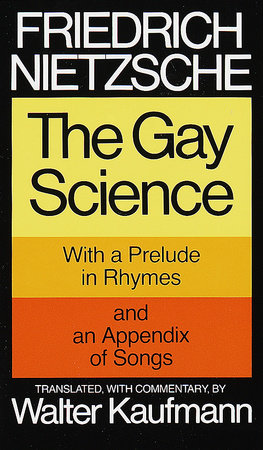
Walter Kaufmann, Vintage Books, 1974
The Gay Science: With a Prelude in Rhymes and an Appendix of Songs, translated with commentary by Walter Kaufmann. Vintage, 1974. ISBN 9780394719856.
This is the edition most responsible for the English heading “The greatest weight.” Kaufmann’s commentary remains useful, and many twentieth-century discussions cite his wording. Its limitation is not incompleteness but age: newer editions offer stronger editorial framing and, in places, different translation choices.
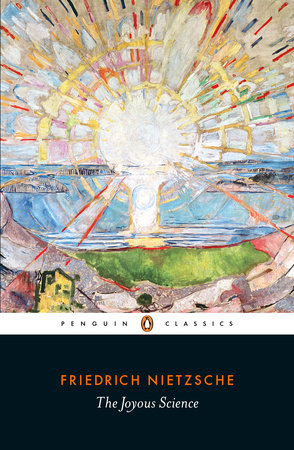
R. Kevin Hill, Penguin Classics, 2018
The Joyous Science, translated and edited with an introduction and notes by R. Kevin Hill. Penguin Classics, 2018; ISBN 9780141195391.
Hill gives readers a recent, accessible complete translation with useful apparatus. The changed book title is the main practical complication: a reader searching only for The Gay Science can miss it. Use §341 rather than the English heading to locate the passage.
For deeper textual work, Adrian Del Caro’s 2023 Stanford volume The Joyful Science / Idylls from Messina / Unpublished Fragments from the Period of the Joyful Science (Spring 1881–Summer 1882), volume 6 of The Complete Works of Friedrich Nietzsche, is the most useful comprehensive English context. It pairs the work with the 1881–82 notebook fragments in which recurrence was first formulated. It is excellent for research, but unnecessarily large for someone who simply wants §341.
| Edition | Translation / context | Best use |
|---|---|---|
| Cambridge, 2001 | Nauckhoff; Williams notes | Best overall / course citation |
| Vintage, 1974 | Kaufmann; influential commentary | Historical reception |
| Penguin, 2018 | Hill; modern apparatus | Accessible alternative |
| Stanford, 2023 | Del Caro; notebooks included | Textual research |
Why “The Greatest Weight” Becomes “The Heaviest Weight”
The title variation does not signal a different aphorism. German Schwergewicht can suggest a heavy weight, a heavyweight, or something carrying exceptional weight or gravity. Common chose “The Heaviest Burden”; Kaufmann made “The greatest weight” familiar; Nauckhoff uses “The heaviest weight.” The same instability affects the book title: Die fröhliche Wissenschaft has appeared as The Joyful Wisdom, The Gay Science, The Joyous Science, and The Joyful Science.
For that reason, §341 is bibliographically more reliable than any translated heading. If a quotation page labels the passage “The Greatest Weight,” it most often points toward Kaufmann’s vocabulary or a secondary convention; it does not prove that the quotation itself was taken from Kaufmann. For precise citation, identify the translator and edition you actually used.
Legal Online and Library Access
Free German first edition
The 1882 e-rara scan is public-domain access to the first edition itself.
Critical German text
Nietzsche Source provides the digital critical text and is the strongest free reference for the German wording.
Free historical English
Project Gutenberg hosts Common’s 1910 public-domain translation. It is complete, but it is not a modern translation.
For readers asking Where to Read “The Greatest Weight” legally, Cambridge, Penguin, Vintage, and Stanford translations remain copyrighted. Their publisher pages and Google Books may provide previews rather than complete free text. Library discovery through WorldCat or a local university catalogue is a route to a copy, not itself full-text access. For free legal English reading, Common is the practical option; for modern English, borrow or purchase a current edition.
Which Edition Should You Choose?
For most readers: Cambridge 2001. It combines a complete text, a modern translation, Bernard Williams’s introduction and notes, and familiar The Gay Science naming. For textual scholarship: use Stanford 2023 alongside the German critical text. For historical English reception: Kaufmann 1974 remains the reference point.
Penguin’s Hill translation is the best alternative if you want a recent edition in a widely available classics format. Common is valuable when cost or public-domain access matters. What should be avoided is not one legitimate complete edition so much as the unsourced excerpt: isolated online quotations often erase translator identity, surrounding section numbers, and the difference between the 1882 and 1887 forms of the book.
What Else Is in the Recommended Collection?
The Cambridge edition is worth using because §341 sits in a meaningful sequence. §340, “The dying Socrates,” immediately precedes it; §342, “Incipit tragoedia,” follows and anticipates the opening of Thus Spoke Zarathustra. Earlier in the book, §125, “The madman,” supplies Nietzsche’s famous treatment of the “death of God,” making the relation between nihilism and recurrence easier to see without turning §341 into an isolated slogan.
The edition also includes Book V, “We Fearless Ones,” added in 1887, as well as the prelude and “Songs of Prince Vogelfrei.” Those additions do not alter the identity of “The Greatest Weight,” but they show how Nietzsche later framed the 1882 book. That is the principal advantage of reading the aphorism in the complete collection rather than as a detached thought experiment.
Frequently Asked Questions
What book contains “The Greatest Weight”?
It is §341 of Book IV of Nietzsche’s The Gay Science, originally Die fröhliche Wissenschaft. It already appeared in the 1882 first edition and remains in the expanded 1887 edition translated by most modern English versions.
Is “The Greatest Weight” a standalone essay?
No. It is a numbered aphorism. Treating it as an essay can make catalogues and tables of contents misleading, because most editions do not index it as an independent work. Search for Book IV and §341.
Why do some editions call it “The Heaviest Weight”?
Because translators render Das grösste Schwergewicht differently. Kaufmann uses “The greatest weight,” Nauckhoff “The heaviest weight,” and Common “The Heaviest Burden.” These are translations of the same §341, not separate Nietzsche texts.
Where to Read “The Greatest Weight” legally online?
Thomas Common’s 1910 The Joyful Wisdom is public domain and available at Project Gutenberg. For a modern translation such as Nauckhoff, Kaufmann, Hill, or Del Caro, use a publisher edition, library copy, ebook, or authorized preview.
Which edition is best for academic citation?
For ordinary English-language university work, Cambridge 2001 is a strong standard because its translator, editor, section numbering, and apparatus are clear. For textual scholarship on the genesis of recurrence, Stanford’s 2023 volume plus the German critical edition is the stronger combination.
Final Recommendation
For readers wondering Where to Read “The Greatest Weight”, start with §341 in the 2001 Cambridge The Gay Science. It is the best balance of modern English, editorial help, completeness, and citability. Kaufmann’s 1974 Vintage version matters chiefly because “The greatest weight” became the familiar English heading through his translation; Stanford 2023 is stronger for research into the 1881–82 notebooks. A free legal English text exists in Common’s 1910 translation, but its title is “The Heaviest Burden.” The collection is worth obtaining because §341 gains precision from §§340–342, Book V, and the book’s wider architecture.
Related BookInLight Reading Guides
The Debt Inside Conscience: Nietzsche’s Genealogy of Guilt — a close guide to Nietzsche’s later genealogy of guilt, debt, punishment, and conscience.
Existence Before Essence: A Beginner’s Path Through Existentialism — places the Cambridge Gay Science in a broader reading sequence leading into existential thought.
What Should You Read Before Heidegger’s “Being and Time”? — useful for readers tracing Nietzsche’s later importance to continental philosophy.
This article was researched and written by the BookInLight Department of Philosophy and Intellectual History, using bibliographical review, comparison of English editions, source verification, and factual cross-checking against publisher, library, first-edition, and critical-edition records. Readers are invited to send factual corrections, overlooked editions, translation observations, source suggestions, and constructive editorial ideas.
Editorial art direction, visual composition, cover selection, and image presentation are credited to the BookInLight Art Department. Rights in individual book covers and any third-party visual material remain with the relevant publishers, artists, designers, institutions, and rights holders. Complete republication, reproduction, translation, or reuse of this article requires prior written permission from BookInLight.
Sources and Further Reading
Original Publication and Textual History
Zentralbibliothek Zürich, Nietzsche, Die fröhliche Wissenschaft (1882) — first-edition scan and publication data.
Heidelberger Akademie der Wissenschaften, historical-critical commentary on §341 — placement, genesis, and reception history.
Nietzsche Source, digital critical edition, FW §341 — German critical text.
English-Language Editions
Cambridge University Press, Nietzsche: The Gay Science — translators, editor, ISBNs, date, and edition structure.
Cambridge introduction — 1882/1887 publication history and editorial framing.
Vintage / Penguin Random House, Kaufmann edition — exact 1974 edition and ISBN.
Penguin Classics, R. Kevin Hill, The Joyous Science — edition data and ISBN.
Stanford University Press volume 6 record — Del Caro translation and 1881–82 unpublished fragments.
Early English and Legal Access
Project Gutenberg, Thomas Common, The Joyful Wisdom (1910) — public-domain English text.
WorldCat record for the 1910 Foulis volume — series and bibliographic confirmation.
University of Pennsylvania Online Books Page: Nietzsche works — lawful discovery routes for early English volumes.
Image Credits
Nietzsche: The Gay Science, Cambridge Texts in the History of Philosophy, 2001 paperback cover. Cambridge University Press. Exact edition source page.
The Gay Science, Walter Kaufmann translation, Vintage Books, 1974 paperback cover. Penguin Random House. Exact edition source page.
The Joyous Science, R. Kevin Hill translation, Penguin Classics, 2018 paperback cover. Penguin Books. Exact edition source page.
Photo credit: Public-domain scan of Friedrich Nietzsche’s Die fröhliche Wissenschaft, first edition, 1882 — Source:
Wikimedia Commons