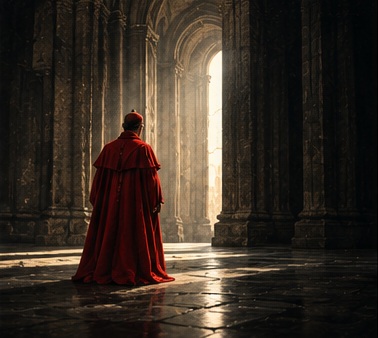
Christ returns to Seville at the height of the Inquisition. He does not announce himself. People recognize him anyway. He heals; the crowd gathers; the old cardinal sees what is happening and orders his arrest. By night the Grand Inquisitor enters the cell and speaks almost without interruption. Christ answers none of his charges. At the end, he kisses the old man.
This is the basic action of “The Grand Inquisitor,” Ivan Karamazov’s prose-poem inside The Brothers Karamazov. It is often detached from the novel and read as a free-standing philosophical parable. That works up to a point. Project Gutenberg even preserves an independent English edition of the episode. But the scene becomes sharper when we remember who is telling it, to whom, and when: Ivan tells it to Alyosha during a conversation about suffering, faith, rebellion and the moral cost of a world in which innocent children suffer. For the wider theological and political scholarship around Dostoevsky, BookInLight’s Dostoevsky political theology reading guide expands the context beyond Ivan’s poem.
Where the scene sits in the novel
In The Brothers Karamazov, the prose-poem appears in Book V, “Pro and Contra,” immediately after Ivan’s chapter usually titled “Rebellion.” That sequence matters. Ivan has just refused to reconcile himself to a cosmic harmony purchased through the suffering of innocent children. The Inquisitor then turns the problem from theodicy toward authority: if freedom exposes human beings to suffering, cruelty and doubt, what kind of institution would dare to correct freedom itself? A useful critical counterpoint comes from Project Gutenberg — The Brothers Karamazov.
The setting also needs one guardrail. Ivan’s sixteenth-century Seville is a literary construction inside a Russian novel, not a neutral documentary history of Roman Catholic doctrine or of the Spanish Inquisition. The ecclesiastical imagery belongs to Ivan’s argument and to Dostoevsky’s dramatic experiment. Reading it that way prevents a philosophical chapter from being mistaken for a historical survey.
First: do not mistake the Inquisitor for Dostoevsky
The old cardinal is persuasive because Dostoevsky gives him a formidable case. That does not make him the author’s spokesman. Dostoevsky’s fiction repeatedly stages ideas dramatically rather than reducing them to conclusions. The Inquisitor’s speech is powerful partly because it understands a real human weakness: freedom is frightening, responsibility is heavy, and people often prefer security, miracle and collective certainty to the burden of choosing.
A weak reading turns the chapter into “religion bad” or “religion good.” A stronger reading asks what kind of religious authority can preserve itself only by distrusting the freedom it claims to save.
The three temptations become a theory of politics
The Inquisitor organizes his indictment around the temptations of Christ in the wilderness: bread, miracle and power. He argues that Christ rejected the very tools that could have made human beings obedient and happy. By refusing to turn stones into bread, refusing spectacular proof and refusing worldly dominion, Christ left people with freedom — and, in the Inquisitor’s view, freedom is precisely what most people cannot bear.
Bread
Material security can purchase obedience. Feed people and they will surrender the dangerous freedom of conscience.
Miracle
Certainty is easier than faith. Spectacle removes the burden of deciding under ambiguity.
Authority
Universal rule promises order. Power can end the plurality and conflict created by free judgment.
This is what makes the episode political theology rather than a simple anti-clerical satire. The Inquisitor does not deny the spiritual problem. He claims to have solved it institutionally. His church will correct Christ by administering human weakness.
Ivan’s question is crueler than the Inquisitor’s answer
Earlier in the conversation, Ivan refuses to justify a harmony purchased at the price of innocent suffering. The Grand Inquisitor extends that rebellion. If a world of freedom produces cruelty, doubt and anguish, why not redesign human life around managed happiness? The temptation is not merely tyranny for its own sake. It is paternalism armed with a tragic anthropology: people are too weak for the freedom Christ gave them.
That is why the scene still feels modern. The Inquisitor’s promise can be secularized easily. Institutions of many kinds can say: give us choice, uncertainty and dissent; we will give you safety, simplicity and belonging. Dostoevsky does not make the trade-off easy, because the desire for relief is not imaginary.
READING NOTE: The scene is built so that Christ does not answer proposition with proposition. Dostoevsky makes the reader experience the difference between an argument for managed happiness and an act that refuses to manage the other person.
Why Christ stays silent
The silence is structurally important. If Christ delivered a counter-lecture, the scene would become a debate in which readers could score propositions. Instead the Inquisitor’s language expands until it almost fills the moral space. The silent prisoner refuses the terms of the argument. He does not answer coercive certainty with rival coercive certainty.
Silence also leaves Ivan exposed. The poem can no longer be treated as a clever intellectual performance once the response is not intellectual. Alyosha will later echo Christ’s gesture. The conversation between brothers begins to resemble the poem inside it, and the boundary between Ivan’s argument and Ivan’s need for an answer becomes unstable.
The kiss is not a tidy refutation
The kiss is famous because it is easy to sentimentalize. It should not be. The Inquisitor does not convert. He opens the door and tells Christ never to return. The system remains. The kiss therefore does not “win” in the ordinary argumentative sense.
Its force is different. The Inquisitor has described human beings as creatures who must be managed because love cannot be trusted to sustain freedom. The kiss treats him as a person rather than as a theory. It is an act that refuses domination without mirroring it. That does not solve the political problem the Inquisitor has raised; it reveals what his solution has excluded.
A reader’s method: four passes through the scene
On a first reading, follow the story. On a second, mark every place where the Inquisitor speaks about human nature rather than church doctrine. On a third, track the three temptations and notice how each becomes an institutional technology. On a fourth, return to Ivan and Alyosha. Ask why Ivan invents this voice, why Alyosha listens, and why the scene ends not with assent but with imitation.
The chapter is difficult because it contains several books at once: a biblical rereading, a theory of authority, a critique of paternalism, a portrait of Ivan, and a dramatic experiment in what an answer to suffering might look like when argument itself has reached its limit.
What other readers have argued
A close reading becomes more persuasive when it is placed beside textual history and the critical record. First, Five Books — Books by Fyodor Dostoevsky adds an editorially curated critical or contextual perspective. Second, Encyclopaedia Britannica — Fyodor Dostoyevsky adds an independent point of comparison to the article’s framing. Finally, Project Gutenberg — The Grand Inquisitor keeps the interpretation tied to a checkable primary text. The point is not to replace reading with authority, but to show how textual evidence, reception, and criticism can pull attention toward different features of the same work.
That critical framing changes the status of the interpretation offered here. The primary text remains the evidence, but textual history, edition choices, and critical reception show how differently that evidence has been organized by readers. The article therefore distinguishes what the text says from what critics have inferred from it, and treats disagreement as part of the reading history rather than as noise.
Read next on BookInLight
The Karamazov Choice: Why Print Should Lead and Audio Should Follow
Where to Start with Russian Literature: A Beginner’s Reading Path
Text, context, and scholarship
Project Gutenberg — The Grand Inquisitor — Public-domain English text of the episode as a standalone work.
Project Gutenberg — The Brothers Karamazov — Public-domain English edition of the novel for reading the episode in context.
Encyclopaedia Britannica — Fyodor Dostoyevsky — Biographical and literary overview.
Five Books — Books by Fyodor Dostoyevsky — Expert-recommendation hub useful for broader Dostoevsky context.