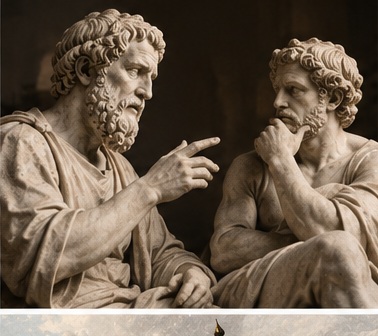
Aristotle waits until Book VIII of the Nicomachean Ethics to give friendship its full treatment. The delay can mislead a modern reader. Friendship can look like a softer topic placed after the serious machinery of virtue, choice and justice. Aristotle treats it almost the other way around: a good human life is so dependent on relations with others that an account of flourishing remains incomplete until friendship is explained.
His opening claim is deliberately strong. No one would choose to live without friends even if all other goods were available. Friendship is necessary in poverty and prosperity, youth and old age, private life and political community. It is not simply emotional comfort. It is a condition under which character is tested, activity is shared and the good becomes livable. For the wider philosophical tradition around philia, BookInLight’s philosophy of friendship reading guide places Aristotle beside later accounts of intimacy, selfhood, and politics.
First, philia is broader than the modern English word “friendship”
“Friendship” is the conventional translation of philia, but Aristotle’s term ranges more widely than modern voluntary friendship. It can include family bonds and other relations of mutual attachment; its cognate verb can shade toward liking or loving. That wider scope helps explain why Books VIII–IX move so naturally between close companions, parents and children, unequal relationships, citizenship and justice. For a secondary map of the argument and its disputes, see Google Books — Michael Pakaluk, Nicomachean Ethics: Books VIII and IX.
This is also why the threefold scheme — utility, pleasure and character — should not be read as a personality quiz. Aristotle is classifying what makes the other person lovable within a relationship and asking how stable that basis can be. The philosophical center is shared virtuous activity, not simply the label attached to a social bond.
Book VIII begins by asking what holds a friendship together
Aristotle classifies friendships according to what is loved in the other person. We may love someone because the relationship is useful, because it is pleasant, or because the person is good and we value that goodness for its own sake.
Utility
Each person receives some benefit. When the benefit ends, the friendship may dissolve.
Pleasure
Each enjoys the other’s company or qualities. It can be real but often changes when tastes, age or circumstances change.
Virtue / character
Each loves the other as the kind of person he or she is and wishes the other’s good for the other’s sake.
The distinction is not an invitation to sneer at useful or pleasant relationships. Aristotle’s point is structural: if the object of love is temporary, the friendship inherits that instability. The highest form is durable because the lovable feature — virtuous character — is itself relatively stable and because each friend’s concern extends beyond what he receives.
Perfect friendship takes time because character has to be known
One of Aristotle’s least sentimental insights is that the best friendship cannot be instantaneous. We can quickly enjoy someone or find someone useful. We cannot quickly know whether another person is reliably good. That takes shared time, action, risk and observation.
This matters because Aristotle’s friendship is not built from private feeling alone. To wish someone well “for his own sake” is a practical orientation. It has to survive occasions when affection is inconvenient, when equality is strained, or when the friend’s good is not identical to our immediate pleasure.
Friendship and justice occupy the same social space
In Book VIII Aristotle repeatedly connects friendship to justice. Different communities — families, military units, political associations, economic partnerships — generate different forms of mutual claim. Friendship and justice vary with the structure of the association. He even remarks that legislators seem to care greatly about concord because political friendship can reduce the need for coercive settlement.
This is a major reason friendship belongs inside ethics rather than a private-life supplement. Aristotle is asking how people share goods and activities under conditions of equality and inequality. Friendship provides a grammar for reciprocity that legal justice alone cannot exhaust.
Unequal friendship needs proportion, not pretending that everyone is identical
Parents and children, rulers and ruled, older and younger persons occupy unequal positions. Aristotle does not solve this by declaring the inequality unreal. He asks what proportional reciprocity would look like when people contribute different things. That solution will trouble many modern readers, especially where Aristotle’s own social assumptions are hierarchical. But the conceptual move is worth seeing: equality in friendship can mean proportionate recognition rather than identical exchange.
Book IX turns the argument inward: the friend as “another self”
The second book on friendship complicates the first by connecting friendship to self-love. Aristotle distinguishes vulgar self-love — grabbing money, honor or pleasure for oneself — from the self-love of a good person who gives the ruling part of the self to noble action. The good person can love himself rightly because there is enough order in his character for self-relation not to collapse into appetite.
From there, the qualities of friendship toward others begin to look like extensions of a well-ordered relation to oneself: wishing good, sharing life, taking pleasure in another’s existence, grieving and rejoicing together. This is why “another self” is not a slogan about similarity. The best friend is someone whose good can enter one’s own practical life without being reduced to utility.
Why does the happy person need friends?
This is Aristotle’s test case. If flourishing is self-sufficient, why would the fully happy person need anyone else? Aristotle’s answer shifts the meaning of self-sufficiency. Flourishing is activity, not private possession. A good person wants to exercise virtue, perceive noble action and share activities worth choosing. Friends enlarge the field in which those activities are possible and visible.
The thought is subtle: friendship does not repair a defective happy life from the outside. Shared activity partly constitutes a complete life for the kind of social animal a human being is.
A reader’s route through Books VIII and IX
The threefold classification is the easiest part to remember and the easiest part to overemphasize. On a serious reading, track four threads instead. First, what exactly is loved? Second, how does equality or proportion sustain the relation? Third, how does friendship overlap with justice and political association? Fourth, why does Aristotle need self-love to explain love of another?
If you follow those questions, the two books stop looking like advice about choosing friends. They become a theory of shared flourishing. Friendship matters because virtue is not fully intelligible as an isolated possession. We learn who a person is partly through what that person can love, sustain, share and wish for someone else.
What the scholarship adds to the primary-text reading
The argument is clearer when it is treated as a dispute in the secondary literature rather than as a sealed doctrine. First, Cambridge — Aristotle on exchange and friendship in Ethics V and VIII–IX provides a more specialized scholarly treatment and makes the interpretive stakes visible. Second, Stanford Encyclopedia of Philosophy — Aristotle’s Ethics maps the main positions, terminology, and bibliography. Finally, MIT Internet Classics Archive — Nicomachean Ethics, Book VIII adds an independent point of comparison to the article’s framing. Read together, these sources show which distinctions are standard, which reconstructions are later scholarly moves, and where apparently simple formulations become controversial.
That source-led method changes the tone of the analysis. It separates the primary argument from later reconstruction and from criticism of that reconstruction. Where commentators disagree about what follows from the canonical text, the disagreement is reported explicitly rather than smoothed into one voice. The result is closer to a guided report through an existing philosophical debate than to a self-contained theoretical essay.
Related ethics reading
Primary text and scholarly guides
Perseus — Aristotle, Nicomachean Ethics, Book VIII — Primary text in H. Rackham’s English translation.
Perseus — Aristotle, Nicomachean Ethics, Book IX — Primary text for self-love, another-self arguments and the happy person’s need for friends.
MIT Internet Classics Archive — Nicomachean Ethics, Book VIII — W. D. Ross translation for comparison.
Stanford Encyclopedia of Philosophy — Aristotle’s Ethics — Scholarly orientation to Aristotle’s ethical project.
Google Books — Michael Pakaluk, Nicomachean Ethics: Books VIII and IX — Bibliographic page for a major modern commentary and translation.