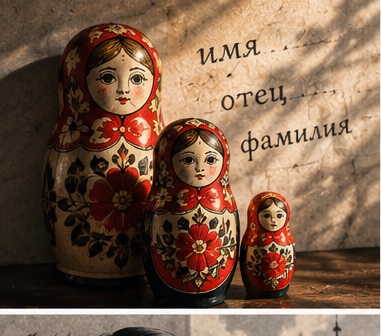
A beginner opens a Russian novel and meets Alexander. Ten pages later someone calls him Sasha. A relative calls him Sashenka. A colleague says Alexander Petrovich. The narrator uses a surname. The reader quietly assumes that four men have entered the book.
They have not. Russian naming can feel difficult in translation because a single person may appear under several socially meaningful forms. Once you understand the system, names stop being an obstacle and become part of characterization. Formality, intimacy, irritation, rank and affection can all be audible in the form of address. If Russian naming is your first barrier to the literature, BookInLight’s beginner’s path through Russian literature gives a practical sequence from Pushkin to Bulgakov.
The five rules
Rule 1: parse the three-part name
A formal Russian name often contains three elements: a given name, a patronymic formed from the father’s given name, and a family name. The patronymic is not merely an English-style middle name. It encodes a naming relation to the father and, in many social settings, participates in conventions of respectful address. Family names may also appear in gendered forms, as in Karenin/Karenina. A useful critical counterpoint comes from Problems of Onomastics — “Patronymic as a Symbol of Russian Culture”.
| Example | What you are seeing |
|---|---|
| Fyodor Mikhailovich Dostoevsky | Fyodor = given name; Mikhailovich = “son of Mikhail”; Dostoevsky = surname. |
| Anna Arkadyevna Karenina | Anna = given name; Arkadyevna = “daughter of Arkady”; Karenina = feminine surname form. |
| Alexei Alexandrovich Karenin | Alexei = given name; Alexandrovich = “son of Alexander”; Karenin = masculine surname form. |
For a reader, the safest rule is structural rather than mystical: learn which element is the patronymic, then watch how speakers use it. Russian reference works such as Gramota.ru’s dictionary of Russian personal names list patronymic forms alongside numerous derived diminutives. Literature adds the social pressure: an author can make the same person sound formal, intimate, affectionate or abrasive by changing the form used in context.
Rule 2: hear the patronymic as social distance
A given name plus patronymic commonly functions as a respectful or relatively formal form of address, but its force is not a universal temperature gauge. Period, age, class, institution and personal relationship matter. In fiction, the important evidence is therefore comparative: who uses the patronymic, who drops it, and when the form changes.
That comparative habit is more useful than memorizing one etiquette rule. A shift from “Ivan Ivanovich” to “Vanya” may mark greater intimacy, but in another scene a diminutive can sound patronizing, teasing or hostile. Treat name forms as pragmatic signals whose meaning is completed by speaker, situation and tone.
Rule 3: treat diminutives as relationship signals
Russian given names generate conventional short forms and further diminutive or affectionate variants. Gramota.ru’s dictionary records extensive families of derived forms: Alexander can become Sasha or Shura; other names branch just as dramatically. These forms are especially common in everyday, family and friendship circles. The English word “nickname” is too blunt because it suggests one optional alias rather than a productive system of related forms.
This is why translators face a real decision. Replacing every diminutive with one English nickname would erase social information. Keeping them all preserves texture but can overwhelm a first-time reader. Good editions often provide character lists or notes because naming is part of the novel’s social architecture.
Rule 4: build a one-line identity card
For a crowded novel, do not create a giant genealogy before you begin. Create a small card only when confusion happens. Write the formal name, the common short form, and one identifying relation. For example:
| Character note | Reader’s shorthand |
|---|---|
| Dmitri Fyodorovich Karamazov — Mitya | Eldest Karamazov brother; “Mitya” is Dmitri, not a second character. |
| Alexei Fyodorovich Karamazov — Alyosha | Youngest brother; the affectionate short form dominates much of the novel. |
| Ivan Fyodorovich Karamazov | Middle brother; the patronymic shows all three brothers share Fyodor Pavlovich as father. |
| Fyodor Pavlovich Karamazov | Father; “Pavlovich” indicates his own father was Pavel. |
The advantage is conceptual as well as practical. Once the father’s given name is known, a patronymic can expose a family relation; shared patronymics can also help a reader recognize siblings or half-siblings. But it is only a clue, not a genealogy. Repeated common patronymics do not by themselves prove that two characters belong to the same family.
Rule 5: notice who changes the form of address
In Anna Karenina, naming is inseparable from social world. Formal public encounters, domestic address and affectionate speech do not sound the same. A reader who treats every name form as interchangeable loses some of the novel’s choreography. The point is not to decode a rigid etiquette manual but to hear shifts in relation.
Pay particular attention when one character adopts a form of address another does not. That asymmetry can reveal more than a paragraph of explanation: who thinks the relationship is intimate, who is enforcing distance, who is performing respect, who is being condescending.
A stage test: Chekhov makes the system audible
Drama sharpens the effect because there is no narrator to smooth the transition. A note on Russian names in a modern edition of Chekhov explains how formal given-name-plus-patronymic address sits beside numerous diminutives such as Vanya for Ivan, Misha for Mikhail and Sasha or Shura for Alexandra. In performance, those choices arrive with tone and timing; on the page, the reader has to supply that social ear.
A 30-second rescue method when you get lost
1. If two forms sound unrelated, check whether one is a conventional short form before assuming a new character has appeared.
2. Treat the patronymic as a clue to both family and formality, not as a second given name.
3. Notice changes in address. A shift from full name to diminutive often matters dramatically.
4. Use the character list after confusion, not before every page. Constant checking can destroy narrative rhythm.
5. When comparing translations, remember that transliteration systems differ: the same Russian name may be spelled in more than one defensible English form.
When names stop being obstacles and start becoming evidence
At first, Russian names can feel like administrative noise. Then they become expressive. You start to hear the gap between public and private selves. You notice when a patronymic makes a room colder, when a diminutive makes it warmer, and when a deliberately rough form carries insult or intimacy that English cannot reproduce with a simple first name.
That is the real reward. The goal is not merely to remember who is who. It is to read the social pressure inside the name.
What critics and textual scholarship add
A close reading becomes more persuasive when it is placed beside textual history and the critical record. First, Gramota.ru — Dictionary of Russian Personal Names: index adds an independent point of comparison to the article’s framing. Second, Gramota.ru — Derived diminutive forms adds an independent point of comparison to the article’s framing. Finally, Indiana University Press — Art and Culture in Nineteenth-Century Russia, appendix on names adds an independent point of comparison to the article’s framing. The point is not to replace reading with authority, but to show how textual evidence, reception, and criticism can pull attention toward different features of the same work.
That critical framing changes the status of the interpretation offered here. The primary text remains the evidence, but textual history, edition choices, and critical reception show how differently that evidence has been organized by readers. The article therefore distinguishes what the text says from what critics have inferred from it, and treats disagreement as part of the reading history rather than as noise.
Useful next reads
Language and literary references
Gramota.ru — Dictionary of Russian Personal Names: index — Reference work listing patronymic and numerous diminutive/affectionate forms for Russian given names.
Gramota.ru — Derived diminutive forms — Explains how Russian diminutive forms are formed and used in everyday, family and friendship contexts.
Indiana University Press — Art and Culture in Nineteenth-Century Russia, appendix on names — Explains why patronymics are not equivalent to English middle names.
Problems of Onomastics — “Patronymic as a Symbol of Russian Culture” — Academic study of the patronymic’s sociolinguistic and pragmatic functions.
Charles University — Patronymic as a Symbol of Russian Culture — University publication record for the same study.
Yale University Press — Russian Full Circle excerpt — Examples of patronymic formation and gendered surname forms.
De Gruyter / Stanford — Note on Russian Names in Chekhov — Literary examples of formal address and diminutive forms.