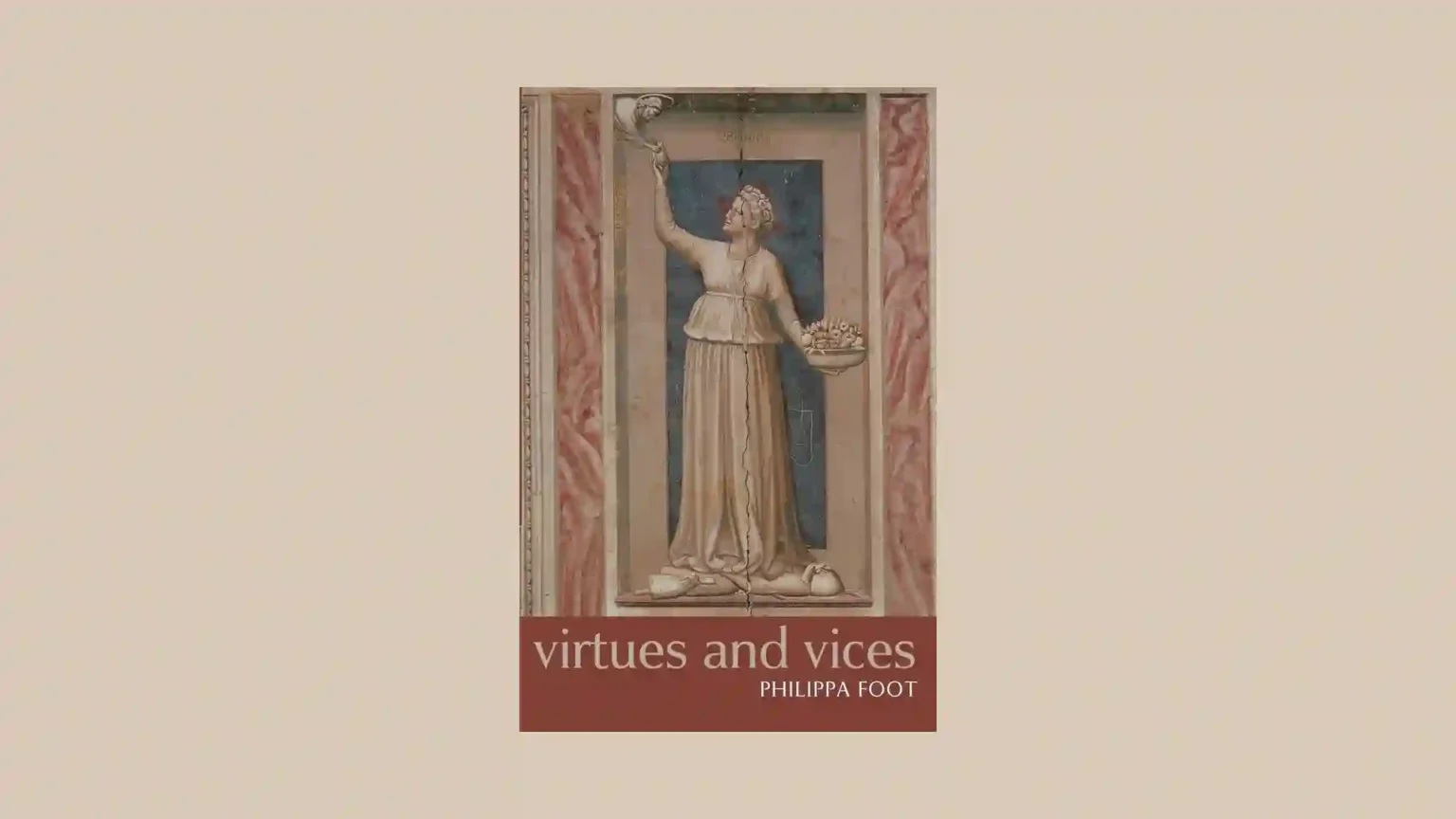
To read Philippa Foot on double effect, locate her abortion essay in the correct collection and separate the principle from its later textbook summaries.
The bibliographic answer is simple, but the philosophical answer is not. Philippa Foot’s essay first appeared in Oxford Review, no. 5 (1967), pp. 5–15. A searchable archival copy is available through PhilPapers. For most readers, however, the best modern place to read it is Foot’s own collection Virtues and Vices and Other Essays in Moral Philosophy, where Oxford University Press prints it as chapter II. The Oxford chapter record is the safest locator when you need a stable citation rather than an unsourced scan.
The direct locator
Original publication: Philippa Foot, “The Problem of Abortion and the Doctrine of the Double Effect,” Oxford Review 5 (1967): 5–15. Modern author collection: Virtues and Vices, 2nd edition, Oxford University Press, 2002, chapter II. That volume was first published in 1978; the 2002 edition adds a new preface and index while preserving the essay within the collection Foot herself assembled.
| Use this version | Best when | What it gives you |
|---|---|---|
| Oxford Review (1967) | Historical citation | Original venue and pagination |
| Virtues and Vices (OUP) | Default modern reading | Author-controlled collection and stable chapter record |
| Killing and Letting Die | Debate context | Reprint alongside later work on doing, allowing, and killing |
Why Virtues and Vices is the best default reprint
The essay is often encountered through anthologies on killing and letting die, including the second edition of Killing and Letting Die. Those anthologies are valuable when the reader wants the later debate. But Foot’s own collection gives a better intellectual neighborhood. The adjacent essays show that her concern was not a one-off intervention in abortion ethics. It belongs to a larger attempt to identify morally relevant distinctions without reducing judgment to a single maximizing rule.
The Stanford Encyclopedia’s entry on Philippa Foot is especially helpful here. It places the 1967 essay beside Foot’s distinction between doing and allowing, her treatment of negative and positive duties, and the early trolley case for which the essay became famous. That context matters because readers who arrive expecting only a defense or rejection of a Catholic doctrine can miss the structure of the argument.
What the essay actually tests
The doctrine of double effect distinguishes harms that are intended as means or ends from harms that are foreseen but not intended. Foot does not simply ask whether intention matters. She tests whether intention can explain several pairs of cases in which our judgments diverge. The trolley case is one pressure point: redirecting a threat from five people toward one seems different from using one person as a means to save five. But Foot also argues that intention alone cannot do all the work. The distinction between initiating harm and allowing a harmful sequence to continue remains morally important.
That point is easy to blur because “double effect” is often taught as a checklist detached from the surrounding cases. Foot’s procedure is more diagnostic. She asks what changes when an agent moves from not saving to actively imposing a threat, when an unwanted death becomes part of the means rather than a side effect, and when a duty not to injure competes with a duty to aid. Each redescription changes which principle appears to explain the judgment. The essay is valuable precisely because no single verbal formula survives every case without pressure.
This is why the essay should be read rather than merely summarized. Its argumentative force comes from the movement among cases. A reader needs to notice when Foot changes the variable: intention, causal sequence, duties of aid, rights against interference, or the status of the person threatened. The point is not to memorize a slogan such as “foreseen is permissible, intended is forbidden.” The SEP treatment of double effect explicitly warns against that simplification: proportionality and other conditions remain necessary, and foreseeable harm is not excused merely by redescribing it as unintended.
The edition difference that matters—and the one that does not
For this essay, the decisive difference among versions is not a radically revised argument. It is the research environment around the text. The 1967 record answers a historical question: what did Foot publish, where, and when? The OUP collection answers a different question: where can a present-day reader verify the essay in a durable author collection? The anthology route answers yet another: how did the argument enter a wider literature on killing, letting die, intention, and rights? Treating these as interchangeable sources loses bibliographic information even when the essay text is substantially the same.
That distinction matters in scholarship. A sentence such as “Foot argued in 1967…” should normally point to the original publication record, not to the date of a later reprint. A classroom recommendation, by contrast, should usually privilege the edition students can obtain and cite consistently. And a literature review may benefit most from an anthology because surrounding selections expose the objections and refinements that made the essay influential. Edition choice is therefore part of source criticism, not a cosmetic preference.
Which text should you cite?
For historical work, cite the 1967 Oxford Review record. For a contemporary course paper or general philosophical essay, the 2002 Oxford Academic edition is usually easier for readers to verify and places the essay in an authoritative author collection. If your subject is the broader killing-versus-letting-die literature, use Killing and Letting Die as the comparative anthology, but identify clearly that this is a reprint rather than the original venue.
A reading sequence inside the essay
Read the opening abortion discussion quickly but carefully enough to see why Foot widens the question. Then slow down when she introduces competing cases. Mark every place where the moral difference could be described in more than one way. Ask three questions: What outcome is foreseen? What is intended as part of the agent’s plan? Who is made worse off by an initiated causal sequence rather than by a failure to provide aid?
A second pass should track Foot’s vocabulary of negative and positive duties. Do not assume that every failure to save is morally light or every active intervention is morally grave; the point is to see what kind of duty is in play and what the agent is doing to whom. Then compare that structure with the conditions summarized in the Stanford Encyclopedia discussion of double effect. The contrast helps separate Foot’s own argumentative moves from later textbook formulations of the doctrine.
Finally, return to the trolley case only after the other distinctions are visible. The modern fame of the trolley can make it seem as though the essay exists to launch a thought-experiment industry. Historically and philosophically, that reverses the relation. The trolley is one instrument in Foot’s larger test of whether our judgments track intention, rights, positive duties, negative duties, doing, or allowing. The decisive evidence is therefore still the primary text itself: read the 1967 essay, then use the reprints to follow what later philosophers made of it.
Cover artwork: credits and source records
- Virtues and Vices — Oxford University Press (source record)