A first route into care ethics should clarify dependence, relationships, moral attention, and the criticism of purely abstract impartiality.
A beginner usually faces the wrong first question: “Which care-ethics book is the easiest?” The more useful question is what kind of confusion you need the first book to correct. If care ethics sounds like a softer version of kindness, begin with the works that show why it became a challenge to dominant pictures of moral reasoning. If it sounds private or domestic, move quickly to books that make dependency, institutions, and political power visible. The route below is designed around those decisions.
Begin with Gilligan if you need to understand why the debate started as a dispute about the shape of moral judgment
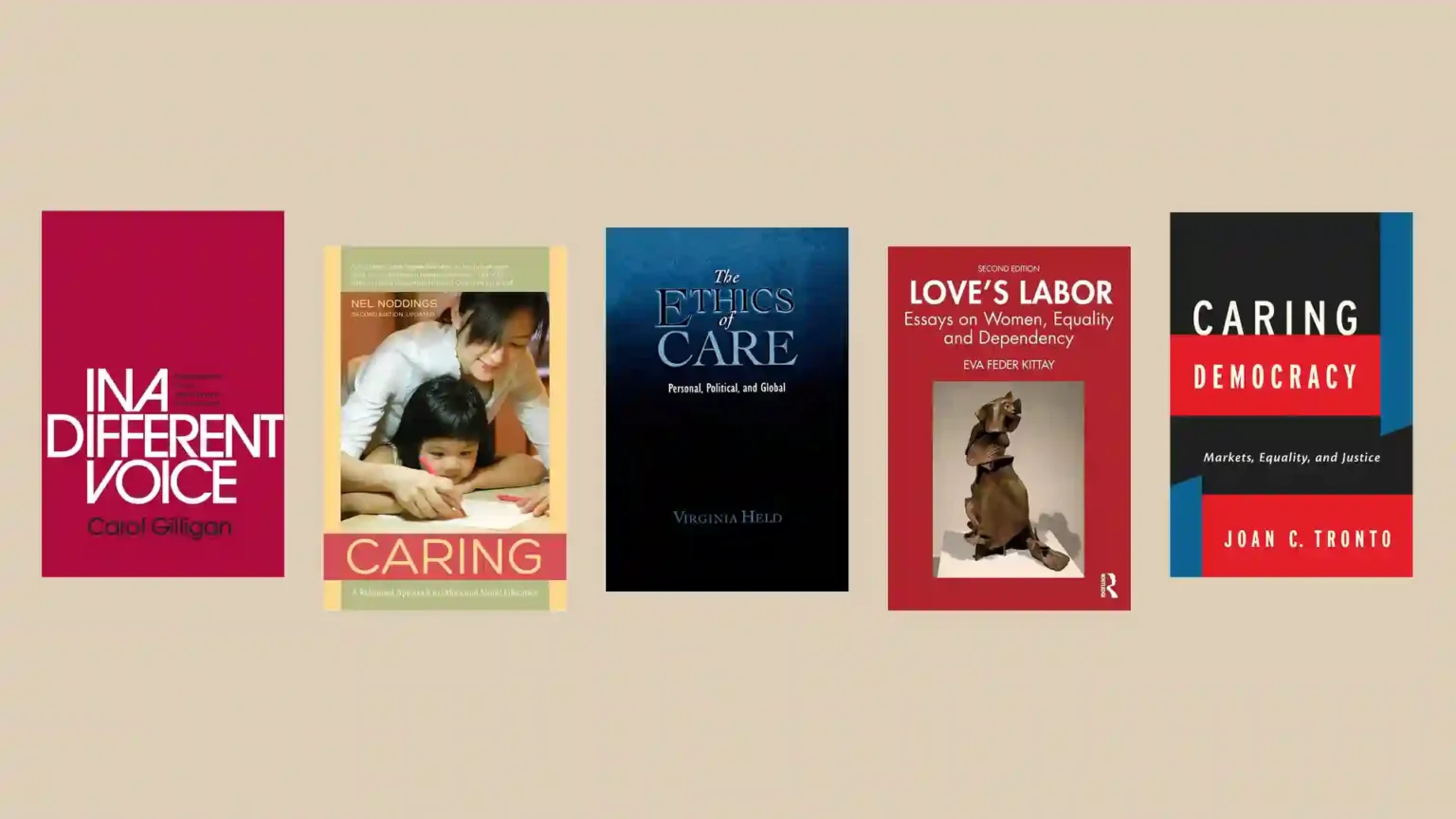
Carol Gilligan’s In a Different Voice is the historical starting point, but it should not be read as a complete theory of care ethics. Its enduring importance lies in the challenge it posed to developmental models that treated one pattern of moral reasoning—abstract rules, rights, and separation—as the implicit standard of maturity. Gilligan drew attention to a different moral vocabulary organized around relationship, responsibility, responsiveness, and the consequences of abandonment.
The beginner’s risk is to turn this into a simple gender binary: men reason through justice and women through care. That is precisely where contemporary feminist ethics requires more care. The Stanford Encyclopedia overview of feminist ethics shows how later work both drew from and criticized early formulations, especially claims that could essentialize women or romanticize roles historically imposed on them. Read Gilligan for the conceptual disturbance she caused, not as a final map of who reasons in which way.
Read Noddings next if “care” still sounds like a feeling rather than a relation with structure and demands
Nel Noddings’s Caring moves from moral-psychological challenge toward a more explicit relational account. Care is not merely an inner sentiment possessed by a virtuous person. It involves attention to a concrete other, receptivity to need, and a relation in which caring is enacted rather than simply announced. This is why the book became especially influential in education: it asks what moral life looks like when actual relationships, not only impartial principles, organize the field of obligation.
Read Noddings slowly where the attraction of particularity begins to create a problem. If moral life is rooted in concrete relationships, what do we owe strangers? How should we respond when caring attachments conflict? Can a theory built around asymmetric relations unintentionally preserve unequal expectations, especially expectations that women will supply care? Those questions are not objections from outside the tradition; they become engines for its later development.
Move to Held when you are ready to see why care is offered as a moral theory rather than a supplement to justice
Virginia Held’s The Ethics of Care is the best pivot from introductory intuition to explicit theory. Held argues that care has values and practices that cannot simply be absorbed into a familiar justice framework. Her chapter on care and moral theory clarifies the ambition: care ethics can evaluate relationships and institutions, not merely praise compassionate behavior inside families.
This is the place to pause over the care/justice contrast. A beginner can easily imagine that justice handles public life while care handles private life. Held rejects that division. Markets, welfare systems, workplaces, health institutions, and international relations all distribute dependency and responsibility. A hospital can follow formal rules and still fail to respond to vulnerability; a family can be intensely “caring” while reproducing domination. Care therefore needs standards for judging relations, not just a preference for warm ones.
Read Kittay when dependency looks like an exception rather than a permanent feature of human life
Eva Feder Kittay’s Love’s Labor changes the scale of the discussion by placing dependency work at the center of equality. Human beings are not continuously independent choosers who occasionally require help. Infancy, illness, disability, aging, and ordinary vulnerability make dependence recurrent; societies survive because someone performs the labor that responds to it. The philosophical question becomes institutional: how can a society claim equality while making dependency labor invisible, poorly rewarded, or privately absorbed by particular groups?
Kittay also helps correct a common beginner’s picture of autonomy. Care ethics need not deny agency or celebrate dependence for its own sake. It can instead ask what social arrangements make agency possible in the first place. The Stanford Encyclopedia discussion of feminist moral psychology is useful alongside this move because it tracks feminist challenges to models of the self that isolate deliberation from embodiment, relationship, emotion, and social power.
Finish the first route with Tronto when you are ready to ask who gets care, who gives it, and who controls the terms
Joan Tronto’s Caring Democracy makes it difficult to confine care ethics to interpersonal morality. Care has a political economy. Some needs become publicly visible while others are neglected; some people can purchase care while others perform it under precarious conditions; some institutions define what counts as need without listening to those who receive care. Democracy, on this account, must be evaluated partly by how responsibilities for care are allocated and contested.
This is also where care ethics meets policy without becoming a checklist. The Stanford Encyclopedia entry on feminist bioethics illustrates how relational autonomy and vulnerability alter questions in medicine and health care. Consent remains important, but a formally valid choice can be shaped by dependency, unequal information, economic pressure, family roles, or institutional neglect. Care does not replace rights; it shows why rights can be insufficient when the conditions for exercising them are badly arranged.
Political care also sharpens the problem of paternalism. Attentiveness to need is not permission to define another person’s good for them. A practice can describe itself as caring while silencing the recipient, normalizing surveillance, or making dependency the basis for control. The recipient’s response therefore matters: good care requires mechanisms through which needs can be interpreted, disputed, and revised. That is one reason the democratic turn in care ethics is more than an expansion of subject matter; it changes who has authority to say whether care is actually working.
The route is complete when you can distinguish three claims that beginners often collapse into one
The first claim is psychological: moral agents notice relationships, dependency, emotion, and responsibility in ways that abstract models can underdescribe. The second is normative: responsiveness, attentiveness, and the maintenance of relationships can have moral value, but relationships themselves remain open to criticism. The third is political: care is socially distributed labor, and its distribution reveals power. Gilligan is strongest as an entry into the first disruption; Noddings makes the relational form vivid; Held defends the normative theory; Kittay exposes dependency and labor; Tronto politicizes the entire field.
That sequence also shows why “care versus justice” is too crude as a final slogan. Mature care ethics does not ask us to choose between compassion and rules. It asks what moral theories leave out when they imagine fully independent agents, treat dependency as marginal, or assume that impartial procedures exhaust fairness. It also asks care theorists to face their own danger: particular attachments can be parochial, oppressive, or unjust. Care requires judgment about which relationships deserve maintenance and which require transformation.
If you want one minimum route, read Gilligan to understand the rupture, Held to understand the theory, and Kittay or Tronto to understand its social consequences. Then return to Noddings with the political questions in view. The beginner has outgrown the slogan “care means being nice” when a scene of care starts to look simultaneously moral, relational, economic, and institutional—and when the question is no longer only whether someone cares, but whether the relationship can answer responsibly to the person whose need gives the practice its point.
Cover artwork: credits and source records
- In a Different Voice — Harvard University Press (source record)
- Caring — University of California Press (source record)
- The Ethics of Care — Oxford University Press (source record)
- Love’s Labor — Routledge (source record)
- Caring Democracy — New York University Press (source record)