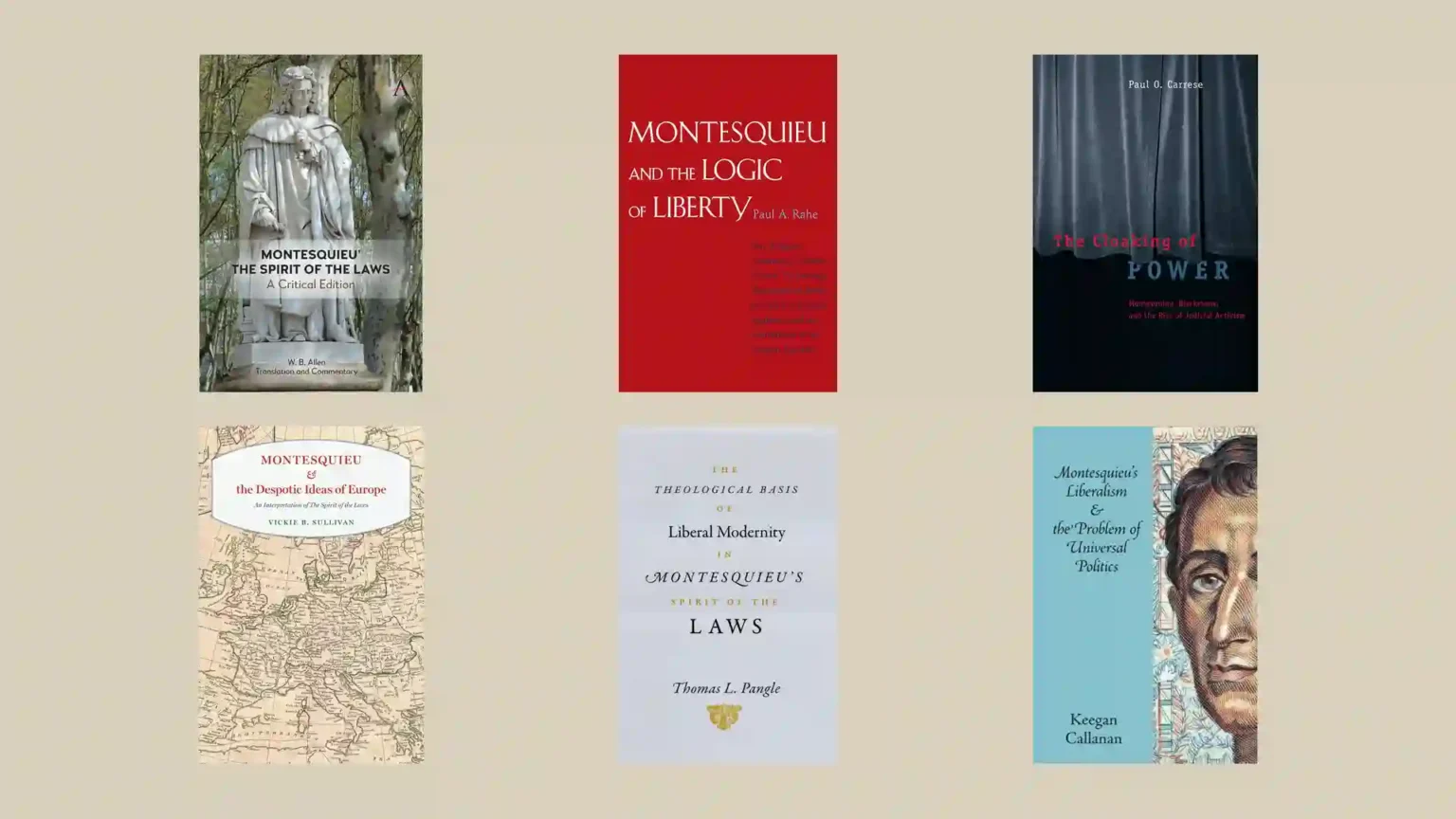
These books on Montesquieu and the separation of powers distinguish institutional checks, liberty, constitutional history, and later interpretations.
The famous constitutional passage sits in Book XI, chapter 6 of a much larger work. The phrase “separation of powers” makes Montesquieu sound tidier than he is. Book XI of The Spirit of the Laws certainly distinguishes legislative, executive, and judicial powers, but Montesquieu’s political liberty depends on more than putting three functions into three boxes. He also cares about social orders, intermediate bodies, institutional checking, legal security, political culture, and the conditions that keep power from becoming arbitrary. The six books below are useful precisely because they disagree about which part of that architecture deserves the most weight.
1. The Spirit of the Laws – start with the problem before the doctrine
Use a serious edition of The Spirit of the Laws before reading any interpretation. The modern shorthand can tempt readers to jump directly to Book XI, chapter 6, but the argument about liberty depends on earlier distinctions among republic, monarchy, and despotism and later discussions of political liberty in relation to the citizen. The Online Library of Liberty text is useful for searching the work, while the Stanford Encyclopedia overview supplies a reliable map of government forms, liberty, commerce, climate, and despotism.
Counterexample to keep in mind: if “separation” merely means institutional isolation, the British constitution Montesquieu admired does not fit neatly. Offices and estates overlap; checking works through mixtures as well as divisions. That is why the phrase should be treated as a question rather than a settled summary.
2. Paul A. Rahe, Montesquieu and the Logic of Liberty
Rahe’s book widens the frame from one constitutional mechanism to the political psychology of modern liberty. War, religion, commerce, terrain, technology, uneasiness, and vigilance all enter the picture. Its value for separation-of-powers readers is adversarial: it asks whether institutions can preserve liberty if the citizens and political culture inhabiting them cease to sustain the habits those institutions presuppose.
Read it against a narrow institutionalist claim: “once powers are separated, liberty follows.” Rahe’s Montesquieu gives you reasons to doubt that conclusion. Constitutional form can be necessary without being self-executing.
3. Paul O. Carrese, The Cloaking of Power
The Cloaking of Power forces the judiciary into a debate often narrated as legislature versus executive. Carrese argues that Montesquieu develops a subtle conception of judicial power that later travels through Blackstone and American constitutionalism. Whether or not one accepts every part of that genealogy, the book is valuable because it makes “the third power” analytically serious rather than treating courts as a residual category.
Its counterexample is the modern constitutional court. If judges can shape public meaning, administrative boundaries, and rights doctrine, then calling judicial power “invisible” or “null” cannot mean politically irrelevant. The interpretive task becomes explaining how a power can be institutionally restrained while still becoming central to constitutional life.
4. Vickie B. Sullivan, Montesquieu and the Despotic Ideas of Europe
Sullivan’s interpretation challenges another simplification: that Montesquieu projects despotism outward onto Asia while Europe represents moderation. Her reading tracks despotic tendencies within European intellectual and institutional traditions. This matters for separation of powers because the enemy of liberty is not merely bad institutional design elsewhere; it can be a recurring temptation inside the political vocabularies of the West itself.
The test here is conceptual rather than constitutional. A state may display recognizable branches and still cultivate theories of power, religion, obedience, or political necessity that push practice toward arbitrariness. Separation must therefore be read together with Montesquieu’s analysis of despotism.
5. Thomas L. Pangle, The Theological Basis of Liberal Modernity in Montesquieu’s Spirit of the Laws
Pangle’s book reads the work at the level of its deepest philosophical project. It is not the book to choose if all you need is an institutional diagram. It becomes useful when you want to ask what kind of modern moral and intellectual order makes limited government intelligible. Separation of powers, in this reading, belongs to a larger transformation of how political authority is justified.
That claim can feel remote from constitutional mechanics. Precisely for that reason it belongs in the set: it prevents the reader from assuming that the famous institutional doctrine is the whole political philosophy.
6. Keegan Callanan, Montesquieu’s Liberalism and the Problem of Universal Politics
Callanan’s study asks how Montesquieu can combine liberal commitments with insistence that laws must be fitted to particular peoples, histories, customs, and conditions. The tension is central to institutional transfer. If separation of powers protects liberty, should every society adopt the same constitutional design? Callanan argues that Montesquieu’s particularism and liberalism are mutually reinforcing rather than contradictory.
This is the strongest book in the set for readers tempted to turn Montesquieu into a constitutional export manual. A mechanism can express a universal concern about arbitrary power while requiring locally specific institutional forms.
What the six-book comparison changes
Together, the books produce six different tests of the standard story. The primary text asks whether we have isolated one chapter from a much larger science of laws. Rahe tests whether institutions can survive without a sustaining political spirit. Carrese tests whether judicial power has been underestimated. Sullivan tests whether despotism is closer to home than the East-West contrast suggests. Pangle tests whether constitutional moderation rests on a deeper philosophical transformation. Callanan tests whether liberal institutions can be universal without becoming uniform.
Those disagreements are preferable to a single slogan. Even contemporary scholarship remains divided over what “separation” should mean. Sharon Krause’s article on the spirit of separate powers stresses the social and cultural conditions that sustain constitutional liberty, while Laurence Claus’s critical reconstruction of separation argues that Montesquieu’s functional distinctions create problems for modern doctrine. The point is not to pick one winner before reading. It is to see which question each interpretation makes visible.
One reason the literature stays divided is that Book XI itself contains two different temptations. The first is functional: assign legislative, executive, and judicial work to distinguishable institutions. The second is relational: arrange offices so that power meets counter-power and no actor can convert temporary control into arbitrary rule. Modern constitutions can satisfy one aim imperfectly while pursuing the other aggressively. A system with formally separate branches may contain extensive delegated rulemaking; a system with overlapping institutions may still generate effective checks.
Montesquieu’s own language of liberty makes the second problem hard to ignore. In Book XI of The Spirit of the Laws, liberty is not the ability to do whatever one wishes; it is security under a political constitution in which power is constrained. The Stanford Encyclopedia account similarly emphasizes rule of law and institutional distribution rather than a diagrammatic doctrine. The strongest secondary books in this list therefore ask what kind of social and legal order makes institutional checking durable.
That is also why Krause and Claus disagree productively. Krause stresses the “spirit” needed to sustain separate powers, while Claus attacks the assumption that governmental powers divide cleanly by function. One interpretation worries that constitutional form can decay when political culture becomes extreme; the other worries that the standard functional model describes modern law badly. Neither objection is answered by repeating the phrase “checks and balances.”
So use the six books as a sequence of counterexamples. Whenever one book seems to have identified the essence of Montesquieu – courts, despotism, theology, political culture, particularism – ask what the next book explains that the previous one leaves out. That procedure is closer to Montesquieu’s comparative method than searching for a single master formula.
A reader who has only encountered Montesquieu as the inventor of three branches should therefore begin with Book XI but refuse to end there. The better formula is less elegant: liberty requires institutions arranged so power checks power, citizens enjoy legal security, and political forms remain proportionate to the society in which they operate. These six books disagree about the proportions. That disagreement is exactly what makes them a useful reading set.
Cover artwork: credits and source records
- Montesquieu’s The Spirit of the Laws — Anthem Press (source record)
- Montesquieu and the Logic of Liberty — Yale University Press (source record)
- The Cloaking of Power — University of Chicago Press (source record)
- Montesquieu and the Despotic Ideas of Europe — University of Chicago Press (source record)
- The Theological Basis of Liberal Modernity in Montesquieu’s Spirit of the Laws — University of Chicago Press (source record)
- Montesquieu’s Liberalism and the Problem of Universal Politics — Cambridge University Press (source record)