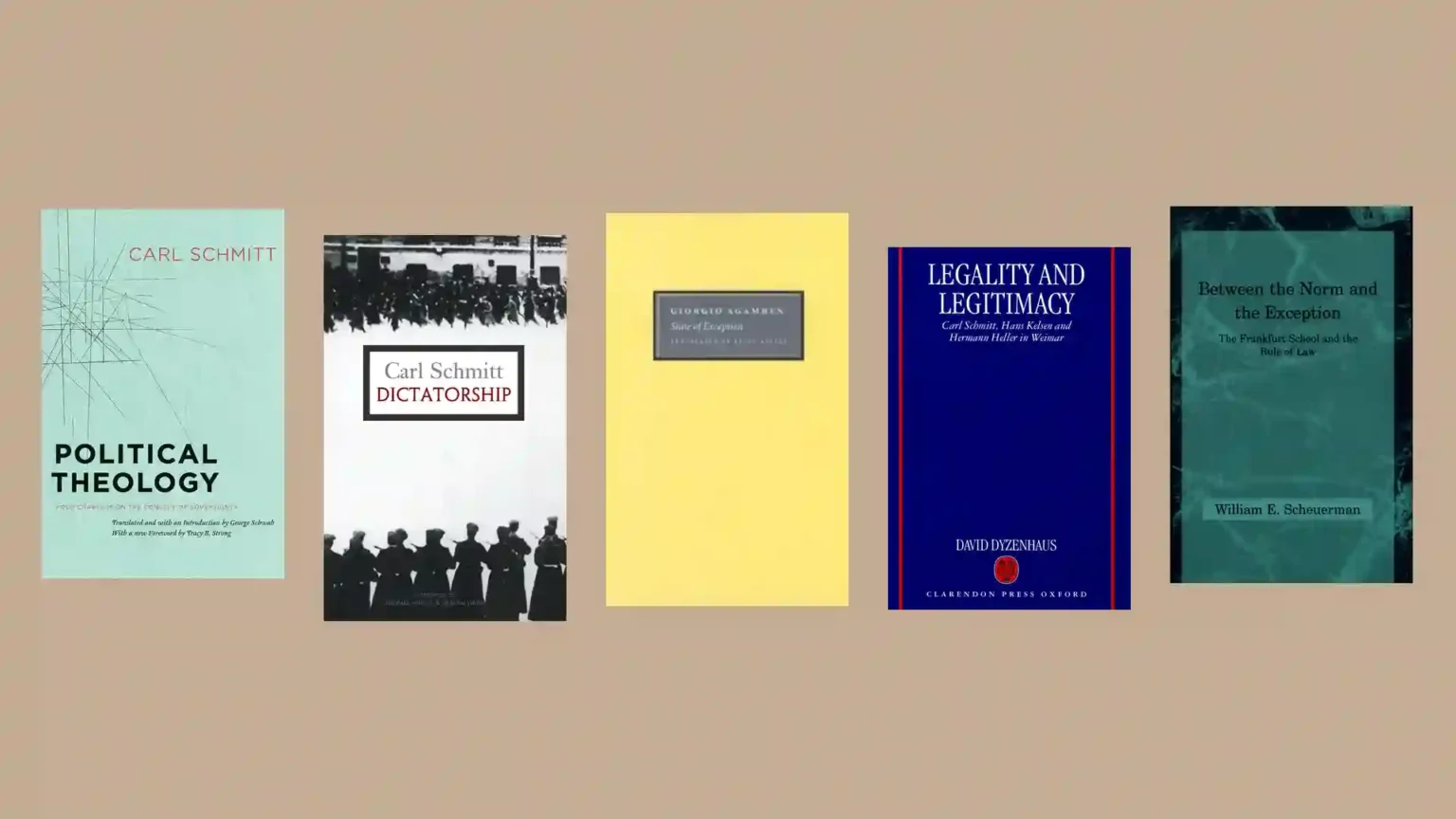
These books on Carl Schmitt approach sovereignty and exceptional power from rival legal, historical, and political perspectives.
The usual introduction to Carl Schmitt begins with one sentence from Political Theology: sovereignty becomes visible in the decision on the exception. The usual mistake follows immediately: readers treat “the exception” as a single Schmittian doctrine and then ask whether it is true. The better approach is historical and adversarial. Schmitt’s argument changes when placed beside his earlier theory of dictatorship, Weimar constitutional conflict, Giorgio Agamben’s later genealogy, liberal rule-of-law criticism, and the Frankfurt School’s alternative account of legal transformation. These five books do not line up behind one concept. They expose a dispute over what emergency power is, where it comes from, and whether law can contain it.
A useful internal comparison is BookInLight’s study of Schmitt’s postwar confrontation with Hannah Arendt, which shows why reception history matters: Schmitt’s concepts were not inherited neutrally after 1945. They were read through the problem of dictatorship, responsibility, totalitarianism, and the jurist’s own political record.
Political Theology does not begin the story
Political Theology is the shortest route into decisionism, but it can mislead when isolated. Schmitt argues that a legal order cannot fully specify in advance the circumstances of its own suspension or the actor authorized to decide that normal rules no longer apply. The exception therefore reveals a dependence of norm on decision. Yet the historical pressure behind the claim is not an abstract puzzle about logical incompleteness. It is the Weimar problem of constitutional authority under crisis.
The first reversal comes from Schmitt himself. Dictatorship predates Political Theology and distinguishes commissarial dictatorship, which suspends normal law to restore an existing constitution, from sovereign dictatorship, which suspends an order in the name of creating a new one. This distinction complicates any definition that makes emergency power simply lawless. Schmitt’s own taxonomy is about different relations between extraordinary power and constitutional purpose.
Read the two books together and a tension appears. If commissarial dictatorship is justified by restoration, law seems to authorize an exceptional instrument for the sake of legal normality. But if sovereignty is defined by the power to decide that the norm does not apply, the authorizing legal framework seems unable to fully master the decision. Is the exception inside law, outside it, or a boundary relation that exposes why the inside/outside distinction breaks down? Schmitt never allows the question to remain merely technical.
The hinge: from Schmitt’s exception to arguments about its afterlife
Giorgio Agamben’s State of Exception makes the most famous later move. It generalizes the problem into a history of emergency government and argues that exceptional measures can become a durable paradigm rather than a temporary interruption. Agamben is not simply explaining Schmitt. He uses Schmitt as one pole in a larger argument about how modern legal orders create zones in which law is suspended while power remains effective. The book’s force comes from this expansion; its risk is that very different emergency regimes can begin to look like instances of one overarching logic.
That is where David Dyzenhaus’s Legality and Legitimacy changes the debate. By reconstructing Schmitt alongside Hans Kelsen and Hermann Heller in Weimar, Dyzenhaus refuses the drama of exception as the only serious account of political legality. The constitutional crisis becomes a contest among rival theories of legal authority, democracy, legitimacy, and the rule of law. Schmitt’s position is historically intelligible without being granted conceptual monopoly over the emergency.
Dyzenhaus therefore supplies a counterexample to the idea that liberal legalism can respond to crisis only by borrowing Schmitt’s vocabulary. If constitutional principles can guide official action even where ordinary rules are under strain, the alternative is not naive normalism. The real dispute concerns how much normative continuity survives the emergency and which institutions are entitled to interpret that continuity.
William Scheuerman’s Between the Norm and the Exception widens the field again. Its central figures are Franz Neumann and Otto Kirchheimer, Frankfurt School jurists who confronted the transformation of law under capitalism, authoritarianism, and fascism. Scheuerman’s reconstruction matters because it identifies a critical-theory route that neither celebrates decision nor assumes a static liberal legal order. The rule of law can be historically transformed and politically threatened without every transformation proving Schmitt correct.
This fifth book is the least obvious item if the title is read narrowly, but it is the most useful for testing Schmitt. A concept becomes intellectually serious when it encounters an alternative explanation of the same evidence. If deformalization, executive power, and crisis can be analyzed through social structure and legal change rather than sovereign decision alone, then “the exception” becomes one diagnosis among competitors.
A sixth text should hover in the background: Schmitt’s The Concept of the Political. It does not belong to the five-book core because its principal problem is the political distinction between friend and enemy, not emergency powers. Yet it helps explain why the exception cannot be detached from Schmitt’s broader concern with the conditions under which a political community identifies existential conflict. Readers who treat the exception as an administrative-law puzzle miss that wider political anthropology.
The historiographical disagreement can now be stated sharply. One camp reads the exception as exposing an unavoidable decision beneath every legal order. Another treats emergency power as a legally structured institution whose justification depends on constitutional purpose. Agamben turns exception into a recurring governmental technology. Rule-of-law theorists answer that legality can retain normative force even during crisis. Critical theorists ask whether focusing on the sovereign decision distracts from slower changes in the social form of law. None of these disagreements is resolved by repeating the famous sovereignty formula.
Test the argument against constitutional history
The Weimar constitutional background makes the disagreement more concrete. Article 48 of the Weimar Constitution granted the Reich president emergency powers under specified conditions, and Schmitt’s legal writing repeatedly tests how far such authority can be derived from a constitution whose normal procedures are said to be endangered. Dictatorship includes a substantial treatment of Article 48. Read beside Dyzenhaus’s reconstruction of Weimar legal theory, the issue stops looking like an abstract contest between “law” and “power” and becomes a dispute over presidential authority, democratic legitimacy, parliamentary breakdown, and constitutional interpretation.
Historical judgment also cannot stop in 1932. Schmitt joined the Nazi Party in 1933 and sought influence within the new regime. That record does not automatically settle every conceptual question in his earlier books, but it changes the burden of interpretation. A theory that celebrates decisive authority must be read against the political uses Schmitt himself accepted or pursued. BookInLight’s Arendt reception study is relevant here because it shows the difficulty of separating later intellectual appropriation from Schmitt’s efforts to interpret his own postwar position.
Contemporary applications require another distinction. A pandemic, terrorist attack, war, financial crisis, natural disaster, and constitutional coup can all produce “emergency” rhetoric while posing different legal problems. Agamben’s State of Exception gains power by finding a common governmental logic across cases, but comparative analysis should not erase differences in duration, judicial review, legislative authorization, rights restriction, territorial scope, and possibilities of political contestation. The concept is most useful when it generates variables, not when it substitutes for them.
That methodological caution is the real payoff of the five-book set. Schmitt teaches readers to ask who decides that normality has failed. His critics force a second question: what evidence would show that the emergency remains legally constrained rather than becoming a new source of ordinary power? A serious theory needs both questions.
The safest conclusion is therefore narrower than either Schmitt’s admirers or his quickest critics often allow. Emergencies create genuine problems for rule-governed government because rules cannot mechanically decide every question of their own application. But it does not follow that the power to name an emergency is normatively self-justifying, or that all constitutional restraint disappears once ordinary law is stressed. The five books matter because they move the debate from a charismatic sentence to institutional and historical comparison.
Sources consulted
Primary and publisher records were checked for Political Theology, Dictatorship, and State of Exception. The legal-theory comparison follows the Oxford record for Legality and Legitimacy and the MIT Press account of Between the Norm and the Exception.
Return, finally, to the first sentence. To say that the exception reveals sovereignty is not yet to say who should decide, what legal reasons remain binding, how long emergency powers may last, or what institutions can contest the declaration. Those unanswered questions are not peripheral objections to Schmitt. They are the reason his formula still generates argument.
Cover artwork: credits and source records
- Political Theology — University of Chicago Press (source record)
- Dictatorship — Polity (source record)
- State of Exception — University of Chicago Press (source record)
- Legality and Legitimacy — Oxford University Press (source record)
- Between the Norm and the Exception — MIT Press (source record)