These books on Nāgārjuna approach emptiness, dependent origination, arguments, and translation challenges from distinct scholarly angles.
The quickest way to misunderstand Nāgārjuna is to assume that every book explaining śūnyatā—“emptiness”—is explaining the same philosophical object. The Stanford Encyclopedia’s current entry on Nāgārjuna describes a thinker whose arguments became foundational across later Madhyamaka traditions; the separate Madhyamaka overview shows how strongly later schools disagreed about argument, language, and the relation between conventional and ultimate truth. A useful seven-book shelf should preserve those fractures.
Translations are different philosophical arguments
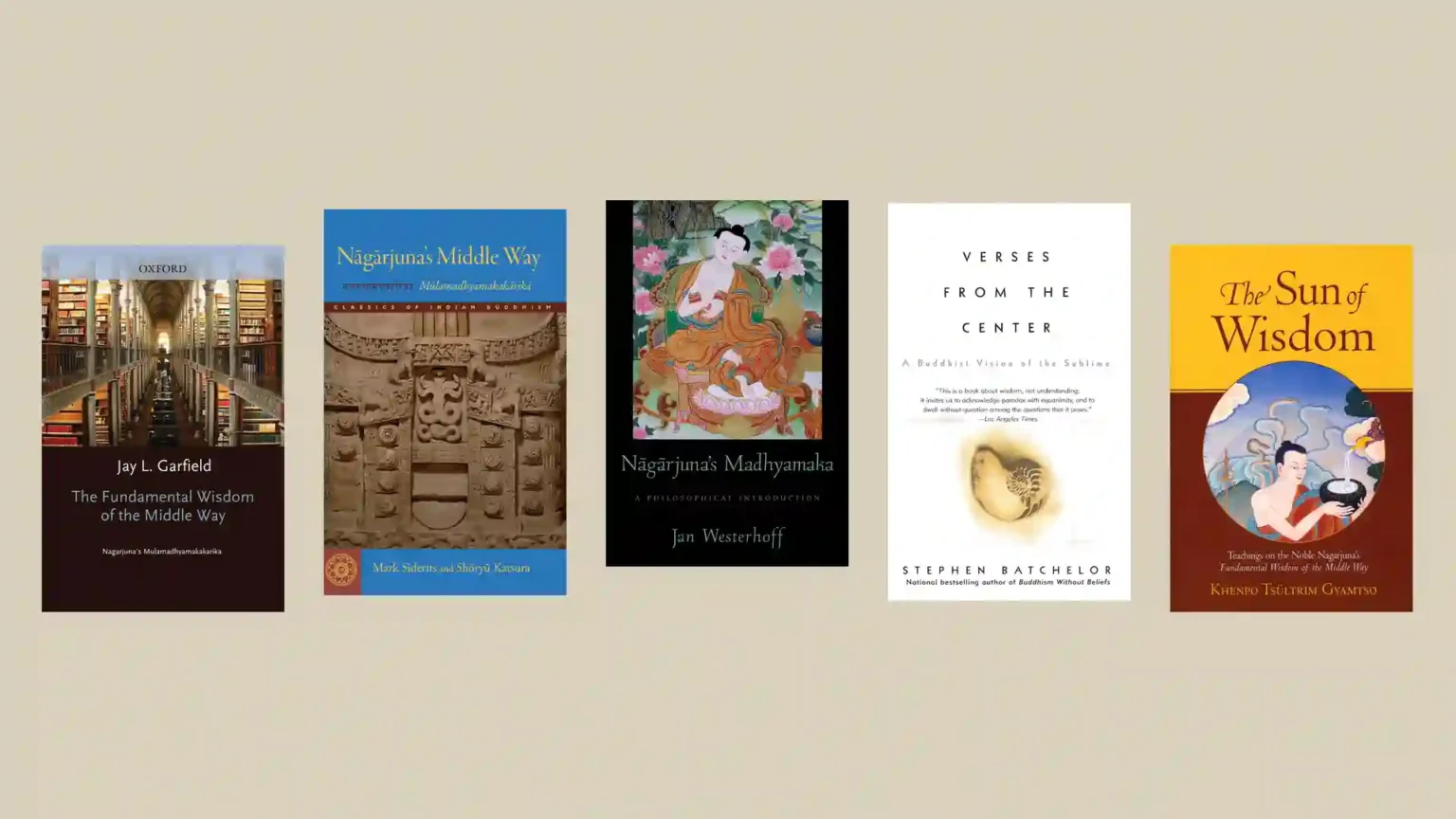
Jay Garfield’s The Fundamental Wisdom of the Middle Way gives an influential philosophical translation and commentary on the Mūlamadhyamakakārikā. Its strength is argumentative visibility: dependent arising, emptiness, convention, and the “emptiness of emptiness” appear as a connected philosophical project rather than a sequence of cryptic verses. Read it first if the initial question is how the arguments can be reconstructed in contemporary philosophical prose.
Edition detail: Oxford University Press dates Jay L. Garfield’s The Fundamental Wisdom of the Middle Way to 1995 (print ISBN 9780195103175). The date identifies Garfield’s translation and commentary, not the composition date of Nāgārjuna’s Sanskrit root text. Source: Oxford Academic bibliographic record.
Now place beside it Mark Siderits and Shōryū Katsura’s Nāgārjuna’s Middle Way. Their translation was prepared through close use of surviving Indian commentaries and accompanies the verses with concise exposition. The counterexample to a single “best translation” appears immediately: Garfield is often better at displaying a coherent philosophical reading; Siderits and Katsura make the early commentarial evidence harder to ignore. If those two books yield different emphases, that difference is evidence, not noise.
Jan Westerhoff’s Nāgārjuna’s Madhyamaka: A Philosophical Introduction is not another translation of the root text. It is a systematic reconstruction based on Nāgārjuna’s principal works, useful when the question becomes whether Madhyamaka is best read as anti-metaphysics, semantic therapy, skepticism, or a distinctive account of dependent reality. It tests claims that a verse-by-verse commentary can leave implicit.
David Kalupahana’s Mūlamadhyamakakārikā of Nāgārjuna provides Sanskrit, English translation, and annotation while arguing for strong continuity with early Buddhist discourses. That thesis is contested, which is precisely why the book belongs here. It prevents a reading list from quietly assuming that Nāgārjuna’s originality, Mahāyāna identity, or relation to early Buddhism has already been settled.
The disagreement becomes the reading method
Stephen Batchelor’s Verses from the Center deliberately shifts the register again. It presents Nāgārjuna through a literary and existentially oriented translation, foregrounding the text’s poetic and practical force. It is not the edition to use for reconstructing Sanskrit syntax or Indian scholastic commentary. It is the counterexample that asks whether philosophical accuracy always improves when the English becomes more technical.
Khenpo Tsültrim Gyamtso’s The Sun of Wisdom works from a Tibetan Buddhist pedagogical lineage and uses selected verses together with Mipham’s commentary. This is a different evidentiary object from a modern academic reconstruction. A reader interested in what Nāgārjuna has meant inside living Indo-Tibetan traditions cannot replace that reception history with an analytic paraphrase, just as traditional exegesis cannot by itself decide philological questions about an early Indian text.
Finally, Garfield’s Empty Words turns from translation to cross-cultural interpretation. Essays on causality, skepticism, positionlessness, language, and the limits of thought make it useful after the root text has begun to resist a single formula. The title itself warns against treating “emptiness” as a hidden substance. Yet the book also invites comparisons with Western philosophy, and those comparisons should be tested rather than accepted merely because the vocabulary sounds familiar.
| Book | What it makes visible | What it can tempt you to overstate |
|---|---|---|
| Garfield, Fundamental Wisdom | Argumentative structure of MMK | One coherent philosophical reconstruction |
| Siderits & Katsura, Middle Way | Early Indian commentarial evidence | That reconstruction can be neutral |
| Westerhoff, Nagarjuna’s Madhyamaka | Systematic philosophical stakes | That a system replaces textual plurality |
| Kalupahana, MMK | Early-Buddhist continuity thesis | That continuity is uncontested |
| Batchelor, Verses from the Center | Poetic/practical force | That accessibility settles interpretation |
| Khenpo Tsültrim, Sun of Wisdom | Tibetan pedagogical reception | That later lineage is identical with early India |
| Garfield, Empty Words | Cross-cultural philosophical testing | That analogies across traditions are equivalences |
Choose a guide by the problem you need to solve
The practical next-reading decision follows from the disagreement. If you have never read the MMK, begin with one full translation—Garfield or Siderits/Katsura—and keep the other open as a control. If your difficulty is conceptual, add Westerhoff. If your question is historical continuity, add Kalupahana. If your question is what Madhyamaka becomes in Tibetan teaching, add The Sun of Wisdom. The seven books do not converge on a final definition of emptiness; they teach you which assumptions produce each definition.
The pair to compare most carefully is Garfield against Siderits–Katsura. Both can be used responsibly; they are not interchangeable. Garfield’s Fundamental Wisdom is unusually good at showing why dependent arising and emptiness should not be read as nihilism. Siderits and Katsura’s Middle Way keeps the Indian commentarial record closer to the surface. When a verse seems to yield one obvious doctrine in English, compare those editions before building an argument on the obviousness. Translation here is already interpretation.
The strongest counterexample to a purely “Western philosophy” reconstruction is not that traditional readers reject argument. It is that later Madhyamaka traditions disagree about how argument works. The SEP entry on Madhyamaka traces disputes over the two truths, conceptual thought, and the use of reasoning; the current Nāgārjuna entry likewise situates the root texts inside a long Indian, Tibetan, Chinese, and East Asian reception. A seven-book list becomes more accurate when it distinguishes the second-century textual problem from what later schools made of it.
Kalupahana and Batchelor are useful partly because they break different habits. Kalupahana’s annotated MMK pushes continuity with early Buddhist materials hard enough that readers must ask which doctrines are being treated as later additions. Batchelor’s Verses from the Center strips away much scholastic scaffolding and makes the verses sound existentially immediate. Neither should be allowed to “win” by tone. Put their claims beside Sanskrit-sensitive and commentarially informed editions and ask which interpretive costs each translation accepts.
The traditional commentary volume, The Sun of Wisdom, creates one more necessary asymmetry. Its aim is not to reconstruct the earliest recoverable Indian meaning as a historian of philosophy would. It teaches Nāgārjuna through a Tibetan lineage and Mipham’s interpretive world. That makes it evidence for reception and philosophical practice rather than a neutral window onto origins. Garfield’s Empty Words then supplies the reverse risk: cross-cultural philosophical comparison can clarify a problem while quietly importing categories from another debate.
Keep three questions separate
A final discipline is to keep three questions separate when two interpreters disagree: What does a particular verse most plausibly say? What philosophical position, if any, does the larger work defend? And how did later Madhyamaka traditions use the verse? A translation can be strong on the first question while a philosophical reconstruction is stronger on the second, and a lineage commentary may be indispensable for the third. The books on this shelf become misleading only when one kind of answer is silently promoted into all three. Reading across them is therefore not eclecticism for its own sake; it is a way of making the object of disagreement explicit before deciding which interpretation is better supported.
Cover artwork: credits and source records
- The Fundamental Wisdom of the Middle Way — Oxford University Press (source record)
- Nagarjuna’s Middle Way — Wisdom Publications (source record)
- Nagarjuna’s Madhyamaka — Oxford University Press (source record)
- Verses from the Center — Riverhead (source record)
- The Sun of Wisdom — Shambhala (source record)