Seven books on ancient Greek skepticism show why Pyrrhonism, Academic doubt, and different kinds of suspension must not be conflated.
What is an ancient skeptic? The definition looks simple until the texts are compared. A skeptic might be a follower of Pyrrho, a member of Plato’s Academy under Arcesilaus or Carneades, a later Pyrrhonist who suspends judgment, or a modern philosopher using ancient arguments to ask whether knowledge is possible. The Stanford Encyclopedia’s overview of ancient skepticism therefore begins by separating Academic and Pyrrhonian traditions rather than treating skepticism as one doctrine. The seven books below are most useful when read as a ledger of rival claims, not as a ladder toward a single definition.
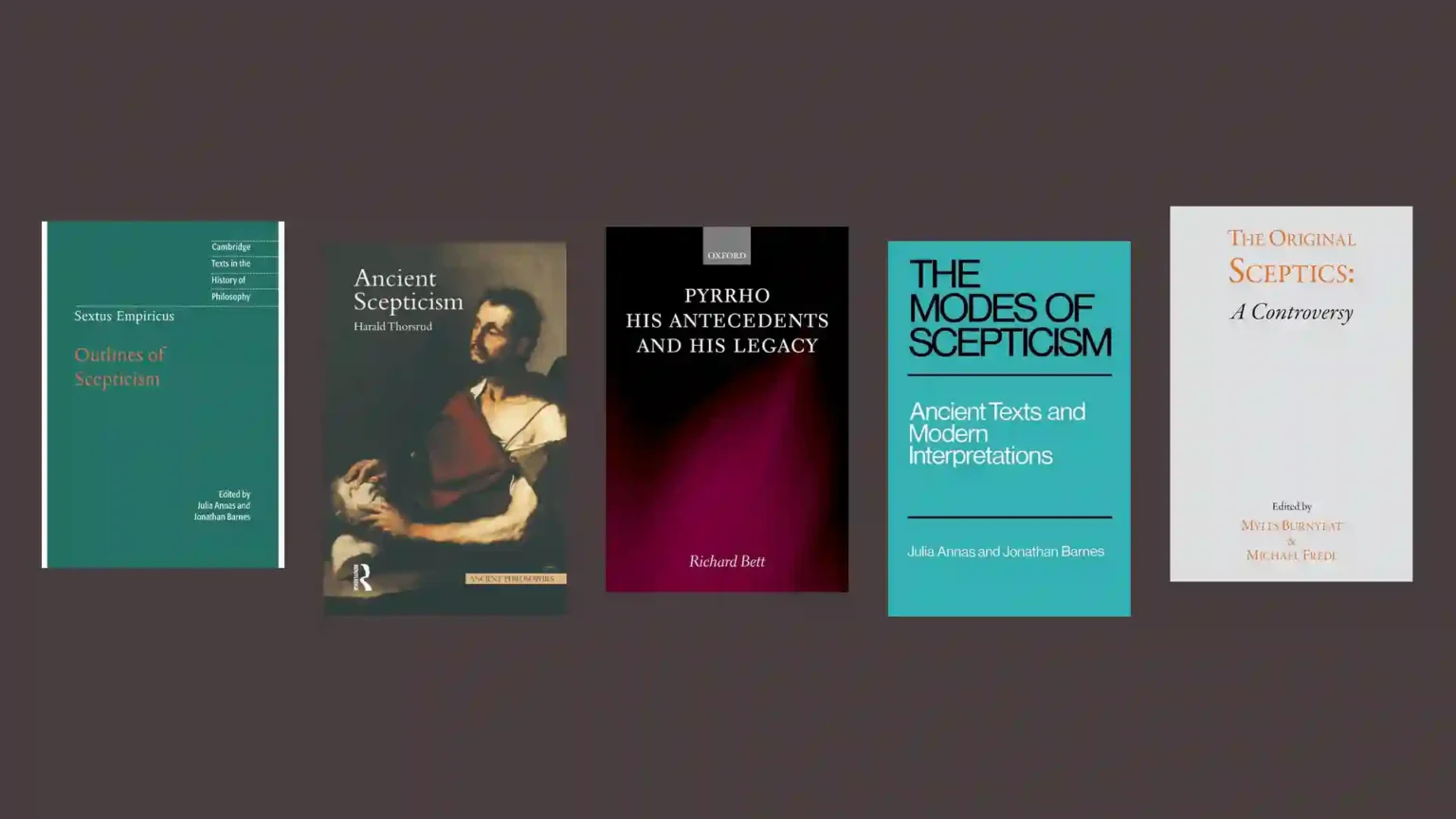
1. Sextus Empiricus, Outlines of Scepticism — the primary text that defines the later Pyrrhonian problem
The indispensable starting point is Sextus Empiricus, Outlines of Scepticism, in the Julia Annas and Jonathan Barnes translation. Sextus presents skepticism as an ability to oppose appearances and judgments in ways that produce suspension rather than as a doctrine asserting that nothing can be known. This is the first proposition to test against every secondary book: does the author preserve the difference between suspending judgment and making a negative dogmatic claim?
2. Harald Thorsrud, Ancient Scepticism — the balanced map
Thorsrud’s Ancient Scepticism is the best single orientation because its chronology forces several skeptical projects apart: Pyrrho and Timon, Arcesilaus, Carneades, Cicero, Aenesidemus, and Sextus. Its virtue is restraint. It does not make the early Academy merely a prototype of Sextus, and it gives the practical question—how a skeptic can live—a place beside the epistemological one.
3. Richard Bett, Pyrrho, His Antecedents, and His Legacy — the book that breaks the genealogical shortcut
Bett’s Pyrrho, His Antecedents, and His Legacy challenges a deeply convenient story: that Pyrrho already held the mature Pyrrhonism later associated with Sextus. Bett argues that the surviving evidence points to a significantly different Pyrrho and that later writers may have projected their own skeptical framework backward. Read this as a warning about names. A tradition can call itself Pyrrhonist without giving us transparent access to Pyrrho’s own position.
4. Julia Annas and Jonathan Barnes, The Modes of Scepticism — the argument machine
The Modes of Scepticism is narrower and more technical. Its subject is the Ten Modes traditionally associated with Aenesidemus: disagreements rooted in species, individual variation, sense organs, circumstances, positions, mixtures, quantities, customs, and related forms of relativity. The book asks how these modes work rather than merely listing them. It is the right test of the proposition that ancient skepticism was principally an attitude. Here skepticism becomes argumentative practice.
5. Gisela Striker — the Academic/Pyrrhonian boundary
Striker’s Essays on Hellenistic Epistemology and Ethics is especially valuable for readers who have begun to flatten Arcesilaus, Carneades, and Sextus into a generic skeptical camp. Her essays on the criterion and on the differences between Pyrrhonists and Academics show that the argument concerns standards of assent, action, and philosophical commitment. The anomaly to preserve is that two traditions can attack dogmatism while disagreeing about what the skeptic may legitimately accept.
6. Myles Burnyeat and Michael Frede, eds., The Original Sceptics — the dispute about whether a skeptic can believe anything
The Original Sceptics is not a neutral survey. It stages a controversy. The essays by Frede, Burnyeat, and Barnes ask whether Pyrrhonian suspension reaches ordinary beliefs or only philosophical commitments, and whether skeptical life is coherent. This volume is useful precisely because it refuses to let “skeptic” settle into a stable classroom definition. Paired with Sextus, it makes visible how much interpretation is needed before one can even describe skeptical assent.
7. Duncan Pritchard, Scepticism: A Very Short Introduction — the bridge that reveals what modern readers import
Pritchard’s Scepticism: A Very Short Introduction is broader than ancient Greece, which is why it belongs last. It distinguishes philosophical skepticism from relativism and traces skepticism into contemporary disputes about knowledge and public distrust. That modern frame helps expose a recurrent category error: ancient skepticism is not simply the cultural posture of “question everything.” A BookInLight reader coming from the broader philosophy-reading map can use Pritchard to see how a technical ancient problem becomes a modern epistemological one.
A final historical test concerns the Academy. Ancient skepticism is sometimes narrated as though Pyrrhonism developed continuously while Academic skepticism was an eccentric interruption. Thorsrud and Striker make that picture difficult to sustain. Arcesilaus and Carneades developed skeptical strategies inside Plato’s Academy, especially in confrontation with Stoic theories of cognition. Questions about the criterion of truth, reasonable action, and assent therefore belong to the center of the story. A reader who jumps from Pyrrho directly to Sextus misses a major laboratory in which skeptical arguments were sharpened.
This is also why Pritchard works better as the seventh book than as the first. Modern skepticism tends to ask whether knowledge is possible; ancient Pyrrhonian practice often asks how inquiry proceeds when opposing considerations are balanced and judgment is suspended. The vocabularies overlap but the philosophical projects need not. Reading the modern bridge last reveals the historical translation work rather than hiding it.
The sequence also guards against retrospective vocabulary. “Academic,” “Pyrrhonian,” and “skeptical” are historical labels with changing referents, not timeless boxes into which every surviving fragment fits cleanly. That is why chronology and source criticism belong inside the philosophical argument, not outside it as background.
Claim ledger: what each book lets you say with confidence
| Claim | Best test | Verdict |
|---|---|---|
| Pyrrho already taught Sextus’s mature Pyrrhonism | Bett | Disputed; the genealogy is not transparent. |
| Academic and Pyrrhonian skepticism are the same school | Thorsrud + Striker | False as a useful historical description. |
| The skeptic simply believes that knowledge is impossible | Sextus + Pritchard | Too crude; suspension differs from negative dogmatism. |
| The Ten Modes are a list of relativist theses | Annas/Barnes | Misleading; they function as strategies for equipollence and suspension. |
| A Pyrrhonist cannot have ordinary beliefs | Burnyeat/Frede/Barnes | A live interpretive dispute, not an established fact. |
Read Sextus first if you want the primary practice, Thorsrud first if you need historical bearings, or Bett first if your main interest is how philosophical traditions construct ancestors. The seven books do not converge on one slogan. Their value is that they force the word “skeptic” to become historically discriminating.
Cover artwork: credits and source records
- Outlines of Scepticism — Cambridge University Press (source record)
- Ancient Scepticism — Routledge (source record)
- Pyrrho, His Antecedents, and His Legacy — Oxford University Press (source record)
- The Modes of Scepticism — Cambridge University Press (source record)
- The Original Sceptics — Hackett (source record)