The Intentional Fallacy has a specific publication and reprint history; start with the actual essay rather than a compressed classroom slogan.
What counts as “the text” of W. K. Wimsatt Jr. and Monroe C. Beardsley’s “The Intentional Fallacy”? The phrase now circulates so freely in literary studies that three different objects are often collapsed: the original 1946 journal article, the revised essay collected by Wimsatt in 1954, and the later critical doctrine known loosely as New Critical anti-intentionalism. A reader who wants the argument rather than the slogan should separate those source layers first.
The original publication is Sewanee Review 54.3 (1946), pages 468–488
The bibliographic starting point is unambiguous. JSTOR’s record for The Sewanee Review, volume 54, number 3 lists Wimsatt and Beardsley’s “The Intentional Fallacy” on pages 468–488, with a stable item record at JSTOR 27537676. If your purpose is historical—what readers encountered in 1946, what wording belonged to the first publication, or how the essay sat among other pieces in the issue—this is the version to cite.
The central target is not the bare existence of authorial intentions. Wimsatt and Beardsley dispute using an author’s intended design, reconstructed from outside the work, as the standard by which a poem’s critical success or meaning is judged. Their argument differentiates kinds of evidence and worries that critical judgment will be displaced by a search for private causes. That is why the essay belongs in a larger history of interpretation, not merely in a list of prohibitions about biography. BookInLight’s guide to hermeneutics provides a useful counter-context because later theories of interpretation ask, in very different ways, what relation should hold among text, author, historical horizon, and reader.
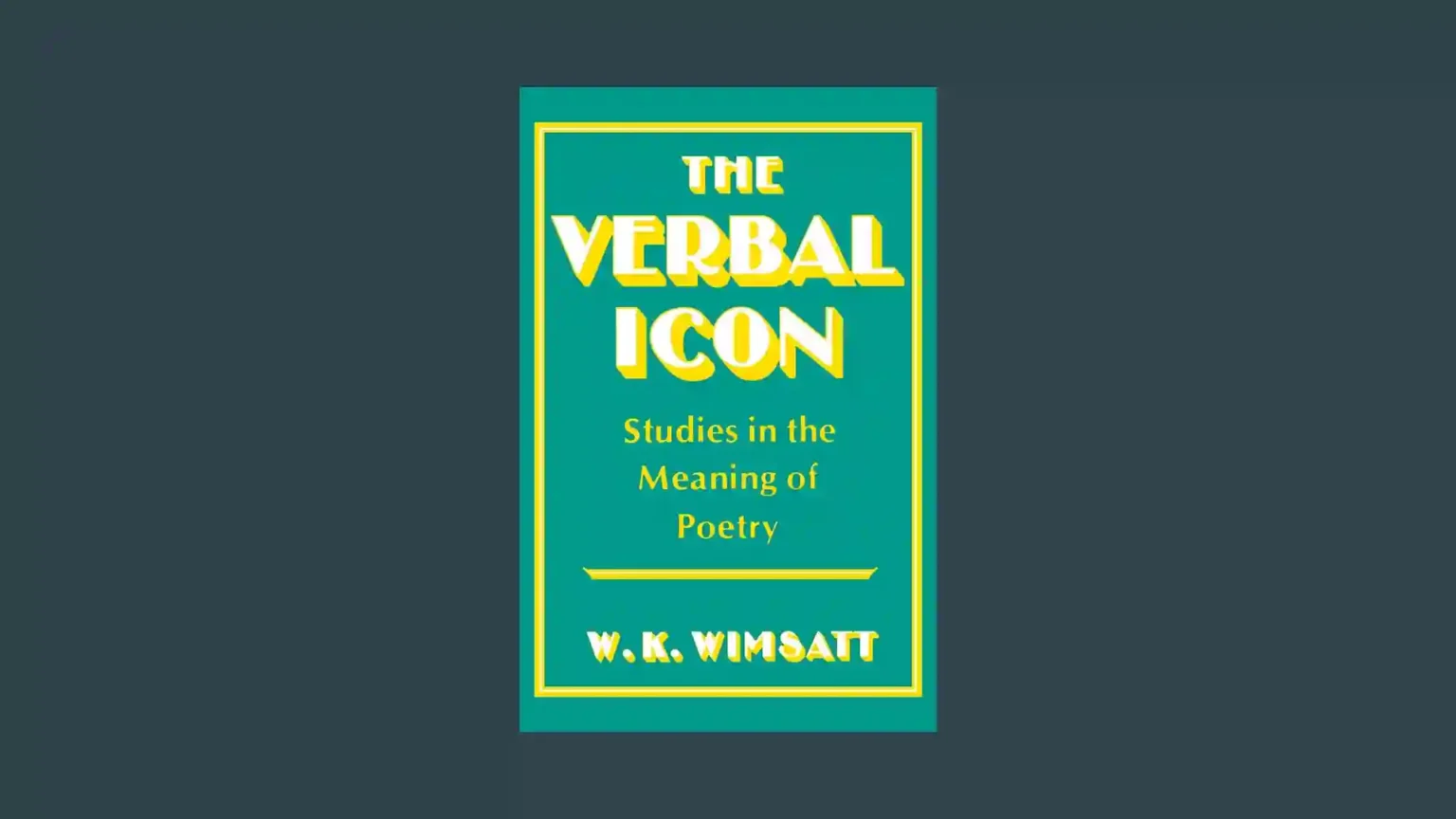
The canonical collection is The Verbal Icon (1954), where the essay becomes chapter 1
For most readers, the most useful collected version is Wimsatt’s The Verbal Icon: Studies in the Meaning of Poetry, published by the University Press of Kentucky in 1954. The publisher’s bibliographic page confirms the date, press, and ISBN, while the JSTOR book record places “The Intentional Fallacy” at pages 3–19. In that collection the essay is no longer an isolated intervention. It opens a sequence that immediately includes “The Affective Fallacy,” making Wimsatt’s larger critical project easier to see.
The Verbal Icon is therefore the better reading copy when the question is conceptual architecture. The neighboring essays show why intention and reader effect were treated as two tempting detours around the critic’s task of attending to the verbal object. The collection also carries revisions made as Wimsatt integrated essays written over more than a decade into what he described as a more coherent whole. If the research claim turns on exact wording, check which version you are quoting. If the goal is to understand the position as it entered the critical canon, the collected version is usually the more revealing context.
Do not turn ‘intentional fallacy’ into the claim that authors or historical evidence never matter
Three contrasts prevent the most common category errors:
Authorial intention versus authorial existence: the essay challenges intention as a critical standard; it does not require pretending that works have no authors, histories, genres, or occasions.
Private evidence versus evidence available through language and convention: the argument’s famous distinctions are about what kind of evidence criticism can responsibly use, not a ban on every fact outside the printed poem.
Meaning versus evaluation: debates after Wimsatt and Beardsley often ask whether intention is relevant to what a work means, whether it is relevant to evaluation, or both. Those are separate questions and later intentionalist theories frequently exploit the separation.
A useful secondary checkpoint is the 1955 discussion by Isabel Hungerland, “The Concept of Intention in Art Criticism”, which shows how quickly the issue generated philosophical resistance. Later aesthetics and philosophy of art continued to revisit the role of categories, conventions, intentions, and historical context. The Stanford Encyclopedia discussion of Beardsley’s aesthetics reconstructs his anti-intentionalist position and later objections, while Peter Lamarque’s Oxford chapter on “The intentional fallacy” places the original claim inside the subsequent theory debate. The persistence of that debate is evidence against treating the 1946 article as the last word rather than a highly influential opening move.
Which version should you use? Match the source to the claim
| Research task | Use | Why |
|---|---|---|
| Publication history or exact 1946 wording | Sewanee Review 54.3, 468–488 | It is the original public form of the co-authored essay. |
| Understanding the canonical New Critical package | The Verbal Icon, pp. 3–19 | The essay is positioned beside Wimsatt’s related critical arguments. |
| Teaching the controversy over authorial intention | Original/collected essay + a later response | Students can distinguish Wimsatt/Beardsley’s claim from later intentionalism. |
| Quoting a sentence in scholarship | Whichever edition you actually consulted | Give page numbers and identify the version rather than silently mixing pagination. |
There is also a later reader-friendly route through anthologies. Collections of authorship theory often excerpt the essay; for example, JSTOR’s record for Authorship: From Plato to the Postmodern includes a selection from “The Intentional Fallacy.” Such excerpts are useful pedagogically, but they are not the best source for a claim about the article’s complete argument. The original is twenty-one journal pages; the Verbal Icon version is a full chapter. Truncation changes what a reader can see about distinctions, examples, and argumentative pacing.
Citation practice should also preserve the essay’s co-authorship. The 1946 article is by Wimsatt and Beardsley; The Verbal Icon is a Wimsatt volume that reprints the jointly authored essay. A bibliography that lists only Wimsatt for the essay because it appears inside his book silently changes the historical record. Conversely, citing the 1946 pagination while quoting a revised collected text makes verification harder. The clean solution is to identify the version actually consulted, retain both authors for the essay, and use the pagination of that version.
That bibliographic precision is modest, but it keeps a theoretical argument attached to a recoverable textual object.
The bibliographic judgment is simple; the interpretive judgment is not
If you need the first publication, cite the 1946 Sewanee Review article. If you want the best single book for reading the essay in its canonical critical environment, use The Verbal Icon. If your research concerns whether authorial intention should matter to interpretation, do not stop with either source: pair the essay with at least one serious reply and state which proposition you are testing. “Intentional fallacy” has become a portable label, but the primary text is less portable than the label suggests.
Return, finally, to the object that started the controversy: a critic confronted with a poem and tempted to settle an interpretive or evaluative dispute by appealing to what the author meant to do. Wimsatt and Beardsley’s intervention asks what evidence the critic actually has and what kind of judgment criticism is making. That concrete situation—not the later slogan “the author is irrelevant”—is the primary text’s best safeguard against caricature.
Cover artwork: credits and source records
- The Verbal Icon — University Press of Kentucky (source record)