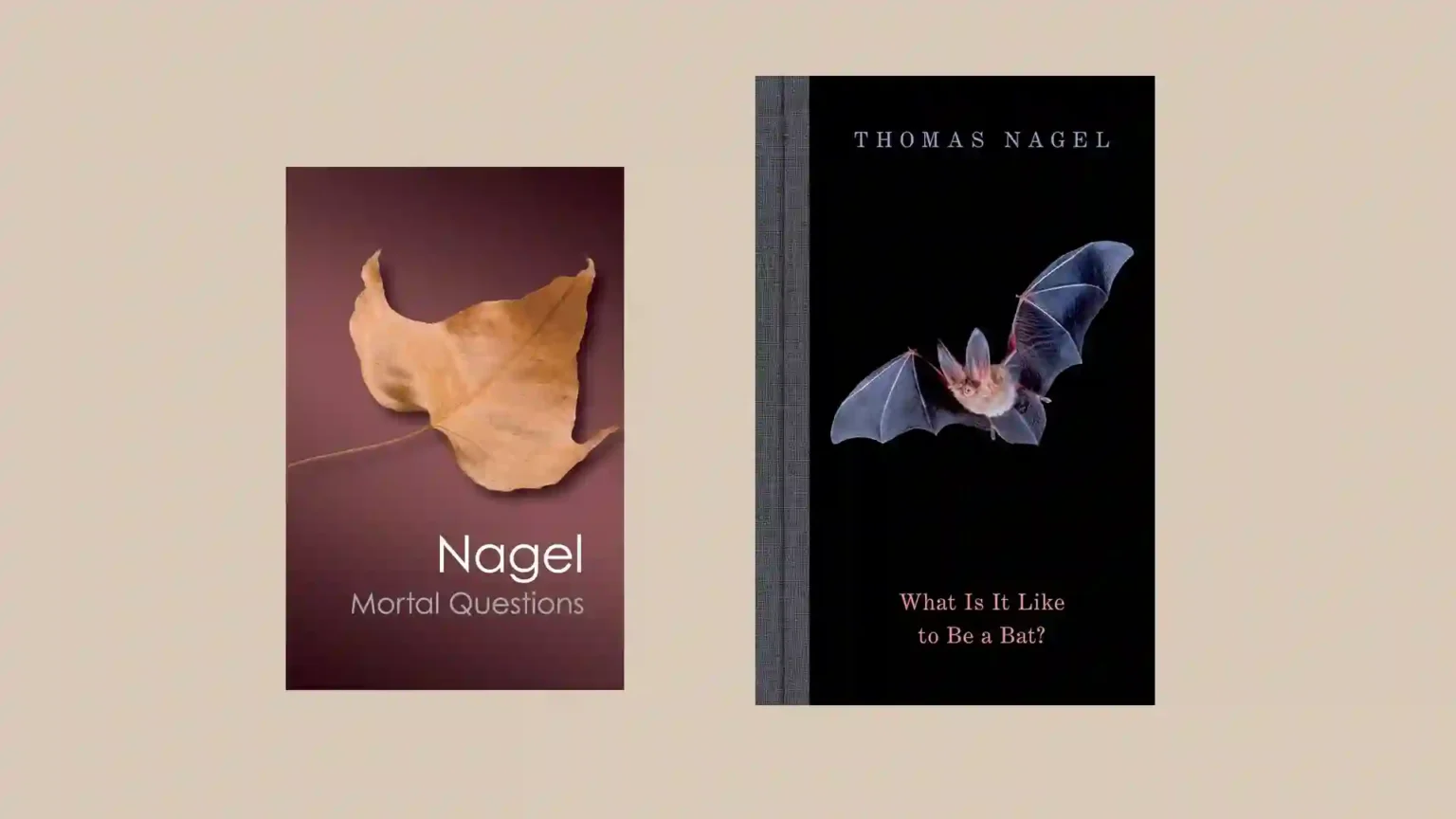
Nagel’s bat essay appeared in 1974 and has important reprints; choose the version that fits your purpose before interpreting its argument.
Three objects are often treated as though they were the same thing: Nagel’s original 1974 journal article, the later reprint in his essay collection Mortal Questions, and Oxford’s 50th-anniversary standalone volume. They contain overlapping material, but they answer different reader needs. The original matters for citation and historical placement; Mortal Questions supplies the canonical essay context; the 2024 Oxford volume adds Nagel’s later return to the mind–body problem. A reader trying to locate the famous argument should choose among those three objects before deciding what the argument means.
Original article
The primary publication is Thomas Nagel, “What Is It Like to Be a Bat?”, The Philosophical Review 83, no. 4 (October 1974), pp. 435–450. The stable DOI is 10.2307/2183914. This is the version to cite when the research question concerns first publication, original pagination, or the article’s place in the 1974 debate. The title question is not a request for bat ethology. It names a problem about the subjective character of experience: if an organism has conscious experience, there is something it is like for that organism to be that organism.
Two distinctions keep the article from being flattened into a slogan. First, Nagel separates objective knowledge about a creature from access to that creature’s point of view. More third-person information about echolocation need not yield the bat’s first-person character of experience. Second, he does not infer that consciousness is supernatural. His target is a reductive program that would explain mentality while leaving out the very feature that makes consciousness consciousness. The Stanford Encyclopedia of Philosophy entry on consciousness places the paper in the modern debate over phenomenal consciousness; the SEP entry on qualia helps distinguish Nagel’s point from later, more specialized uses of “qualia.”
Mortal Questions
For most readers who want Nagel rather than only this one article, the best reprint remains Mortal Questions, first published by Cambridge University Press in 1979. Cambridge lists “What Is It Like to Be a Bat?” as chapter 12; the collection places it alongside essays on death, absurdity, moral luck, equality, war, and the mind–body problem. That neighborhood changes the reading. The bat paper becomes one instance of Nagel’s recurring method: identify a perspective or value that an impersonal theory seems unable to absorb without remainder.
Mortal Questions is therefore not merely a convenient reprint. The Cambridge contents page makes visible the book’s architecture, and WorldCat’s record is useful for identifying library copies and edition history. For a seminar assigning several Nagel essays, this is the efficient choice. For a paper quoting the 1974 publication, the journal pagination is cleaner. Those are bibliographic differences, not competing philosophical texts.
The anniversary book
Oxford University Press added a third option in 2024: the standalone volume What Is It Like to Be a Bat?. It reproduces the classic essay and pairs it with Nagel’s later “Further Thoughts: The Psychophysical Nexus.” The Oxford chapter record for the original essay makes the relation explicit. This is the best current choice when the reader wants the 1974 argument together with Nagel’s later attempt to say what a non-reductive psychophysical theory might require.
That addition matters because the original essay is often remembered as purely negative: objective science cannot capture subjectivity, full stop. Nagel’s later work makes the position harder to classify. He continues to resist reductions that eliminate appearance or viewpoint, but he also treats the explanatory gap as a problem for theory construction rather than as permission to stop explaining. The anniversary volume therefore belongs to a different reading task from the journal article: it stages a fifty-year conversation between the original obstacle and a later metaphysical proposal.
What the three versions are for
| Reading task | Best object | Why |
|---|---|---|
| Historical citation | 1974 Philosophical Review article | Original pagination, issue context, first publication |
| Nagel in intellectual context | Mortal Questions | Canonical collection; places the essay beside Nagel’s other recurring problems |
| One-volume contemporary study | 2024 Oxford standalone | Classic essay plus Nagel’s later psychophysical reflections |
The practical sequence is correspondingly simple:
Read the 1974 text first if the aim is to reconstruct the argument. Mark the move from imagination—trying to picture being a bat—to the stronger point that changing the imaginative perspective does not give access to the bat’s own point of view.
Use Mortal Questions when the aim shifts from one argument to Nagel’s philosophical temperament. Compare the bat paper with the collection’s work on moral luck and the absurd: each tests what happens when an impersonal standpoint tries to dominate a perspective-bound human problem.
Use the 2024 volume last if the question becomes constructive: what sort of theory could acknowledge subjective character without treating it as an inexplicable extra?
A common misconception disappears once the versions are separated. The famous article is neither a report on bats nor a proof that science cannot study consciousness. It is a constraint on explanation: a theory that changes the subject by omitting subjective character has not yet explained the phenomenon it set out to explain. The primary text establishes that constraint; the later publication history shows Nagel continuing to ask what a theory capable of respecting it would have to look like.
What the argument does not establish
The publication history is useful because each format makes a different overreading tempting. In the journal article, the dramatic bat example can make the conclusion look like an argument against every objective science of mind. Nagel’s claim is narrower: an objective description must not be mistaken for a complete account if the phenomenon includes a subjective point of view. In Mortal Questions, the surrounding essays show that this is part of a broader concern with conflicts among standpoints rather than a one-off anti-scientific gesture. In the anniversary volume, the later psychophysical discussion shows that Nagel still treats explanation as a live task rather than declaring consciousness permanently unknowable.
A second overreading identifies the argument with the claim that humans cannot imagine bat experience. Imaginative limitation is evidence for the problem, not its whole content. A person can imagine having webbed arms, navigating by sound, or hanging upside down, but those exercises remain transformations of the human point of view. Nagel’s deeper constraint is about the relation between a point of view and an account that abstracts from points of view. That is why the paper remains relevant even if neuroscience eventually models bat perception in extraordinary detail: the philosophical question concerns what kind of explanatory achievement such a model would amount to, not whether the model can be scientifically sophisticated.
Further Reading
For orientation beyond Nagel, use the SEP overview of consciousness for the larger problem-space and the SEP survey of qualia for later terminology. For the article itself, keep the JSTOR original or DOI record beside whichever reprint is being read.
Cover artwork: credits and source records
- Mortal Questions — Cambridge University Press (source record)
- What Is It Like to Be a Bat? — Oxford University Press (source record)