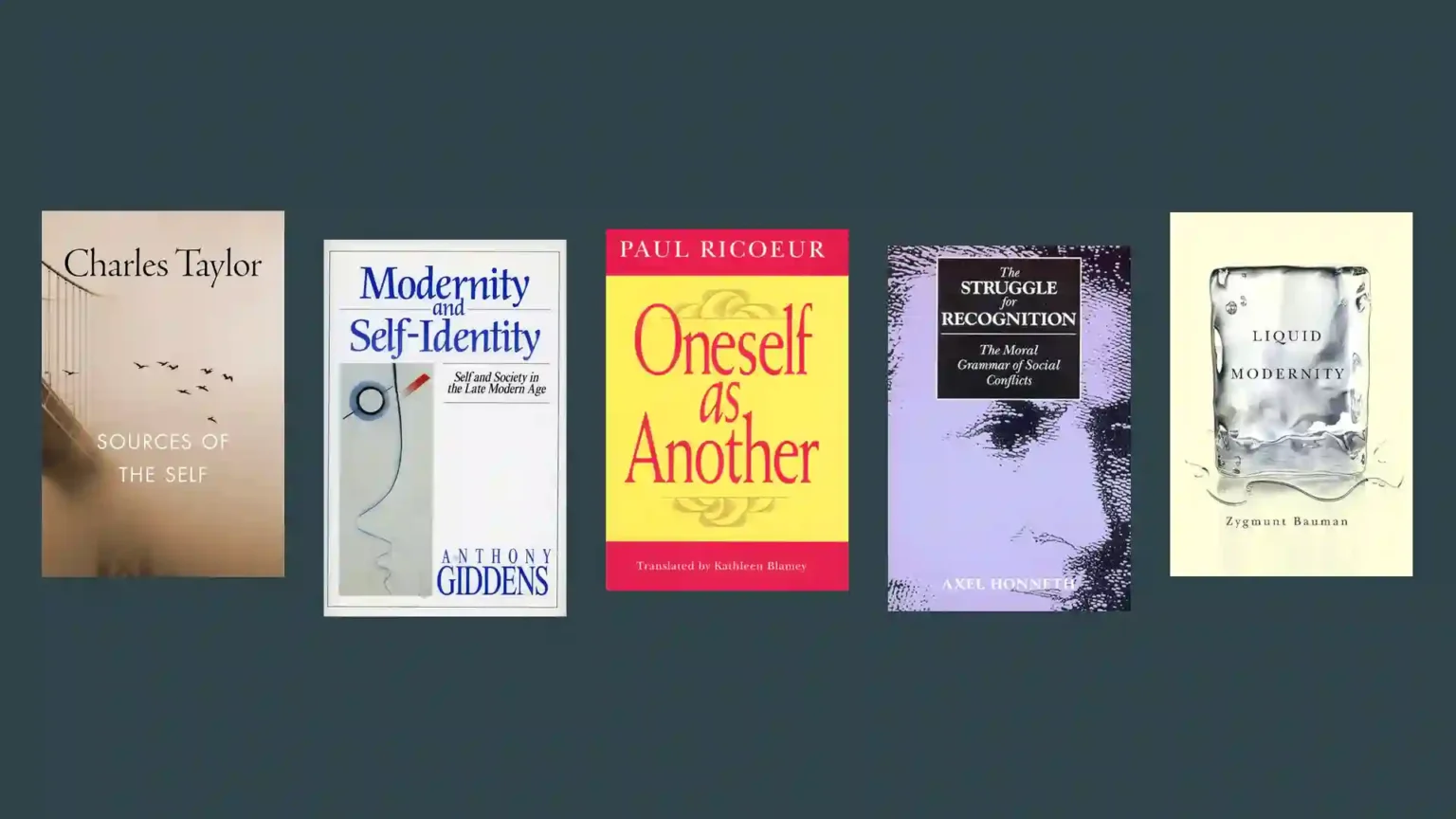
Books on modernity and self-identity show how institutions, social recognition, and reflexivity change what it means to be a self.
A striking fact about modern identity is that the self is often expected to become a project. People are asked to choose careers, affiliations, relationships, values, lifestyles, and even narratives of who they “really” are, while the institutions that structure those choices keep changing. A bibliography on modernity and self-identity therefore needs more than books about introspection. It needs books about institutions, moral vocabularies, recognition, and reflexivity.
The long genealogy
1. Charles Taylor, Sources of the Self. Taylor reconstructs the moral sources that make modern inwardness intelligible: the disengaged subject, ordinary life, expressive individualism, and the demand for authenticity. Read it when you want to know why “having an identity” can feel like a moral task rather than merely a sociological description. The philosophical genealogy connects directly with the longer history summarized in the SEP entry on authenticity.
2. Anthony Giddens, Modernity and Self-Identity. Giddens shifts scale from moral genealogy to late-modern institutions. The self becomes reflexively organized: biographies are continuously revised under conditions of abstract systems, risk, expert knowledge, and rapidly changing social relations. Read Taylor and Giddens together because one explains moral depth while the other explains institutional instability.
Continuity, recognition, and the pressure of choice
3. Paul Ricoeur, Oneself as Another. Ricoeur complicates identity by distinguishing sameness from selfhood and by emphasizing narrative identity. This is useful whenever “identity” is treated as if it meant an unchanging inner core. Narrative continuity allows a person to change without making identity unintelligible.
4. Axel Honneth, The Struggle for Recognition. Modern selves are not produced privately. Recognition by others, institutions, and social norms helps constitute practical identity. Honneth therefore corrects any bibliography that makes self-identity a solitary act of self-description.
5. Zygmunt Bauman, Liquid Modernity. Bauman’s metaphor of liquidity captures a different pressure: institutions and social forms become less durable, increasing individual burdens of navigation and self-revision. Use Bauman as a diagnosis, not as a universal empirical law. His conceptual power lies in making instability visible.
Counterweights
6. Erving Goffman, The Presentation of Self in Everyday Life. Goffman predates much “identity” vocabulary but provides a durable microsociology of performed selves. His dramaturgical model is a counterweight to romantic authenticity: presenting a self is not necessarily evidence that a truer private self is being concealed.
7. Derek Parfit, Reasons and Persons. Parfit belongs here as a philosophical disruption. If personal identity is less deep than we ordinarily suppose, modern projects of self-continuity may rest on assumptions metaphysics does not guarantee. The SEP lineage from Locke to later personal-identity debates helps locate that challenge.
| Book | Scale | Identity mechanism |
|---|---|---|
| Taylor — Sources of the Self | Moral genealogy | Moral sources and inwardness |
| Giddens — Modernity and Self-Identity | Institutions | Reflexive biography |
| Ricoeur — Oneself as Another | Narrative philosophy | Sameness / selfhood |
| Honneth — Struggle for Recognition | Social theory | Recognition |
| Bauman — Liquid Modernity | Macro diagnosis | Instability and mobility |
| Goffman — Presentation of Self | Interaction | Performance |
| Parfit — Reasons and Persons | Metaphysics | Reduction of identity |
The map reveals a useful asymmetry. Modernity does not simply “liberate the individual” and then leave identity to private preference. It creates institutions that require repeated self-description while also multiplying external systems of classification, expertise, surveillance, mobility, and recognition. The self becomes more explicitly authored and more obviously dependent at the same time.
That is why authenticity alone is not enough. The SEP authenticity entry shows how philosophical authenticity can involve owning possibilities, freedom, and relations to others; Giddens and Bauman ask what happens when the social conditions of such ownership are unstable; Honneth asks whose recognition makes agency possible; Goffman shows how identity is enacted before an audience.
For readers coming from classical personal identity, the shift can be disorienting. Metaphysical debates ask what makes a person numerically the same over time. Modernity debates often ask how a person sustains an intelligible biography, receives recognition, or navigates institutions. The IEP overview of personal identity is useful precisely because it makes the metaphysical question visible, preventing a sociological use of “identity” from silently replacing it.
A compact synthesis follows. Taylor explains why identity can carry moral depth. Giddens explains why it becomes reflexive. Ricoeur explains how narrative continuity differs from simple sameness. Honneth explains why identity is relational. Bauman diagnoses instability. Goffman reveals performance. Parfit destabilizes the assumption that identity itself is the deepest relation. Together they map modern selfhood as neither a hidden substance nor a free-floating lifestyle choice, but a changing intersection of continuity, interpretation, institutions, and recognition.
The seven books also differ in what counts as evidence. Taylor works through philosophical and intellectual history; Giddens through social theory; Ricoeur through phenomenology, hermeneutics, and narrative; Honneth through normative social theory; Bauman through diagnosis and metaphor; Goffman through interactional observation; Parfit through conceptual argument and thought experiment. A system-map should preserve those methodological differences rather than pretending they are interchangeable “perspectives.”
Taylor and Giddens form the central contrast. Taylor asks how modern moral sources make inwardness, autonomy, and expression intelligible. Giddens asks how late-modern institutions make identity a reflexive project. One gives genealogy to the ideals; the other gives sociology to the conditions under which those ideals are maintained.
Ricoeur then prevents reflexivity from collapsing into endless choice. Narrative identity is constrained by events, commitments, memory, and relations. A life can be reinterpreted, but not rewritten as though nothing happened. This is a useful counterweight to consumer models of identity in which revision is treated as costless.
Honneth supplies a second constraint: recognition. Identities are not sustained only through inward coherence; they depend on social relations in which persons can develop self-confidence, self-respect, and self-esteem. That makes failures of recognition philosophically relevant to identity rather than merely external obstacles to it.
Goffman complicates authenticity from another direction. Social performance is not necessarily hypocrisy. Roles and presentations are part of ordinary interaction, and the distinction between “performed” and “real” self can itself become too simple. Read beside the philosophical history of authenticity, Goffman forces a harder question about whether social mediation corrupts identity or constitutes it.
Parfit finally breaks the map open. If numerical personal identity is not what matters in survival, then projects of autobiographical continuity may be practically important without resting on a deep metaphysical ego. The Locke-to-Parfit lineage is crucial here because it shows that modern selfhood debates inherit older questions even when they shift vocabulary.
The seven-book set therefore traces three axes: depth (what moral or metaphysical sources make a self intelligible), reflexivity (how identity is revised through time), and recognition (how others and institutions participate in that process). Modernity intensifies all three rather than replacing one with another.
The unresolved issue is empirical as well as philosophical: how evenly are the burdens and opportunities of reflexive self-making distributed? Class, gender, race, migration, disability, and digital infrastructures alter who can revise a biography and at what cost. The classic books map the architecture; contemporary research must test how that architecture is inhabited.
Digital life adds a contemporary layer to the map. Profiles, archives, quantified behavior, recommendation systems, and platform identities create forms of persistence that are neither simply narrative nor bodily. A person can revise a biography while data infrastructures preserve older versions, forcing a distinction between self-interpretation and machine-readable identity.
Migration adds another: modern identity is often maintained across legal categories, languages, memories, and institutions that do not recognize the same person in the same terms. Recognition theory and reflexive biography therefore meet in practical conflicts over documentation, belonging, and continuity.
These cases do not make the classic seven books obsolete. They show what a system-map is for. Taylor helps ask which moral sources survive; Giddens which expert systems mediate action; Ricoeur how narrative repairs rupture; Honneth where misrecognition damages agency; Bauman how instability becomes normal; Goffman how presentation adapts; Parfit how much metaphysical identity must matter at all.
A strong bibliography should end by generating research questions. Which institutions now demand the most identity work? When does reflexivity become coercive? How do recognition and surveillance interact? Can narrative continuity survive algorithmic memory? The classic texts provide coordinates, not final answers.
Cover artwork: credits and source records
- Sources of the Self — Harvard University Press (source record)
- Modernity and Self-Identity — Stanford University Press (source record)
- Oneself as Another — University of Chicago Press (source record)
- The Struggle for Recognition — MIT Press (source record)
- Liquid Modernity — Polity (source record)