Books on translation and empire disagree about how power enters language, circulation, publishers, and cultural institutions.
“Translation and empire” can sound like a thesis already proved: empires translate in order to rule, therefore translation is an instrument of domination. The six books below are more useful because they do not leave the claim at that level. They ask where power actually enters translation—through philology, missionary conversion, property metaphors, schooling, canon formation, language hierarchy, or the very categories with which “original” and “translation” are separated.
The set should therefore be read comparatively, not as six confirmations of one postcolonial slogan. Some books emphasize colonial knowledge; others show colonized speakers redirecting translation, mistranslating strategically, or creating new vernacular possibilities. The strongest reading path keeps both directions visible.
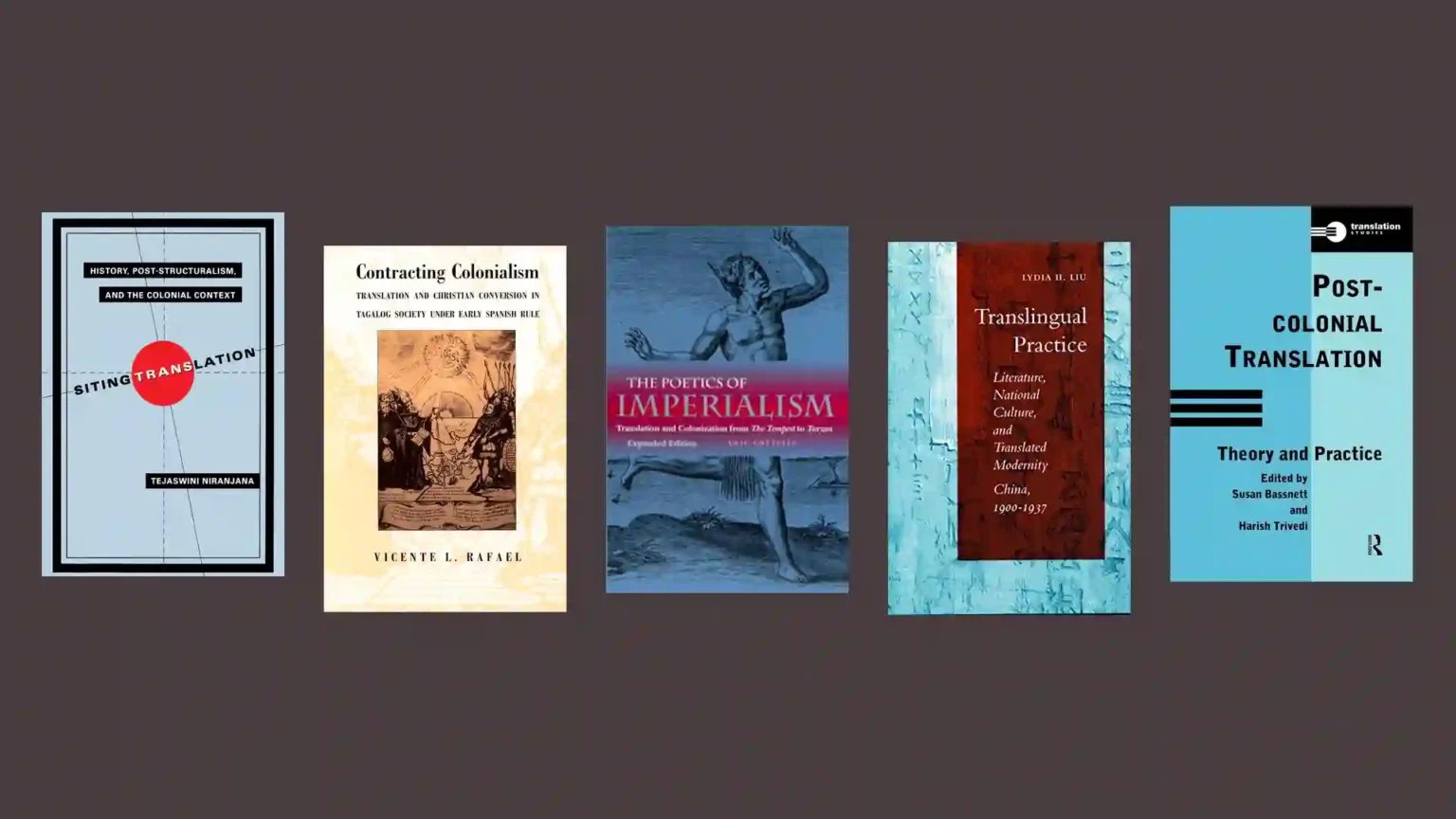
1. Tejaswini Niranjana — Siting Translation
Start with Tejaswini Niranjana’s Siting Translation because it makes the broadest theoretical claim. Published by University of California Press in 1992, the book argues that translation under colonialism cannot be treated as neutral linguistic transfer: it participates in historical representations that construct the colonized as knowable, static, and governable. Niranjana draws on Benjamin, Derrida, and de Man, but the force of the book comes from joining deconstructive questions about representation to British colonial practices in India.
Its strength is diagnostic. It teaches you to ask what theory of language makes a colonial translation appear innocent. Its risk, if read alone, is that “translation” can begin to look too uniformly absorbed by colonial power. That is exactly why the next case matters.
2. Vicente L. Rafael — Contracting Colonialism
Vicente Rafael’s Contracting Colonialism moves from the British-Indian frame to Spanish rule in the Philippines and from literary theory toward historical anthropology. Translation here is entangled with Catholic conversion, confession, Tagalog responses, and the practical difficulty of making Spanish religious categories work in another linguistic world. Duke’s description explicitly notes both colonial regime formation and resistance.
Rafael is the first major counterexample to a one-directional model. The colonizer does not simply deposit meaning in a passive receiving language. Conversion requires linguistic accommodation, and that accommodation produces slippage. Colonial authority needs translation precisely because it does not control equivalence. The book therefore shifts the key question from “Does empire use translation?” to “What happens when empire cannot make translation obey?”
3. Eric Cheyfitz — The Poetics of Imperialism
Eric Cheyfitz’s The Poetics of Imperialism widens the archive from colonial administration to literary form. The book follows translation and colonization from The Tempest into American literature and argues that imperial culture repeatedly imagines linguistic difference through hierarchies of eloquence, property, and possession. Translation becomes both a literal practice and a metaphor through which cultural authority is organized.
That metaphorical reach is productive but should be tested rather than merely admired. If every act of representing difference becomes “translation,” the term can lose discriminatory power. Cheyfitz is most convincing when the language of translation is tied to specific literary and political structures, not when it becomes a synonym for cross-cultural contact.
4. Douglas Robinson — Translation and Empire
Douglas Robinson’s compact Translation and Empire is the set’s map rather than its most original archive. It reconstructs postcolonial translation theory, explains power differentials, and devotes sections to Cheyfitz, Niranjana, Rafael, resistance, redirection, and criticism. That last component is important: Robinson does not present the field as a settled consensus.
Read it after the first three, not before them. Otherwise its clarity can make distinct arguments look like components of one system. After primary exposure to the case studies, however, Robinson becomes an excellent test of vocabulary: he lets you see which claims actually belong to which theorist and where critics have challenged the postcolonial model.
5. Lydia H. Liu — Translingual Practice
Lydia Liu’s Translingual Practice moves the problem away from a simple colonizer/colonized exchange and toward the production of modern concepts across Chinese and European languages. The book’s central importance is methodological: it asks us not to imagine two complete languages meeting at a border, with translation carrying intact meanings between them. Modern political and literary vocabulary is often made in the traffic itself.
That move complicates the moral geometry of empire. Unequal power remains, but linguistic change is not exhausted by a model of an imperial source language imposing itself on a target language. Concepts are coined, borrowed, resisted, naturalized, and retroactively made to look native. In that sense, “translingual practice” is a counterexample to accounts that treat translated modernity as secondary or derivative by definition.
6. Susan Bassnett and Harish Trivedi, eds. — Post-colonial Translation
Finish with the multi-author collection Post-colonial Translation: Theory and Practice, a volume that Routledge continues to identify as a major work in Susan Bassnett’s translation bibliography. The collection is useful precisely because an edited volume refuses the fantasy of one theory. It brings questions of hybridity, migration, rewriting, power, and literary practice into contact without making them identical. For orientation, Bassnett’s later Translation also places postcolonial translation beside globalisation, cultural translation, invisibility, and rewriting.
An edited collection also reveals a disciplinary shift. By the late 1990s, the question was no longer whether translation studies could discuss colonial power; the harder issue was how to do so without reducing languages, translators, and postcolonial subjects to predetermined roles. That is why this book belongs at the end of the sequence rather than the beginning.
What the six books rule in—and what they rule out
Together, these books rule in a strong proposition: translation is never insulated from institutions, language hierarchies, and political history. They also rule out a weaker but tempting proposition: that translation under empire is always a one-way technology whose meaning can be read directly from the intentions of rulers. Rafael’s mistranslations, Liu’s concept-making, and the comparative disagreements collected by Bassnett and Trivedi make that simplification impossible.
The most useful companion on BookInLight is Reading Orientalism Again, because it poses a related methodological problem: how to identify durable structures of representation without declaring every European encounter identical. Translation studies has the same burden. A theory of power becomes more credible, not less, when it can explain variation, failed control, and counter-use.
Four comparison axes that keep the field from collapsing into one claim
First, compare the archive. Niranjana reads colonial translation in India through a critique of representation; Rafael reconstructs missionary and vernacular encounters in the Philippines; Cheyfitz moves through literary and political texts in the Americas; Liu follows modern conceptual traffic among Chinese, Japanese, and European languages. “Translation and empire” changes meaning when the archive changes. A theory that works in missionary catechism may not transfer unchanged to literary modernity or canon formation.
Second, compare agency. Some accounts emphasize institutions that commission, authorize, classify, or teach translations. Others show translators, converts, writers, and readers redirecting the process. Agency here does not mean freedom from power. It means that unequal systems still contain mediators whose choices can alter outcomes. Rafael’s work is particularly useful because resistance does not occur outside translation; it can emerge through the same linguistic encounter colonial authority depends on.
Third, compare the unit called “translation.” Cheyfitz sometimes treats translation as a broad cultural logic, while Liu’s “translingual practice” can describe the production of concepts that no longer look like translations after they settle into a language. Robinson is valuable precisely because he exposes these shifts in scale. Before importing a claim from one book into another case, ask whether “translation” names a text, an institution, a metaphor, a language policy, or a long process of conceptual transfer.
Fourth, compare temporality. Colonial translation can legitimize rule in the moment, but its texts may later become resources for anticolonial argument, retranslations, or historical recovery. A translation can outlive the institution that produced it and acquire political functions its sponsors did not anticipate. The field becomes strongest when it follows that afterlife rather than freezing every translated text at the moment of imperial commission.
After the six core books, Emily Apter’s The Translation Zone works well as a methodological counterpoint because it stretches translation beyond colonial administration toward war, migration, language politics, and zones of untranslatability. Read after the six rather than inside the numbered set, it tests whether “empire” has become too convenient an explanatory container. If every multilingual asymmetry is named imperial in advance, the category stops discriminating among coercion, market hierarchy, exile, state language policy, and literary circulation. A comparative field needs concepts broad enough to travel but narrow enough to be falsified by cases that do not fit.
One final counterexample is methodological rather than historical. A text can circulate inside an imperial system without being commissioned by an imperial office, and a translator can reproduce imperial assumptions while imagining the work as cosmopolitan or educational. Conversely, a translation produced under coercive institutions can become material for later critique. Political analysis therefore has to reconstruct the chain of selection, patronage, publication, teaching, and reuse instead of assigning the same political function to every translated object from an imperial setting.
So the comparison ends with a distinction. Empire can structure the conditions of translation without determining every translated meaning. Translation can reproduce hierarchy without being reducible to obedience. The next question is therefore empirical: in any specific colonial archive, which institution controlled the translation, which language pair was involved, what choices were available to intermediaries, and where did the resulting text exceed the political project that commissioned it?
Cover artwork: credits and source records
- Siting Translation — University of California Press (source record)
- Contracting Colonialism — Duke University Press (source record)
- The Poetics of Imperialism — University of Pennsylvania Press (source record)
- Translingual Practice — Stanford University Press (source record)
- Post-colonial Translation — Routledge (source record)