“The Task of the Translator” changes its meaning across editorial contexts; locate Walter Benjamin’s text before comparing translations.
“No poem is intended for the reader.” Walter Benjamin puts that provocation near the opening of the essay English readers usually know as “The Task of the Translator”. The sentence is useful because it immediately blocks the most comfortable way of approaching the piece: as advice about how to carry information from one language into another. Benjamin’s essay is not a handbook for translators. It is a speculative argument about what translation reveals about the life of works and the relation among languages.
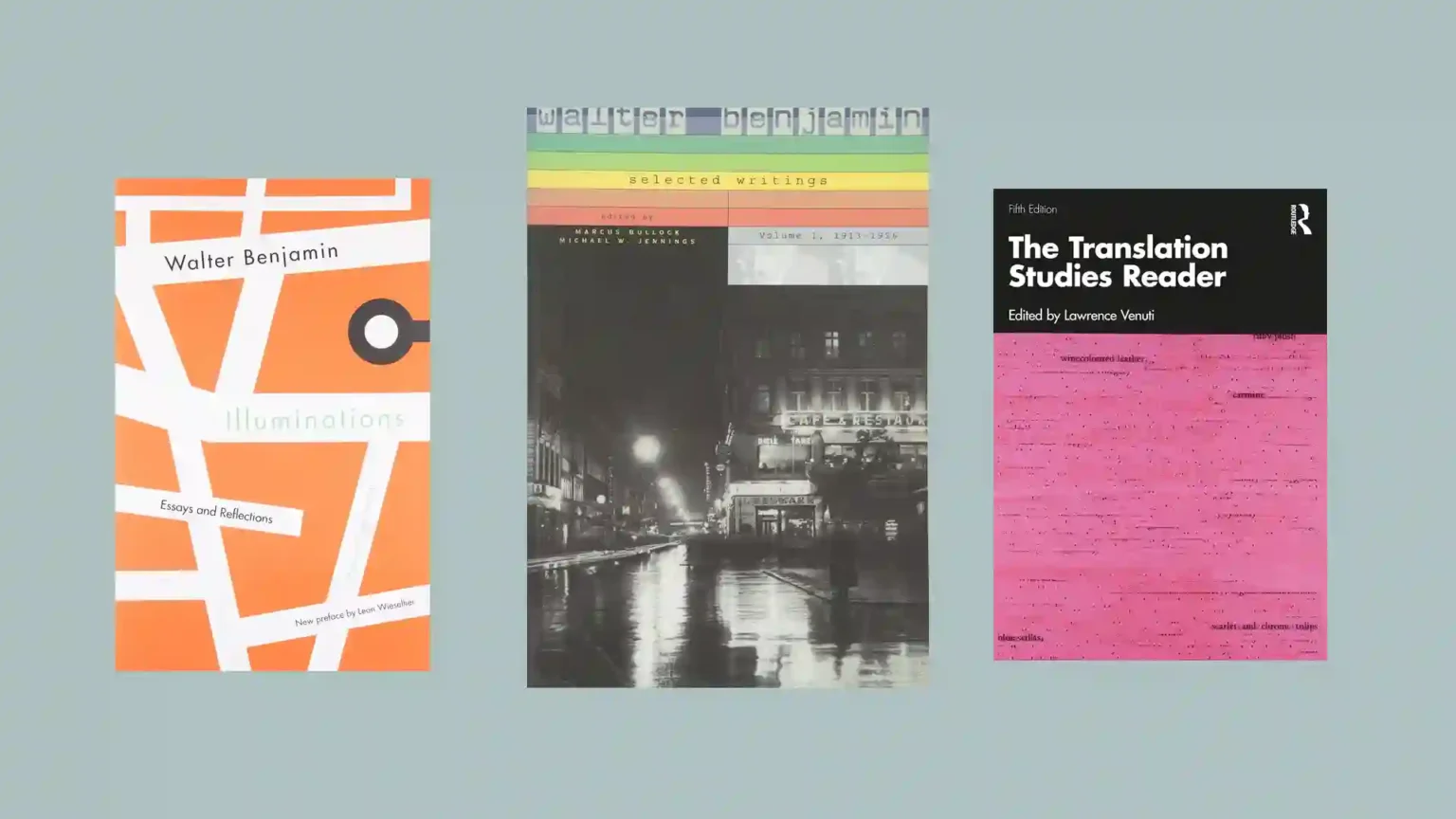
The bibliographic answer is simple but incomplete. In Hannah Arendt’s English-language collection Illuminations, the Harry Zohn translation appears as “The Task of the Translator: An Introduction to the Translation of Baudelaire’s Tableaux Parisiens,” beginning on page 69 in the familiar Schocken edition. Yet that placement can make the text look like a freestanding Benjamin essay that happens to mention Baudelaire. Historically, it was the other way around: the German “Die Aufgabe des Übersetzers” was written as a preface to Benjamin’s own translations of Baudelaire’s “Tableaux Parisiens.”
Composition versus publication: Benjamin wrote “Die Aufgabe des Übersetzers” in 1921, but it first appeared in print in 1923 as the preface to his German translation of Baudelaire’s Tableaux parisiens. English-language reprints should not be cited as if they were the essay’s original publication. Source: Cambridge scholarly history.
The essay began as a preface, not as an isolated theory text
The 1923 object matters. A catalog record for Tableaux parisiens identifies Benjamin as translator and describes the volume as a German translation with a preface on “die Aufgabe des Übersetzers.” Suhrkamp’s critical edition of the Baudelaire translations likewise reconstructs the translation project, the essay, drafts, publication history, and later textual states in one documentary frame. Reading that critical-edition description changes the scale of the problem. The essay is not merely “about translation”; it emerges from Benjamin translating a specific poet and confronting the mismatch between languages in practice.
That context also explains why readers who encounter only Illuminations can miss the force of the subtitle. Benjamin is thinking beside Baudelaire’s poems, not above translation as an abstract activity. The source volume binds a theoretical claim to an act of literary transfer. The later anthology separates them. Neither arrangement is illegitimate, but they produce different first impressions: one makes translation practice the occasion; the other makes Benjaminian theory the destination.
The most important edition question is therefore not only “Which book contains the essay?” but “Which English wording are you reading?” Harry Zohn’s version became canonical through Illuminations and was reprinted widely. A later Steven Rendall translation appeared under the slightly altered title “The Translator’s Task.” The current fifth edition of The Translation Studies Reader prints Rendall’s version, making the title shift visible before a reader reaches the first paragraph.
This is not a cosmetic difference. Rendall wrote separately about problems in Zohn’s rendering, and the 1997 issue of TTR that published “The Translator’s Task” also included a critique of Zohn. The bibliographic record for that issue shows the two pieces side by side: Rendall’s translation and his notes on Zohn. A research bibliography maintained by the University of Tokyo’s comparative-literature association likewise distinguishes the Zohn and Rendall lines of transmission and records their different English titles and republication histories.
That disagreement is especially revealing because the German word Aufgabe carries more than one English possibility. “Task” is obvious, but the word can also suggest assignment, charge, problem, even giving-up or surrender in some contexts. The title cannot settle Benjamin’s theory by itself, yet it warns readers that translation begins before the first sentence of the essay. The English text is already an interpretation of what the translator’s “task” is.
The comparison becomes more reliable when the bibliography itself is treated as evidence. A comparative bibliography maintained by the University of Tokyo records Zohn and Rendall as distinct English transmission lines rather than interchangeable reprints. That is a small bibliographic fact with a large interpretive consequence: quotations that appear to disagree may come from different translators, while quotations that look identical may have been inherited from the same translation through a later anthology. Before arguing from one English word, establish translator, venue, and publication lineage. That discipline is especially important for Benjamin because the essay itself makes linguistic mediation part of its philosophical object.
Illuminations or Selected Writings?
For a first encounter, Illuminations remains defensible because the essay sits among Benjamin’s famous writings on literature, art, collecting, storytelling, and history. That neighborhood shows how translation connects with a larger account of works surviving through altered historical conditions. The volume is also easy to identify in libraries because the Arendt–Zohn configuration is stable across many reprints.
For research, however, Selected Writings, Volume 1: 1913–1926 gives a more useful chronological home. It returns the essay to Benjamin’s early period and places it among writings produced before the later Baudelaire studies that often dominate interpretations of him. The volume’s Harvard/Belknap bibliographic record also makes it easier to cite the work in a dated corpus rather than as one item in a posthumous thematic anthology. The chronological frame also helps prevent a retrospective error: it keeps the 1923 essay from being read as though Benjamin had already written the later Baudelaire studies and then summarized them backward. The early text should be allowed to remain early, even when later Benjamin makes some of its problems easier to recognize.
A third option is a translation-studies reader. That context is best when your question is disciplinary: how Benjamin was canonized inside translation theory, and how his vocabulary looks beside Schleiermacher, Pound, Borges, Nabokov, Venuti, and later theorists. The trade-off is obvious. A reader creates a genealogy of a field, which can tempt you to assume Benjamin was writing for that later field. He was not.
Do not compare whole translations sentence by sentence at first. Track a small vocabulary: the work’s afterlife, translatability, kinship among languages, “pure language,” fidelity, freedom, and the relation between original and translation. When Zohn and Rendall diverge, ask what philosophical pressure the English choice introduces. Then return to the 1923 Baudelaire setting and ask whether the theory sounds different when it is attached to poems Benjamin himself had to translate.
The comparison also prevents a common mistake: treating Benjamin as if he proposed a usable recipe for literalness versus freedom. His essay repeatedly exceeds that binary. Translation is important because it marks a work’s continued life and because languages disclose their relations through difference, not because a translator can finally transfer an invariant message without remainder. A practical translator may find the essay illuminating, but its “task” is not a checklist.
Read the Zohn essay in Illuminations first if that is the edition already in your hands. Then read Rendall in The Translation Studies Reader, keeping the titles themselves in view. Finally inspect the 1923 Tableaux Parisiens bibliographic context or Suhrkamp’s critical-edition description so that the preface returns to the translation project that produced it. If you are citing Benjamin in scholarship, identify the English translator in the citation rather than writing as though there were one transparent English “Task.”
Three publication histories that should not be collapsed
There are at least three histories in play. The first is the 1923 German publication history: Benjamin translates a Baudelaire sequence and prefaces it with “Die Aufgabe des Übersetzers.” The second is the English anthology history, in which Zohn’s version becomes one of the signature essays of Illuminations under Arendt’s editorial frame. The third is the translation-studies history, in which the essay is excerpted, retranslated, criticized, and positioned near other canonical statements about fidelity, foreignness, and linguistic difference. Each history answers a different question about what kind of text this is.
That distinction matters for interpretation. If you begin with the 1923 object, you notice that Benjamin’s theory is adjacent to an actual translation and that “afterlife” is not only metaphorical: Baudelaire’s poems are being given another linguistic existence. If you begin with Illuminations, you are likely to connect the essay to Benjamin’s theories of art, history, and literary survival. If you begin with a translation-studies reader, you are invited to ask how later theorists adopted, corrected, or resisted his vocabulary. None of those frames is neutral, and no single one should silently substitute for the others.
The difference between “The Task of the Translator” and “The Translator’s Task” is small enough to overlook and large enough to use methodologically. The first English title can sound as though a stable object called “the task” belongs to an occupational figure; the second puts the possessive relation first. Neither translation decides the German word once and for all. The point is that English syntax starts interpreting Benjamin before the argument begins. A reader who cites the essay without naming the translator erases exactly the kind of linguistic mediation the essay asks us to notice.
The same discipline should be applied to recurring technical terms. “Pure language,” “kinship,” “afterlife,” and “fidelity” arrive in English carrying philosophical associations that may feel more settled than Benjamin’s German. Instead of building a doctrine from one English keyword, compare how the term behaves across passages and translations. A word that looks metaphysical in isolation may be functioning relationally; a word that looks practical may carry theological or philological pressure.
For an undergraduate paper, it is usually enough to cite the edition actually read and include Harry Zohn or Steven Rendall as translator. For a thesis or article centered on translation, record both the collection and the translator, and give page numbers from that edition rather than importing pagination from another reprint. If you are comparing versions, treat them as distinct textual witnesses. Do not write “Benjamin says” and then alternate silently between Zohn and Rendall sentences as if the English wording were interchangeable.
For archival or philological work, the Suhrkamp critical edition becomes more important because it reunites the essay with the Baudelaire translation project, drafts, variants, and documentary material. For disciplinary history, the successive editions of The Translation Studies Reader matter because they show a field changing the English text through which students encounter Benjamin. The best edition therefore depends on the question: context, chronology, translation comparison, or classroom accessibility.
The existence of translation differences does not mean Zohn is useless, nor does a newer translation automatically supersede an older one. Zohn’s version has its own reception history: generations of criticism quote it, respond to its vocabulary, and sometimes build arguments around precisely the choices later translators question. Rendall is indispensable for comparison, but reading only Rendall can hide the English-language history Benjamin actually had. An older translation can be both contestable as a rendering and decisive as an event in reception.
The next question the evidence makes unavoidable is larger than an edition choice: if the English versions of Benjamin’s essay materially redirect its vocabulary, what would it mean to use “The Task of the Translator” as a theory of translation without first treating its own translation history as evidence?
Cover artwork: credits and source records
- Illuminations — Schocken (source record)
- Selected Writings, Volume 1: 1913-1926 — Harvard University Press (source record)
- The Translation Studies Reader — Routledge (source record)