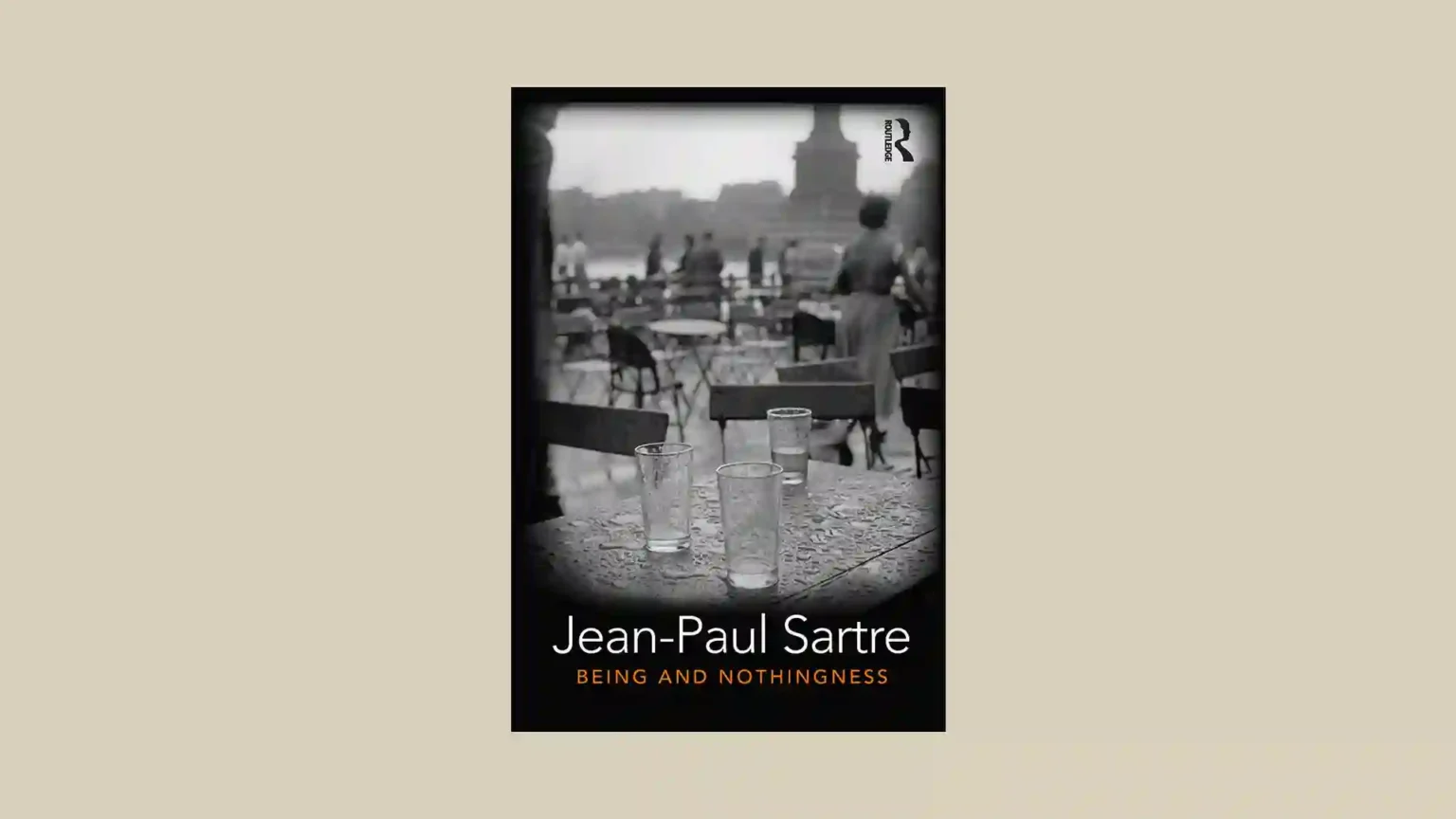
Sartre’s bad faith is not simply lying to oneself; the key section, original terminology, and translation choices matter.
The phrase mauvaise foi enters Being and Nothingness not as a moral label attached to dishonest people but as a problem internal to consciousness. In the current Routledge Sarah Richmond translation, “Bad Faith” is Chapter 2 of Part One, The Problem of Nothingness. That location matters: Sartre develops bad faith only after arguing that human consciousness can negate what is given.
The familiar English phrase invites a false equivalence. “Bad faith” sounds like insincerity; “self-deception” sounds like a cognitive mistake; mauvaise foi carries the ordinary French sense of acting in bad faith while Sartre turns it into an ontological pattern. The Stanford Encyclopedia discussion accordingly treats the chapter as part of his account of the for-itself, not simply as applied moral psychology.
Two apparently similar cases
Take Sartre’s waiter and the person who hides from an uncomfortable truth about a relationship. Both can be called “inauthentic,” but the mechanisms are not identical. The waiter over-identifies with a social role, behaving as though he were simply what the role defines. The other case may involve treating possibilities as though they were fixed facts or treating facts as though they could be dissolved by possibility. Sartre’s vocabulary of facticity and transcendence is designed to explain why consciousness can oscillate between these distortions.
This is where translation becomes argumentative evidence. “Bad faith” keeps the quasi-ethical resonance of mauvaise foi but can understate the paradox Sartre wants: the deceiver and the deceived are not cleanly separable. The SEP entry on Sartre notes that Sartre attacks Freudian models partly because an unconscious censor seems to recreate, inside the psyche, the division needed to explain how one part knows what another part does not.
Where the chapter sits in the book
The Routledge table of contents gives the macro-structure clearly: Introduction; Part One, “The Problem of Nothingness”; Chapter 1, “The Origin of Negation”; Chapter 2, “Bad Faith”; then Part Two, “Being-for-Itself.” This sequence is philosophically important. Sartre has not yet reached the later social drama of being-for-others. Bad faith is first built from the structure of consciousness itself.
The chapter therefore reads differently if you arrive from the public lecture Existentialism Is a Humanism. The lecture makes freedom and responsibility vivid, but the ontology behind those claims is compressed. The broader SEP entry on existentialism can help readers distinguish the later slogan “existence precedes essence” from the more technical machinery of negation, facticity, and transcendence in Being and Nothingness.
Older English and the Richmond translation
Hazel Barnes’s long-standard English version made Sartre available to generations of readers; Sarah Richmond’s newer translation revisits terminology, supplies a substantial translator’s introduction, and provides an index. The publisher’s Routledge edition page confirms that this translation reorganizes none of the fundamental parts but gives readers better navigational apparatus. For a chapter-finder article, that practical difference is not trivial: a difficult ontology becomes easier to verify when the edition exposes its internal map.
The most important comparison, however, is not old translation versus new translation as a ranking. It is term versus argument. If you search only for “bad faith,” you may miss the way related claims reappear under freedom, situation, being-for-itself, and existential psychoanalysis. The term names a chapter; the problem exceeds the chapter.
What the text rules out
It rules out one easy picture: that bad faith is simply lying to oneself in the same way one lies to another person. Ordinary lying presupposes an asymmetry of knowledge. Sartre’s problem is to explain how one consciousness can both disclose and flee from what it discloses. It also rules out the comforting idea that a fixed identity excuses action. The contemporary existentialism entry stresses that Sartrean freedom is not unlimited power: choices occur within factical situations, but situations do not mechanically dictate the meaning we give them.
So the best edition is the one that lets you keep three levels visible at once: the French conceptual problem, the chapter’s place in the ontology, and the later consequences for freedom. Richmond is especially useful for that task, but the decisive reading practice is comparative: use the chapter heading to locate the text, then refuse to let the English phrase substitute for Sartre’s argument.
From here there are three sensible routes. Readers interested in self-deception can follow the Freud dispute; readers interested in ethics can move from bad faith toward authenticity and responsibility; readers interested in social philosophy can continue to being-for-others and later Sartrean accounts of situated freedom. The same chapter opens all three paths because mauvaise foi is not a detachable “concept card.” It is where Sartre tests what a consciousness that is never simply identical with itself can do to itself.
Sartre’s examples are famous enough to become misleading. The café waiter is often treated as proof that social roles are inherently false. But the problem is not that a person should never be a waiter “too seriously.” The problem is the attempt to exist as though one’s role exhausted one’s mode of being. A human being can factically occupy a role while transcending it through projects and possibilities. Bad faith appears when one pole is treated as the whole truth.
The complementary mistake is equally important. If facticity can be denied, bad faith becomes a fantasy of pure self-invention. Sartre’s gambler who resolves never to gamble again discovers that a past resolution does not mechanically determine present action; yet the past is not unreal. The for-itself must continually take a stance toward what has been. This is why the concept cannot be reduced to upbeat language about “choosing who you are.”
The French term also carries a legal and interpersonal resonance that English readers should keep in view. Mauvaise foi can name bad faith in negotiation or conduct, where one exploits a situation while refusing the standards implicit in it. Sartre’s philosophical use is not identical to that ordinary sense, but the overlap helps explain why the term feels more normatively charged than a neutral phrase such as “motivated self-misrepresentation.”
For comparison, “self-deception” in analytical philosophy often begins from a puzzle about contradictory beliefs: how can the same person believe p and intentionally make herself believe not-p? Sartre’s solution is not to partition the mind into two agents. His phenomenological account instead asks how consciousness can disclose a fact while changing the mode in which it is taken up. The SEP treatment is helpful precisely because it connects bad faith to his critique of Freudian division.
Translation therefore affects the shape of the puzzle. A rendering that makes the language sound primarily psychological may pull readers toward hidden beliefs and inner mechanisms; a rendering that keeps ontological vocabulary visible directs attention to modes of being. Richmond’s introduction in the Routledge edition is useful because it makes those choices explicit rather than presenting translation as transparent.
The chapter’s relation to authenticity is also indirect. Sartre does not simply offer “authenticity” as the opposite state with a checklist of correct behaviors. Later existentialist discussions, including Beauvoir’s, develop more ethically explicit accounts. The existentialism overview helps track that development without retrofitting a later ethical vocabulary into every sentence of the 1943 ontology.
Finally, the social role examples should not obscure the historical evolution of Sartre’s freedom. His later work increasingly stresses that situations are structured by institutions, class, racism, colonialism, and material constraint. The SEP Sartre article notes this transition from radical ontological freedom toward more mediated accounts. Reading bad faith with that later trajectory in mind prevents the crude conclusion that oppression can be escaped merely by “choosing differently.”
The strongest reading, then, holds four claims together: consciousness is not a thing; facticity is real; transcendence prevents facticity from exhausting what a person can be; and bad faith distorts their relation. If one of those claims disappears, the chapter becomes either moralism, voluntarism, or psychology. The translation question matters because exact wording helps keep all four visible.
Another translation-sensitive phrase is Sartre’s distinction between être-en-soi and être-pour-soi. English “being-in-itself” and “being-for-itself” can sound like labels for two substances. Sartre’s argument is instead about modes of being. Bad faith becomes intelligible only if the for-itself is understood as a mode that cannot coincide with itself like an inert thing. The Routledge edition keeps the technical vocabulary consistent enough for readers to trace this pattern across chapters.
The woman in the famous café-date example further demonstrates why moralistic paraphrase is dangerous. The passage has been criticized for gendered assumptions, and contemporary readers should not treat its staging as neutral. Yet philosophically it tests temporal deferral: a person can suspend the meaning of an unfolding situation by isolating fact from significance. Reading critically means evaluating both the conceptual function and the social script of the example.
These complications are why the chapter rewards slow reading more than quotation hunting. A single sentence about the waiter can illustrate role-identification, but the chapter’s argument emerges from transitions among examples, definitions, and objections. If a secondary source produces a clean definition that the primary text repeatedly destabilizes, trust the instability.
Cover artwork: credits and source records
- Being and Nothingness — Routledge (source record)