A Waste Land annotated edition is most useful when you know whether you need source identification, textual history, or a second-pass reading.
In 1922, readers first encountered The Waste Land in little magazines and then, within months, as a book with an apparatus of notes. That shift is the right place to begin the format question. The poem did not become difficult because later editors annotated it; annotation entered its publication history almost immediately. A 2025 Library of Congress account traces the poem through The Criterion, The Dial, and the December 1922 Boni and Liveright volume, while the Poetry Foundation’s manuscript exhibit notes that the book appearance carried a section of notes that the earlier magazine publications did not.
The first notes are part of the poem’s reception history, not neutral instructions
The temptation is to imagine annotation as a transparent service: Eliot writes an obscure poem, and notes decode it. The history is less tidy. The Poetry Foundation’s account of the poem’s publication explains that Horace Liveright worried the work was too short for a commercial book and that Eliot’s added notes helped create more printed matter. Those notes then became inseparable from how generations learned to read the poem. The Library of Congress publication history and the Foundation’s essay “Dig It Up Again” make this strange editorial fact impossible to treat as background trivia.
That means an annotated print edition can teach two different things at once. It can identify sources—Dante, Shakespeare, the Upanishads, popular song, anthropology—and it can show how a modernist poem trained readers to experience explanation as another layer of the work. The danger is that annotation can become an instruction to stop at recognition. Knowing that a phrase comes from a particular source is not the same as explaining why Eliot places it where he does, in that voice, at that rhythm.
The original notes also created a peculiar authority problem. Because the poet supplied them, readers can treat them as if they were final explanations of intention. But Eliot’s notes are selective, playful, and sometimes strategically misleading. They identify some sources while leaving other echoes untouched; they can magnify a source’s importance simply by naming it. An editor who annotates Eliot’s notes is therefore doing a second-order job: explaining not only the poem but the history of how the poet taught readers to pursue it.
The best first use of an annotated edition is therefore delayed use. Read the poem once with minimal interruption. Let the changes of speaker, register, language, and cadence register before the apparatus tells you what each fragment is. On a second pass, use notes to convert puzzlement into questions precise enough to investigate. The free Poetry Foundation text demonstrates what dense digital annotation can do: its glosses can identify allusions immediately, but the speed of access can also encourage a reading in which each difficulty is treated as a lookup task.
Read the poem twice, but use the notes differently
A two-pass method protects the poem’s sound from the apparatus without romanticizing confusion. On pass one, mark only places where the voice, language, or rhythm shifts. On pass two, consult notes for those marked sites and for references that block literal comprehension. The result is different from reading every footnote in sequence: annotation becomes a response to a noticed formal event. That distinction matters in a poem whose structure depends on interruption.
Choose the apparatus according to the problem you are trying to solve
If your question is “What is this reference?”, an annotated print edition is efficient because the note stays physically adjacent to the poem and does not require tab-switching. If your question is “How did the poem become this poem?”, annotations are not enough. You need the draft history and Ezra Pound’s interventions. The Poetry Foundation’s Better Craftsmen, Not Gods exhibit centers the surviving manuscript and the annotations by Pound and Vivienne Eliot, making revision itself part of the reading object.
If your question is formal—what happens to rhythm when the poem moves from pub conversation to Sanskrit, from lyric memory to typist narrative—too much explanatory matter can be actively distracting. The line must sometimes be heard before it is decoded. This is where print has a quiet advantage over a fully interactive page: you can decide when to leave the poem and when not to. The physical separation between text and note can preserve a second of resistance that hyperlinks erase.
Print also changes the geometry of comparison. A reader can keep the poem open while placing a manuscript facsimile, a Bible, Dante, or a critical essay beside it. That spatial simultaneity is useful for a poem built from juxtaposition. Digital annotation is faster; physical annotation can make relations more deliberate. Neither medium is intrinsically superior, but the reading behavior each encourages is different enough to count as evidence in a format decision.
An annotated print copy is especially valuable for students writing papers because it stabilizes citation and lets you mark recurring motifs across the whole poem. But the apparatus should be treated as evidence with an author and a date. Eliot’s own notes, a modern editor’s notes, and a manuscript facsimile answer different questions. Combining them without labeling the source of the explanation creates the same problem as combining three translations and calling them one text.
Match the apparatus to the reading task
For teaching, the choice of annotation should match the assignment. A survey course may need concise cultural and mythic identification. A modernism seminar may need publication history, magazine contexts, and Pound’s editing. A course on poetry and sound may need fewer explanatory notes and more room for scansion, voice, and repeated motifs. “Annotated edition” names a format, not a single pedagogical function.
The same principle applies to private reading. If the notes are making every page slower without making your questions sharper, reduce them. Annotation earns its place when it changes what you can notice or verify. It is not a badge of seriousness, and more apparatus is not automatically a more serious encounter with the poem.
There is also a pedagogical simplification worth resisting: “read the notes first.” That approach can turn The Waste Land into a scavenger hunt for classical references. The poem’s difficulty is not merely its allusiveness. It is also its broken continuity, unstable speakers, competing cultural registers, and sonic patterning. The Poetry Foundation’s 2023 poem guide is useful after a first encounter precisely because it can organize some of those problems without pretending that reference identification exhausts them.
For a first serious reading, annotated print is usually worth having—but as a second-pass instrument, not as a substitute for the poem. For textual scholarship, move from ordinary annotation to the draft/manuscript record. For a reader studying sound, voice, and interruption, deliberately spend part of the reading without notes at all. The reliable choice is not “annotated” versus “unannotated.” It is deciding which kind of difficulty you want the apparatus to solve, and which kinds you need the poem to keep difficult.
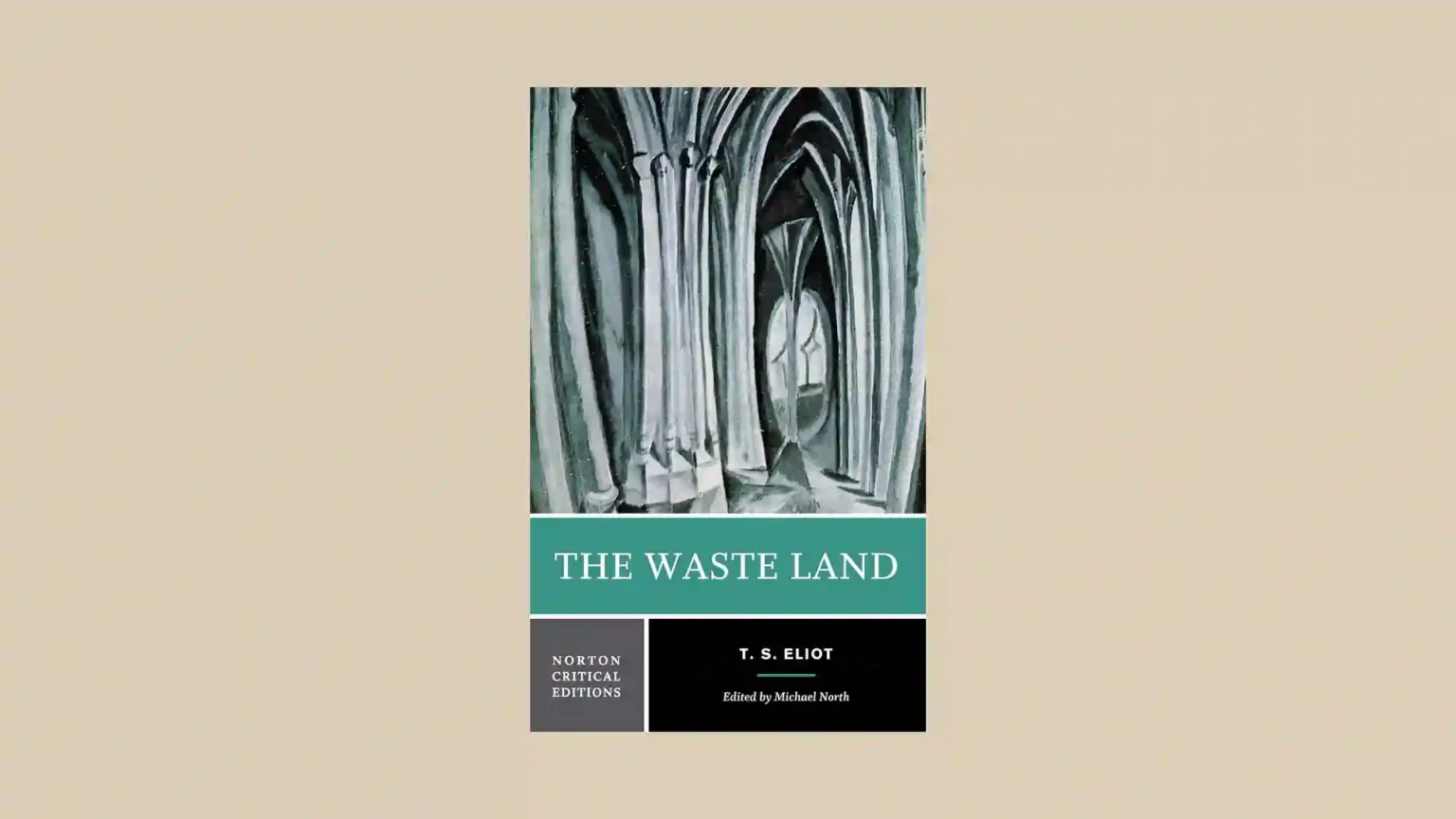
Cover artwork: credits and source records
- The Waste Land — W. W. Norton (source record)