A Dante translation, bilingual edition, or audiobook solves different problems of verse, comprehension, and sustained reading.
For a first serious reading of Dante’s Divine Comedy, choose an annotated modern translation as your main text, keep the Italian visible through a facing-page edition or the Princeton Dante Project when you want to inspect a line, and use audio as a companion rather than as your only format. That answer is less glamorous than declaring one format “best,” but it matches what the poem actually asks readers to do: move forward for hundreds of cantos while repeatedly stopping to check names, theology, politics, syntax, and echoes across distant passages.
If you want one volume and one language
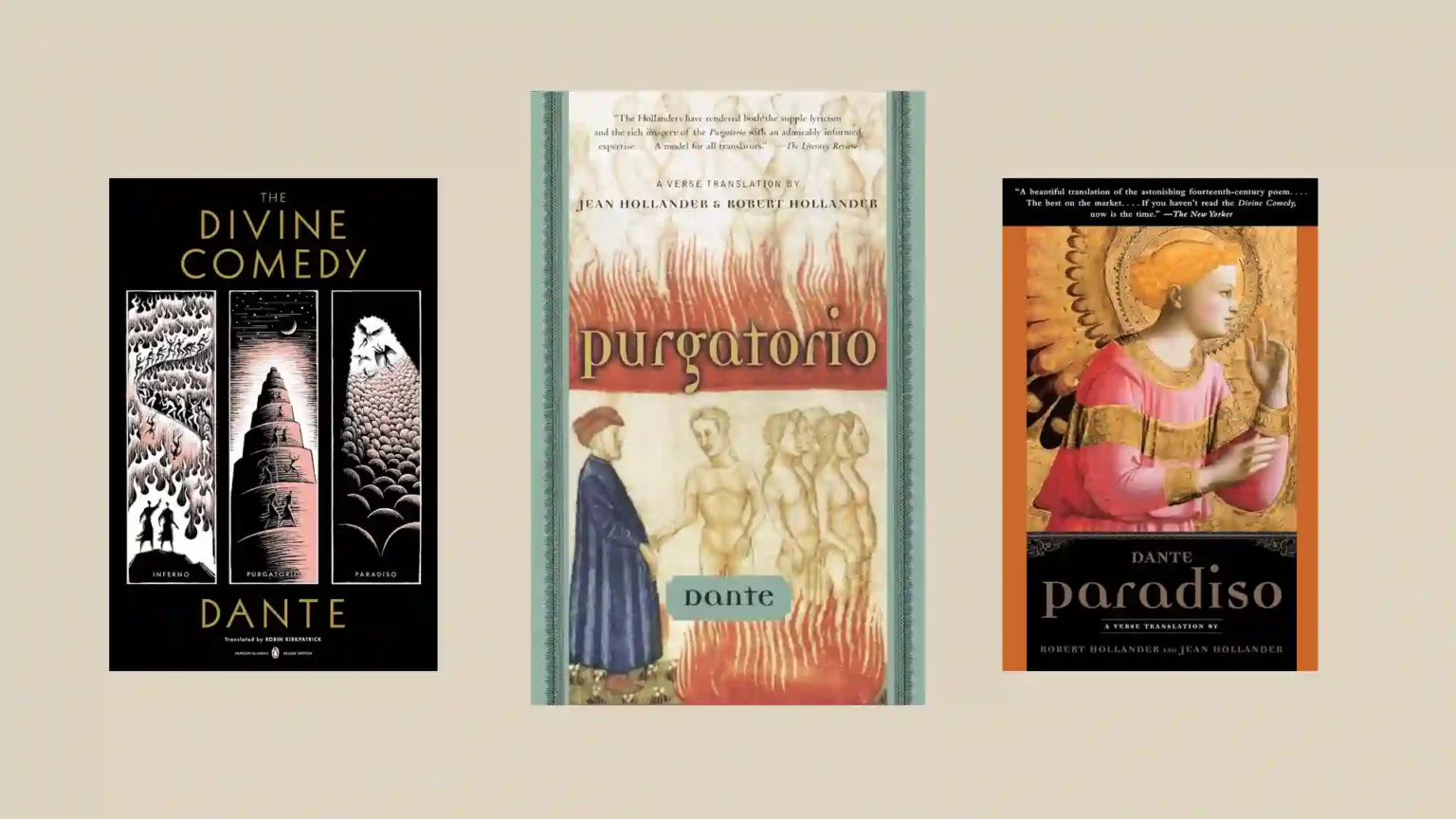
An English-only annotated edition minimizes friction. Robin Kirkpatrick’s one-volume Penguin Classics Divine Comedy is a practical example: it contains all three canticles, an introduction, notes, and a modern blank-verse translation in a single portable volume. For a reader who knows no Italian and mainly wants to finish the poem without juggling books, that coherence matters.
The limitation is not that translation “betrays” Dante. Every edition makes choices. The limitation is diagnostic: when an English line seems especially smooth, strange, theological, or comic, you cannot see whether the pressure comes from Dante or the translator unless you can inspect the Italian. An English-only text is therefore excellent for continuity but incomplete as a tool for translation-sensitive rereading.
If you want the Italian beside the English
A bilingual edition changes the reading task. Robert and Jean Hollander’s Anchor editions print the Italian opposite the English; the publisher description of Purgatorio explicitly identifies the facing-page format and extensive commentary. The same translation underlies the Princeton Dante Project, which pairs the Hollanders’ English with Giorgio Petrocchi’s Italian text and lets readers move canto by canto.
You do not need fluent Italian to benefit. Even a beginner can notice repeated words, proper names, rhyme endings, sentence boundaries, and the compression that an English translation has had to unpack. But bilingual reading becomes counterproductive if you stop at every line. The goal is not to certify the translator; it is to make selected moments inspectable.
A practical bilingual rule
Read a canto in English first. Mark only the lines that generate a real question. Then compare those passages with the facing Italian or the Princeton text. This preserves narrative movement while turning bilingual access into an instrument rather than a ritual. If you begin by checking every tercet, the Commedia can become a language exercise before it becomes a poem.
If audio is the format that gets you through the poem
Audio is not a lesser medium. Dante’s poem is built from voices, encounters, argument, address, and recurring sound. A good recording restores performance pressure that silent readers can flatten. Penguin’s current UK listing for The Divine Comedy offers Robin Kirkpatrick’s translation as an audio download with named readers, making it possible to keep print and audio on the same textual basis. That textual matching is more important than choosing a famous narrator whose recording uses a different translation.
The weakness of audio is retrieval. When a Florentine politician appears after forty minutes of listening, or when a theological distinction depends on one noun, rewinding is slower than glancing up a page. Notes, maps, canto headings, and cross-references also disappear unless the audio platform supplies a companion file. For close study, audio works best beside a searchable ebook or annotated print copy.
Three reader profiles
1. First-time general reader: use a one-volume annotated English translation, with the Princeton Dante Project open only when a passage puzzles you.
2. Student or discussion-group reader: use a bilingual Hollander-style edition or another edition with stable canto numbering and serious notes. Add audio for rereading difficult cantos after you have seen the page.
3. Accessibility-first or commute-heavy reader: make an unabridged audiobook the primary format, but pair it with a searchable digital text so names, quotations, and canto locations remain recoverable.
What about rhyme?
Format and translation strategy are different decisions. A rhyming English Dante may foreground formal momentum; a blank-verse or looser version may preserve syntax and semantic detail differently. Do not infer from “bilingual” that a translation is more literal, or from “audiobook” that it is more performative. The same English translation can move across print, ebook, and audio, while two print editions can represent radically different theories of translation.
This is why the first purchase should be based on your reading behavior. If you annotate, compare, and return to earlier passages, print has a strong advantage. If you search names and motifs constantly, ebook helps. If continuity is your main barrier, audio may be the difference between an abandoned Inferno and a completed Paradiso.
The minimum context before choosing a format
BookInLight’s reader’s route into the Divine Comedy makes a complementary point: beginners do not need to finish a shelf of medieval theology before Canto I. The same economy applies to format. Do not spend weeks optimizing an edition. Choose a traceable modern translation with notes, learn how to check the Italian when needed, and begin.
A simple decision table
| Main need | Best primary format | Why | Add this companion |
|---|---|---|---|
| Momentum and completion | Annotated English print | Low friction; easy backtracking | Audio in the same translation |
| Translation-sensitive reading | Bilingual print | Italian and English stay aligned | Princeton Dante Project |
| Accessibility / long commutes | Unabridged audiobook | Sustains continuity and voice | Searchable ebook or print notes |
| Seminar citation | Stable print/ebook edition | Reliable canto and line reference | Bilingual or digital Italian text |
If you are still undecided, choose annotated print plus free digital Italian access. That combination is the least likely to trap you in one medium’s weakness. Audio can then become a second pass rather than a substitute for everything the page makes visible.
Keep the textual basis stable when you mix formats
Readers often create accidental confusion by buying a print translation, streaming an audiobook based on another translation, and consulting notes keyed to a third. Dante’s canto numbering remains stable enough to survive that mixture, but lineation, phrasing, names, and explanatory choices can diverge sharply. If you plan to alternate print and audio, choose editions that identify the same translator. Penguin’s audio availability for Kirkpatrick is valuable mainly because it permits that continuity.
The same principle applies across the three canticles. Some readers buy Inferno in one edition, then switch translations for Purgatorio because the second volume is easier to find. That is legitimate if you are intentionally comparing translators; it is less useful if you are trying to hear recurrent language across the whole Comedy. For a first complete reading, continuity of translator and notes usually matters more than marginal gains from choosing a different “best” version for each canticle. A stable library record also matters when buying volumes separately: the WorldCat record for Hollander’s Paradiso makes translator and edition identity recoverable when retailer listings are inconsistent.
Why Purgatorio and Paradiso change the format calculation
Inferno can mislead readers into thinking narrative momentum is the whole problem. Purgatorio increases the importance of liturgy, moral vocabulary, and structural repetition; Paradiso increases the density of theology, cosmology, and abstract argument. As the poem rises, notes become more valuable and audio-alone becomes harder for many readers because conceptual distinctions pass quickly. A format that felt effortless in Inferno may need reinforcement later.
This is where bilingual or digital support earns its place. You do not need to become an Italianist in Canto XXIII. You need a way to pause on a word when the translation seems to carry a large conceptual burden. The Princeton Dante Project is unusually good for that because the Italian, the Hollander translation, and commentary are coordinated rather than scattered across unrelated sites.
A seven-day test before committing to a full set
Before buying three large bilingual volumes or a complete audio production, test one week of reading. Read Cantos I–V in your proposed main format. Listen to one of those cantos in the matching audio if available. Revisit a short passage in Italian on Princeton. Then ask three concrete questions: Did you actually use the notes? Did seeing the Italian clarify anything? Did audio improve attention or make retrieval harder? Your answers predict format fit better than a generic ranking.
If you never consult the facing page, a bilingual edition may be unnecessary weight. If you constantly search names and cross-references, ebook may outperform a beautiful hardcover. If you understand the poem much better when heard, audio deserves a larger role. A reader-decision article should make those tradeoffs explicit rather than treating one medium as culturally superior.
There is also a citation advantage to keeping a stable written text even if audio is primary. Discussion groups and courses will refer to canto and line, commentators will quote exact wording, and translation comparisons require recoverable sentences. A low-cost ebook can perform that reference function beside audio without requiring a second heavy print volume. The goal is redundancy where formats compensate for one another: ears for continuity, searchable text for retrieval, notes for context, and Italian access for moments when the English itself becomes the question.
Further reading
For one secondary book rather than another edition guide, Prue Shaw’s Reading Dante: From Here to Eternity is especially useful because it treats the Comedy as poetry while giving first-time readers historical and linguistic orientation. For a reference collection, the second edition of The Cambridge Companion to Dante provides separate essays on the three canticles, theology, politics, classical antecedents, commentary, and Dante in English. Neither should replace the poem; both work best after a canto has already created the question you want answered.
The next question is not “Which format is objectively best?” It is which translation strategy you want to hear when the formats are held constant. Compare one canto across two translators after you have read enough Dante to know what kinds of differences matter to you.
Cover artwork: credits and source records
- The Divine Comedy — Penguin Classics (source record)
- Purgatorio — Anchor (source record)
- Paradiso — Anchor (source record)