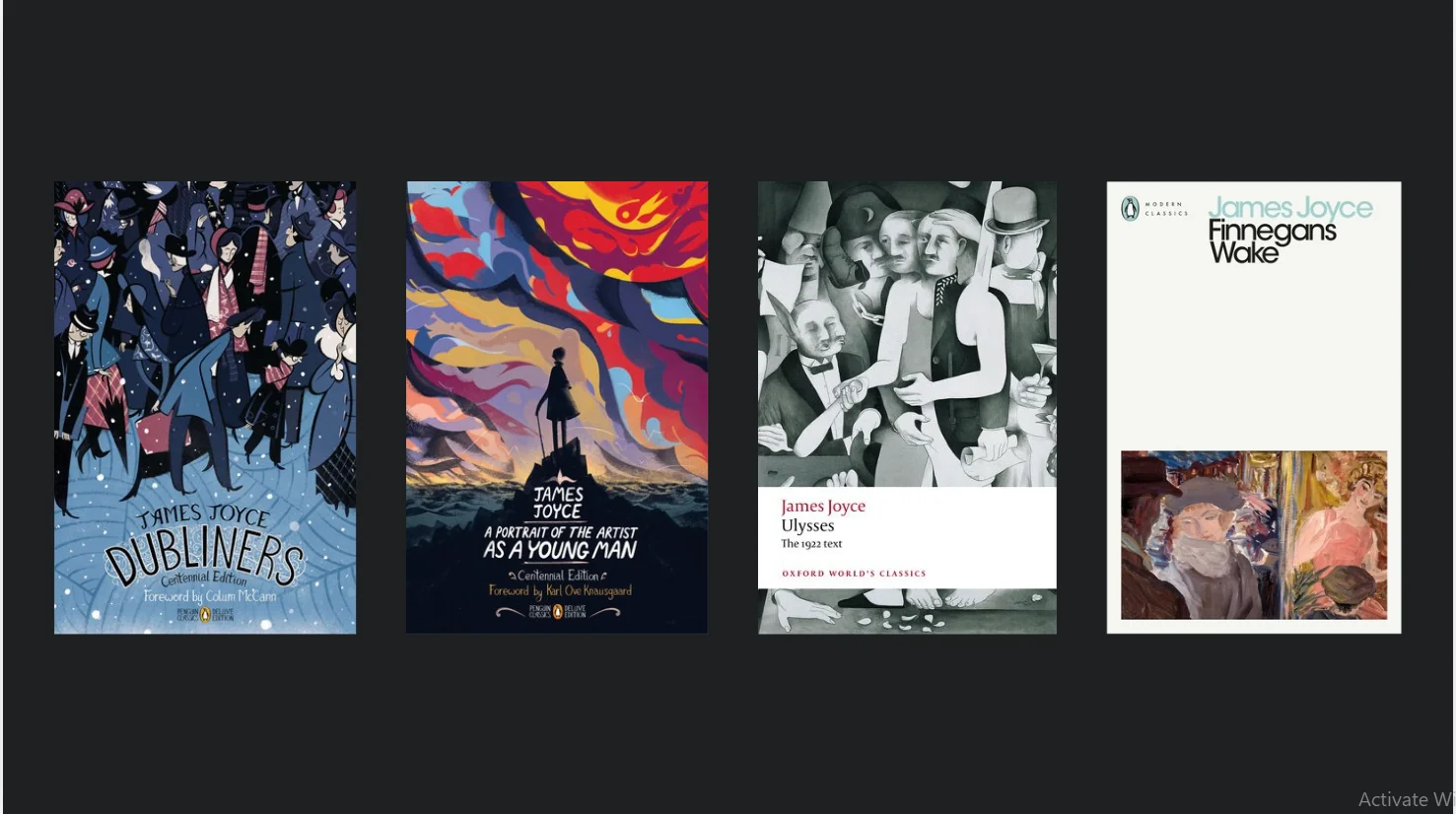
How to Start Reading James Joyce becomes much easier once you stop treating Ulysses as the entrance exam. Begin with Dubliners, move through A Portrait of the Artist as a Young Man, then take on Ulysses with a reader-oriented scholarly edition, and approach Finnegans Wake last. This four-book route lets Joyce’s increasing formal difficulty teach you how to read the next work.
Introduction
Joyce is difficult because the rules keep changing. Dubliners can look like exact social realism; Portrait lets language mature with Stephen Dedalus; Ulysses repeatedly changes narrative machinery; Finnegans Wake makes multilingual wordplay, dream logic, and sound the medium itself. The James Joyce Centre’s biographical overview is useful orientation, but biography is not a prerequisite syllabus.
This guide answers How to Start Reading James Joyce by asking what each book trains you to notice. Chronology helps because it roughly tracks a real escalation in formal experiment, not because publication order is sacred. The Modernist Journals Project archive of The Little Review documents the magazine that serialized much of Ulysses; that publication history matters more once the fiction has given you something to attach it to.
The shortest honest answer
If you are asking How to Start Reading James Joyce, start with Dubliners. Read the collection whole if you can, then A Portrait of the Artist as a Young Man, then Ulysses, and only afterward Finnegans Wake. You do not need to finish Homer, Irish history, Catholic theology, or a Joyce biography before beginning. Learn context when a book makes it necessary.
The order is simple because each stage solves a different beginner problem. Dubliners teaches Joyce’s ear and social world without requiring experimental decoding. Portrait shows consciousness and style changing together. Ulysses turns that flexibility into a method of eighteen distinct episodes. Finnegans Wake should be treated as an advanced practice of recurrent, partial, often aloud reading rather than as a final examination.
Before you start: how to approach James Joyce
The main beginner mistake is to confuse difficulty with required background. Joyce draws on theology, Irish politics, songs, newspapers, philosophy, advertising, Latin, and Dublin geography; no reader can front-load all of it. Prepare procedurally instead: notice who is speaking or thinking, when style changes, and when a reference genuinely blocks understanding.
For the early books, good notes are enough. Before Ulysses, know the broad shape of the Odyssey, Stephen’s earlier history, and the rough political and religious situation of Dublin in 1904. Do not turn Homeric correspondences into a code. Distinguish interior monologue from free indirect discourse, and avoid calling every formal shift “stream of consciousness.”
The James Joyce Digital Archive lets advanced readers inspect manuscripts and proofs after questions arise. That is the right direction: text first, apparatus second. How to Start Reading James Joyce is chiefly a matter of choosing a sequence in which Joyce’s earlier work prepares you for what follows.
The best first book on James Joyce
Start with: Dubliners
Dubliners is the right first book because it gives you Joyce’s durable subjects before his most intimidating procedures. Family obligation, money, clerical authority, respectability, disappointed ambition, nationalism, sex, drink, and work all enter the texture of speech. You learn to hear Joyce before being asked to decode extreme experiment.
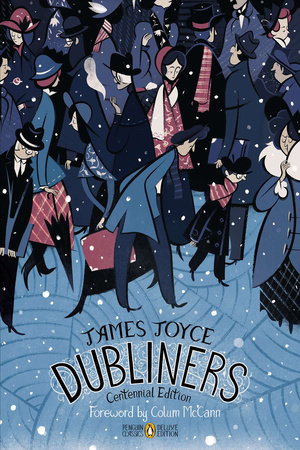
The 2014 Penguin Classics Deluxe Centennial Edition presents an authorized text collated from proofs, manuscripts, and impressions, with Terence Brown’s introduction and notes and a foreword by Colum McCann. After it, move directly to A Portrait of the Artist as a Young Man, where perception becomes a principle of form. For a compressed sample, read “Araby,” “A Little Cloud,” “Counterparts,” and “The Dead,” though the collection is stronger whole.
The core reading sequence
Book 1
Dubliners
Edition shown: Penguin Classics Deluxe Edition, Centennial Edition; foreword by Colum McCann; introduction and notes by Terence Brown; paperback, 2014; ISBN 9780143107453
Place in the sequence: The accessible first encounter with Joyce’s city, ear, ethics, and method of implication
Begin by resisting the temptation to read Dubliners as merely the conventional Joyce before the “real” experiments. Its apparent plainness is highly controlled. Joyce often withholds the explanatory sentence a beginner expects: motive appears through gesture, repeated phrase, social embarrassment, a change of register, or the gap between what a character says and what the story lets us infer. This is foundational training for everything later. The famous concept of “epiphany” can help if it means a sudden intensification of significance, but it becomes misleading if you expect each story to end in a neat revelation. Often recognition is partial, belated, compromised, or available more clearly to the reader than to the character.
Read the stories in order. The movement from childhood through adolescence and public life toward “The Dead” gives the collection a social and emotional scale that selected-story reading loses. Pay particular attention to speech: euphemism, cliché, bargaining, clerical diction, nationalist rhetoric, sentimental song, and the verbal evasions by which people protect themselves. Joyce’s Dublin is not a backdrop waiting for Ulysses to make it important. It is already an exact network of jobs, houses, institutions, debts, ambitions, loyalties, and humiliations. That density is why later recurring names and places feel like a city rather than an allusion system.
The Penguin Centennial Edition is a sensible beginner choice because the editorial apparatus is serious without dominating the page, and because its textual basis is stated rather than hidden. Use notes after a story or when a reference genuinely obstructs meaning; stopping for every detail will flatten the rhythm. The collection’s limitation as preparation is obvious: it does not teach the severe stylistic transformations of later Joyce. That is precisely why it belongs first. Once you can hear implication in these restrained surfaces, Portrait‘s shifting consciousness feels like development rather than an abrupt demand for specialist technique. In a guide to How to Start Reading James Joyce, Dubliners earns first place not because it is simply “easy,” but because it establishes the human and linguistic world against which later experiment acquires force.
Difficulty: Beginner
“The stories contain some of the most beautiful sentences ever written in English.”
— Colum McCann • Penguin Random House
Book 2
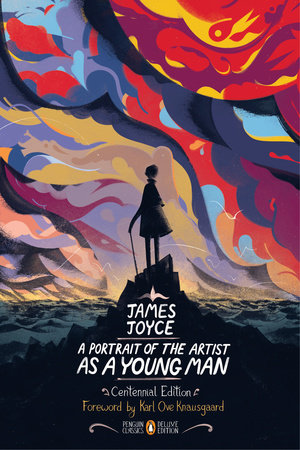
A Portrait of the Artist as a Young Man
Edition shown: Penguin Classics Deluxe Edition, Centennial Edition; foreword by Karl Ove Knausgaard; notes by Seamus Deane; paperback, 2016; ISBN 9780143108245
Place in the sequence: The bridge from social realism to a prose style shaped by developing consciousness
If Dubliners teaches you to notice what a narrative withholds, Portrait teaches you to notice how narrative language itself changes with a mind. The opening does not describe childhood from a stable adult distance; its rhythms, repetitions, sensory associations, and fragments inhabit a child’s cognitive world. As Stephen ages, the prose acquires new vocabularies—school, religion, sexuality, aesthetics, nationalism—and each vocabulary offers both a way of understanding experience and a trap. This is the key preparation for Ulysses: style is no longer a neutral container for content. It becomes evidence about what a consciousness can perceive, desire, rationalize, or exclude.
Read the whole novel, but do not treat Stephen’s increasingly articulate theories as Joyce’s final doctrine. His famous ambition to escape nets of nationality, language, and religion is moving, intelligent, theatrical, and self-mythologizing at once. That ambiguity matters because Ulysses returns Stephen to Dublin after the imagined triumph of departure. The later novel tests what the youthful pose of artistic autonomy cannot solve: grief, money, friendship, bodily life, dependency, and relation to other people. A reader who skips Portrait can follow Ulysses, but will hear less irony in Stephen’s brilliance and feel less of the damage behind his defenses.
The 2016 Penguin Centennial Edition provides a declared authorized text and helpful notes, while Karl Ove Knausgaard’s foreword gives a contemporary novelist’s account of the book’s persistence. If spoilers or interpretive framing bother you, read the foreword after the novel; the notes can remain beside you. The most demanding passages are the long sermon on hell and Stephen’s aesthetic theorizing. Neither requires prior theology or Aquinas. Read them first for what they do to Stephen—the production of terror, system, and self-definition—then return to their intellectual sources if they fascinate you. By the end, you should be comfortable asking not only “what does Stephen think?” but “what kind of prose makes this thought possible?” That question is the passport into Ulysses.
Difficulty: Moderate
“One believes in Stephen Dedalus as one believes in few characters in fiction.”
— H. G. Wells • Penguin Random House

Book 3
Ulysses
Edition shown: Oxford World’s Classics, second edition; edited with an introduction and notes by Jeri Johnson; paperback, 2022; ISBN 9780192855107
Place in the sequence: The major work in which changing narrative form becomes the subject of reading
By the time you reach Ulysses, you should know Stephen, trust Joyce’s ear for Dublin speech, and expect style to carry psychological evidence. That is enough. The novel takes place on 16 June 1904 and gradually shifts its center from Stephen to Leopold Bloom, but the deeper challenge is episodic reinvention. “Aeolus” behaves like a newspaper invaded by headlines; “Sirens” makes prose answer to musical procedures; “Oxen of the Sun” parodies historical prose styles; “Circe” becomes a hallucinatory drama; “Ithaca” turns domestic return into an impersonal catechism; “Penelope” releases a long, minimally punctuated interior flow. Do not ask one reading technique to master all eighteen episodes.
Use the Oxford World’s Classics second edition shown here because Jeri Johnson’s revised introduction, explanatory notes, appendices, map, chronology, and account of composition and publication give a first reader substantial help while returning to the 1922 text. That choice does not end the textual debate. Ulysses exists in a complicated history of proofs, editions, corrections, and editorial interventions, and advanced readers may later compare the 1922 printing with Hans Walter Gabler’s critical text and other editorial approaches. For a first reading, transparency matters more than pretending the controversy has vanished. The Rosenbach’s Joyce manuscript collection is an excellent destination once textual questions become interesting rather than intimidating.
Read the novel completely, but change the timing of your help. First read an episode for action, voice, and dominant formal pressure; then consult notes or a guide. If you annotate every name before the sentence has moved, you will turn comedy into inventory. A synopsis of the Odyssey is useful, especially the Telemachus, Cyclops, Sirens, and homecoming structures, but Joyce’s correspondences are transformations rather than a cipher. The ethical center of the book is ordinary life: eating, walking, mourning, prejudice, desire, work, embarrassment, memory, hospitality. Keep those bodies and relations in view. The reward for the first two books is that the density now feels like expansion of a known world, not random difficulty.
Difficulty: Demanding
“It is a book to which we are all indebted, and from which none of us can escape”
— T. S. Eliot • Penguin Books

Book 4
Finnegans Wake
Edition shown: Penguin Modern Classics / Penguin Classics; introduction by Brian Fox; edited by Andrew Gibson; paperback, 2026; ISBN 9780241405925
Place in the sequence: The advanced culmination, where sound, multilingual pun, dream, and recurrence displace ordinary narrative security
Do not begin Finnegans Wake with the goal of proving that you can finish it. Begin by changing what counts as reading. The book’s words continually carry several languages, names, sounds, etymologies, historical echoes, and private transformations at once. Syntax may suggest a scene without stabilizing it; identities merge; apparent narrative events recur in altered forms; the book’s ending folds into its beginning. A first encounter therefore benefits from voice. Read passages aloud, listen for rhyme and buried familiar phrases, and allow partial recognition to accumulate. The demand is real, but so is the comedy. Treating every portmanteau as a code to be solved once is one of the fastest ways to miss both.
This is why the book belongs after Ulysses. Earlier Joyce trains you to accept shifting focalization and style while preserving an ordinary day, recognizable streets, and relatively stable characters. Finnegans Wake removes much of that stability. What remains familiar is Joyce’s conviction that language is social memory: songs, jokes, theology, politics, gossip, myth, family conflict, and literary history are not references added to a story but materials from which verbal events are made. Having already learned not to stop for every allusion in Ulysses, you are better prepared to let opacity coexist with rhythm and local intelligibility.
The 2026 Penguin Modern Classics paperback is a practical current reading edition, edited by Andrew Gibson with a new introduction by Brian Fox. Read the introduction strategically—either before beginning for orientation or after the opening pages if you want the strangeness first. On a first pass, complete reading is optional. A defensible route is to read the opening, several sustained passages, the Anna Livia Plurabelle material, and the final pages, then return with commentary or a reading group. Finnegans Wake has always generated collaborative reading because no individual competence exhausts its linguistic field. That is not an excuse to surrender judgment; it is a clue to the kind of attention the book rewards. Advanced readers can then use manuscripts and genetic scholarship to watch the text becoming itself through revision.
Difficulty: Advanced
“A great comic vision, one of the few books of the world that can make us laugh aloud on nearly every page”
— Anthony Burgess • Penguin Books
How these books fit together
The sequence is a ladder of altered reading contracts. Dubliners asks you to infer from social detail; Portrait lets language develop with consciousness; Ulysses makes each episode a new formal problem; Finnegans Wake carries experiment into dream, recurrence, multilingual pun, and unstable identity. Each book supplies a habit the next one complicates.
Publication sequence is also a strong beginner sequence here for pedagogical reasons: Joyce expands formal possibilities while retaining continuities of place, figures, language, and memory. The James Joyce Centre timeline supplies composition and publication dates. Poetry, Exiles, Stephen Hero, letters, notebooks, and specialist criticism can enter later according to interest.
Common beginner mistakes
Starting with Ulysses because it is the famous one
You can do it, but you give up useful continuity. Dubliners and Portrait make Dublin, Stephen, and Joyce’s changing relation to narrative voice familiar before the major experiment begins.
Treating annotations as the real book
A note is useful when a reference blocks action, tone, or an important joke. Constantly leaving the sentence to identify every name destroys timing. On a first reading, finish a paragraph or episode before asking scholarship to settle what you have just experienced.
Calling every experiment “stream of consciousness”
Joyce uses interior monologue, free indirect discourse, parody, dramatic form, catechism, lists, headlines, musical patterning, and much else. Naming the local mechanism is more useful than attaching one famous label to every difficult page.
Making Finnegans Wake an endurance test
The book rewards rereading, reading aloud, collective interpretation, and selective return. Completion is not the only legitimate first encounter. A reader who hears ten pages closely may learn more than one who races through seven hundred in defensive incomprehension.
Optional paths depending on your interest
If you are interested in Dublin as a social world, prioritize Dubliners. Then move to Ulysses with attention to recurring institutions, occupations, streets, speech habits, and the ethical weight Joyce gives ordinary urban encounters.
If you are interested in artistic formation, religion, and education, prioritize A Portrait of the Artist as a Young Man. Read Stephen’s theories as part of a dramatic self-fashioning rather than as a handbook of Joyce’s settled beliefs.
If you are interested in modernist form, prioritize Ulysses. Keep a brief episode log: what literally happened, whose language dominated, and what formal rule changed. That record will make rereading much more productive.
For a more advanced path, continue with Finnegans Wake. Read aloud, work in short stretches, and bring genetic or linguistic scholarship in only after you have formed local hypotheses of your own.
FAQ
Is Dubliners really representative enough to begin with?
Yes. It does not display the full formal extremity of later Joyce, but it establishes his Dublin, his sensitivity to speech, his methods of implication, and his interest in how institutions shape private life. For anyone deciding How to Start Reading James Joyce, that foundation is more useful than beginning with maximal difficulty.
Which Ulysses edition is best for a first reading?
The 2022 Oxford World’s Classics second edition edited by Jeri Johnson is a strong first-reading choice because it identifies its 1922 textual basis and supplies revised notes, appendices, map, chronology, and publication history. No edition makes the textual history uncontested; transparency and usable apparatus are the priorities.
Do I need to read Homer’s Odyssey before Ulysses?
No. Know the homecoming structure, Odysseus, Telemachus, Penelope, and the major episodes. A good synopsis is enough for a first pass. Read Homer in full because you want Homer, not because Joyce has imposed an entrance requirement.
Should I finish Finnegans Wake on my first attempt?
Not necessarily. A serious first encounter can be selective and recurrent. Read enough to experience its sound, punning, dream logic, and circular structure, then return with commentary, a reading group, or manuscript resources. The book is built for rereading rather than one-pass mastery.
Related BookInLight Reading Guides
What to Read Before Ulysses? — A focused dependency map for Homer, Stephen Dedalus, Dublin in 1904, annotations, and the minimum background worth learning before the novel.
Oxford World’s Classics: A Complete Guide to the Series — Useful for understanding why scholarly introductions, notes, textual principles, and bibliographies matter when choosing a reading edition.
Penguin Classics: A Complete Guide to the Series — A broader edition-selection guide relevant to the Penguin Joyce volumes used for three stages of this reading path.
This article was researched and written by the BookInLight Department of Literature and Comparative Humanities, with bibliographical review, source verification, quotation verification, link verification, and editorial fact-checking. We welcome factual corrections, overlooked sources, edition suggestions, interpretive observations, and constructive ideas that can improve the guide.
Editorial art direction, visual composition, cover selection, and image presentation were prepared by the BookInLight Art Department. Rights in third-party book covers remain with their publishers, artists, designers, and other rights holders. Complete republication, reproduction, translation, or reuse of this article requires prior written authorization from BookInLight.
Sources and Further Reading
Primary Texts and Editions
James Joyce, Dubliners, Penguin Classics Deluxe Centennial Edition, 2014. Supports edition, textual-basis, contributor, ISBN, and publication details.
James Joyce, A Portrait of the Artist as a Young Man, Penguin Classics Deluxe Centennial Edition, 2016. Supports edition, textual-basis, contributor, ISBN, and publication details.
James Joyce, ed. Jeri Johnson, Ulysses, Oxford World’s Classics, second edition, 2022. Supports the 1922-text basis, revised apparatus, ISBN, and edition recommendation.
James Joyce, ed. Andrew Gibson, intro. Brian Fox, Finnegans Wake, Penguin Modern Classics, 2026. Supports contributor, format, ISBN, and publication details.
James Joyce, ed. Andrew Gibson, Ulysses, Penguin Classics, 2026. Consulted for current 1922-text framing and the verified T. S. Eliot quotation.
Archives, Bibliography, and Context
James Joyce Centre, “James Joyce”. Biographical orientation and the relation of Joyce’s fiction to Dublin.
James Joyce Centre, “Timeline”. Supports chronology and publication context.
Modernist Journals Project, The Little Review. Supports the serial-publication context of Ulysses.
The Rosenbach, “James Joyce’s Ulysses”. Supports manuscript and compositional-history discussion.
James Joyce Digital Archive. Consulted for manuscript, proof, and genetic-document context.
National Library of Ireland catalogue record for Ulysses, 2022. Independent bibliographical verification of editor, publisher, format, date, and ISBN.
Exeter College, University of Oxford, “Jeri Johnson”. Supports Johnson’s Joyce editorial work and research specialization in modernism and textual theory.
Reading Strategy and Critical Orientation
BookInLight, “What to Read Before Ulysses?” Supports the selective-preparation principle, use of the 2022 Oxford edition, and distinction between prerequisite and companion reading.
Penguin, “Where to start reading James Joyce”. Consulted as a current publisher-facing account of entry points across Joyce’s oeuvre.
Philip Kitcher, ed., Joyce’s Ulysses: Philosophical Perspectives, Oxford University Press, 2020. Consulted for the novel’s interpretive and philosophical density after first-reading orientation.
Image Credits
Dubliners — Penguin Classics Deluxe Centennial Edition paperback, 2014; cover art by Roman Muradov; image served by Penguin Random House. Authoritative edition page.
A Portrait of the Artist as a Young Man — Penguin Classics Deluxe Centennial Edition paperback, 2016; cover art by Roman Muradov; image served by Penguin Random House. Authoritative edition page.
Ulysses — Oxford World’s Classics second edition paperback, 2022; image served by Oxford University Press. University Press edition page.
Finnegans Wake — Penguin Modern Classics / Penguin Classics paperback, 2026; image served by Penguin Books. Authoritative edition page.