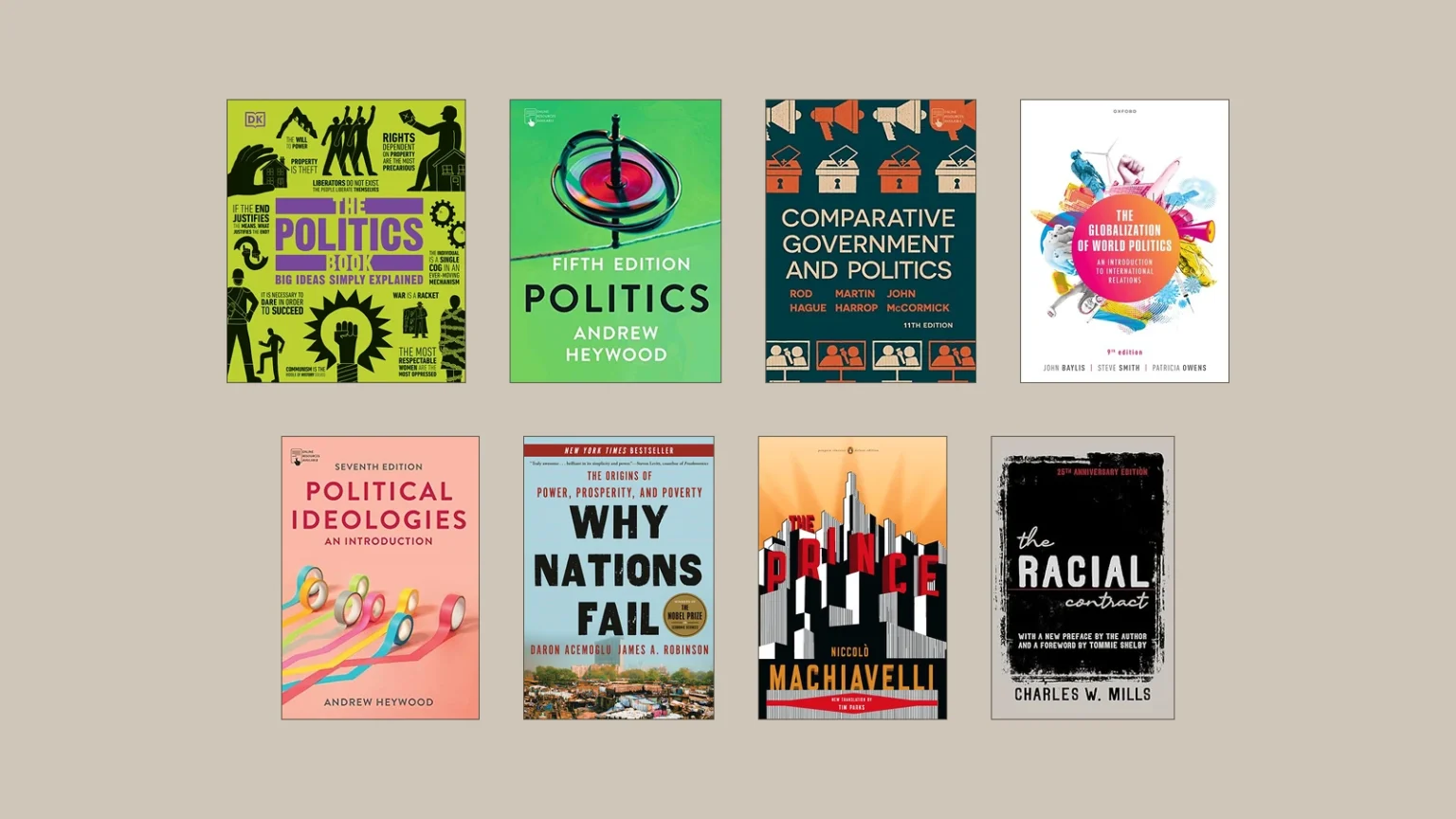
The best political science books for beginners should do more than name famous classics. These 20 curated books lead from a first visual orientation to comparative politics, international relations, research methods, institutions, political behavior, and demanding primary theory. Each entry identifies a useful edition, with exact Amazon and publisher links, so beginners can decide what to read first while advanced readers can build a serious route through the discipline.
Affiliate note: Book in Light may earn a small commission if you buy through some of the links on this page, at no extra cost to you. We include books only when they serve the editorial purpose of the reading guide.
Quick Answer
Start with DK’s The Politics Book for orientation, then read Andrew Heywood’s Politics for the broadest beginner overview. Add Hague and Harrop for comparison, Baylis, Smith, and Owens for international relations, and Kellstedt and Whitten for research methods. The deeper route moves from Plato through Hobbes, Rousseau, Mill, Arendt, Mills, and Fanon rather than reading all 20 mechanically.
How to Use This Reading List
Not every reader needs all 20 books. The list is an intellectual pathway, not a ranking in which number one defeats number twenty. A complete beginner should first acquire a vocabulary of power, state, authority, representation, institutions, ideology, and evidence. That means beginning with the visual survey, Heywood’s general textbook, and one subfield introduction.
The best political science books for beginners also need to show how the discipline produces knowledge. That is why a methods book appears before the major classics. Readers can then recognize the difference between a causal claim, a normative argument, a historical interpretation, and a conceptual reconstruction. The Gonzaga guide to reading political science is a useful companion for identifying questions, arguments, evidence, and implications.
Use the Reading Map to compare difficulty and purpose. Follow a route that matches your question: institutions and development; democracy and political behavior; international relations; public policy and collective action; or political theory. Advanced readers can move toward Hobbes and Arendt, but beginners will understand them better after learning the discipline’s ordinary categories and methods.
The 20 best political science books for beginners
The sequence moves from orientation to disciplinary structure, empirical explanation, and primary political thought. It includes expected classics, but it does not confuse political science with political philosophy alone.
Book 1 of 20 · BEGINNER
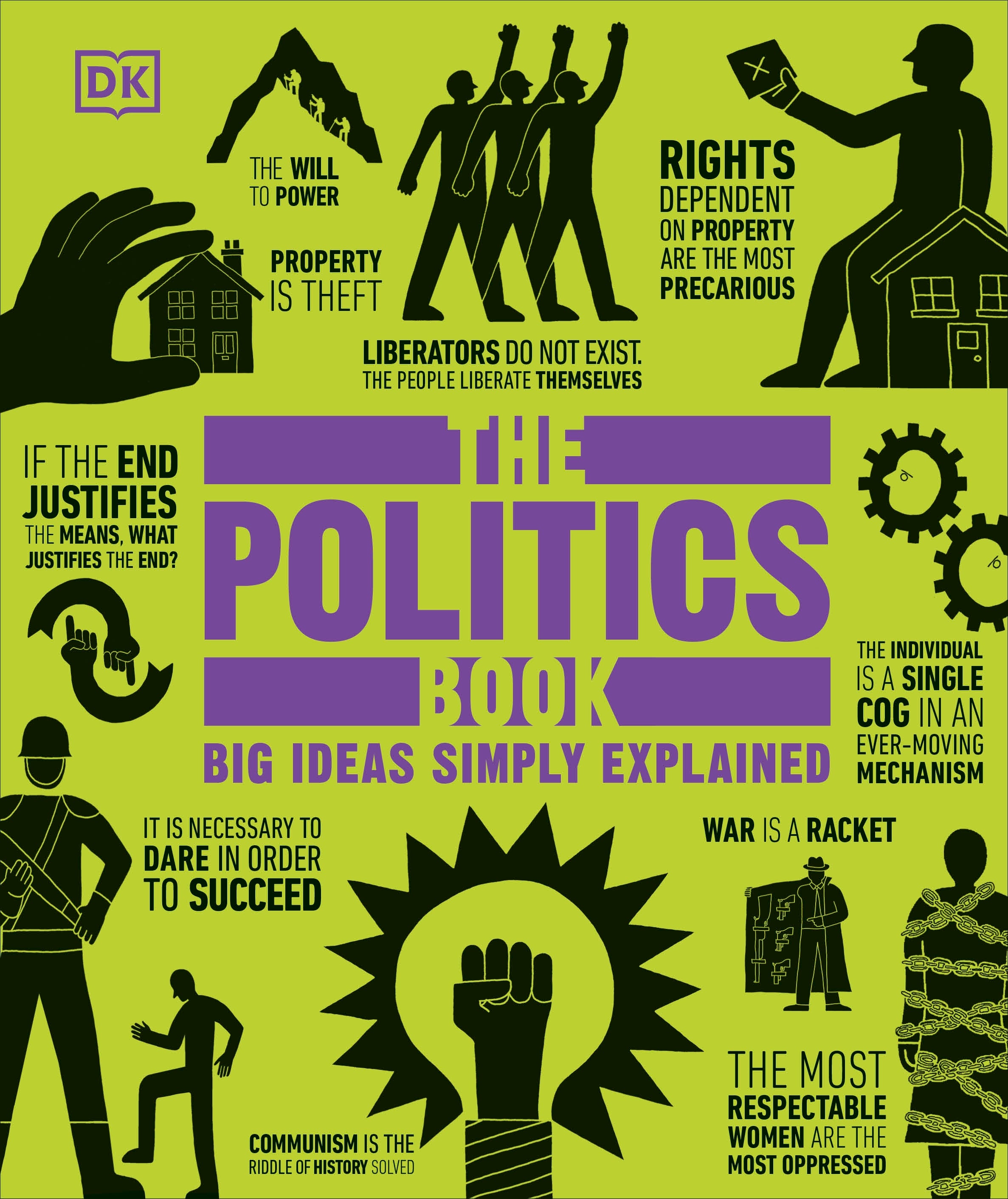
1. The Politics Book by DK
Publisher: DK | First published: 2013 | Edition shown: 2024 US hardcover; ISBN 9780593844120
Beginner
This is the least intimidating doorway into the subject. Organized around major ideas, thinkers, movements, and institutions, it turns political history into a sequence of compact visual explanations. Its strength is orientation, not depth: the reader sees how sovereignty, representation, revolution, liberalism, socialism, feminism, nationalism, and decolonization fit into a long argument about power. That makes it especially useful before Heywood’s broader textbook or the primary classics later in this list. The format inevitably compresses disputes and can make contested concepts look more settled than they are, so it should not become a substitute for sustained argument. Read it with a pencil, marking unfamiliar terms and thinkers for later investigation. A complete beginner can move through it nonlinearly, while a student can use it as a quick reference. It belongs first because it reduces the initial burden of names and concepts without pretending that political science is simple.
Best for: visual learners and readers who want a low-friction survey before opening a textbook
Why read it: It supplies the vocabulary and historical coordinates that make every later book on this list easier to place.

Book 2 of 20 · BEGINNER
2. Politics by Andrew Heywood
Publisher: Bloomsbury Academic / Red Globe Press | First published: 1997 | Edition shown: 5th edition, 2019 paperback; ISBN 9781352005455
Beginner
If only one broad textbook can be read, this is the most defensible choice. Heywood explains what politics is, how power and authority operate, how states and governments are organized, and how participation, parties, constitutions, and global forces shape outcomes. Unlike a classic-only list, it introduces the actual architecture of political science: concepts, institutions, processes, and competing approaches. The prose is deliberately instructional, with definitions and comparisons that help a novice distinguish terms often used loosely in public debate. Its breadth is also its limitation. No chapter can settle disputes that occupy whole subfields, and readers should resist treating textbook categories as neutral containers. Still, it provides the disciplinary map needed to understand where comparative politics, political theory, public policy, and international relations meet and diverge. Read it early and selectively: begin with power, the state, democracy, and representation, then return to relevant chapters as later books raise more demanding questions.
Best for: readers seeking the strongest single-volume introduction to the discipline
Why read it: Heywood connects concepts, institutions, ideologies, and global developments in a structure close to an introductory university course.

Book 3 of 20 · BEGINNER
3. Comparative Government and Politics by Rod Hague and Martin Harrop
Publisher: Red Globe Press | First published: 1982 | Edition shown: 11th edition, 2019 paperback; ISBN 9781352005059
Beginner
Political science becomes a discipline when the reader stops treating one country’s institutions as the natural model for all politics. Hague and Harrop provide that corrective. The book compares states, constitutions, executives, legislatures, elections, parties, political culture, and public policy across regime types and regions. Its value lies less in memorizing country facts than in learning how comparison works: selecting cases, identifying institutional variation, and asking why similar pressures generate different results. It therefore follows naturally after Heywood’s general survey. Beginners will find the chapter structure clear, though the density of examples requires slower reading than the opening books. Use it alongside current country data rather than as a catalogue to be mastered cover to cover. The displayed eleventh edition is not the newest edition, but it remains a coherent, widely used introduction with a verified matching edition record. Readers primarily interested in domestic news should read it precisely because it unsettles domestic assumptions and builds a genuinely comparative vocabulary.
Best for: readers who want to compare regimes, institutions, and political systems across countries
Why read it: It teaches the comparative habit: asking why similar institutions produce different outcomes in different settings.

Book 4 of 20 · GENERAL
4. The Globalization of World Politics by John Baylis, Steve Smith, and Patricia Owens, editors
Publisher: Oxford University Press | First published: 1997 | Edition shown: 9th edition, 2023 paperback; ISBN 9780192898142
General
International relations is often introduced as a procession of wars, treaties, and powerful states. This volume is better because it joins history to theory and contemporary problems. Its chapters explain realism, liberalism, constructivism, Marxist approaches, postcolonial analysis, gender, security, international political economy, human rights, and global governance. Multiple contributors mean the prose and emphasis vary, but that plurality accurately reflects a field without one settled framework. Read the historical overview first, then the theory chapters, and only afterward the issue-based chapters that match your interests. The book is longer and more textbook-like than the first three entries, yet individual chapters are accessible to an attentive general reader. It also corrects a common beginner’s mistake: assuming that “world politics” is simply domestic politics conducted on a larger stage. The absence of a world government changes incentives, institutions, and claims to authority. Pair it with comparative politics to see why internal regimes and external systems must be studied together.
Best for: beginners who need a substantial introduction to international relations
Why read it: It presents international relations as a field of rival theories and global problems, not merely diplomatic chronology.

Book 5 of 20 · BEGINNER
5. Political Ideologies by Andrew Heywood
Publisher: Bloomsbury Academic | First published: 1992 | Edition shown: 7th edition, 2021 paperback; ISBN 9781352011838
Beginner
Political labels are frequently used as insults, identities, or shorthand. Heywood turns them back into objects of analysis. Each chapter traces an ideology’s core concepts, internal divisions, historical development, and contemporary mutations. Liberalism, conservatism, socialism, anarchism, nationalism, fascism, populism, feminism, green ideology, multiculturalism, and religious fundamentalism appear as contested traditions rather than single doctrines. This book differs from the general textbook because it asks how political beliefs organize perceptions of freedom, authority, equality, community, and change. It is accessible enough to read early, but it should be read critically: any taxonomy reflects editorial choices, and traditions often look different from inside their own debates. Use the comparative tables as starting points, then test them against primary texts such as Mill, Rousseau, and Fanon later in the list. For beginners, its chief benefit is conceptual hygiene. It prevents the common error of assuming that one party, country, or public figure exhausts the meaning of an ideology.
Best for: readers confused by labels such as liberal, conservative, socialist, populist, nationalist, or green
Why read it: It separates ideological families without pretending that each is internally uniform or historically fixed.

Book 6 of 20 · INTERMEDIATE
6. The Fundamentals of Political Science Research by Paul M. Kellstedt and Guy D. Whitten
Publisher: Cambridge University Press | First published: 2008 | Edition shown: 3rd edition, 2018 paperback; ISBN 9781316642672
Intermediate
A reading list that omits research methods mistakes political commentary for political science. Kellstedt and Whitten introduce theory building, causal inference, measurement, research design, probability, hypothesis testing, regression, and model specification. The mathematics becomes more demanding in later chapters, but the book’s real lesson is conceptual: evidence does not interpret itself, correlation is not causation, and every empirical claim depends on choices about cases, variables, and comparison. Beginners should not read it first. Read Heywood and one substantive subfield book, then use this volume to examine how their claims could be tested. The authors emphasize quantitative analysis, so this is not a complete methods curriculum; qualitative case studies, interviews, archival work, ethnography, and interpretive methods require further study. Even so, it gives newcomers a disciplined way to question confident assertions. A reader who completes the early chapters will be better equipped to evaluate polls, cross-national rankings, election studies, and causal claims in both scholarship and journalism.
Best for: students who want to understand evidence, causation, measurement, and quantitative research
Why read it: It explains how political scientists move from an interesting claim to a testable causal argument.

Book 7 of 20 · GENERAL
7. The Dictator’s Handbook by Bruce Bueno de Mesquita and Alastair Smith
Publisher: PublicAffairs | First published: 2011 | Edition shown: 2022 trade paperback; ISBN 9781541701366
General
This book begins from a deliberately unsentimental premise: leaders generally prioritize remaining in power. Bueno de Mesquita and Smith explain political behavior through the size of the group that can select a leader and the smaller coalition whose support keeps that leader in office. The framework illuminates patronage, corruption, taxation, public goods, foreign aid, war, and institutional reform. Its clarity makes it memorable, but clarity can harden into reductionism. Political actors also pursue beliefs, identities, institutional duties, and long-term projects that cannot always be translated into coalition maintenance. Read the book as a strong model, not a universal law. It belongs after introductory institutional material because readers can then compare its incentive-based account with richer historical and normative approaches. The great practical gain is learning to ask who must be satisfied, what resources leaders control, and why apparently wasteful policies may be politically rational. It is especially useful beside How Democracies Die, which focuses less on coalition arithmetic and more on the erosion of democratic restraints.
Best for: readers interested in leadership survival, coalitions, patronage, and authoritarian politics
Why read it: Its selectorate framework makes political survival incentives visible across dictatorships and democracies.
Book 8 of 20 · GENERAL
8. Why Nations Fail by Daron Acemoglu and James A. Robinson
Publisher: Currency | First published: 2012 | Edition shown: 2013 paperback; ISBN 9780307719225
General
Acemoglu and Robinson argue that long-run prosperity depends largely on whether political and economic institutions are inclusive or extractive. Their historical comparisons range widely, connecting distributions of power to incentives for investment, innovation, and participation. The book’s accessibility and argumentative confidence explain its popularity. Those same qualities require caution: the inclusive–extractive distinction can flatten complex histories, and geography, empire, war, state capacity, and international structures sometimes receive less explanatory weight than critics would prefer. That makes the book pedagogically valuable. A beginner can identify a clear thesis, follow the evidence, and then ask where cases strain the model. Read it after comparative politics and before Seeing Like a State. The first helps locate institutions comparatively; the second complicates any assumption that well-designed institutions can simply be imposed from above. This is not a neutral overview of development, but a forceful institutionalist intervention. Its best use is to train comparison and argument, not to supply a single formula for national success.
Best for: readers asking why some states become prosperous, stable, and innovative while others do not
Why read it: It makes institutions central to development while giving beginners a clear argument to test against rival explanations.

Book 9 of 20 · GENERAL
9. How Democracies Die by Steven Levitsky and Daniel Ziblatt
Publisher: Broadway Books | First published: 2018 | Edition shown: 2019 paperback; ISBN 9781524762940
General
Levitsky and Ziblatt shift attention from dramatic coups to gradual democratic erosion carried out by elected leaders. Drawing on comparative historical cases, they describe warning signs of authoritarian behavior and emphasize the informal norms of mutual toleration and institutional forbearance. The analysis is especially useful for beginners because it connects constitutional design to party strategy and elite choices. It also has limits. Its focus on gatekeeping and norms can understate deeper inequalities, social movements, media systems, and material conflicts that shape democratic resilience. Read it as a comparative framework rather than a complete theory of democracy. It pairs well with The Dictator’s Handbook: one highlights leaders’ survival incentives, while the other explains why democratic competitors sometimes refuse to exploit every legal advantage. The book belongs in the contemporary middle of the list, after basic institutional study but before the canonical theories of legitimacy and freedom. Its central lesson is exacting: democratic breakdown often occurs through ordinary institutions whose defenders normalize one violation at a time.
Best for: readers seeking a clear account of democratic erosion from within elected institutions
Why read it: It shows how constitutions depend on party behavior, mutual toleration, and restraint that formal rules cannot fully enforce.

Book 10 of 20 · GENERAL
10. The Righteous Mind by Jonathan Haidt
Publisher: Vintage | First published: 2012 | Edition shown: 2013 paperback; ISBN 9780307455772
General
Political behavior cannot be understood through institutions alone. Haidt argues that moral judgment is often intuitive first and justificatory second, and that people draw on several moral foundations with different emphases across ideological groups. The book helps explain coalition identity, partisan misunderstanding, and the failure of arguments that address only an opponent’s weakest moral language. Its studies and evolutionary claims have prompted substantial debate, and readers should not convert group-level patterns into fixed portraits of individuals or cultures. Nor does moral psychology replace analysis of interests, institutions, media, or inequality. Its proper role in this list is interdisciplinary: it adds a theory of moral perception to the study of ideology and political behavior. Read it after Heywood’s Political Ideologies so that psychological tendencies are not confused with ideological traditions. It is more accessible than a research monograph and more systematic than a book of campaign advice. The enduring question it raises is methodological as much as political: how can scholars study convictions that participants experience as self-evident truths?
Best for: readers interested in moral psychology, polarization, ideology, and political persuasion
Why read it: It explains why political disagreement persists even when each side believes it is reasoning from obvious moral facts.

Book 11 of 20 · INTERMEDIATE
11. Seeing Like a State by James C. Scott
Publisher: Yale University Press | First published: 1998 | Edition shown: 1999 paperback; ISBN 9780300078152
Intermediate
Scott examines why ambitious schemes to reorganize societies so often produce destructive results. States simplify forests, cities, names, land, labor, and populations into categories that can be counted and governed. These acts of legibility are necessary for administration, yet they can erase local knowledge and invite high-modernist projects that ignore practical complexity. The argument is richer than a simple warning against government. Scott is interested in the combination of administrative simplification, ideological confidence, authoritarian power, and a weakened civil society. The book’s historical cases reward careful reading, and some generalizations have been challenged, but its conceptual vocabulary has become central to discussions of planning and policy. Read it after Why Nations Fail: Acemoglu and Robinson emphasize institutional incentives, while Scott asks what governing institutions can actually know. It also prepares the reader for Ostrom, whose work shows how local communities may develop durable rules without conforming to either centralized command or privatization. Beginners should postpone it until they possess a basic map of institutions and public policy.
Best for: readers studying state capacity, planning, bureaucracy, development, and policy failure
Why read it: Scott reveals the political cost of making complex societies administratively legible.

Book 12 of 20 · INTERMEDIATE
12. Governing the Commons by Elinor Ostrom
Publisher: Cambridge University Press | First published: 1990 | Edition shown: Canto Classics paperback, 2015; ISBN 9781107569782
Intermediate
Ostrom asks how communities sometimes manage shared resources without exhausting them, privatizing them, or surrendering control to a central authority. Through comparative institutional analysis, she identifies recurring design features in durable arrangements: clear boundaries, locally fitted rules, participation in rule-making, monitoring, graduated sanctions, conflict-resolution mechanisms, and nested organization where needed. The book is empirical and cautious, not a celebration of spontaneous harmony. Commons can fail, and institutional success depends on context. That discipline distinguishes Ostrom from books that offer one political mechanism as a universal answer. Read it after the introductory methods volume or alongside it; her cases show how concepts, evidence, and institutional comparison can support theory without erasing variation. It also challenges both the state-centered confidence criticized by Scott and the assumption that markets solve every allocation problem. The prose is more technical than popular political writing, but the argument becomes clearer when readers focus on the cases before abstracting the design principles. This is the list’s best bridge from theory to institutional research.
Best for: readers interested in collective action, institutions, environmental governance, and public policy
Why read it: It replaces the false choice between state control and privatization with evidence about self-governing institutions.

Book 13 of 20 · INTERMEDIATE
13. The Republic by Plato
Publisher: Penguin Classics | First published: c. 375 BCE | Edition shown: 2007 paperback; translated by Desmond Lee, revised with introduction by Melissa Lane; ISBN 9780140455113
Intermediate
Plato’s dialogue begins with a question about justice and expands into an argument about education, political order, knowledge, desire, and the corruption of regimes. The famous ideal city is not a constitutional blueprint to be copied. It is a device for making the structure of the soul and the city visible together. That is why the book remains politically generative and politically dangerous: it asks whether competent rule requires knowledge unavailable to ordinary opinion, while giving hierarchy an austere philosophical defense. Beginners should not read it as the first book on politics. Read an overview first, then approach the dialogue slowly, tracking who speaks and how arguments change. The Desmond Lee translation is readable, while Melissa Lane’s revised introduction helps situate the work without dissolving its provocations. Compare Plato with Machiavelli, who breaks from the search for morally ordered rule, and with Mill, who treats individual development and dissent as safeguards rather than threats. The Republic supplies questions the discipline has never escaped.
Best for: readers seeking the classical foundation of arguments about justice, education, rule, and political knowledge
Why read it: It demonstrates that political theory begins by questioning the character of citizens and rulers, not merely designing offices.
Book 14 of 20 · GENERAL
14. The Prince by Niccolò Machiavelli
Publisher: Penguin Classics | First published: 1532 | Edition shown: Deluxe paperback, 2009; translated and introduced by Tim Parks; ISBN 9780143105862
General
Few books have been more frequently reduced to a slogan. The Prince is not simply a manual for cruelty, nor is it a complete statement of Machiavelli’s republican thought. It is a compressed inquiry into acquisition, preservation, military power, fortune, reputation, and the exceptional decisions demanded by unstable rule. Its examples come from a fragmented and violent political world, but the analytical move remains modern: judge political action by consequences, constraints, and the structure of power rather than by declared intentions alone. Tim Parks’s translation is brisk and readable, making this edition suitable for newcomers who already possess basic historical orientation. Read it after Plato for the sharpest contrast. Plato asks what justice requires of rulers; Machiavelli asks what effective rule requires when virtue and survival diverge. Then compare it with The Dictator’s Handbook, which translates part of the survival problem into a contemporary incentive model. The Prince is short, but it should be reread; its ambiguity is part of its intellectual function.
Best for: readers studying political leadership, necessity, reputation, violence, and state formation
Why read it: Machiavelli forces readers to distinguish moral aspiration from the conditions under which political orders survive.
Book 15 of 20 · ADVANCED
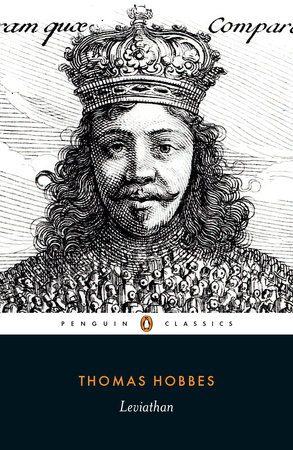
15. Leviathan by Thomas Hobbes
Publisher: Penguin Classics | First published: 1651 | Edition shown: 2017 paperback; introduction and notes by Christopher Brooke; ISBN 9780141395098
Advanced
Leviathan is the most demanding systematic classic on this list. Hobbes begins with sensation, language, reasoning, desire, and fear before constructing the state as an artificial person authorized to secure peace. His state of nature is not merely a prehistoric story; it is an analytical condition showing what follows when no common authority can reliably enforce agreements. The argument forces readers to confront a severe question: how much authority is justified by the need to escape insecurity? Hobbes’s answer favors undivided sovereignty, yet his political order is built from equal vulnerability and individual authorization rather than inherited hierarchy. Do not read the book first, and do not skip directly to the most quoted chapters. The earlier account of human action makes the political conclusion intelligible. Christopher Brooke’s introduction and notes help with historical and theological contexts. Compare Hobbes with Rousseau’s account of freedom and legitimate association, then with Mill’s limits on social coercion. Together they expose the unresolved tension between security, consent, and liberty.
Best for: readers ready for a systematic argument about authority, fear, obligation, sovereignty, and civil peace
Why read it: Hobbes constructs political authority from an account of human equality, insecurity, and covenant with unmatched systematic force.

Book 16 of 20 · INTERMEDIATE
16. The Social Contract and Other Later Political Writings by Jean-Jacques Rousseau
Publisher: Cambridge University Press | First published: 1762 | Edition shown: 2nd edition, 2018 paperback; edited and translated by Victor Gourevitch; ISBN 9781316605448
Intermediate
Rousseau’s central problem is not simply how government begins, but how political association can preserve freedom. The Social Contract develops the ideas of popular sovereignty, the general will, law, citizenship, and legitimate rule while refusing to equate freedom with private choice alone. The argument is compressed and frequently misunderstood. The general will is not whatever a majority happens to desire, yet Rousseau’s account leaves difficult questions about dissent, civic formation, and coercion. This Cambridge volume is especially useful because it places the famous treatise beside later political writings and provides Victor Gourevitch’s editorial apparatus. Read it after Hobbes. Both begin from individuals and association, but Rousseau rejects security purchased at the cost of domination and asks whether citizens can obey only laws they prescribe collectively. Then compare it with Mill, whose fear is not insufficient civic unity but the pressure of society upon individuality. Rousseau belongs in the intermediate route: the prose is shorter than Hobbes’s, but its concepts require repeated, sentence-level reading.
Best for: readers examining popular sovereignty, civic freedom, law, and collective self-government
Why read it: Rousseau asks how obedience to law can count as freedom when citizens are genuinely authors of the political order.

Book 17 of 20 · GENERAL
17. On Liberty, Utilitarianism and Other Essays by John Stuart Mill
Publisher: Oxford University Press | First published: 1859 | Edition shown: 2nd edition, 2015 paperback; edited by Mark Philp and Frederick Rosen; ISBN 9780199670802
General
On Liberty provides the clearest classical argument in this list for protecting individuality against legal and social coercion. Mill’s harm principle is famous, but the book’s deeper concern is epistemic and developmental: dissent exposes error, living opinions require contest, and human beings need room for experiments in living. The companion essays in this Oxford volume reveal the utilitarian framework and broaden the moral context. Mill is more accessible than Hobbes or Arendt, though his examples and assumptions require historical scrutiny. His defense of liberty does not settle where harm begins, how power distorts formally free choices, or how colonial exclusions shaped nineteenth-century liberalism. Those tensions are reasons to read him, not excuses to avoid him. Place Mill after Rousseau. Rousseau asks how a people can rule itself collectively; Mill asks how collective rule can become oppressive even without a tyrant. Then read Mills and Fanon, who expose racial and colonial structures that liberal universality has often failed to confront. This sequence turns a familiar classic into an argument under pressure.
Best for: readers studying liberty, harm, individuality, public opinion, and liberal moral argument
Why read it: Mill shows why freedom of thought and experiment matters even when majorities are sincere, educated, and confident.

Book 18 of 20 · ADVANCED
18. The Human Condition by Hannah Arendt
Publisher: University of Chicago Press | First published: 1958 | Edition shown: 2nd edition, 2018 paperback; introduction by Margaret Canovan, foreword by Danielle Allen; ISBN 9780226586601
Advanced
Arendt distinguishes labor, work, and action, then asks what modern societies lose when public freedom is displaced by production, consumption, and administration. Her account of action emphasizes plurality, speech, unpredictability, and the creation of a shared public world. This is not an introductory survey, an institutional textbook, or a conventional empirical study. Its value lies in changing the reader’s object of attention: politics is not only the distribution of resources or the enforcement of decisions, but the space in which people appear to one another as distinct actors. The conceptual architecture is demanding, and Arendt’s use of Greek categories, social history, and sharp distinctions has generated extensive criticism. Read it late, preferably after Plato, Hobbes, Rousseau, and Mill. Danielle Allen’s foreword and Margaret Canovan’s introduction help place the argument while leaving its difficulty intact. The book challenges the state-centered and behaviorist tendencies of the discipline. It asks not merely how political systems function, but what forms of human activity deserve to be called political at all.
Best for: readers ready to rethink action, public life, freedom, labor, work, and modernity
Why read it: Arendt restores political action and plurality to a field often reduced to administration, interests, or sovereign command.

Book 19 of 20 · INTERMEDIATE
19. The Racial Contract by Charles W. Mills
Publisher: Cornell University Press | First published: 1997 | Edition shown: 25th anniversary paperback, 2022; new preface and foreword by Tommie Shelby; ISBN 9781501764288
Intermediate
Mills rewrites social-contract theory by arguing that the modern world was also organized through a racial contract: a political, economic, and epistemological order determining who counts fully as a person and whose domination becomes normalized. The book’s force comes from placing race inside, not outside, the history of liberal modernity. It also introduces the idea of an epistemology of ignorance, showing how institutions and habits of perception can make domination difficult for beneficiaries to recognize. Read it after Hobbes, Rousseau, and Mill, because its intervention depends on understanding what canonical contract and liberal theories claim. It differs from Fanon’s phenomenological and revolutionary account by working through analytic political philosophy and the conceptual architecture of contract. The anniversary edition adds Mills’s new preface and Tommie Shelby’s foreword, useful for assessing the argument’s later reception. The prose is direct, but the implications are substantial. For beginners, it prevents the canon from appearing as a sequence of abstract universal arguments untouched by conquest, slavery, and racial hierarchy.
Best for: readers examining race, liberalism, social-contract theory, and the political production of ignorance
Why read it: Mills shows how racial domination can be constitutive of modern political orders rather than an accidental failure to apply universal ideals.

Book 20 of 20 · ADVANCED
20. The Wretched of the Earth by Frantz Fanon
Publisher: Grove Press | First published: 1961 | Edition shown: 60th anniversary paperback, 2021; translated by Richard Philcox, introduction by Cornel West; ISBN 9780802158635
Advanced
Fanon analyzes colonialism as a total structure of violence, spatial division, economic extraction, racial classification, and psychic injury. He writes from within anticolonial struggle, not from the distance of a neutral institutional survey. The book examines revolutionary violence, national consciousness, the dangers of a postcolonial national bourgeoisie, political organization, culture, and mental disorder under colonial rule. Its rhetoric is intense, and readers should neither romanticize violence nor detach the argument from the wars of decolonization that produced it. The Richard Philcox translation and anniversary materials provide a strong contemporary edition. Read Fanon late, after the basic texts on states, institutions, ideology, and liberal freedom. His work then exposes what those frameworks may exclude when empire is treated as peripheral. Pair it with The Racial Contract: Mills reconstructs the racial foundations of modern political philosophy, while Fanon describes the lived and revolutionary consequences of colonial rule. The book closes this list because it reopens every earlier question—authority, freedom, violence, nationhood, and political agency—under conditions the traditional canon often marginalizes.
Best for: readers studying colonial violence, national liberation, postcolonial elites, and political transformation
Why read it: Fanon makes colonial domination a material and psychological structure that reshapes both liberation and the states that follow it.
The Reading Map
Use this comparison to select the next book by function rather than reputation. Difficulty describes the reading demand of the work itself, not the intelligence of its reader.
Where to Start
If you are completely new, read The Politics Book, Heywood’s Politics, and Comparative Government and Politics. That three-book route supplies vocabulary, a disciplinary overview, and the habit of cross-national comparison. Readers who prefer a free preliminary survey can also consult the Open Textbook Library’s introductory political science text.
If you want the classical foundation, begin with Plato and Machiavelli, then read Hobbes, Rousseau, and Mill. Do not start with Leviathan merely because it is canonical. Heywood’s chapters on authority, legitimacy, and the state will make Hobbes’s architecture far more intelligible.
If you want contemporary debates, move from The Dictator’s Handbook to How Democracies Die, The Righteous Mind, and the current V-Dem Democracy Reports. This route links incentives, norms, psychology, and comparative evidence without pretending that one mechanism explains democratic change.
If you want historical and institutional depth, read Why Nations Fail, Seeing Like a State, and Governing the Commons. Their disagreement is productive: institutions matter, administrative knowledge has limits, and communities can sometimes govern common resources through locally developed rules.
If you want the most demanding route, read Hobbes, Arendt, Mills, and Fanon after completing the introductory and methods sections. The sequence moves from sovereign order to public action, racial domination, and colonial liberation. It is difficult because the books do not share a single method or political vocabulary.
What Most Reading Lists on Political Science Miss
Many lists silently substitute political philosophy for political science. Plato, Machiavelli, Hobbes, and Mill matter, but a student who reads only canonical theory still lacks comparative method, research design, political behavior, international relations, public policy, and the study of institutions. The University of Washington’s description of political science makes that disciplinary breadth explicit.
A second mistake is confusing accessibility with suitability. A vivid popular book may be easier than a textbook but provide only one mechanism. The Dictator’s Handbook foregrounds coalition survival; Why Nations Fail foregrounds inclusive and extractive institutions; How Democracies Die foregrounds norms and party gatekeeping. Each clarifies something by leaving other things out. Beginners need a framework that lets them compare models instead of adopting the first memorable explanation as a total theory.
The third omission is method. The best best political science books for beginners must teach readers to ask what would count as evidence, how concepts are measured, why cases are comparable, and whether a claim is causal or normative. Without that discipline, reading becomes an accumulation of positions. Kellstedt and Whitten are included because the intellectual difference between commentary and research is not ornamental.
Finally, lists centered exclusively on European canonical texts can make empire and race look like later applications of universal theories. Mills and Fanon reverse that order. They show that racial and colonial structures helped constitute modern states, economies, citizenship, and political knowledge. Their inclusion does not “balance” an otherwise complete canon; it changes what the canon itself can be seen to explain.
Frequently Asked Questions
What is the best political science book for a complete beginner?
The Politics Book is the easiest orientation because its visual structure reduces the burden of unfamiliar names and concepts. For a full course-like introduction, Andrew Heywood’s Politics is the stronger single book.
What is the best one-volume overview of political science?
Heywood’s Politics offers the broadest accessible overview in this list. It connects power, states, democracy, institutions, participation, and global politics while showing where the discipline’s subfields meet.
Should beginners read political classics first?
Usually not. Read one introductory overview before Plato, Hobbes, or Rousseau. Primary classics assume historical problems and argumentative conventions that become easier to recognize after the reader has basic conceptual coordinates.
What order should the best political science books for beginners be read in?
Move from orientation to a broad textbook, then choose a subfield, add research methods, and only afterward undertake the demanding classics. A practical first sequence is DK, Heywood, Hague and Harrop, Kellstedt and Whitten, then one thematic route.
Which book is best for understanding democracy today?
How Democracies Die is the clearest entry point to democratic erosion, but it should be paired with comparative evidence such as V-Dem reports and with institutional and behavioral books. No single volume covers democracy’s normative, historical, and empirical dimensions.
Which book is best for learning political science research methods?
The Fundamentals of Political Science Research is the best bridge into causal theory, measurement, research design, and quantitative analysis. It is intermediate rather than introductory and should be supplemented later with qualitative and interpretive methods.
What is the most difficult book on this list?
Leviathan is the most demanding systematic classic, while The Human Condition is the most conceptually disruptive. Both should be postponed until the reader understands basic debates about authority, liberty, institutions, and political action.
How many books are needed for a serious introduction?
Five well-chosen books can provide a serious start: one overview, one comparative text, one international-relations or policy text, one methods book, and one primary classic. The full 20-book map becomes useful when the goal shifts from orientation to sustained study.
Where the Reading Becomes a Discipline
The best best political science books for beginners do not lead toward one political creed. They teach the reader to separate description from judgment, institutions from intentions, comparison from anecdote, and evidence from confidence. Start with the visual map and Heywood’s overview. Add comparative politics and methods before asking any popular explanatory book to carry the weight of the whole field.
The advanced route begins when the books start correcting one another. Hobbes’s sovereign security encounters Rousseau’s collective freedom and Mill’s individuality. Scott’s suspicion of administrative simplification meets Ostrom’s institutional craftsmanship. Mills and Fanon expose the racial and colonial conditions hidden by abstract universality. Political science becomes serious at precisely this point: not when disagreement disappears, but when the reader can identify what kind of disagreement is occurring and what evidence or argument could move it forward.
Editorial research and authorship: This reading guide was researched and written by the BookInLight Department of Political Thought and Intellectual History, with bibliographical review, edition verification, source checking, link verification, and editorial fact-checking by the BookInLight research team. Readers who identify a factual correction, an overlooked book or source, or a valuable interpretive possibility are warmly invited to share their comments and suggestions.
Art direction and rights: The editorial art direction, visual composition, cover selection, and presentation of images were developed by the BookInLight Art Department. Individual book covers remain the property of their respective publishers, designers, artists, and rights holders and are credited below. Complete republication, reproduction, translation, or reuse of this article, whether in print or digital form, is permitted only with prior written authorization from BookInLight.
Sources and Further Reading
Disciplinary Scope and Study
- University of Washington, “What Is Political Science?” — supports the field’s major subdisciplines and breadth. Source
- Open Textbook Library, Introduction to Political Science — consulted for beginner-level scope and terminology. Source
- King’s College London recommended reading list — used to compare undergraduate expectations and contemporary selections. Source
- Temple University Libraries political science reading lists — used to check subfield breadth and institutional analysis. Source
- Gonzaga University, “How to Read Political Science” — supports guidance on arguments, evidence, and scholarly structure. Source
Editions and Publisher Records
- DK, The Politics Book — exact 2024 US hardcover record, ISBN, and official cover source. Source
- Bloomsbury Academic, Andrew Heywood’s Politics — exact fifth-edition publisher record and bibliographical details. Source
- Oxford University Press, The Globalization of World Politics — ninth-edition editors, date, ISBN, and format. Source
- Cambridge University Press, The Fundamentals of Political Science Research — third-edition scope and paperback record. Source
- Cambridge University Press, Governing the Commons — Canto Classics edition and institutional-analysis context. Source
Intellectual and Historical Context
- Stanford Encyclopedia of Philosophy, “Political Legitimacy” — authority, consent, obligation, and legitimacy. Source
- Stanford Encyclopedia of Philosophy, “Democracy” — major normative models and recurring disputes. Source
- Nobel Prize, Elinor Ostrom facts — verifies the recognized significance of her commons research. Source
Contemporary Evidence and Debate
- V-Dem Institute, Democracy Reports — contemporary evidence on democratization and autocratization. Source
- Yale University Press, Seeing Like a State — edition record and the book’s policy-planning focus. Source
- Grove Atlantic, The Wretched of the Earth — anniversary-edition contents, translation, ISBN, and cover. Source
Image Credits
1. The Politics Book. 2024 US hardcover; ISBN 9780593844120; DK. Image source: DK official product image server. Authoritative edition page.
2. Politics. 5th edition, 2019 paperback; ISBN 9781352005455; Bloomsbury Academic / Red Globe Press. Image source: Open Library exact-edition cover record. Authoritative edition page.
3. Comparative Government and Politics. 11th edition, 2019 paperback; ISBN 9781352005059; Red Globe Press. Image source: Open Library exact-edition cover record. Authoritative edition page.
4. The Globalization of World Politics. 9th edition, 2023 paperback; ISBN 9780192898142; Oxford University Press. Image source: Oxford University Press official cover server. Authoritative edition page.
5. Political Ideologies. 7th edition, 2021 paperback; ISBN 9781352011838; Bloomsbury Academic. Image source: Open Library exact-edition cover record. Authoritative edition page.
6. The Fundamentals of Political Science Research. 3rd edition, 2018 paperback; ISBN 9781316642672; Cambridge University Press. Image source: Open Library exact-edition cover record. Authoritative edition page.
7. The Dictator’s Handbook. 2022 trade paperback; ISBN 9781541701366; PublicAffairs. Image source: Open Library exact-edition cover record. Authoritative edition page.
8. Why Nations Fail. 2013 paperback; ISBN 9780307719225; Currency. Image source: Penguin Random House official cover server. Authoritative edition page.
9. How Democracies Die. 2019 paperback; ISBN 9781524762940; Broadway Books. Image source: Open Library exact-edition cover record. Authoritative edition page.
10. The Righteous Mind. 2013 paperback; ISBN 9780307455772; Vintage. Image source: Open Library exact-edition cover record. Authoritative edition page.
11. Seeing Like a State. 1999 paperback; ISBN 9780300078152; Yale University Press. Image source: Open Library exact-edition cover endpoint. Authoritative edition page.
12. Governing the Commons. Canto Classics paperback, 2015; ISBN 9781107569782; Cambridge University Press. Image source: Open Library ISBN-specific cover endpoint. Authoritative edition page.
13. The Republic. 2007 paperback; translated by Desmond Lee, revised with introduction by Melissa Lane; ISBN 9780140455113; Penguin Classics. Image source: Amazon exact-edition product image, cross-checked against Penguin Classics. Authoritative edition page.
14. The Prince. Deluxe paperback, 2009; translated and introduced by Tim Parks; ISBN 9780143105862; Penguin Classics. Image source: Penguin Random House official cover server. Authoritative edition page.
15. Leviathan. 2017 paperback; introduction and notes by Christopher Brooke; ISBN 9780141395098; Penguin Classics. Image source: Penguin Random House official cover server. Authoritative edition page.
16. The Social Contract and Other Later Political Writings. 2nd edition, 2018 paperback; edited and translated by Victor Gourevitch; ISBN 9781316605448; Cambridge University Press. Image source: Amazon exact-edition product image, cross-checked against Cambridge University Press. Authoritative edition page.
17. On Liberty, Utilitarianism and Other Essays. 2nd edition, 2015 paperback; edited by Mark Philp and Frederick Rosen; ISBN 9780199670802; Oxford University Press. Image source: Amazon exact-edition product image, cross-checked against Oxford University Press. Authoritative edition page.
18. The Human Condition. 2nd edition, 2018 paperback; introduction by Margaret Canovan, foreword by Danielle Allen; ISBN 9780226586601; University of Chicago Press. Image source: Amazon exact-edition product image, cross-checked against University of Chicago Press. Authoritative edition page.
19. The Racial Contract. 25th anniversary paperback, 2022; new preface and foreword by Tommie Shelby; ISBN 9781501764288; Cornell University Press. Image source: Amazon exact-edition product image, cross-checked against Cornell University Press. Authoritative edition page.
20. The Wretched of the Earth. 60th anniversary paperback, 2021; translated by Richard Philcox, introduction by Cornel West; ISBN 9780802158635; Grove Press. Image source: Grove Atlantic official cover image server. Authoritative edition page.