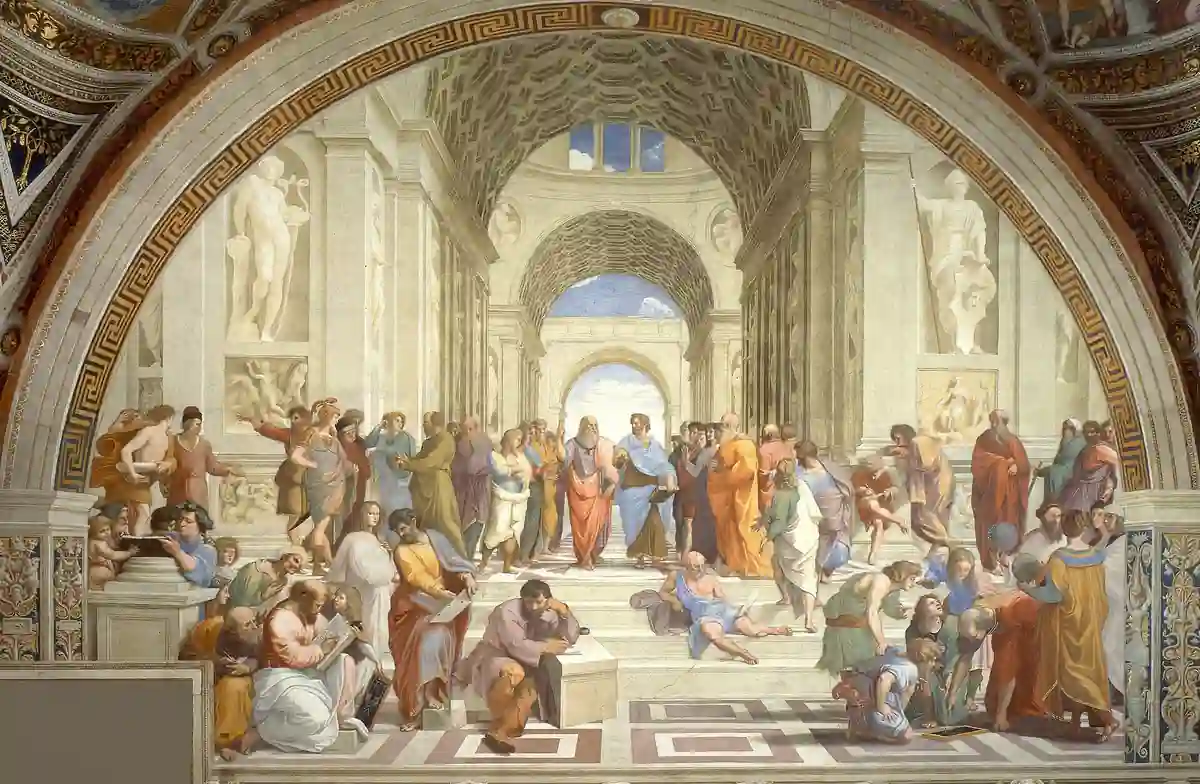
Where to Start with Plato is less a question of chronology than of learning how his dialogues work. Begin with Five Dialogues, where Socratic questioning is dramatic, compact, and difficult in the right ways; then move through Symposium, Republic, Phaedrus, and finally The Theaetetus of Plato. The sequence moves from ethical examination to love, politics, rhetoric, and the problem of knowledge.
Introduction
Plato is unusually friendly to beginners and unusually easy to misread. He rarely writes in his own voice: arguments arrive through conversations, speeches, jokes, myths, rivalries, and carefully chosen settings. The result feels alive while resisting the simple question, “What does Plato believe?” The Stanford Encyclopedia of Philosophy overview of Plato emphasizes this combination of philosophical range, literary form, and authorial indirectness.
A first reading should not reconstruct a finished “Platonic system” before meeting the dialogues or assume that every sentence spoken by Socrates is Plato’s final doctrine. Plato is not merely transcribing his teacher. The Internet Encyclopedia of Philosophy account of Plato is useful on the conventional early-middle-late grouping and the limits of treating it as settled chronology.
This path is pedagogical rather than chronological. It begins with short dialogues, opens into Plato’s more constructive works, and ends with a dialogue that refuses an easy definition of knowledge. The aim is not to rank Plato’s “best” books, but to make each encounter prepare the next without postponing Plato behind a mountain of secondary reading.
The shortest honest answer
If you want one practical answer: start with Hackett’s Five Dialogues, read the volume in order, then read Symposium, Republic, Phaedrus, and The Theaetetus of Plato. That route begins with Socratic examination, adds eros and the Forms, expands into justice and political psychology, revisits love through rhetoric and writing, and ends by testing what knowledge itself can mean.
You do not need a survey of all Greek philosophy first. A small amount of context about Socrates, the sophists, democratic Athens, and the trial of 399 BCE is enough. The later books become difficult for different reasons, so the sequence deliberately alternates dramatic accessibility with conceptual pressure.
Before you start: how to approach Plato
The first beginner problem is not vocabulary; it is genre. A Platonic dialogue is not a modern textbook with the thesis announced at once. Watch who speaks, who resists, and what the setting makes possible. A courtroom changes the stakes of Apology; a drinking party makes the speeches of Symposium part of its argument; a walk outside Athens lets Phaedrus join desire, rhetoric, and writing.
Second, keep Socrates and Plato conceptually distinct. The historical Socrates wrote nothing, and our evidence is mediated through authors with different purposes. The Stanford Encyclopedia of Philosophy entry on Socrates explains why the “Socratic problem” frustrates a clean boundary. A safe first habit is to write “Socrates argues” when the claim belongs to the speaker, and “Plato suggests” only when the dialogue as a whole supports the attribution.
Third, do not make chronology carry more weight than scholarship can support. Early, middle, and late groupings can be useful, but exact dating and doctrinal development remain contested. The Stanford discussion of Plato’s shorter ethical works shows why the Socratic dialogues matter without turning a conventional grouping into a rigid biography of Plato’s mind.
You need only a few concepts in advance: elenchus as testing by question and answer; aretê as virtue or excellence; logos as account, argument, or reason; and “Form” as an intelligible standard such as Beauty or Justice rather than a visible specimen. Learn the rest when the dialogues force the need.
The best first book on Plato
Start with: Five Dialogues (Second Edition)
Hackett’s 2002 Five Dialogues, in G. M. A. Grube’s translations revised by John M. Cooper, is the strongest first volume because it gives a beginner several Platonic experiences without requiring a long commitment to any one of them. Euthyphro teaches the danger of defining a moral term too quickly. Apology makes philosophy a question of life, public accountability, and intellectual conscience. Crito tests obligation and civic loyalty. Meno moves from virtue to inquiry, recollection, and true belief. Phaedo then opens the door to arguments about the soul and the Forms.
The volume does not provide a comprehensive map of Plato. It contains no political architecture comparable to the Republic, no sustained treatment of eros like the Symposium, and no mature examination of rhetoric and writing like the Phaedrus. That is precisely why it works first: it teaches how to read before it asks you to manage Plato at full scale.
Read all five, preferably in the printed order. Do not turn Apology into a heroic quotation book or skip straight to the metaphysics of Phaedo. The progression from failed definitions to trial, law, inquiry, and death gives the volume a pedagogical arc even though it is an anthology rather than a single work. After finishing it, go directly to Symposium. You will recognize Socrates, but the change in form—a sequence of speeches rather than a compact elenchus—will show how much more varied Platonic writing can be.
The core reading sequence

Book 1
Five Dialogues (Second Edition)
Edition shown: Hackett Publishing / G. M. A. Grube, trans. / John M. Cooper, rev. / 2002 / paperback / ISBN 978-0-87220-633-5
Place in the sequence: The best first encounter with Socratic method, moral examination, and the transition toward distinctively Platonic problems.
Begin here because this volume gives you repetition without monotony. Across five relatively short works, Socrates keeps asking what a person means by piety, virtue, justice, knowledge, or a good life, yet the conversations do not all end in the same way. Euthyphro is a compact lesson in the instability of confident definitions. Its famous problem about piety and the gods matters, but the deeper beginner lesson is methodological: examples are not yet definitions, and definitions have consequences that must survive questioning.
Apology changes the temperature. Socratic examination is no longer a clever exercise; it is bound to a life under judgment. Read the speech for the relation between philosophy, public reputation, and the claim that recognizing one’s ignorance can be intellectually superior to pretending knowledge. Crito then makes easy admiration for Socrates harder by placing obedience, justice, friendship, and the city’s laws in tension. Do not assume that the personified Laws simply state Plato’s final political theory.
Meno is where the volume begins to point beyond the early Socratic pattern. The question “Can virtue be taught?” generates the paradox of inquiry, the slave-boy demonstration, recollection, and the distinction between knowledge and true belief. Then Phaedo adds arguments for immortality and a more explicit role for Forms. The movement matters: a reader who starts with a schematic summary of “Plato’s theory of Forms” misses how metaphysical claims emerge from problems about inquiry, explanation, death, and the philosophical life.
The Grube translations, revised by Cooper, are direct enough for a first reading and widely usable alongside secondary scholarship. Read the whole anthology rather than cherry-picking only Apology and Phaedo. Its limitation is selection: five dialogues cannot show Plato’s comic range, political scale, or later technical pressure. That is why it should remain the doorway, not the destination. Keep notes on recurring questions.
Difficulty: Beginner
“Both Meno and Phaedo, moreover, are included together in the excellent Five Dialogues”
— Josh Wilburn • Notre Dame Philosophical Reviews
Book 2
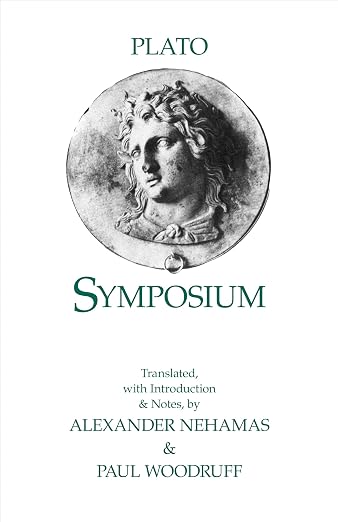
Symposium
Edition shown: Hackett Publishing / Paul Woodruff and Alexander Nehamas, trans. / 1989 / paperback / ISBN 978-0-87220-076-0
Place in the sequence: The first major expansion from Socratic questioning into competing speeches, eros, beauty, ascent, and literary form.
After the compact moral pressure of Five Dialogues, the Symposium teaches a new rule: in Plato, philosophy can be distributed across a social drama rather than delivered by one argument. The dialogue is framed as a remembered account of a drinking party, and the participants offer successive speeches about eros. Those speeches are not disposable preludes to Socrates. Phaedrus, Pausanias, Eryximachus, Aristophanes, and Agathon each construct a different relation among desire, education, body, social convention, and value.
Read slowly enough to notice what changes when Socrates reports Diotima’s teaching. The so-called “ladder of love” moves from attachment to a beautiful body toward recognition of beautiful bodies, practices, knowledge, and finally Beauty itself. Beginners often extract that ascent as a neat doctrine and move on. Resist the temptation. Ask what is gained—and what may be lost—when desire becomes philosophical education. Then watch Alcibiades enter and turn Socrates himself into an object of desire. The dramatic ending prevents the ascent from floating free of embodied attachment, charisma, shame, and political life.
This stage also prepares you for the Republic. The Symposium makes the intelligible/sensible distinction emotionally legible before the Republic makes related distinctions part of an educational and political architecture. It also gives you a first sustained encounter with Plato’s use of myth-like discourse and elevated rhetoric. The Woodruff-Nehamas translation is especially suitable here because it is readable without flattening the tonal changes among speakers, and its notes intervene economically.
Read the entire dialogue, including the framing opening and Alcibiades’ speech. Do not read only Diotima. The principal difficulty is not technical argument but interpretive plurality: several speeches contain insights without being simply endorsed, and Socrates’ own position arrives through another reported voice. That indirectness is not noise around the philosophy. It is part of the philosophy. Notice who laughs, interrupts, and remembers.
Difficulty: Moderate
“A model of the kind of text one needs for lecture courses: the translation is extremely readable”
— S. G. Nugent • Hackett Publishing

Book 3
Republic
Edition shown: Hackett Publishing / G. M. A. Grube, trans. / C. D. C. Reeve, rev. / 1992 / paperback / ISBN 978-0-87220-136-1
Place in the sequence: The central synthesis of justice, moral psychology, education, politics, metaphysics, and the philosophical life.
The Republic belongs third, not first. Its fame tempts beginners to treat it as Plato’s manifesto, but the dialogue is much easier to read well once you have already seen Socratic refutation and the ascent language of the Symposium. It begins with a question about justice and quickly expands. Cephalus, Polemarchus, and Thrasymachus offer positions that are tested; Glaucon and Adeimantus then demand something harder: an account of why justice is good for the person who possesses it, not merely useful for reputation or reward.
The city-in-speech is built partly to make the soul easier to see. Keep that analogy active. The guardians, auxiliaries, and producers are not simply items in a political blueprint; they correspond to a tripartite psychology of reason, spirit, and appetite. Education, censorship, property, family, philosopher-rulers, and political decline therefore operate simultaneously at civic and psychic levels. A first reading should neither sanitize the dialogue’s authoritarian features nor reduce the work to them. Ask what problem each institutional proposal is meant to solve, and then ask whether the proposed cure creates new problems.
Books VI and VII are the conceptual center for many readers: the philosopher, the Form of the Good, the sun, divided line, and cave connect epistemology, metaphysics, and education. Read those images alongside the arguments that surround them; they are not interchangeable inspirational metaphors. Book X then returns to poetry, imitation, and the soul before the Myth of Er closes the work with cosmic moral imagination.
Grube’s translation as revised by Reeve remains a strong teaching edition because it combines philosophical accuracy with relatively unforced English and provides a useful introduction, index, and bibliography. Read all ten books on a first serious pass, but give yourself permission to mark difficult sections rather than solve every controversy immediately. The Republic should enlarge your questions, not terminate them.
Difficulty: Demanding
“The Republic is full of brilliant thoughts, and one needs to preserve brilliance to capture them.”
— Jonathan Lear • Hackett Publishing

Book 4
Phaedrus
Edition shown: Hackett Publishing / Alexander Nehamas and Paul Woodruff, trans. / 1995 / paperback / ISBN 978-0-87220-220-7
Place in the sequence: A self-reflective return to eros that joins psychology, Forms, rhetoric, dialectic, and the limits of writing.
The Phaedrus can look like two dialogues stitched together: a first part about love and divine madness, a second about rhetoric and writing. Reading it after the Symposium and Republic makes the unity easier to see. Plato is asking what kind of speech can genuinely lead a soul, and that requires an account of what souls are, what they desire, what they can remember, and how a speaker must understand an audience.
Pay special attention to the sequence of speeches. Socrates first competes with Lysias on the premise that the non-lover is preferable, then repudiates his first speech and offers a palinode in praise of divinely inspired love. The charioteer myth gives a vivid psychology of reason, spirited drive, appetite, recollection, and the soul’s attraction to beauty. Because you have already read the Republic, you can compare rather than simply identify the two accounts of soul. Plato’s images change with argumentative context.
The second half is where the dialogue becomes indispensable for reading Plato himself. A genuine art of rhetoric, Socrates argues, cannot be reduced to tricks of persuasion; it requires truth, division and collection, and knowledge of different kinds of soul. The final discussion of writing is equally easy to caricature. Plato does not simply declare writing bad while writing a book. He dramatizes the limits of texts that cannot answer questions, while presenting written dialogue as a stimulus to living inquiry.
The Nehamas-Woodruff edition is a particularly good choice because the translation preserves rhetorical energy and the notes illuminate allusions without burying the dialogue. Read it complete. Its difficulty comes from structural integration rather than sheer length. If you can explain why eros, rhetoric, dialectic, memory, and writing belong in one conversation, you have crossed an important threshold in reading Plato. Read the myths as arguments in motion.
Difficulty: Demanding
“A superb translation that captures the rhetorical brilliance of the Greek.”
— Tim Mahoney • Hackett Publishing

Book 5
The Theaetetus of Plato
Edition shown: Hackett Publishing / M. J. Levett, trans. / Myles Burnyeat, rev. and introd. / 1990 / paperback / ISBN 978-0-915144-81-5
Place in the sequence: The advanced culmination: an aporetic investigation of knowledge supported by Burnyeat’s substantial philosophical commentary.
End this five-book path with the Theaetetus because it corrects one of the worst habits a beginner can acquire from simplified Platonism: the expectation that Plato always resolves a question by invoking the Forms. Here Socrates asks the brilliant young mathematician Theaetetus what knowledge is. The dialogue tests three broad proposals—knowledge as perception, as true judgment, and as true judgment with an account—without delivering a simple final definition.
That negative result is philosophically productive. The first proposal draws the reader into Protagorean relativism and Heraclitean flux. The second forces difficult questions about false belief. The third turns on what an “account” or logos could add to true judgment. Along the way Plato gives us the midwife image for Socratic practice, the wax tablet, the aviary, and the famous digression contrasting the philosopher with the rhetorically trained man of the law courts. These images are not detachable illustrations; each reorganizes the problem temporarily and exposes a different pressure point.
Why place such a demanding work last? Because you now have enough Plato behind you to feel what is absent. After Phaedo, Symposium, Republic, and Phaedrus, the relative silence about Forms in the central epistemological investigation becomes an interpretive problem rather than a fact you might not notice. Scholars disagree over what that absence means and over how the dialogue relates to Plato’s other works. The disagreement is worth encountering rather than prematurely settling.
The 1990 Hackett volume is more than a translation. Levett’s English is revised by Myles Burnyeat, whose long introduction and commentary turns the book into a guided advanced seminar. Read the dialogue itself first with restrained use of the commentary; then return to Burnyeat section by section. The edition is physically longer than the dialogue because the apparatus is substantial, and that is an advantage at this stage. The goal is no longer merely to follow Plato. It is to learn how a serious interpreter argues with him.
Difficulty: Advanced
“Students at all levels, including professional philosophers, cannot fail to learn from it, to enjoy it. A real gem.”
— Gail Fine • Hackett Publishing
How these books fit together
The architecture of the sequence is cumulative but not doctrinal. Five Dialogues establishes a habit of testing definitions and watching Socrates under ethical pressure. Symposium then makes philosophy polyphonic: competing speeches show that a dialogue’s literary form can itself structure an inquiry. Republic scales up, tying justice in the person to justice in the city and linking education to psychology, epistemology, and metaphysics.
Phaedrus then folds the earlier books back on themselves. Eros returns, but now it is connected to a theory of soul, a theory of rhetoric, and a critique of how written discourse transmits knowledge. The Stanford Encyclopedia of Philosophy discussion of Plato on rhetoric and poetry is useful after, not before, your first reading because it clarifies why rhetoric, poetry, psychology, and philosophy form a single dispute about education and the direction of souls.
Finally, the Theaetetus deprives the reader of easy synthesis. Its central question—what is knowledge?—ends in aporia, an acknowledged impasse. The current Stanford study of knowledge in the Theaetetus lays out major interpretive alternatives and the dialogue’s three definitions. Ending here is deliberate: a beginner becomes a better reader of Plato when the aim shifts from collecting doctrines to understanding why a problem remains difficult after brilliant arguments have been tried.
Common beginner mistakes
Reading Plato as a list of doctrines. “The Forms,” “the philosopher-king,” and “the cave” are convenient labels, but they can detach conclusions from the conversations that generate them. Always ask who is speaking, in response to what challenge, and with what degree of success.
Treating dialogue chronology as settled. Early-middle-late groupings are useful hypotheses, not a perfectly dated intellectual diary. A reading order can therefore be pedagogical without pretending to reconstruct the exact sequence in which Plato formed every view.
Equating Socrates with Plato too quickly. The dialogues rarely give Plato a direct voice. “Socrates says” is often the more precise first claim. Interpretation begins when you ask what the whole dramatic composition does with what Socrates says.
Skipping the frame, myths, and comic details. The opening narrators of Symposium, the setting outside the walls in Phaedrus, or the framing conversation in Theaetetus can look ornamental. They frequently shape questions of memory, testimony, audience, and philosophical authority.
Ignoring edition and reference conventions. Translation choices matter, especially for words such as aretê, logos, psychê, and epistêmê. Learn to cite Plato by Stephanus numbers—the marginal numbers and letters such as 514a or 201d—because they let readers compare passages across different translations and editions.
Optional paths depending on your interest
If you are interested in ethics and the examined life, prioritize Five Dialogues. Spend extra time on Apology, Crito, Meno, and the ethical arguments of Phaedo before moving outward.
If you are interested in love, beauty, and philosophical desire, prioritize Symposium and Phaedrus. Read them as a pair and compare Diotima’s ascent with the charioteer myth and the later account of rhetoric.
If you are interested in politics, education, and justice, prioritize Republic. Read the city-soul analogy carefully and resist separating the political proposals from the dialogue’s moral psychology and theory of education.
For a more advanced path, continue with Sophist after The Theaetetus of Plato. The dramatic continuity is useful, while the inquiry into being, not-being, division, and false statement pushes beyond the epistemological impasse you have just encountered.
FAQ
Which English translation of Plato should I use?
There is no single translation that is best for every dialogue. For this path, the Hackett editions are strong because they combine established translators, philosophical notes, and stable Stephanus references. If you later want one reference volume, John M. Cooper’s edited Plato: Complete Works is useful for keeping translations and editorial conventions together.
Do I need to know ancient Greek or a lot of Athenian history?
No. Greek helps with contested terms, but it is not a prerequisite. Learn enough context to understand Socrates’ trial, the role of sophists and rhetoric, the social world of the polis, and the difference between democratic Athens and the ideal constructions inside Plato’s dialogues. Good notes can supply the rest when it becomes relevant.
What is Stephanus pagination, and why should a beginner learn it?
Stephanus pagination is the standard reference system printed in the margins of serious Plato editions, using numbers and letters such as Republic 514a. A careful Where to Start with Plato plan should adopt it early: unlike ordinary page numbers, Stephanus references remain comparable across translations, publishers, and formats.
Should I buy a complete Plato before reading individual editions?
Not necessarily. Individual editions are easier to carry, often provide dialogue-specific introductions, and make the first path less intimidating. Buy or borrow a complete works volume once you begin following cross-references into dialogues outside the core sequence; at that point it becomes a research tool rather than an obligation to read cover to cover.
Related BookInLight Reading Guides
Thinking Begins Here: Twenty Books That Teach You How to Read Philosophy — A broader primer on how philosophical reading differs from summary-driven reading, with Plato’s Socratic dialogues as a foundational encounter.
Learning to Think Politically: Nine Books for a Serious Beginner — Places the Republic inside a beginner route through political thought and helps readers carry Plato’s justice problem into later traditions.
Aristotle’s Function Argument, Precisely Located — A precise bridge from Plato to Aristotle, useful after this path for seeing how ancient ethical argument changes in form and method.
This article was researched and written by the BookInLight Department of Philosophy and Intellectual History. The editorial process included bibliographical review, source verification, quotation verification, link verification, and editorial fact-checking. We welcome factual corrections, overlooked sources, edition suggestions, interpretive observations, and constructive ideas that can improve the guide.
The BookInLight Art Department is responsible for editorial art direction, visual composition, cover selection, and image presentation. Rights in third-party book covers remain with the relevant publishers, artists, designers, and other rights holders. Complete republication, reproduction, translation, or reuse of this article requires prior written authorization from BookInLight.
Sources and Further Reading
Primary Texts and Editions
Hackett Publishing, Five Dialogues (Second Edition) (2002). Source — Exact edition, translators, revision, paperback ISBN, contents, and edition description.
Hackett Publishing, Symposium (Woodruff & Nehamas Edition) (1989). Source — Exact translation, paperback ISBN, publication details, and named critical assessment.
Hackett Publishing, Republic (Grube, Second Edition) (1992). Source — Exact Grube–Reeve edition, paperback ISBN, revision description, and Jonathan Lear assessment.
Hackett Publishing, Phaedrus (Nehamas & Woodruff Edition) (1995). Source — Exact translation, paperback ISBN, publication details, and Tim Mahoney assessment.
Hackett Publishing, The Theaetetus of Plato (1990). Source — Exact Levett–Burnyeat edition, paperback ISBN, commentary description, and Gail Fine assessment.
Google Books, Five Dialogues, second edition. Source — Independent bibliographical corroboration of the 2002 Hackett edition, translator, editor, and ISBN.
Google Books, Symposium. Source — Independent bibliographical corroboration of the 1989 Hackett Woodruff–Nehamas edition and ISBN.
Google Books, Republic (Grube Edition). Source — Independent bibliographical corroboration of the 1992 revised Hackett edition and ISBN.
Google Books, Phaedrus. Source — Independent bibliographical corroboration of the Hackett Nehamas–Woodruff edition.
Google Books, The Theaetetus of Plato. Source — Independent bibliographical corroboration of the Levett–Burnyeat Hackett volume.
Context, Interpretation, and Reception
Christopher Bobonich and others, “Plato,” Stanford Encyclopedia of Philosophy. Source — Dialogue form, authorial indirectness, scope of Plato’s philosophy, and interpretive cautions used in the introduction.
Internet Encyclopedia of Philosophy, “Plato.” Source — Chronological groupings, basic historical framing, and bibliographical orientation.
Debra Nails and others, “Socrates,” Stanford Encyclopedia of Philosophy. Source — The Socratic problem, historical evidence, and the need to distinguish Plato’s literary Socrates from the historical figure.
Hugh H. Benson and others, “Plato’s Shorter Ethical Works,” Stanford Encyclopedia of Philosophy. Source — Ethical and methodological context for the shorter Socratic dialogues.
Charles L. Griswold and others, “Plato on Rhetoric and Poetry,” Stanford Encyclopedia of Philosophy. Source — The relation among rhetoric, psychology, poetry, education, and philosophy in Phaedrus and Republic.
Timothy Chappell and others, “Plato on Knowledge in the Theaetetus,” Stanford Encyclopedia of Philosophy. Source — The dialogue’s three definitions of knowledge, its aporetic ending, and major interpretive alternatives.
Josh Wilburn, “Meno and Phaedo,” Notre Dame Philosophical Reviews. Source — Comparative assessment of student editions and verification of the quotation used for Five Dialogues.
Image Credits
Five Dialogues (Second Edition) — Hackett Publishing paperback, 2002, ISBN 978-0-87220-633-5. Cover image served from Amazon’s product-image CDN for the exact retail edition; edition and cover correspondence checked against Hackett Publishing. Third-party cover rights remain with the publisher, designer, artist, and other rights holders.
Symposium — Hackett Publishing paperback, 1989, ISBN 978-0-87220-076-0. Cover image served from Amazon’s product-image CDN for the exact retail edition; edition and cover correspondence checked against Hackett Publishing. Third-party cover rights remain with the publisher, designer, artist, and other rights holders.
Republic — Hackett Publishing paperback, 1992, ISBN 978-0-87220-136-1. Cover image served from Amazon’s product-image CDN for the exact retail edition; edition and cover correspondence checked against Hackett Publishing. Third-party cover rights remain with the publisher, designer, artist, and other rights holders.
Phaedrus — Hackett Publishing paperback, 1995, ISBN 978-0-87220-220-7. Cover image served from Amazon’s product-image CDN for the exact retail edition; edition and cover correspondence checked against Hackett Publishing. Third-party cover rights remain with the publisher, designer, artist, and other rights holders.
The Theaetetus of Plato — Hackett Publishing paperback, 1990, ISBN 978-0-915144-81-5. Cover image served from Amazon’s product-image CDN for the exact retail edition; edition and cover correspondence checked against Hackett Publishing. Third-party cover rights remain with the publisher, designer, artist, and other rights holders.
Image credit: Raphael, The School of Athens — Source: Wikimedia Commons — License: Public Domain