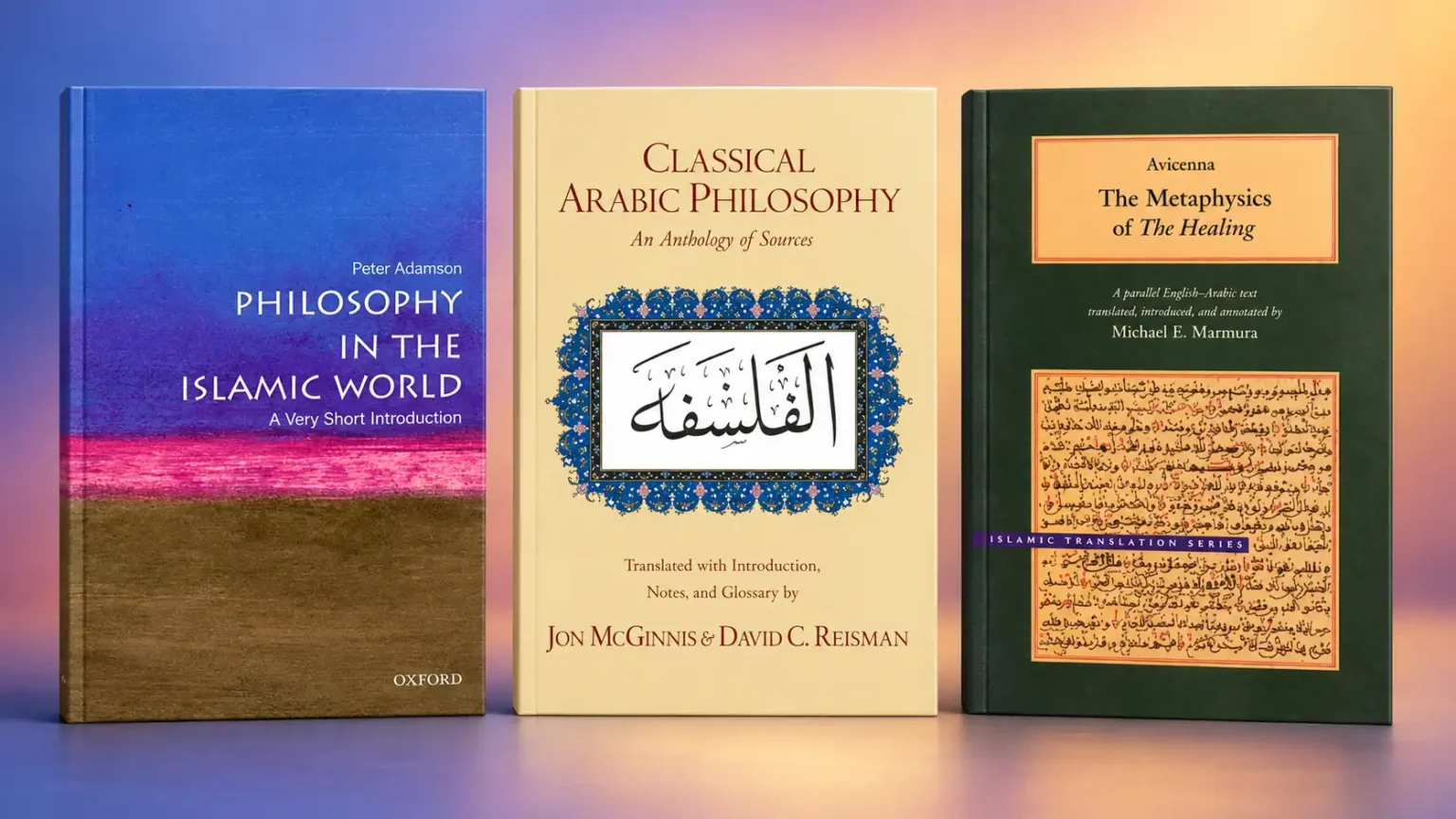
By the BookInLight Medieval & Scholastic Philosophy Desk
Islamic philosophy books are easiest to enter through one clear map, one primary-source anthology, and then a sequence from Avicenna through al-Ghazali, Averroes, Suhrawardi, and Mulla Sadra.
Introduction
The difficulty is not simply unfamiliar names: falsafa, kalam, theology, mysticism, Greek translation, and later Persian traditions overlap without becoming identical. Begin with a map, then read arguments. BookInLight’s guide to learning how to read philosophy helps with method; the Greek sources of Arabic philosophy and the field’s metaphysical tradition supply the historical frame.
The shortest honest answer
Start with Peter Adamson, then move quickly into translated primary texts. The order below favors conceptual preparation over strict chronology.
| Step | Book | Role | Difficulty |
|---|---|---|---|
| 1 | Philosophy in the Islamic World | Orientation | Beginner |
| 2 | Classical Arabic Philosophy | Primary-source sampler | Moderate |
| 3 | The Metaphysics of The Healing | Avicennan system | Demanding |
| 4 | The Incoherence of the Philosophers | Critique | Demanding |
| 5 | Decisive Treatise | Reason and revelation | Moderate |
| 6 | The Philosophy of Illumination | Alternative metaphysics | Advanced |
| 7 | The Elixir of the Gnostics | Later synthesis | Demanding |
Before you start: how to approach Islamic philosophy books
Do not equate Islamic philosophy with one school, or assume it ends with Averroes. Track arguments about being, causation, intellect, prophecy, and revelation, while keeping falsafa, kalam, and illuminationist or mystical philosophy distinct.
The best first book on Islamic philosophy
Start with: Philosophy in the Islamic World by Peter Adamson
Its thematic chapters give enough geography and vocabulary to stop the primary texts from becoming a blur. Read it once quickly, then return to relevant chapters as the sequence reaches Avicenna, Andalusia, and post-Avicennan thought.
The core reading sequence

Philosophy in the Islamic World: A Very Short Introduction by Peter Adamson
Edition: Oxford University Press paperback, 2015 · ISBN 9780199683673 · Place in sequence: map before immersion
Adamson resists the old story in which philosophy simply travels from Greece to Baghdad, peaks with Avicenna and Averroes, then disappears. He includes Muslims, Jews, and Christians writing in Islamic lands, and keeps philosophy in contact with theology and mysticism without collapsing the traditions. That breadth is precisely why it belongs first. The book is concise enough to reread, but dense enough that names will initially move faster than memory. Use its thematic chapters—reason and revelation, God and being, eternity, knowledge, ethics and politics—as a reference grid, not as a substitute for primary texts. The Stanford overview of Arabic and Islamic philosophy of religion is a useful companion when theological vocabulary thickens. Its chief limitation is compression: it gives a map, not the experience of an argument unfolding.
Difficulty: Beginner
“This short introduction will be invaluable for students of the study of Islam.”
— Sajjad Rizvi • Oxford University Press

Classical Arabic Philosophy: An Anthology of Sources edited by Jon McGinnis and David C. Reisman
Edition: Hackett paperback, 2007 · ISBN 9780872208711 · Place in sequence: first sustained primary encounter
This anthology lets a beginner hear the tradition before choosing a master. Selections from al-Kindi, al-Farabi, Avicenna, al-Ghazali, Ibn Tufayl, Averroes, Suhrawardi, and others reveal how logic, metaphysics, psychology, politics, and natural philosophy share a vocabulary while producing sharply different systems. Read the introduction, then sample al-Kindi and al-Farabi before concentrating on the Avicenna, al-Ghazali, and Averroes chapters that prepare the next stages. The translators’ notes and bilingual glossary are especially valuable because technical Arabic terms rarely map neatly onto one English word. The limitation is structural: an anthology fragments arguments. Treat selections as doors into whole works, not as detachable statements of doctrine.
Difficulty: Moderate
“This book will make a major impact on the study, and especially the teaching, of Arabic philosophy.”
— Peter Adamson • Hackett Publishing
The Metaphysics of The Healing by Avicenna
Translation: Michael E. Marmura · Brigham Young University, 2005 · ISBN 9780934893770 · Place in sequence: conceptual center
Avicenna is the hinge of the sequence because later thinkers repeatedly define themselves by accepting, revising, or attacking his system. The Stanford account of Ibn Sina is useful before entry into a work whose architecture presupposes logic and natural philosophy. Read Books I and IV–VIII selectively on being, essence, causation, and the Necessary Existent; then sample IX–X on emanation, providence, prophecy, and political order. Marmura’s complete English translation is the reference choice because it permits sustained argument rather than isolated excerpts. Aristotle remains in the background, especially actuality and first causation; BookInLight’s guide to Aristotle’s unmoved mover clarifies one major inheritance. Do not try to absorb all 868 pages on a first pass.
Difficulty: Demanding
“A complete English translation is highly welcome and gives a major boost to the study of Avicenna and medieval Arabic philosophy.”
— Ayman Shihadeh • Muslim World Book Review
The Incoherence of the Philosophers by al-Ghazali
Translation: Michael E. Marmura · 2nd ed., Brigham Young University, 2000 · ISBN 9780842524667 · Place in sequence: internal pressure test
Read al-Ghazali after Avicenna because the Incoherence is not an uninformed rejection of philosophy: it is a technically skilled attack on specific philosophical claims. The Stanford entry on al-Ghazali helps prevent the familiar mistake of treating him as the man who simply “ended” philosophy. Concentrate first on the discussions of the world’s eternity, divine knowledge, resurrection, and especially causation. For the Aristotelian vocabulary behind that dispute, BookInLight’s explanation of Aristotle’s four causes is useful background. Marmura’s facing Arabic-English second edition is the right working text. The principal challenge is dialectical: al-Ghazali often grants a premise provisionally in order to expose what follows, so isolated sentences can misrepresent the argument.
Difficulty: Demanding
“a masterwork of philosophical literature and may have been decades in the making.”
— Frank Griffel • Stanford Encyclopedia of Philosophy
Decisive Treatise and Epistle Dedicatory by Averroes
Translation: Charles E. Butterworth · Brigham Young University, 2001 · ISBN 9780842524797 · Place in sequence: legal-philosophical defense
Averroes belongs here not as the “last Muslim philosopher” but as a powerful Andalusian answer to the problem sharpened by al-Ghazali: what authority may philosophy claim inside a revealed religious community? The Stanford account of Ibn Rushd emphasizes that his commentaries, law, medicine, and religious writings form one intellectual career. The Decisive Treatise is shorter and more approachable than the Incoherence of the Incoherence, making it the better first Averroes. Watch how demonstration, dialectic, rhetoric, scripture, and legal obligation are ranked for different audiences. Butterworth’s translation preserves the work’s juridical texture. The book’s limitation is also its strength: it does not display the full technical Averroist system, but isolates the relation between philosophical inquiry and the Law with unusual clarity.
Difficulty: Moderate
“an argument for the value of philosophy to Islam”
— Fouad Ben Ahmed and Robert Pasnau • Stanford Encyclopedia of Philosophy
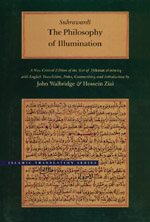
The Philosophy of Illumination by Suhrawardi
Translation: John Walbridge and Hossein Ziai · Brigham Young University, 2000 · ISBN 9780842524575 · Place in sequence: post-Avicennan alternative
Suhrawardi shows why the tradition cannot be reduced to Peripatetic Aristotelianism. His “science of lights” keeps rigorous logical preparation while assigning philosophical weight to immediate, illuminative knowledge. The Stanford account of Suhrawardi helps distinguish his self-conscious rejection and transformation of Avicennan categories from a simple retreat into mysticism. On a first reading, do not force yourself through every logical rule. Read the translators’ introduction, sample Part One, then concentrate on Part Two’s hierarchy of lights, knowledge, prophecy, and eschatology. Walbridge and Ziai’s parallel text remains the essential English edition. The difficulty lies less in individual sentences than in changing metaphors of explanation: essence, existence, light, presence, and intuitive disclosure do not function as interchangeable vocabularies.
Difficulty: Advanced
“In 1186, he completed his most important work, the Philosophy of Illumination”
— Roxanne Marcotte • Stanford Encyclopedia of Philosophy
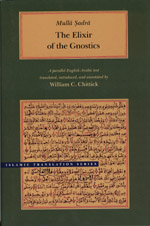
The Elixir of the Gnostics by Mulla Sadra
Translation: William C. Chittick · Brigham Young University, 2003 · ISBN 9780934893701 · Place in sequence: seventeenth-century continuation
End here to destroy the misleading idea that Islamic philosophy expired in twelfth-century Andalusia. Mulla Sadra inherits Avicenna and Suhrawardi while reshaping metaphysics around the primacy and modulation of existence, substantial motion, the soul, and a synthesis of demonstration, scripture, and spiritual discipline. The Stanford account of Mulla Sadra supplies the larger architecture that this compact work cannot. The Elixir is preferable to beginning with the massive Four Journeys: it is shorter, thematically coherent, and translated with Chittick’s extensive notes. Read for the relation between self-knowledge, the soul’s origin and return, and philosophy as transformative practice. Its limitation is representativeness: no single short treatise can carry Sadra’s full metaphysics, but this one gives a manageable doorway into the later tradition.
Difficulty: Demanding
“The Elixir is a unique work of Sadra’s”
— Atif Khalil • American Journal of Islam and Society
How these books fit together
Adamson supplies the map; the anthology supplies voices; Avicenna builds the system; al-Ghazali tests its claims; Averroes defends philosophical inquiry; Suhrawardi changes the epistemic model; Mulla Sadra proves the story continues beyond the classical period.
Common beginner mistakes
Treating “Islamic philosophy” as synonymous with theology erases real methodological conflicts.
Reading al-Ghazali as an anti-rationalist caricature misses his philosophical sophistication.
Ending the history with Averroes makes later Persian and Shi‘i philosophy disappear.
Reading only summaries prevents technical terms such as essence, existence, intellect, and demonstration from acquiring textual precision.
Optional paths depending on your interest
Metaphysics: linger over Avicenna, then move to Suhrawardi and Mulla Sadra.
Reason and revelation: pair al-Ghazali with Averroes before returning to Avicenna.
Logic and language: expand the anthology’s al-Farabi and Avicenna selections with the Stanford guide to Arabic logic.
Latin reception: follow Avicenna and Averroes into the Arabic influence on medieval Latin philosophy.
FAQ
Which Islamic philosophy books should a beginner read first?
Begin with Adamson’s short overview, then use McGinnis and Reisman’s anthology before committing to a major primary system.
Do I need Arabic or Persian?
No for a serious first route; reliable translations suffice, though technical terms should be tracked in glossaries.
Should I read Avicenna cover to cover?
Not initially. Read selected books of the Metaphysics, then return once later debates have made his architecture meaningful.
Did Islamic philosophy end with Averroes?
No. Suhrawardi, Nasir al-Din Tusi, the School of Isfahan, Mulla Sadra, and later traditions make that older narrative untenable.
Related BookInLight Reading Guides
Twenty books that teach you how to read philosophy — general method for beginners.
Aristotle’s unmoved mover in Book Lambda — key background for first-cause metaphysics.
Aristotle’s four causes in Physics II.3 — useful for causation debates.
What to read before Heidegger’s Being and Time — another model of prerequisite-sensitive philosophical reading.
Sources and Further Reading
1. Oxford Academic — Adamson edition, scope, ISBN, publication date.
2. Hackett Publishing — anthology contents, edition, reviews, ISBN.
3. University of Chicago Press — Avicenna/Marmura edition.
4. University of Chicago Press — al-Ghazali/Marmura second edition.
5. University of Chicago Press — Averroes/Butterworth edition.
6. University of Chicago Press — Suhrawardi translation and contents.
7. University of Chicago Press — Mulla Sadra/Chittick edition.
8. SEP: Greek Sources — translation movement and Hellenic inheritance.
9. SEP: Arabic and Islamic Metaphysics — field-wide conceptual history.
10. SEP: Ibn Sina — Avicenna’s system and reception.
11. SEP: al-Ghazali — intellectual context of the Incoherence.
12. SEP: Ibn Rushd — philosophy, law, commentary, religion.
13. SEP: Suhrawardi — Illuminationism and chronology.
14. SEP: Mulla Sadra — later metaphysics and legacy.
15. American Journal of Islam and Society — Atif Khalil’s review of The Elixir.
Image Credits
Philosophy in the Islamic World, OUP paperback, 2015 — exact-edition cover from Amazon; edition verified by OUP.
Classical Arabic Philosophy, Hackett paperback, 2007 — exact-edition cover from Amazon; edition verified by Hackett.
The Metaphysics of The Healing, BYU, 2005 — cover and edition: University of Chicago Press/BYU.
The Incoherence of the Philosophers, 2nd ed., BYU, 2000 — cover and edition: University of Chicago Press/BYU.
Decisive Treatise and Epistle Dedicatory, BYU, 2001 — cover and edition: University of Chicago Press/BYU.
The Philosophy of Illumination, BYU, 2000 — cover and edition: University of Chicago Press/BYU.
The Elixir of the Gnostics, BYU, 2003 — cover and edition: University of Chicago Press/BYU.