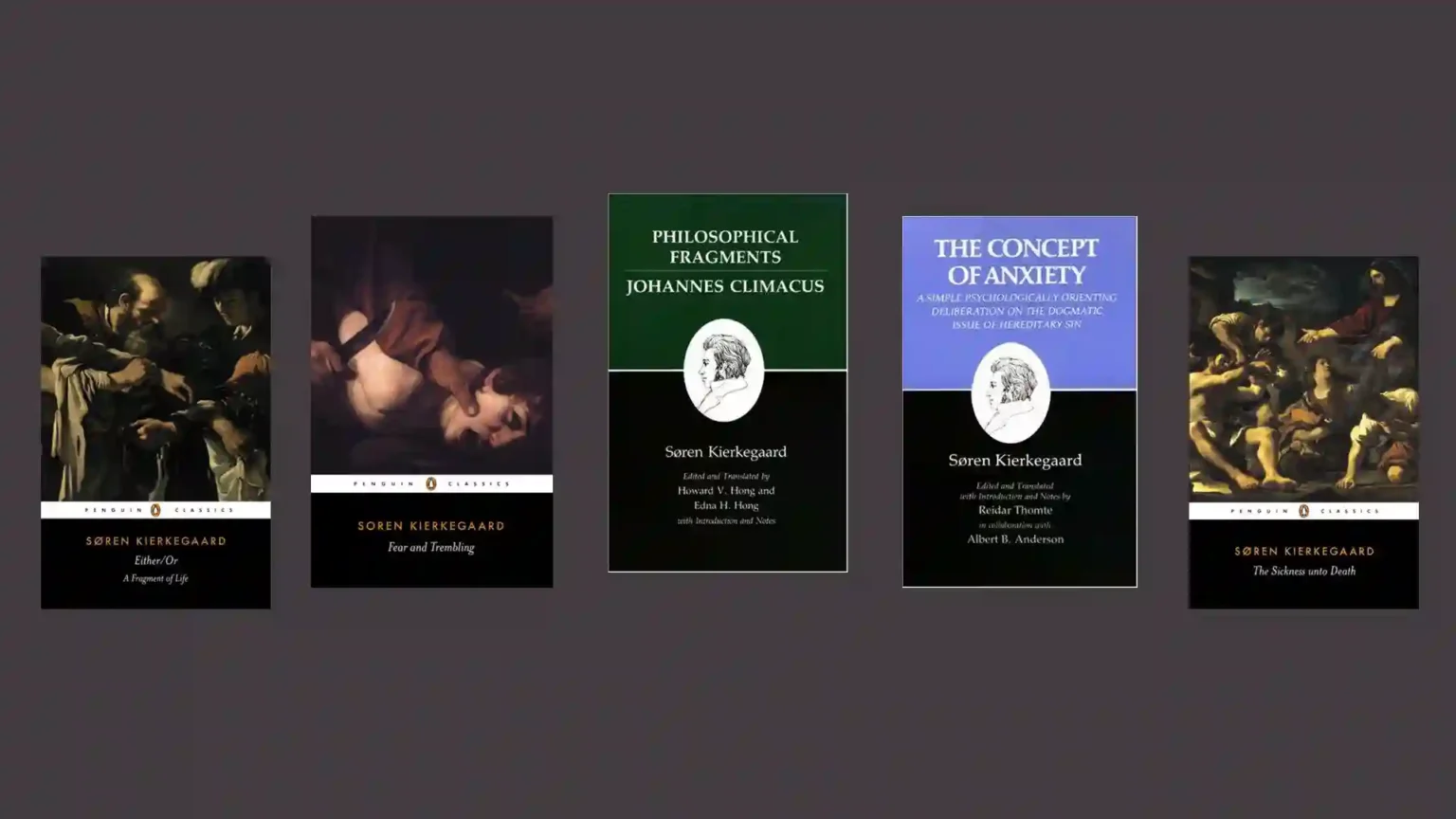
A Kierkegaard reading order should preserve the significance of pseudonyms instead of treating every book as the philosopher’s direct confession.
A chronological list is not yet a reading order. Søren Kierkegaard published many major works in a compressed burst between 1843 and 1846, often under pseudonyms that represent different existential standpoints rather than transparent aliases for the author. The Stanford Encyclopedia of Philosophy chronology shows how dense that period is. A useful route therefore has to preserve three things at once: publication sequence, pseudonymous distance, and the gradual shift from aesthetic and ethical existence toward explicitly Christian categories.
Pseudonym key for this route: Either/Or appeared under the editorial persona Victor Eremita; Fear and Trembling under Johannes de silentio; Repetition under Constantin Constantius; Philosophical Fragments and its Postscript under Johannes Climacus; The Concept of Anxiety under Vigilius Haufniensis; and The Sickness Unto Death and Practice in Christianity under Anti-Climacus. Works of Love was signed by Kierkegaard himself. These are authorial standpoints, not simply interchangeable pen names. Sources: Kierkegaard’s own attribution; Stanford authorship account.
| Stage | Read | Why here |
|---|---|---|
| 1 | Either/Or | Meet aesthetic and ethical voices before receiving a doctrinal key. |
| 2 | Fear and Trembling | Faith appears as a problem that cannot be reduced to ethics. |
| 3 | Repetition | Tests whether existence can be repeated rather than merely remembered. |
| 4 | Philosophical Fragments | Introduces Climacus and the paradox of becoming a Christian. |
| 5 | The Concept of Anxiety | Adds freedom, possibility, sin, and anxiety. |
| 6 | Concluding Unscientific Postscript | Expands Climacus into the great experiment in subjective truth. |
| 7 | Works of Love | Shift to a signed work on Christian love and obligation. |
| 8 | The Sickness Unto Death | Anti-Climacus analyzes despair and the structure of the self. |
| 9 | Practice in Christianity | Pushes Anti-Climacus toward the offense and demand of Christianity. |
| 10 | Late attack writings / journals | Only now reconstruct the authorial strategy and final church conflict. |
Kierkegaard Reading Order, Steps 1–3: Do Not Decide What He “Really Thinks”
Begin with Either/Or. Penguin’s edition description foregrounds the split between the aesthetic voice of “A” and the ethical Judge Vilhelm. That division is not a quiz whose answer is simply “choose ethics.” It trains the reader in Kierkegaard’s indirect communication: positions are given enough life to become attractive, unstable, and internally revealing. Read slowly enough to feel why the aesthetic life can be brilliant and empty at once.
Then read Fear and Trembling. Johannes de silentio cannot make Abraham ethically intelligible, and that failure is the point. Placing the book immediately after Either/Or lets the question sharpen: if ethical universality is the highest category available, what could faith possibly mean? Do not flatten the answer into “religion overrides morality.” The pseudonym repeatedly marks his own inability to become a knight of faith.
Read Repetition third. It is shorter and formally strange, but it keeps the early authorship from becoming a two-book opposition between aesthetic life and faith. Repetition asks whether existence can be received again as a task rather than possessed as a memory. Its experimental form also makes the next step—the Climacus books—less jarring.
4 → 6: let Johannes Climacus change the problem from life-view to knowledge and paradox
Move to Philosophical Fragments before The Concept of Anxiety. Climacus asks how an eternal truth could enter time and how a learner could be transformed in order to recognize it. This creates the conceptual setting for the later Concluding Unscientific Postscript without forcing the reader to digest that huge work immediately.
Next place The Concept of Anxiety. The Princeton translation record makes clear that the book analyzes anxiety in relation to freedom, sin, and the self. In this sequence, anxiety becomes the bridge between possibility and responsibility: freedom is not experienced as pure empowerment but as vertigo. This is also one of the texts that later existential and phenomenological thinkers mined heavily, which makes BookInLight’s existentialism guide useful as a secondary orientation—but only after the Kierkegaardian theological setting is kept in view.
Now read Concluding Unscientific Postscript. It is the summit of the Climacus experiment and should not be used as a first introduction to the phrase “subjective truth.” By this point the reader has seen enough pseudonymous voices to understand that the book’s rhetoric is part of its philosophy. The question is no longer simply which propositions are true; it is what kind of existence is involved in relating to a truth that demands transformation.
7 → 9: change hands—signed Kierkegaard, then Anti-Climacus
After the Postscript, read Works of Love under Kierkegaard’s own name. The change in signature matters. The book’s concern with the command to love the neighbor places ethical and religious demands in a register different from the pseudonymous experiments. The reader can now compare indirect dramatization with direct Christian deliberation rather than pretending they are interchangeable genres.
Then read The Sickness Unto Death. Anti-Climacus gives one of Kierkegaard’s most concentrated analyses of the self and despair. The pseudonym is crucial: he speaks from an idealized Christian standpoint Kierkegaard did not straightforwardly claim for himself. Read Practice in Christianity next, preserving the same distance. Christianity now appears not as cultural identity but as offense, imitation, and demand.
10: only at the end turn the authorship into a map
Once these works have been read, the journals and the late attack on Christendom become much more useful. Princeton’s catalog of Kierkegaard’s Journals and Notebooks shows how extensively drafts, reading notes, personal reflections, and plans survive. They can illuminate the architecture of the authorship, but they should not be used too early to cancel the distance of the pseudonyms by replacing every voice with a biographical explanation.
The recommended route is therefore not strictly chronological and not thematic in the usual sense. It is architectural. Either/Or teaches the multiplicity of voices; Fear and Trembling tests ethics with faith; Repetition complicates existential movement; Climacus turns the problem toward knowledge and paradox; anxiety deepens freedom; the Postscript radicalizes subjective appropriation; the signed works and Anti-Climacus intensify explicitly Christian demands. Only after that should the journals be allowed to explain the machinery.
Readers interested mainly in existentialism can stop after The Sickness Unto Death and circle back. Readers interested in theology should continue into the discourses and late church writings. Readers interested in philosophy of selfhood should compare anxiety and despair with later phenomenology. But preserve the pseudonyms. Kierkegaard’s reading order works best when it does not solve in advance the very problem his authorship constructs: how a truth can be communicated to a reader who must become different in order to receive it.
One final rule prevents a common reading-order mistake: do not collapse ‘early’ into secular and ‘late’ into religious. The signed upbuilding discourses run alongside the pseudonymous works from the beginning, and Christian categories are already structuring the supposedly philosophical books. The route above postpones some signed works for pedagogical clarity, not because they were historically absent. Once the ten-stage sequence is complete, a second pass should interleave the discourses with the pseudonymous publications by date. That rereading reveals the two-handed authorship Kierkegaard himself described: indirect voices on one side, signed religious address on the other.
Cover artwork: credits and source records
- Either/Or — Penguin Classics (source record)
- Fear and Trembling — Penguin Classics (source record)
- Philosophical Fragments — Princeton University Press (source record)
- The Concept of Anxiety — Princeton University Press (source record)
- The Sickness Unto Death — Penguin Classics (source record)