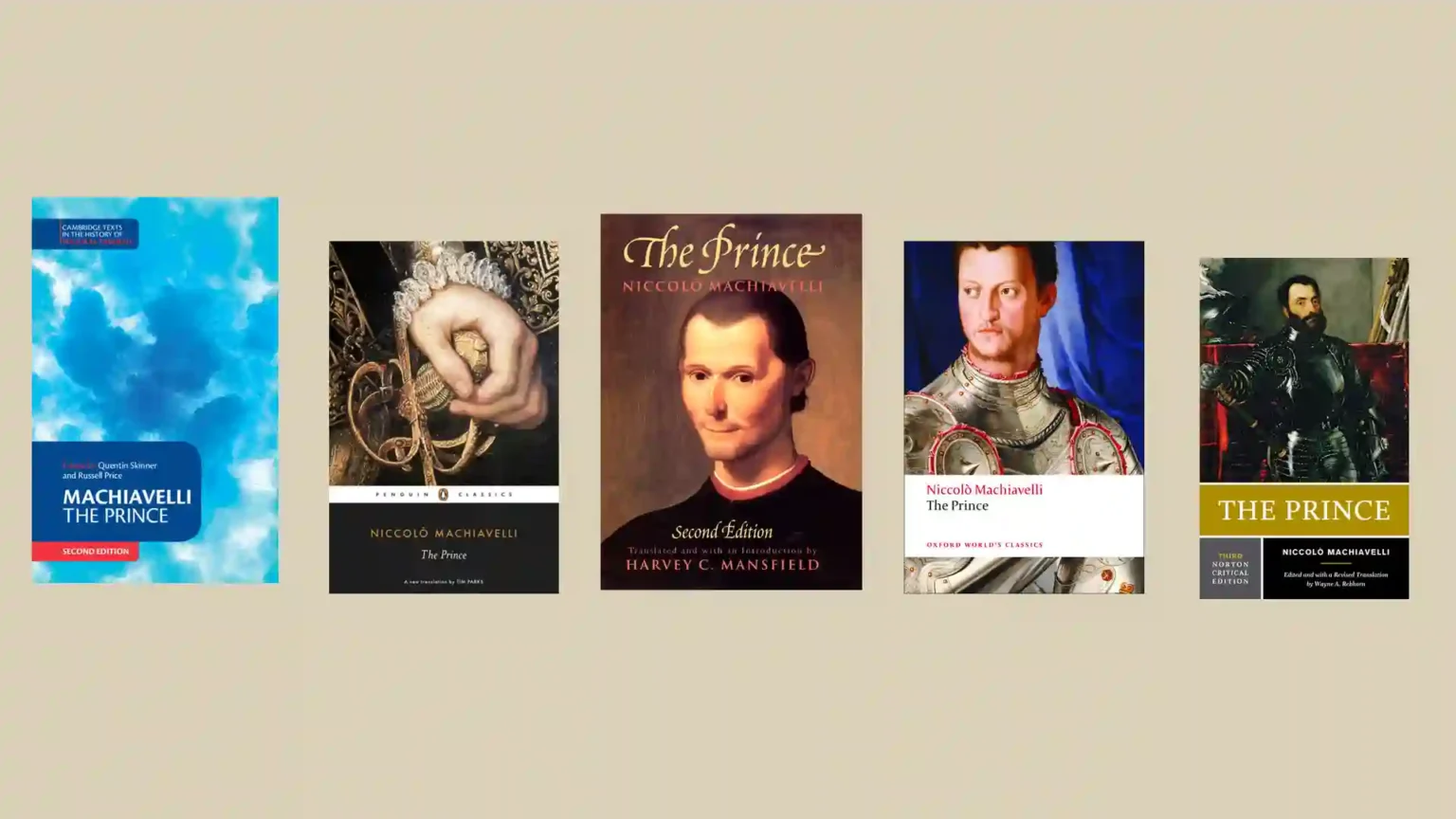
The best edition of The Prince depends on your reading aim: accessible translation, historical notes, precise terminology, or a classroom text.
For most serious first-time readers, buy the 2019 Cambridge edition translated by Russell Price and edited by Quentin Skinner. For the most fluent modern reading experience, choose Tim Parks’s Penguin. For a deliberately close and conceptually literal translation, choose Harvey Mansfield. For balanced notes in a compact classics format, Oxford is strong. For a course that needs primary text, contexts, and criticism in one volume, buy the Norton Critical Edition. There is no edition that wins every category because The Prince is unusually sensitive to translation, historical framing, and the amount of editorial apparatus a reader actually wants.
Best overall: Cambridge
The Cambridge Texts in the History of Political Thought edition is the best all-purpose choice for readers who want Machiavelli situated historically without turning the book into a documentary anthology. The second edition, published in 2019, retains Russell Price’s translation and adds a thoroughly revised and extended introduction by Quentin Skinner, along with an improved timeline, updated bibliography, biographical notes, and a map. Its main advantage is proportion. The apparatus is serious enough to explain the political and intellectual setting but not so extensive that the primary text disappears inside commentary.
Best for fluency: Penguin / Tim Parks
Tim Parks’s Penguin Classics translation is the edition to buy when the main priority is momentum. Published in 2009, it presents modern English with an introduction by the translator. Parks is alert to Machiavelli as a rhetorician: abrupt, provocative, ironic, and capable of switching quickly from compressed maxim to historical example. That makes the edition especially good for readers who have previously encountered The Prince only through quotations about fear, love, foxes, lions, and fortune. The trade-off is that a fluent first reading is not the same thing as maximum conceptual transparency.
Best for close terminology: Chicago / Mansfield
Harvey Mansfield’s University of Chicago Press second edition is more demanding and often more literal in its handling of recurrent terms. The volume includes a substantial glossary, chronology, map, bibliography, introduction, and Machiavelli’s 1513 letter to Francesco Vettori. Readers who care about the consistency with which words such as virtù, stato, ordine, modo, and necessità are rendered will appreciate the resistance to smoothing Machiavelli into contemporary political English. The same feature can make the prose feel less immediately natural. That is not a defect if the purpose is close study.
Best compact scholarly alternative: Oxford
The Oxford World’s Classics edition, translated by Peter Bondanella and edited by Maurizio Viroli, is a strong middle position. Oxford describes the 2008 edition as a fluent new translation with comprehensive notes and an introduction addressing the purpose of the work and common myths surrounding it. It is compact, portable, and better equipped than a bare public-domain reprint for readers who need names, events, and political geography explained as they go.
Best for a seminar: Norton
Wayne A. Rebhorn’s third-edition Norton Critical Edition is not the volume to choose if the goal is simply to carry a slim Prince on a train. It is the strongest choice when the edition itself should function as a course packet. Norton combines Rebhorn’s translation and annotations with other Machiavelli writings, contextual materials, twelve interpretive essays, bibliography, index, and a map. The apparatus lets a seminar move directly from the text to debates about republicanism, rhetoric, morality, historical context, and reception without requiring a second anthology.
| Edition | Translation / editorial posture | Apparatus | Best for |
|---|---|---|---|
| Cambridge, Skinner/Price (2nd ed., 2019) | Historically framed; clear without aggressively modernizing | Revised introduction, timeline, bibliography, biographical notes, map | Best overall serious first edition |
| Penguin, Tim Parks (2009) | Fast, idiomatic, rhetorically alive | Translator introduction; lighter apparatus | Fluent first reading |
| Chicago, Harvey Mansfield (2nd ed., 1998) | Close, terminologically disciplined, deliberately less smoothing | Glossary, chronology, map, bibliography, Vettori letter | Close conceptual study |
| Oxford, Bondanella/Viroli (2008) | Fluent and balanced | Introduction, comprehensive notes, bibliography | Compact scholarly reading |
| Norton Critical, Rebhorn (3rd ed., 2019) | Readable translation embedded in teaching apparatus | Contexts, other writings, 12 critical essays, notes, map | University seminar / comparative criticism |
Do not confuse a cheap complete text with a neutral edition
Public-domain editions can be perfectly usable when price is decisive, but translation provenance matters. BookInLight’s analysis of Dover Thrift Editions uses its 1992 Prince as a revealing case: the low-cost volume is based on an older English lineage and offers little apparatus for judging terms whose translation can change the argument. The issue is not that inexpensive books are inaccurate by definition. It is that ‘complete and unabridged’ answers a different question from ‘which translation and editorial framework best support this reading purpose?’
What changes across translations
A reader comparing editions should watch a handful of recurring terms rather than random sentences. Virtù is the obvious example because English ‘virtue’ can imply a moral harmony Machiavelli repeatedly disrupts. Fortuna is more than luck; stato does not always map cleanly onto the modern bureaucratic ‘state’; necessità can carry both situational compulsion and argumentative force. The Stanford Encyclopedia of Philosophy entry on Machiavelli is a useful conceptual check, while BookInLight’s interpretive essay on The Prince follows necessity, reputation, fortune, arms, and public judgment through the work rather than reducing it to a handbook of manipulation.
The buying decision
Buy Cambridge if there is no special constraint. Buy Penguin if a vivid first encounter matters more than extensive apparatus. Buy Mansfield if repeated terminology and interpretive precision are central. Buy Oxford if you want a compact, well-annotated compromise. Buy Norton if the book is being taught alongside scholarship and contextual documents. Readers building a wider political-theory sequence can use BookInLight’s political science reading route to decide whether The Prince is being read as a classic of political thought, a historical document, or a bridge toward later political analysis.
The apparent question—‘Which edition is best?’—therefore hides a category error. Editions solve different editorial problems. The most useful purchase is the one that makes its compromises visible. For most readers that means Cambridge; for some, another edition will be better precisely because it sacrifices what Cambridge prioritizes. Once that is clear, choosing an edition becomes part of reading Machiavelli rather than a preliminary shopping problem.
Sources consulted
Cambridge edition record; Penguin Tim Parks edition; University of Chicago Mansfield edition; Oxford World’s Classics edition; Norton Critical Edition.
Cover artwork: credits and source records
- The Prince (Cambridge edition) — Cambridge University Press (source record)
- The Prince (Penguin Classics) — Penguin Classics (source record)
- The Prince (Chicago edition) — University of Chicago Press (source record)
- The Prince (Oxford World’s Classics) — Oxford University Press (source record)
- The Prince (Norton Critical Edition) — W. W. Norton (source record)