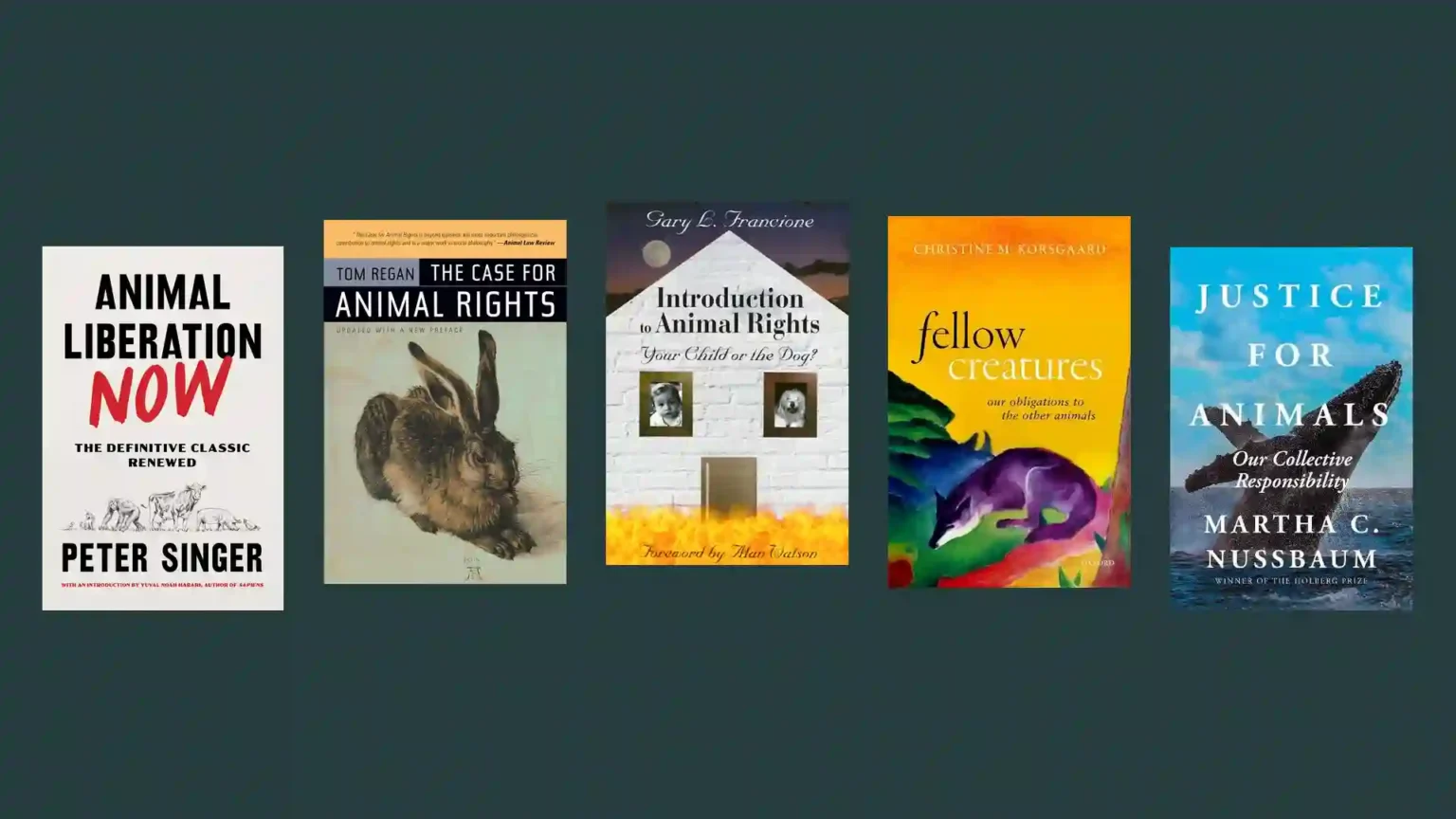
These books on animal rights disagree about welfare, rights, interests, duties, and the status of nonhuman lives; the disagreement matters.
Animal ethics becomes clearer when the reader stops treating “animal rights” as one position. The Stanford Encyclopedia overview of animals’ moral status shows the fault lines: suffering, interests, rights, agency, relationships, and political membership can each ground different claims. The five books below are useful because they do not merely repeat the demand to take animals seriously; they disagree about why animals matter, what counts as an injury, and whether reform of human institutions is enough.
A good comparison therefore needs a stress test. Imagine five recurring cases: painful animal experimentation that could yield major human benefit; a farm that greatly improves welfare but still breeds and kills animals; a legal system that classifies animals as property; a conflict between a human interest and an animal’s flourishing; and a wild animal whose suffering is not caused by a human owner. Each book illuminates some of these cases and strains against others.
Keep one further distinction visible from the beginning: moral status is not yet a complete theory of action. Two authors may agree that animals count morally and still disagree about whether interests can be aggregated, whether rights block trade-offs, whether ownership is inherently wrongful, or whether justice includes positive duties to support flourishing. The comparison becomes useful only when agreement at the level of concern is separated from disagreement about the structure of obligation.
Singer
Peter Singer’s revised Animal Liberation is the consequentialist pressure test. The central challenge is equal consideration of comparable interests: species membership by itself cannot justify discounting suffering. This does not amount to a theory of inviolable animal rights. That distinction matters. Singer’s framework can permit trade-offs that a rights theorist will reject if the overall balance of interests supports them. Read Singer first because he makes the cost of ordinary practices—food production and experimentation—impossible to hide behind the word “tradition.”
The laboratory case exposes both the power and the vulnerability of the view. If comparable pain counts comparably, many experiments become difficult to justify once benefits are speculative or alternatives exist. But a genuine case of enormous benefit can still generate a consequentialist argument for sacrifice. A reader who thinks the individual animal should remain protected even when the numbers favor harm has already reached the point at which Regan becomes indispensable.
Regan
The Case for Animal Rights is the clearest counterexample to the idea that all serious animal ethics must be utilitarian. Regan argues that subjects-of-a-life possess inherent value and must not be treated merely as resources. The contrast with Singer is structural: Singer asks how interests enter an impartial calculation; Regan asks what treatment is ruled out by the standing of the individual. A case in which harming one animal would produce greater aggregate benefit therefore exposes the difference immediately.
Regan also changes what counts as a successful reform. If the central wrong is not simply excess suffering but treating a bearer of inherent value as a resource, then larger cages and less painful killing cannot settle the issue. The farm case becomes a test of status rather than welfare. That is why the book is philosophically stronger when read against Singer rather than as a second route to the same conclusion: the two theories can converge on opposition to a practice while disagreeing radically about the reason.
Francione
Introduction to Animal Rights turns the rights argument toward the legal status of animals as property. Francione’s recurring challenge is institutional inconsistency: societies condemn “unnecessary” suffering while property rules make human uses of animals presumptively important. The book is accessible, but the argument is radical. Welfare reforms can look morally progressive while leaving the basic property relation untouched. Read it after Regan to see how a claim about moral status becomes a claim about abolition rather than improved treatment.
The property case is where Francione earns his place in the set. A moral theory can say that animals matter and yet operate inside institutions that price their interests against owners’ purposes. Francione argues that this legal structure systematically distorts the balancing exercise before it begins. The counterquestion is practical and philosophical at once: can welfare reforms reduce serious harms on the way to deeper change, or do they stabilize the very institution that creates the harms? His answer is far less conciliatory than Singer’s reform-oriented consequentialism.
Korsgaard
Fellow Creatures asks whether a Kantian framework usually associated with rational agents can generate direct obligations to sentient animals. Korsgaard argues that creatures for whom things can be good or bad have a good of their own, and that our own claims to normative standing commit us to taking that good seriously. Her chapter “Are People More Important than the Other Animals?” is a useful stress test because it refuses to let “humanity” function as an unexplained trump card.
Korsgaard’s route matters because it does not begin from adding animal pains to a common welfare ledger or from assigning rights as independent moral atoms. It begins from the standpoint of a creature for whom the world can go well or badly, then asks what our own norm-making commits us to respecting. The conflict case becomes harder: the question is not only whose interest is stronger but what it means for a rational agent to legislate principles while confronting another creature’s good.
Nussbaum
Martha Nussbaum’s Justice for Animals shifts the vocabulary again, toward justice and capabilities. The relevant question is not merely whether an animal is suffering or whether it has a right not to be used. It is whether creatures have real opportunities to exercise species-appropriate forms of life. This widens animal ethics beyond farms and laboratories toward habitat, companionship, captivity, disability, and the treatment of wild animals.
The wild-animal case shows what the capabilities approach adds. If justice concerns opportunities for flourishing, morally relevant deprivation can exist even where no human owns or intentionally harms the creature. That expansion is also controversial: once the theory reaches predation, disease, habitat, and ecological systems, duties become harder to specify without paternalism or ecological disruption. Nussbaum therefore forces a question the earlier books can postpone: is animal ethics mainly about restraints on human use, or can justice require positive support for animal flourishing?
Reform
The most revealing disagreement appears when an institution becomes less cruel without giving up animal use. Singer can welcome a reform when it substantially reduces suffering while still asking whether the remaining practice produces more harm than benefit. Regan asks whether the reform leaves individuals exposed to treatment forbidden by their rights. Francione is more suspicious still when welfare improvement legitimizes a property regime that continues to classify animals as usable things. Korsgaard asks whether the institution can be justified to creatures whose good it subordinates; Nussbaum asks whether the animals retain meaningful opportunities for characteristic forms of flourishing. One policy change therefore receives five different diagnoses.
That difference matters for political strategy. A reader may agree with all five authors that a particular practice is wrong and still face a serious dispute about what counts as progress. Is a less painful system morally better even if its basic status relation survives? Can incremental reform be defended as harm reduction without confusing it with justice? Does insisting on abolition ignore improvements available now, or does reform entrench an institution by making it easier to accept? These are not side questions about activism. They expose what each theory takes the underlying wrong to be.
The fault line
The Stanford Encyclopedia discussion of grounds of moral status helps name what these books are fighting about. Sentience can ground concern because pain and pleasure matter to the subject. Psychological complexity can support richer interests. Rights language can block aggregation. Kantian arguments can derive duties from the structure of normativity. Capability theory can ask what a creature needs in order to flourish. Those grounds overlap, but they are not interchangeable.
This is also why empirical information about human distinctiveness cannot decide the ethical argument by itself. BookInLight’s essay “After the Human Exception: Darwin, Morality, and the Trouble of Descent” is useful background because evolutionary continuity destabilizes simple species boundaries without automatically generating a moral principle. Showing continuity can weaken one exclusionary premise; it does not tell us whether the correct replacement is welfare, rights, abolition, Kantian standing, or capabilities.
The five books are best read as controlled contrasts. Singer asks whether suffering is being discounted. Regan asks whether the individual may be used at all. Francione asks whether property status predetermines the answer. Korsgaard asks what rational norm-makers owe creatures with a good of their own. Nussbaum asks whether justice requires conditions for flourishing. If a reader finishes the set still saying only “animals have rights,” the books have not yet done their work. The real gain is knowing which claim is being made, what grounds it, and which hard case would force it to reveal its limits.
Cover artwork: credits and source records
- Animal Liberation Now — Harper Perennial (source record)
- The Case for Animal Rights — University of California Press (source record)
- Introduction to Animal Rights — Temple University Press (source record)
- Fellow Creatures — Oxford University Press (source record)
- Justice for Animals — Simon & Schuster (source record)