Books on Hegel’s aesthetics should be chosen with the lecture-history problem in view, not just the slogan about the end of art.
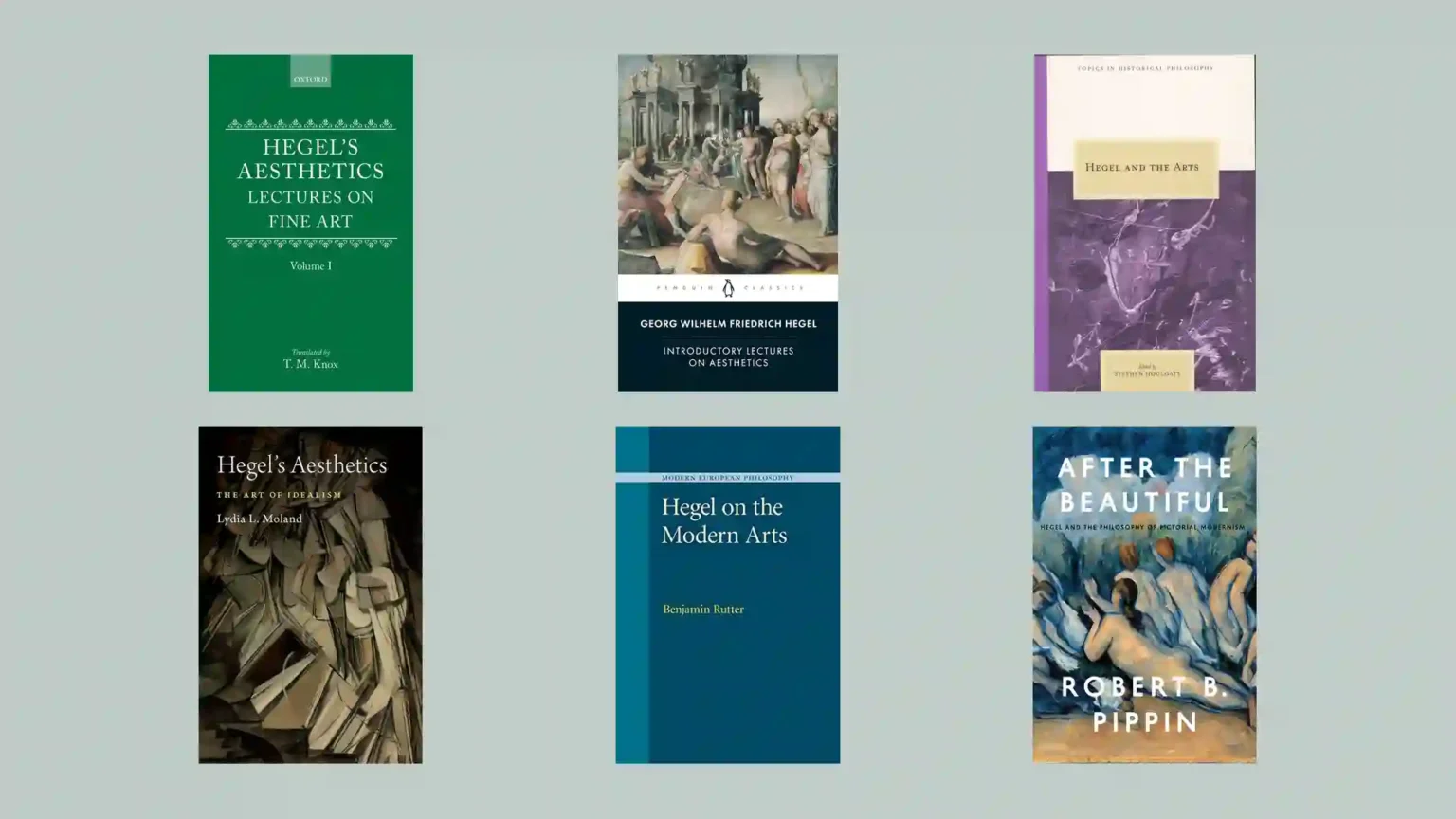
Two books that look as if they serve the same purpose do not. Hegel’s complete Aesthetics: Lectures on Fine Art in the Knox translation is a two-volume reconstruction of the lecture material and the standard English gateway to the full architecture; the much shorter Introductory Lectures on Aesthetics offers a manageable entrance but cannot stand in for Hegel’s detailed treatment of symbolic, classical, and romantic art or of architecture, sculpture, painting, music, and poetry. Confusing these two kinds of book is the first way readers reduce Hegel’s aesthetics to a slogan.
The system and the source problem
1. Hegel, Aesthetics: Lectures on Fine Art. Use the Knox text when you need the whole system in English. It is expansive enough to show that “the end of art” is not a prediction that people stop making artworks. Hegel places art within Absolute Spirit and traces historically changing relations among sensuous form, religious content, freedom, and self-understanding. The free online archive of the Aesthetics text is useful for searching passages, though serious citation should still identify the edition being used.
2. Hegel, Introductory Lectures on Aesthetics. Choose this when you need the general argument before committing to the full lectures. It is especially useful for readers arriving from Kant or German idealism. If Hegel’s systematic vocabulary is the real obstacle, BookInLight’s preparation guide to the Phenomenology of Spirit provides background on negation, spirit, and post-Kantian idealism; it should not be mistaken for an aesthetics prerequisite, but it can prevent basic vocabulary from consuming the art discussion.
3. Stephen Houlgate, ed., Hegel and the Arts. This collection is the best bridge from “Hegel’s philosophy of art” to Hegel on particular arts. Its chapters test architecture, sculpture, painting, music, tragedy, romanticism, religion, and the end-of-art thesis. The advantage is diagnostic: if your interest is music or tragedy, you can see quickly which parts of the system become relevant without reading the lecture corpus as an undifferentiated block.
4. Lydia L. Moland, Hegel’s Aesthetics: The Art of Idealism. Moland reconstructs the aesthetics from a wider range of lecture sources and makes idealism rather than “end of art” the organizing problem. Her account distinguishes several senses in which art can end and reconnects Hegel’s individual arts to perception, feeling, selfhood, and freedom. It is the strongest book here for readers who want a contemporary systematic interpretation rather than a collection of specialist essays.
5. Benjamin Rutter, Hegel on the Modern Arts. Rutter asks what Hegel can say about painting, poetry, the novel, and modern artistic value after the supposed decline of art’s highest vocation. The book is important because it refuses to let the end-of-art debate eclipse the actual arts. Its treatment of Dutch painting, lyric poetry, and virtuosity turns Hegel from a philosopher who announces art’s death into a critic of distinctive artistic modes of freedom.
6. Robert Pippin, After the Beautiful. Pippin takes Hegel beyond Hegel’s own historical horizon by bringing his account of modernity to Manet and Cézanne. This is the book to read if your question is not “What did Hegel say?” but “Can a Hegelian philosophy of art illuminate modernism that Hegel never saw?” It also forces the end-of-art thesis to confront art history rather than remain a proposition about systematic rank.
Choose by the problem you actually have
| If you need… | Start with… | Then move to… |
|---|---|---|
| The complete primary architecture | Hegel, Aesthetics (Knox) | Moland for systematic reconstruction |
| A shorter first encounter | Introductory Lectures | Houlgate for particular arts |
| The “end of art” without caricature | Moland | Rutter, then Pippin |
| Painting, poetry, music, tragedy | Houlgate | Rutter for modern arts |
| Hegel and modernism | Pippin | Rutter, then selected primary lectures |
The table hides one complication: “Hegel’s Aesthetics” is itself an editorial object. Hegel did not publish the lecture course as the finished book most English readers encounter. The surviving lecture materials and later editorial reconstructions matter because modern scholarship can compare lecture series and question how confidently any single printed formulation represents Hegel’s settled view. The Stanford Encyclopedia entry on Hegel’s aesthetics is a reliable orientation to both the philosophy and the source situation.
Three reader routes follow. For a philosophical route, read the Introductory Lectures, then Moland, then selected Knox sections on the Idea, forms of art, and the individual arts. For an art-historical route, begin with Houlgate, use the primary lectures selectively, then read Rutter and Pippin. For the end-of-art question, reverse the usual order: read Moland and Rutter before returning to the primary passages. That route makes it harder to mistake “art no longer has its highest vocation” for “art is over.”
The six books do not solve the same problem, and that is precisely why they belong together. One supplies the reconstructed system, one lowers the entry threshold, one distributes the theory across arts, one rebuilds its idealist logic, one retrieves modern art from a pessimistic reading, and one tests Hegel after the historical period he knew. The map is more useful than a ranking.
The editorial history behind Hegel’s published Aesthetics
The source problem deserves more than a footnote. What English readers call Hegel’s Aesthetics derives from lecture courses delivered in Berlin and edited posthumously from manuscripts and student notes. Recent scholarship has gained access to more differentiated lecture materials, which is one reason a modern interpreter such as Moland can reconsider how securely familiar formulations belong to Hegel’s own lectures. This does not make the Knox edition useless. It makes edition-conscious reading part of interpretation.
The system also matters because Hegel does not rank artworks by detachable formal criteria. Art gives sensuous presentation to ways a culture understands divinity, freedom, subjectivity, nature, and itself. His sequence from symbolic through classical to romantic art is therefore simultaneously philosophical and historical. The SEP guide to Hegel’s aesthetics is useful for seeing how art’s changing vocation fits Hegel’s account of Absolute Spirit without requiring the reader to master the entire Logic first.
That context changes the “end of art.” Hegel’s claim is about art’s highest vocation as the privileged sensuous presentation of truth, not about an empirical end to painting, poetry, or music. Rutter exploits this distinction by reconstructing modern artistic values from the lectures themselves; Pippin asks how a Hegelian account might illuminate modernist painting beyond Hegel’s lifetime. Their disagreement with simplistic endings is not a charitable repair from outside. It emerges from the complexity of Hegel’s own relation between art and modern freedom.
Test the philosophical claims against artworks
Finally, do not read the secondary books as substitutes for artworks. Hegel’s claims become more intelligible when tested against the media he analyzes: Greek sculpture, Dutch genre painting, lyric poetry, tragedy, music. The essays in Hegel and the Arts are particularly useful for this reason. They force systematic claims to answer to particular arts, where questions of sensuous embodiment, interiority, temporality, and expression take different forms.
This also explains why the best Hegel reading list mixes primary, editorial, systematic, and art-historical books. No single volume can answer simultaneously what Hegel said in a particular lecture, how the published Aesthetics was constructed, how art fits the system, and whether the theory survives modernism. Treating those as separate questions is not pedantry; it prevents an editorial reconstruction from masquerading as a single timeless text.
That division of labor is the real advantage of the six-book map: it lets the reader move between text, system, individual arts, and later reception without pretending that one interpretive problem can settle all the others.
Cover artwork: credits and source records
- Aesthetics: Lectures on Fine Art, Volume 1 — Oxford University Press (source record)
- Introductory Lectures on Aesthetics — Penguin (source record)
- Hegel and the Arts — Northwestern University Press (source record)
- Hegel’s Aesthetics: The Art of Idealism — Oxford University Press (source record)
- Hegel on the Modern Arts — Cambridge University Press (source record)
- After the Beautiful — University of Chicago Press (source record)