Five books on Frankfurt School aesthetics disagree on art’s critical potential, cultural industry, autonomy, and modernism.
The central disagreement in Frankfurt School aesthetics is easy to hide by calling everything “critique of mass culture.” Walter Benjamin can treat technological reproducibility as a transformation with emancipatory possibilities; Adorno can defend the autonomy and difficulty of art while distrusting administered culture; Marcuse can insist that aesthetic form preserves a promise of liberation even when art is socially compromised. The Stanford Encyclopedia overview of aesthetics in Critical Theory is useful because it keeps those tensions visible rather than inventing a school doctrine.
1. Benjamin — art and technological reproducibility
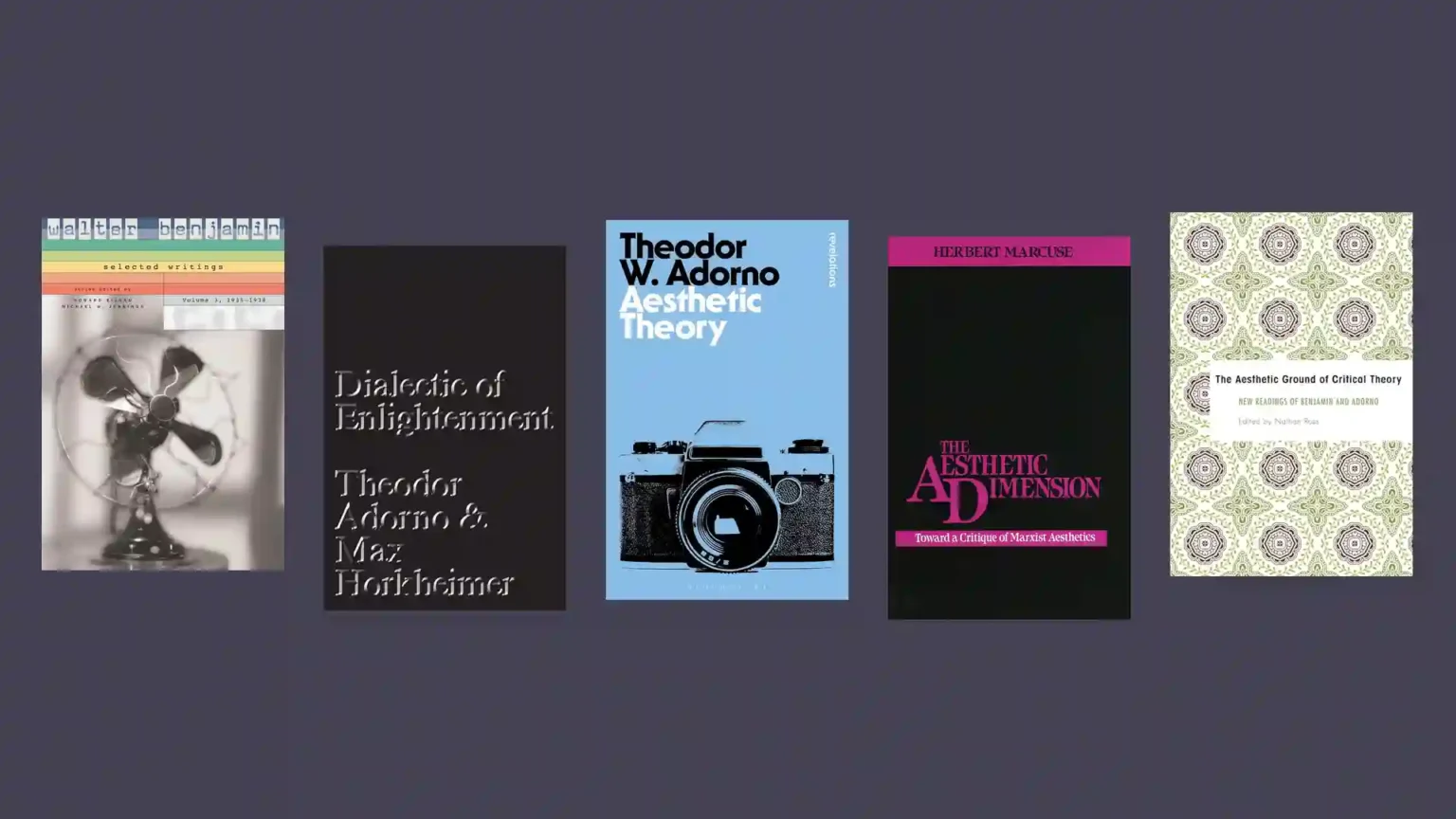
Begin with Walter Benjamin in the 1930s. The third volume of his Selected Writings contains the second version of “The Work of Art in the Age of Its Technological Reproducibility.” Its historical evidence is media-specific: photography, film, reproducibility, exhibition value, collective reception. Benjamin’s wager is not that technology automatically democratizes art. It is that technological conditions reorganize perception and the politics of cultural authority.
2. Horkheimer and Adorno — the culture industry
Then read Max Horkheimer and Theodor W. Adorno’s Dialectic of Enlightenment, especially “The Culture Industry.” Here mass cultural production is less an opening than a system of standardization, pseudo-individuality, and adaptation. Put beside Benjamin, the evidence conflicts productively. The same modern conditions that can shatter inherited ritual authority may also intensify commercial administration. “Mass culture” stops being a single empirical object and becomes a dispute about institutions, audiences, technology, and power.
3. Adorno — autonomy and aesthetic form
Adorno’s Aesthetic Theory then changes scale again. The work is not a longer Culture Industry essay. It asks how autonomous artworks, precisely through formal difficulty and their refusal to become transparent social messages, can register damaged social reality. The SEP entry on Adorno helps with terms such as autonomy, mimesis, truth content, and nonidentity, but the primary text matters because Adorno’s own form resists the easy extraction of theses.
4. Marcuse — the aesthetic dimension
Herbert Marcuse’s short The Aesthetic Dimension is the best counterweight to a caricature in which Marxist aesthetics values works only when their politics are explicit. Marcuse argues against reducing art to class standpoint or correct content. Aesthetic form can estrange ordinary reality, preserve negated possibilities, and give sensuous shape to needs that existing society suppresses. The book’s optimism about art’s emancipatory potential is not Adorno’s, even when their defenses of aesthetic autonomy overlap.
5. The later debate in critical theory
Finally read Nathan Ross’s edited The Aesthetic Ground of Critical Theory. A secondary collection belongs fifth because the Benjamin–Adorno relationship is too often taught through a few famous oppositions: aura versus reproduction, optimism versus pessimism, popular culture versus high art. The essays reopen the correspondence between aesthetic experience and philosophical critique, showing both continuities and unresolved tensions.
How the five works disagree
The evidence matrix is therefore unstable by design. Benjamin asks what new media do to perception. Horkheimer and Adorno ask how industrial organization shapes cultural consumption. Aesthetic Theory asks how artworks can embody social contradiction without becoming sociology in disguise. Marcuse asks how form can preserve possibilities excluded by reality. Later scholarship asks whether these positions can still be held together under the name “Critical Theory.”
This is also why a five-book list should not end with a verdict on whether the Frankfurt School was “elitist.” That label sometimes identifies a real problem—especially when popular pleasures are treated as signs of domination—but it can also erase the internal dispute over jazz, film, reproduction, autonomy, and political efficacy. The broader SEP entry on Critical Theory provides the institutional and philosophical background; the entry on Marcuse shows why his aesthetics cannot simply be treated as a softer Adorno.
The most revealing primary object remains a contradiction: a technologically reproduced work that is commercially distributed yet formally disruptive, collectively consumed yet capable of estrangement. Put that object between Benjamin and Adorno rather than choosing one in advance. Frankfurt School aesthetics becomes most useful when the artwork is allowed to make the theory disagree with itself.
Further reading: Stanford Encyclopedia: Aesthetics in Critical Theory · Adorno · Marcuse
The Benjamin–Adorno disagreement is especially instructive because it is not a clean division between a technophile and an elitist. Adorno valued formal experimentation and could recognize historical changes in media; Benjamin was acutely aware that fascism could mobilize aestheticized politics. Their divergence concerns how mediation, collective reception, autonomy, and commodification alter the political capacities of art. The field becomes more accurate when this is treated as a dispute over mechanisms rather than temperaments.
A second disagreement concerns autonomy. In Aesthetic Theory, autonomy is socially produced and contradictory: the artwork withdraws from immediate usefulness, yet its very separation can preserve a critical relation to society. Marcuse’s Aesthetic Dimension also defends form against demands for direct political messaging, but he gives aesthetic estrangement a more affirmative emancipatory accent. The similarity makes the difference easier to see.
The later collection The Aesthetic Ground of Critical Theory is valuable because it refuses to treat these tensions as museum pieces. Questions about streaming platforms, algorithmic recommendation, franchised culture, political art, and avant-garde difficulty still reproduce the older problem: when does accessibility create a new public, and when does it become adaptation to administered demand? Frankfurt School aesthetics remains useful only if those questions are investigated rather than answered in advance.
The five-book route therefore moves from altered perception, through industrial cultural organization, to autonomous form and its emancipatory promise. It is deliberately not chronological completion. Each book supplies a pressure the others cannot absorb. If a theory makes every popular work administered, Benjamin asks what new modes of reception can do. If reproduction is treated as liberation by itself, Adorno asks who organizes the apparatus. If autonomy becomes withdrawal, Marcuse asks what negated possibilities form can preserve.
Cover artwork: credits and source records
- Selected Writings, Volume 3: 1935-1938 — Harvard University Press (source record)
- Dialectic of Enlightenment — Verso (source record)
- Aesthetic Theory — Bloomsbury (source record)
- The Aesthetic Dimension — Beacon Press (source record)
- The Aesthetic Ground of Critical Theory — Rowman & Littlefield (source record)