These books on aesthetic judgment do not offer one consensus: taste, disinterestedness, social practice, and artistic value pull apart.
A disagreement about aesthetic judgment begins before anyone says whether a painting is beautiful. Is the judgment a refined sentiment, a claim to universal assent, a report of an experience, an exercise of perceptual discrimination, a socially conditioned distinction, or an assessment relative to an artistic category? The contemporary Stanford Encyclopedia overview makes clear why the field cannot be organized around a single opposition between “subjective” and “objective.” The seven books below are useful because each changes the question.
1. Hume — cultivated judgment
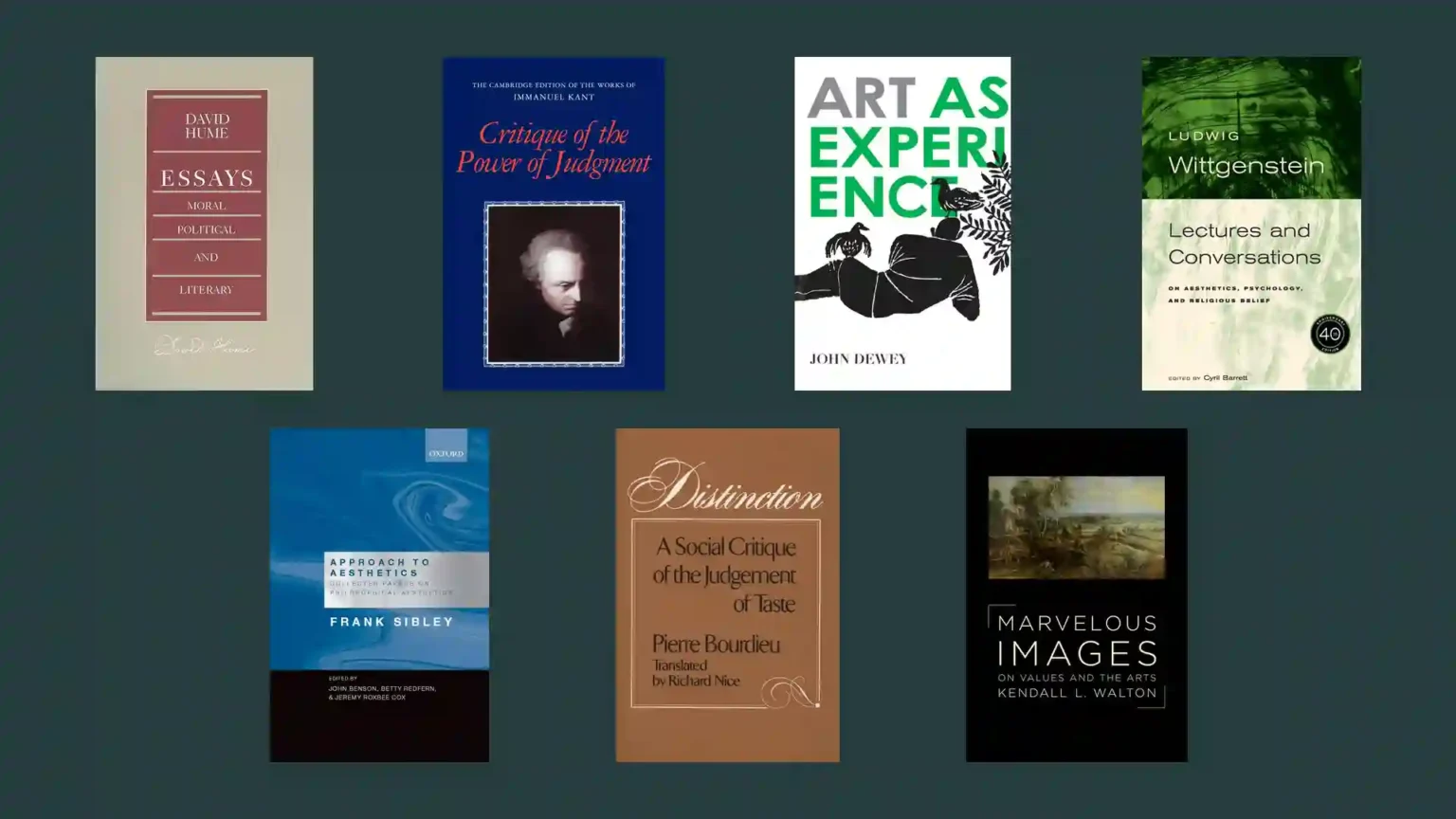
1. David Hume, Essays, Moral, Political, and Literary. Read “Of the Standard of Taste” as a problem about authority among sentiments. Hume does not turn aesthetic judgment into proof. He asks why extensive practice, comparison, delicacy, sound understanding, and freedom from prejudice make some critics better than others while leaving room for real diversity. This is the right opening book because it makes disagreement itself part of the evidence.
2. Kant — universal validity without a concept
2. Immanuel Kant, Critique of the Power of Judgment. Kant changes the grammar. A pure judgment of taste is grounded in pleasure yet claims a kind of universal validity without proving the object beautiful by a concept. The SEP guide to Kant’s aesthetics is indispensable because “subjective universality,” disinterestedness, purposiveness without purpose, and the free play of the faculties are easy to flatten into slogans. Kant is not merely saying that everyone ought to like the same things.
3. Dewey — aesthetic experience
3. John Dewey, Art as Experience. Dewey shifts attention from verdicts to the temporal organization of experience. An artwork is not simply an object that receives a predicate; aesthetic experience emerges through doing, undergoing, tension, consummation, and continuity with ordinary life. This is a counterexample to theories that start as if judgment were a detached sentence uttered after perception has finished.
4. Wittgenstein — practice and context
4. Ludwig Wittgenstein, Lectures and Conversations on Aesthetics. These are student notes rather than a polished book by Wittgenstein, a textual fact the SEP entry on Wittgenstein’s aesthetics emphasizes. Their value is methodological. Wittgenstein directs attention to practices of comparison, correction, trained reaction, and reasons given within a culture. “Beautiful” is rarely the most informative word in criticism. What matters is learning what counts as getting a passage, gesture, proportion, or performance right.
5. Sibley — aesthetic perception
5. Frank Sibley, Approach to Aesthetics. Sibley’s essays give the most precise account in this list of aesthetic concepts and the perceptiveness required to apply them. His famous discussion of aesthetic concepts denies that non-aesthetic features mechanically entail aesthetic descriptions. A critic can point, compare, and educate attention without possessing an algorithm for “graceful,” “balanced,” or “gaudy.”
6. Bourdieu — taste and social distinction
6. Pierre Bourdieu, Distinction. Bourdieu makes the supposedly disinterested judge socially visible. Taste sorts people as well as objects; competence, education, class position, and cultural capital structure what can appear natural or refined. Read Bourdieu after Kant, not instead of Kant. The productive question is whether a philosophical account of the normativity of taste can survive a sociology of who acquires the dispositions that make certain tastes authoritative.
7. Walton — categories of art
7. Kendall Walton, Marvelous Images. Walton’s essays pull judgment toward categories, history, and the way works are perceived under descriptions. His classic essay on “Categories of Art” shows that aesthetic properties can change with the category under which a work is correctly perceived. The same physical marks can look dynamic, awkward, or standard depending on relevant artistic practices.
Putting the seven approaches to the test
These seven positions do not form a chronological staircase. Hume and Kant ask how a judgment can reach beyond private liking. Dewey asks whether the isolated judgment is already an abstraction from experience. Wittgenstein and Sibley shift from foundations toward the education of attention. Bourdieu asks whose education and which social institutions are being naturalized. Walton shows that perceptual description itself depends on art-historical categorization.
A useful stress test is a difficult avant-garde work that initially seems ugly or pointless. Hume asks whether practice and comparison could refine the judge. Kant asks what kind of pleasure and demand for assent are involved. Dewey asks whether the experience can achieve a meaningful unity. Wittgenstein asks what competent participants actually do when they criticize it. Sibley asks which features become aesthetically salient to a perceptive observer. Bourdieu asks what social formation made this response available. Walton asks whether you are perceiving the work in the right category at all.
That stress test also shows why the phrase “aesthetic judgment” can conceal several jobs: describing aesthetic character, evaluating merit, explaining reasons, reporting pleasure, and locating an object in a practice. The revised SEP entry on the concept of the aesthetic is a good map of these fractures. BookInLight’s discussion of Kant and disciplined enthusiasm can also help readers who need a broader sense of how Kant ties judgment to freedom and public reason without making aesthetic experience reducible to politics.
If you teach the seven together, do not ask students to rank them by “objectivism.” Ask instead which problem each theory can explain without borrowing unnoticed resources from another. That question produces sharper disagreements—and makes it harder for any one vocabulary to pretend it has already defined what an aesthetic judgment is.
A second comparison concerns reasons. Hume’s good critic can cite discriminations formed by practice; Kant’s judgment cannot be derived from determinate concepts; Sibley insists that no set of non-aesthetic properties mechanically entails an aesthetic term. Yet none of the three concludes that reasons are useless. This is why the SEP overview of aesthetic judgment spends so much time on normativity and disagreement. A reason in criticism may direct attention, reveal a relation, or invite a competent response without functioning like a proof in geometry.
Dewey and Wittgenstein then complicate the picture from opposite directions. Dewey makes evaluation continuous with an unfolding experience whose parts acquire significance through rhythm and consummation. Wittgenstein makes critical judgment look embedded in learned practices of comparison and correction. Neither account is well captured by asking whether beauty is “in the object” or “in the subject.” The better question is what capacities, histories, and forms of attention make a judgment answerable to something beyond momentary preference.
Bourdieu and Walton create a final pressure point. Bourdieu’s Distinction shows that the cultivated eye has a social history; Walton’s Marvelous Images shows that the work must be perceived under historically appropriate categories. Those claims can reinforce one another—both reject the fantasy of a view from nowhere—but they need not collapse into relativism. Social formation can explain why a competence is unequally distributed without proving that every exercise of that competence is arbitrary. Category-dependence can make perception historical without making every category equally correct.
Read the sequence again with one question held constant: when two people disagree, what would count as improvement? Hume says cultivate the judge. Kant says examine the kind of pleasure and claim to assent involved. Dewey says reorganize the experience. Wittgenstein says learn the practice and its comparisons. Sibley says become perceptive to aesthetic features. Bourdieu says expose the social conditions that made the judgment seem natural. Walton says check the category through which the work is seen. Seven books now become seven models of aesthetic education.
Cover artwork: credits and source records
- Essays, Moral, Political, and Literary — Liberty Fund (source record)
- Critique of the Power of Judgment — Cambridge University Press (source record)
- Art as Experience — Perigee (source record)
- Wittgenstein: Lectures and Conversations on Aesthetics, Psychology and Religious Belief — University of California Press (source record)
- Approach to Aesthetics — Oxford University Press (source record)
- Distinction — Harvard University Press (source record)
- Marvelous Images — Oxford University Press (source record)