Books on testimony and knowledge disagree about when another person’s word can justify belief and what independent support is required.
A bibliographic puzzle sits at the entrance to the epistemology of testimony. Human knowledge is massively dependent on what other people say, yet much modern epistemology was built as though the normal knower were an individual checking evidence personally. If testimony is indispensable, what gives a hearer epistemic permission to accept it? The seven books below do not merely supply seven defenses of testimony. They disagree about where the warrant comes from, whether knowledge is transmitted or newly generated in the hearer, and how trust and social environment enter the explanation.
Coady: why is testimony not a second-rate source?
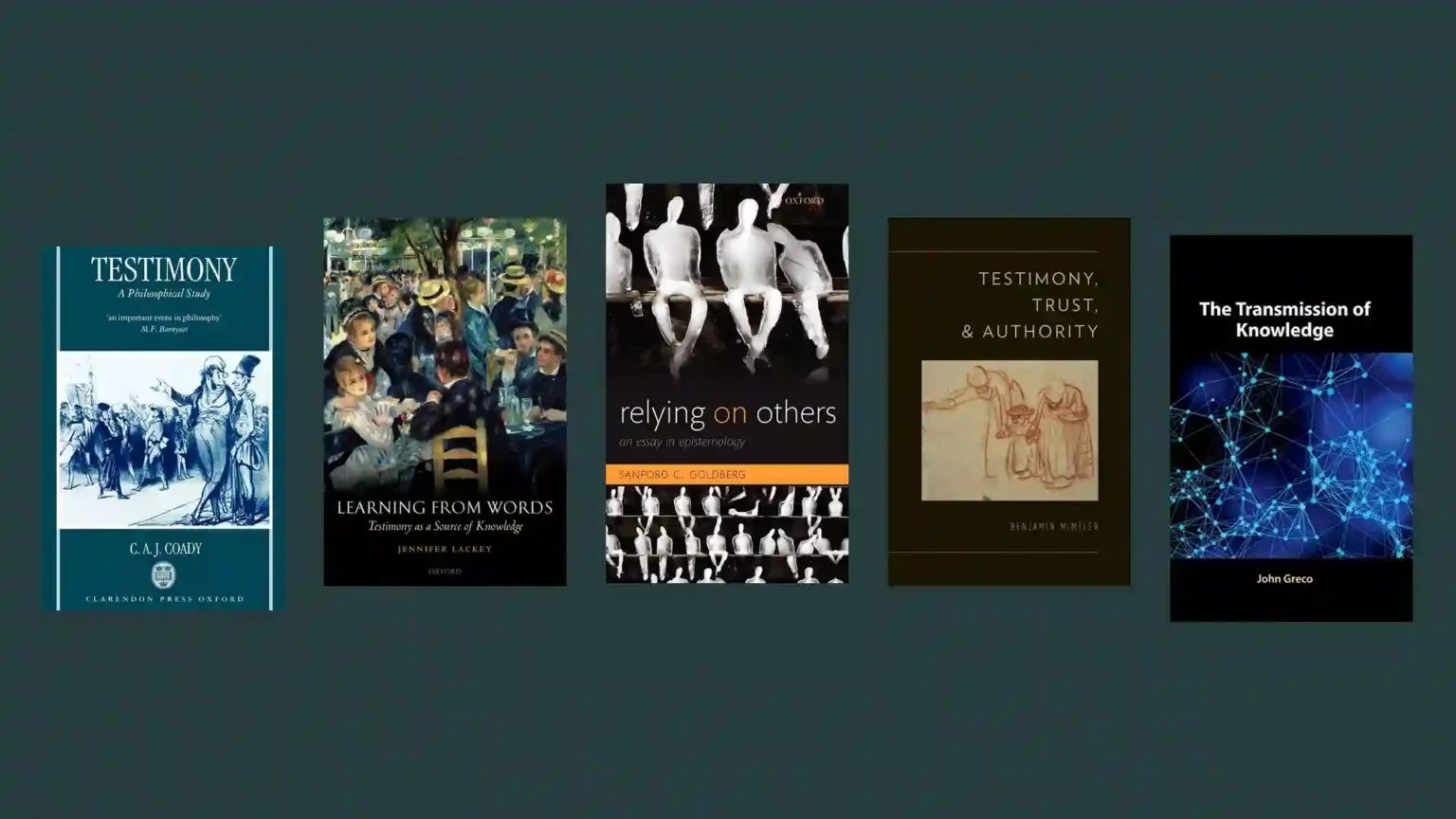
C. A. J. Coady’s Testimony: A Philosophical Study is the modern field-setting book because it challenges the picture of testimony as evidence that must always borrow its authority from perception, memory, or inductive checking. His chapter on “The Domain of Testimony” pushes the point beyond courtroom cases: language learning, history, geography, science, and ordinary social life already presuppose dependence on speakers. The counterexample pressure is simple. A theory that demands independent verification for every testimonial belief seems unable to explain how enough independent knowledge could ever be accumulated to begin the verification project.
Lackey: is knowledge merely passed from speaker to hearer?
Jennifer Lackey’s Learning from Words accepts testimony’s centrality while attacking simple pictures on both sides of the reductionist divide. Her critique of reductionism and non-reductionism and her later development of a dualism about testimonial justification and knowledge emphasize that speaker and hearer can contribute differently to successful testimony. A useful counterexample is the knowledgeable hearer who corrects or filters an unreliable speaker: if the hearer can acquire knowledge even when the speaker does not possess the relevant knowledge in the required way, a pure “transmission” model looks too simple.
Goldberg: how far does the epistemic process extend?
Sanford Goldberg’s Relying on Others moves the unit of analysis outward. On a social-reliabilist picture, whether a hearer is well positioned can depend on the reliability of processes and environments that include other people. Goldberg’s discussion of process and environment makes testimonial knowledge less like importing a proposition from another mind and more like participating in an extended epistemic system. The challenge for this view is explanatory control: if the social environment carries part of the epistemic burden, which features of that environment are constitutive of the hearer’s justification and which are merely causally helpful?
McMyler and Faulkner: is believing testimony partly a relation of trust?
Benjamin McMyler’s Testimony, Trust, and Authority treats testimonial exchange as distinctively interpersonal. A speaker does not merely emit evidence; in telling someone something, the speaker may undertake responsibility for its truth, giving the hearer a second-personal reason to believe. Paul Faulkner’s Knowledge on Trust also makes trust central, but the philosophical work is not identical. Trust has to be distinguished from blind acceptance, reliance, and prediction. These approaches capture something that impersonal reliabilism can miss—the normative relation between teller and hearer—but they face counterexamples involving anonymous sources, institutional testimony, and information obtained where no personal assurance is present.
Greco: what exactly is transmitted?
John Greco’s The Transmission of Knowledge restores transmission to center stage but develops it through social epistemology rather than a crude copy model. The question becomes whether knowledge can be a genuinely social achievement whose success depends on the competences and normative positions of multiple agents. That reframes familiar counterexamples. A speaker may possess knowledge but fail to transmit it because the communicative act is defective; a hearer may end with a true justified belief but not through the right social route. The object being tracked is therefore not simply truth, but an epistemically successful act connecting agents.
The edited field: can one theory survive all the cases?
The collection The Epistemology of Testimony, edited by Jennifer Lackey and Ernest Sosa, is the seventh book because it prevents the reading path from ending with a single victor. Elizabeth Fricker’s chapter on “Testimony and Epistemic Autonomy”, for example, keeps alive the worry that responsible hearers must exercise discriminatory capacities rather than default credulity. Other contributions approach testimony through entitlement, virtue, reliability, and social dependence. As a field map, the volume shows that “Is testimony a basic source?” is not one question but a cluster: justification, knowledge, defeaters, responsibility, transmission, and trust can come apart.
| Book | Primary explanatory center | Case that pressures it |
|---|---|---|
| Coady — Testimony | Testimony as a fundamental social source | The impossibility of independently checking the testimonial background on which checking depends |
| Lackey — Learning from Words | Joint contributions of speaker and hearer | Knowledgeable hearer / unreliable or non-knowing speaker cases |
| Goldberg — Relying on Others | Socially extended reliable process | Which environmental contributors count as epistemically relevant? |
| McMyler — Testimony, Trust, and Authority | Second-personal responsibility and authority | Anonymous or institutional testimony without personal assurance |
| Faulkner — Knowledge on Trust | Trust as an epistemic relation | Reliable acceptance that lacks interpersonal trust |
| Greco — The Transmission of Knowledge | Successful social transmission of knowledge | True belief acquired despite failure of the transmitting act |
| Lackey & Sosa, eds. — Epistemology of Testimony | Plural field of entitlement, autonomy, virtue, and defeat | No single case-set settles all dimensions at once |
The matrix also explains why the reductionism/non-reductionism label is necessary but insufficient. Two philosophers can agree that testimony is irreducible to the hearer’s non-testimonial evidence and still disagree about whether acceptance is grounded in a default entitlement, in social reliability, in a speaker’s assurance, or in a knowledge-transmitting act. Conversely, two views can both demand hearer sensitivity to defeaters while locating the positive source of warrant in very different places.
A further counterexample concerns institutions. A weather service, a laboratory, a court, and an encyclopedia speak through procedures rather than a single identifiable teller. Trust theories must explain how responsibility is distributed; reliabilist theories must explain how a hearer can rationally depend on processes they cannot audit; autonomy-centered theories must avoid requiring impossible expertise from ordinary users. Institutional testimony is not a marginal case. It is where modern knowledge makes the tension between dependence and responsibility most visible.
No seven-book route settles the matter because the remaining uncertainty is principled. The field still lacks agreement on whether testimonial knowledge has one general architecture across intimate conversation, expert institutions, digital networks, and collective inquiry. A theory that handles one setting elegantly can become strained in another. The unresolved evidence is therefore not simply “more examples needed”; it is whether testimony names one epistemic kind or several socially related kinds that should not be forced under a single model.
Defeaters and expertise: where the theories converge only partly
The seven positions are less divided about one practical point than their theoretical vocabularies suggest: testimonial acceptance is defeasible. Evidence that a speaker is joking, biased, incompetent, badly placed, or contradicted by stronger sources can rationally block uptake. The disagreement concerns what exists before such a defeater appears. Does a hearer begin with a presumptive entitlement, with socially reliable dependence, with reasons grounded in trust, or with an interpersonal assurance? Expert testimony sharpens the issue because non-experts often cannot reproduce the expert’s evidence. A theory that makes responsible belief depend on independent verification becomes unrealistic; a theory that makes deference automatic becomes credulous. The hard cases therefore sit between autonomy and dependence, where a hearer must assess markers of competence and institutional reliability without becoming an expert in the first-order subject.
Compact bibliography
Primary comparison set: Coady; Lackey; Goldberg; McMyler; Faulkner; Greco; and the Lackey–Sosa collection.
Cover artwork: credits and source records
- Testimony — Oxford University Press (source record)
- Learning from Words — Oxford University Press (source record)
- Relying on Others — Oxford University Press (source record)
- Testimony, Trust, and Authority — Oxford University Press (source record)
- The Transmission of Knowledge — Cambridge University Press (source record)