Political philosophy editions differ in translation, textual accuracy, notes, and pedagogy; this guide chooses by student need.
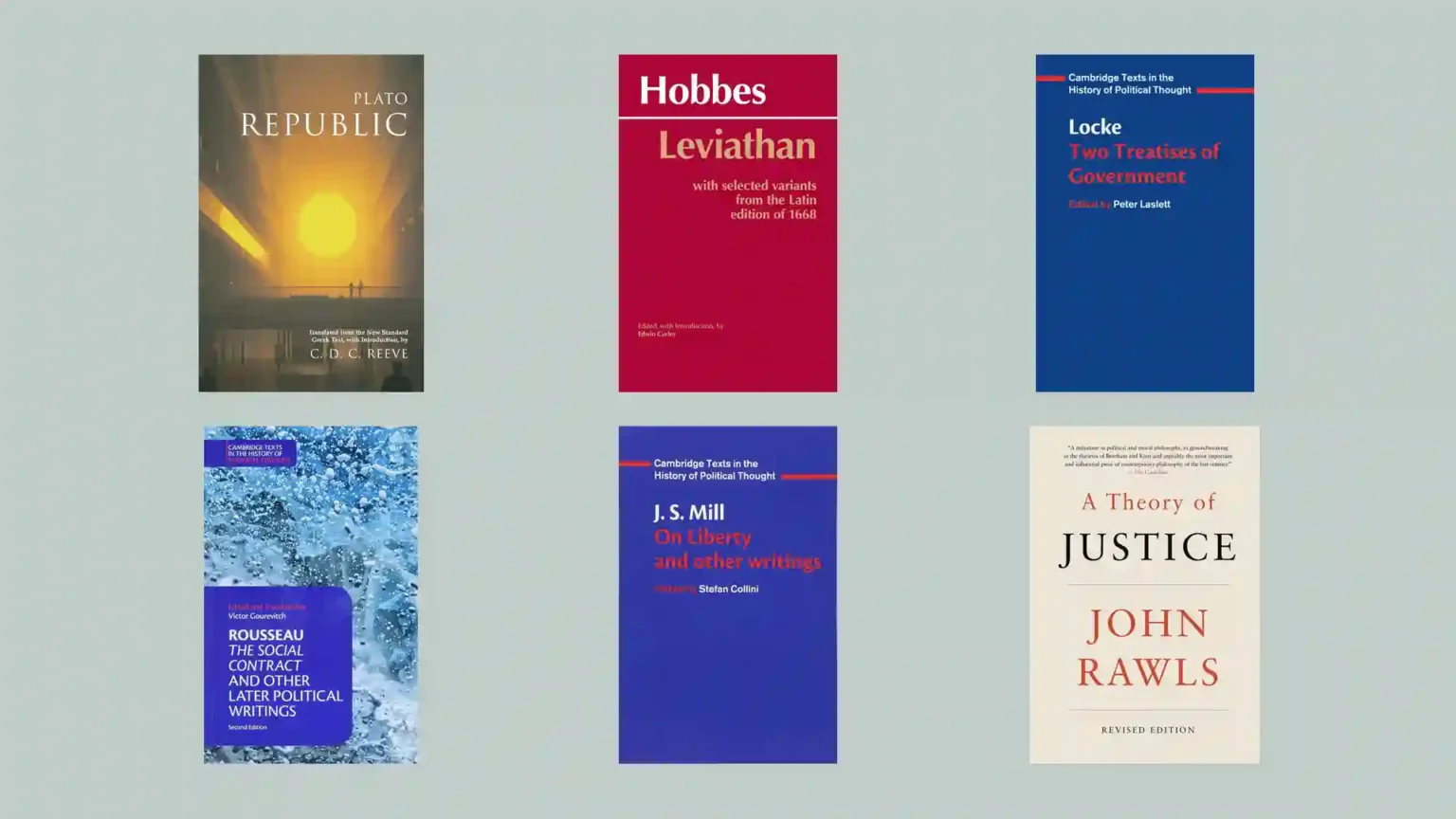
The concrete decision is not “Which political-philosophy edition is best?” It is “Best for what kind of university reading?” A seminar needs stable pagination, intelligible annotation, and enough historical apparatus to prevent anachronism; a survey course also needs price, portability, and a text students will actually navigate. The useful contrast is therefore teaching edition versus prestige edition. Six works illustrate how the choice changes with the job.
BookInLight’s serious-beginner route through political philosophy supplies one curricular sequence, while its broader twenty-book map of how politics works distinguishes political philosophy from political science. The edition map below answers a narrower question: once a primary work is on the syllabus, which classroom text best exposes the argument without hiding the editorial decisions behind it?
A six-text teaching matrix
| Work | Recommended teaching edition | Why it works in class | Main caveat |
|---|---|---|---|
| Plato — Republic | Hackett, trans. C. D. C. Reeve | Readable contemporary translation; useful student apparatus; compact course format | Translation choices can smooth Greek ambiguities; advanced seminars may compare another translation |
| Hobbes — Leviathan | Hackett, ed. Edwin Curley | Modernized spelling, strong introduction, attention to Latin variants | Modernization improves access but reduces the visual feel of the seventeenth-century text |
| Locke — Two Treatises of Government | Cambridge Texts, ed. Peter Laslett | Full textual-historical apparatus; influential dating argument; excellent for intellectual history | Much heavier than a course assigning only the Second Treatise |
| Rousseau — Social Contract and Other Later Political Writings | Cambridge Texts, trans./ed. Victor Gourevitch, 2nd ed. | Places Social Contract beside related political writings; extensive editorial apparatus | Larger anthology than a class needing only Social Contract |
| Mill — On Liberty | Cambridge Texts, ed. Stefan Collini | Stable scholarly classroom edition; situates the essay among Mill’s political writings | For a single short unit, a cheaper standalone can be sufficient |
| Rawls — A Theory of Justice | Harvard/Belknap revised edition | Authoritative revised text; standard reference point for contemporary political philosophy | Long and demanding; excerpts need careful signaling so architecture is not lost |
Plato and Hobbes: readability can be an editorial intervention
For Plato, the Hackett Republic in C. D. C. Reeve’s translation is a strong default when the teaching aim is philosophical argument rather than translation history. Its value is not that it eliminates difficulty, but that students can follow the dialogue, Stephanus references, and argumentative sequence without fighting an archaizing English surface. In a translation-focused seminar, that very fluency becomes the reason to add a second version for comparison.
For Hobbes, Edwin Curley’s Hackett Leviathan makes a different compromise. Modernized spelling reduces an obstacle that is philosophically irrelevant in many courses, while Curley’s editorial work flags important textual and Latin issues. The caveat is methodological: students can forget that modernization is mediation. A course on seventeenth-century print culture may therefore need images or a historical edition alongside it.
Locke and Rousseau: apparatus changes the argument students see
Peter Laslett’s Cambridge edition of Two Treatises of Government is more than a clean text. Its introduction, chronology, and dating argument helped reshape how the Treatises are placed in political history. Cambridge describes the 1988 student edition as a revised version of Laslett’s major scholarly edition, with updated bibliography and further reading. That makes it unusually valuable where historical context is part of the course. It is excessive if students are assigned only a few chapters on property and consent.
Victor Gourevitch’s second edition of Rousseau: The Social Contract and Other Later Political Writings solves the opposite problem: Social Contract is easily isolated from the rest of Rousseau’s political thought. The Cambridge anthology includes Political Economy, the later Polish writings, material on war, and extensive editorial guidance. For an upper-level seminar, that ecology is an advantage. For a two-week survey slot, Hackett’s compact On the Social Contract can be easier to assign.
Mill and Rawls: the unit of teaching determines the edition
The Cambridge On Liberty gives instructors a stable scholarly text within the Cambridge political-thought tradition. It is especially useful when On Liberty is read as a composed political argument rather than as a source of the “harm principle” in isolation. Cambridge’s chapter structure also makes precise assignment straightforward. A general-education course that wants only the core essay can rationally prefer a cheaper standalone; the philosophical cost depends on whether editorial context is part of the learning outcome.
Rawls reverses the economy problem. The revised A Theory of Justice is the authoritative classroom reference, but very few courses can treat its entire architecture at equal depth. The danger is not choosing the wrong edition so much as assigning fragments that make the difference principle look detachable from the original position, the priority rules, institutions, and the later parts of the argument. Harvard’s sample from the revised edition is useful for verifying the revised text and its framing. Where time is shorter, Rawls’s Justice as Fairness: A Restatement can supplement rather than silently replace A Theory of Justice.
Three course decisions before buying
If textual history is part of the learning outcome, prefer an edition whose introduction and notes expose editorial history—Laslett’s Locke is the clearest case.
If the work occupies only one or two weeks, compactness and navigability may matter more than exhaustive apparatus; a large scholarly anthology can become unused cost.
If a central term depends heavily on translation, make the translation visible as a choice. Plato and Rousseau benefit from comparison more than from pretending one English version is philosophically neutral.
The qualified judgment is that there is no single publisher series that wins across the canon. Hackett is especially strong when a compact philosophical teaching text is the priority; Cambridge Texts in the History of Political Thought is especially strong when textual history, chronology, and contextual apparatus are part of the course; Harvard/Belknap remains the natural reference for Rawls’s own revised book. Source class matters more than brand loyalty.
The unresolved part is local rather than theoretical: price, accessibility services, ebook licensing, and institutional holdings change by campus and semester. An edition that is bibliographically ideal but inaccessible to half a class is not the best teaching edition in practice. The matrix should therefore be treated as a scholarly default, then checked against the actual course’s access conditions before adoption.
Cover artwork: credits and source records
- Republic — Hackett (source record)
- Leviathan — Hackett (source record)
- Two Treatises of Government — Cambridge University Press (source record)
- The Social Contract and Other Later Political Writings — Cambridge University Press (source record)
- On Liberty and Other Writings — Cambridge University Press (source record)
- A Theory of Justice — Harvard University Press (source record)