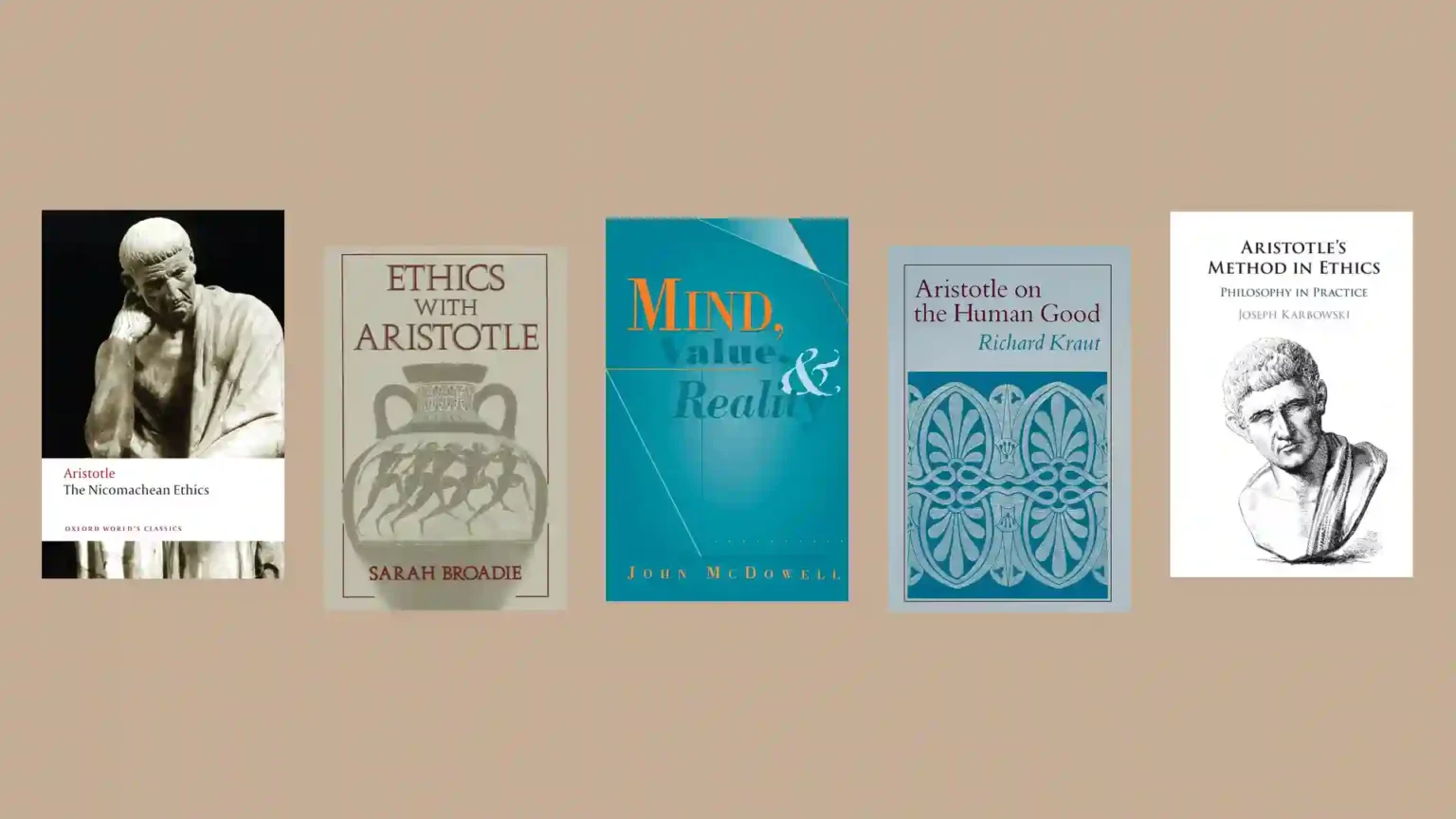
Books on Aristotle’s phronēsis distinguish practical deliberation, virtue, rule-following, education, and forms of contemporary interpretation.
The usual misconception is that phronēsis means “good practical judgment” and that the scholarly problem is merely how much judgment a virtuous person needs. Book VI of the Nicomachean Ethics is less tidy. Aristotle distinguishes practical wisdom from scientific knowledge, art, and philosophic wisdom; ties it to deliberation about things that can be otherwise; insists that it needs particulars; and finally binds it to moral virtue. The primary text of Book VI makes every one of those claims visible.
A historiography of phronēsis is therefore a history of disagreements about which of those claims has priority. The following six books or book-length routes should not be read as a ranked list.
1. An edition of the Nicomachean Ethics with serious notes
The first “book on phronēsis” should be Aristotle. A translation that marks the Greek vocabulary and provides Bekker numbers prevents secondary literature from silently deciding the term for you. The SEP overview of Aristotle’s ethics is useful for checking the wider architecture: flourishing, virtue, deliberation, and the limits of ethical precision.
2. Sarah Broadie, Ethics with Aristotle
Broadie’s reading is valuable because it refuses to isolate practical wisdom from Aristotle’s account of human ends. It presses the relation between correct desire, deliberation, and the structure of a life. Read it when the question is not “How does phronēsis calculate?” but “Why is calculation impossible without a conception of the good?”
3. John McDowell on virtue and practical reason
McDowell’s Aristotelian essays changed later debates by emphasizing perceptual sensitivity: the virtuous agent can see what matters in a situation. This sharpens Aristotle’s claim that practical wisdom concerns particulars. It also creates a dispute: does “seeing reasons” underdescribe deliberation, or does it capture the experienced agent better than rule-based models do?
4. Richard Kraut on the human good and ethical reasoning
Kraut helps re-center the teleological background. Practical wisdom is not a freestanding faculty for clever choices; Aristotle explicitly distinguishes it from mere cleverness. The SEP account stresses that ethics aims at living well and that deliberative skill is shaped by habituation, emotion, and social practice.
5. Joseph Karbowski, Aristotle’s Method in Ethics
Karbowski is useful because he shifts the argument from moral psychology to method. His Cambridge study argues that Aristotle’s ethics can aspire to systematic knowledge while remaining sensitive to variable particulars. That matters for phronēsis: if ethical inquiry is not simply anti-theoretical, practical wisdom must be related to, but not collapsed into, general understanding.
6. A contemporary collection on practical wisdom
A good collection lets you see how phronēsis migrates into current virtue ethics, professional judgment, education, and political theory. But the historical test must remain Aristotle’s Book VI. The Stanford virtue-ethics entry is a useful checkpoint because it shows how neo-Aristotelians inherit, revise, or reject parts of the original teleological framework.
Several propositions can now be tested. First: phronēsis is not technique; Aristotle contrasts action with making. Second: it is not value-neutral cleverness; virtue makes the end right while practical wisdom concerns the means and particulars. Third: it is not merely knowledge of general rules; experience matters because action terminates in particulars. Fourth: it is not isolated from character; Aristotle says one cannot be practically wise in the strict sense without being good.
The historiographical disagreement begins after those textual points, not before them. Some readers emphasize perception, some deliberation, some teleology, some ethical method, and some the unity of virtues. A strong reading list preserves that plurality instead of translating phronēsis once and then treating the translation as an argument.
The decisive evidence is still Book VI. Secondary literature is valuable when it tells you which sentence to return to and what interpretive cost follows from giving that sentence priority. When a book on practical wisdom no longer sends you back to Aristotle’s distinctions, it has changed the subject.
Broadie, McDowell, Kraut, and Karbowski also disagree about what kind of rationality practical wisdom exemplifies. Is the practically wise person applying an implicit grasp of universals, perceiving salient features without rule mediation, reasoning from a conception of flourishing, or exercising a capacity whose structure can be scientifically described? Those options overlap, but they are not interchangeable.
The translation history adds pressure. “Prudence” once carried stronger classical associations than it does in contemporary English; “practical wisdom” avoids some modern connotations of cautious self-interest but can sound more intellectualist than Aristotle intends. Because no English phrase perfectly preserves the Greek field, the safest scholarly practice is to retain phronēsis when the distinction itself is under examination.
Book VI also blocks the fantasy that experience is merely a database feeding a rule engine. Aristotle says young people can become mathematicians but are not ordinarily practically wise because particulars become familiar through time. That claim supports perceptual and experience-centered interpretations, yet it does not eliminate reasoning. Deliberation remains essential because practical life concerns what can be otherwise.
Finally, political phronēsis complicates individualistic readings. Aristotle connects practical wisdom with household management, legislation, deliberative politics, and judgment. A bibliography restricted to private moral choice therefore narrows the textual phenomenon. The Book VI text itself is the corrective: the same state can be named differently according to the domain in which practical deliberation operates.
The six-book route is strongest when used diagnostically. After each secondary work, write down which clause in Book VI has become more important and which has receded. If a reading makes “particulars” central, ask what happens to teleology. If it makes flourishing central, ask how the agent recognizes the relevant particular. Historiography begins in those shifts of emphasis.
The debate over phronēsis also reaches the relation between universals and particulars. Aristotle says practical wisdom must know particulars because action concerns particulars, but he does not say universals are useless. One interpretive camp stresses non-codifiable perception; another stresses structured practical syllogism; others argue that the opposition itself is misleading because experienced judgment integrates both. This is a genuine fault line, not a vocabulary dispute.
A second fault line concerns moral virtue. If practical wisdom requires correct desire, can a vicious but brilliant strategist possess phronēsis? Aristotle’s answer appears to be no; such a person has cleverness. Modern readers sometimes resist this because they want practical reasoning to be assessable independently of character. The Book VI text makes the dependence explicit and forces the modern disagreement into view.
A third concerns development. Aristotle’s emphasis on age and experience raises questions about education: can practical wisdom be taught, modeled, habituated, or only acquired through lived particulars? Contemporary work in professional ethics often borrows the term while weakening the character-and-flourishing framework. Use the virtue-ethics overview to notice when phronēsis has migrated into a new theory rather than simply been “applied.”
These tensions explain why six books are better than one definitive guide. Each secondary account stabilizes a different relationship—between perception and rule, virtue and cleverness, theory and practice, individual and political judgment. The reader’s job is not to average them but to test each against Aristotle’s text and against the others.
Cover artwork: credits and source records
- Nicomachean Ethics — Oxford University Press (source record)
- Ethics with Aristotle — Oxford University Press (source record)
- Mind, Value, and Reality — Harvard University Press (source record)
- Aristotle on the Human Good — Princeton University Press (source record)
- Aristotle’s Method in Ethics — Cambridge University Press (source record)