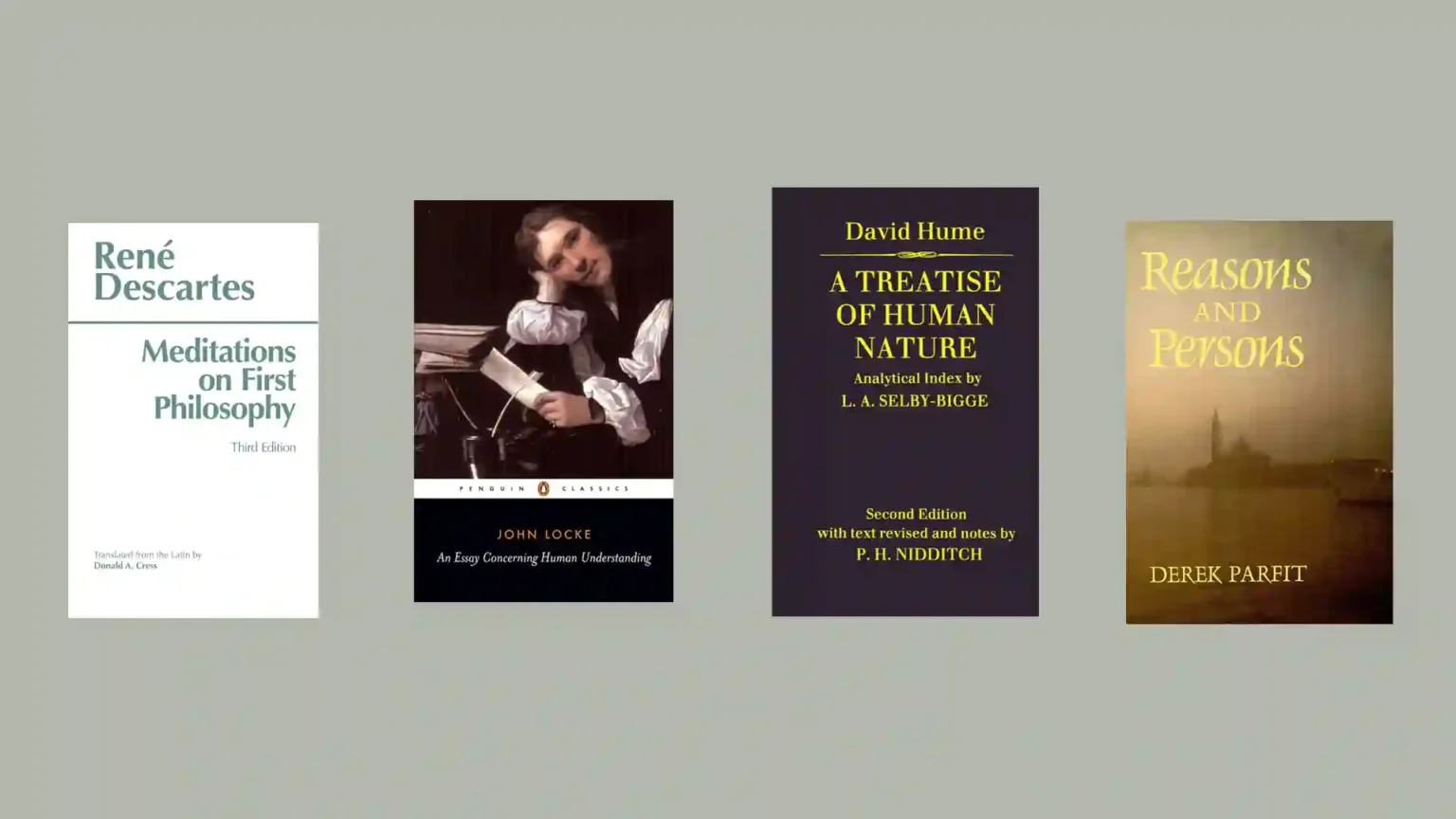
The philosophy of the self begins with competing questions about identity, embodiment, memory, narration, and first-person experience.
The common misconception is that “the self” is one philosophical problem. Test that immediately. Are you asking what makes you the same person over time? What you can know about yourself from the first person? Whether a self is a substance? Whether identity is bodily, psychological, narrative, or socially constituted? The Internet Encyclopedia of Philosophy overview shows how quickly these questions separate.
1. Is the self a thing?
Start with Descartes if your instinct is that there must be a subject underlying experience. You do not need all of Cartesian metaphysics at first; you need the pressure behind the idea that thought seems to require a thinker. Then use Hume as the counter-pressure. In Treatise 1.4.6, Hume reports finding changing perceptions rather than an invariant impression of self. To locate Hume’s exact argument and the important Appendix qualification, see the Hume bundle-theory text guide.
2. What makes a person persist?
Locke changes the debate by centering consciousness and personhood rather than merely sameness of soul or body. The SEP entry on Locke’s personal identity is the best orientation because it also traces the enormous afterlife of his view. Once persistence is psychological rather than simply substantial, memory, continuity, duplication, and responsibility become connected problems.
3. Is identity what matters?
Parfit radicalizes the reductionist line. The important historiographical change is that personal identity may not be the deepest fact needed to explain survival and concern for the future. The SEP historical discussion of personal identity and ethics gives a compact account of how Parfit turns a Lockean inheritance into a challenge to the importance of identity itself. Before his major work, see the Reasons and Persons preparation route.
4. What did the debate leave out?
Classical thought experiments are powerful because they isolate variables, but they can also make persons look like transportable packets of psychology. Later work presses embodiment, social recognition, gender, narrative, disability, and lived continuity. The general IEP personal-identity map is useful here not as a last word but as a checklist of assumptions that different theories build into the word “person.”
5. Which route should you take?
If you care about metaphysical persistence, take Descartes → Locke → Hume → Parfit.
If you care about first-person experience, pair Hume with phenomenology rather than staying only inside persistence puzzles.
If you care about responsibility, focus on Locke’s forensic notion of person and later debates linking identity to praise and blame.
If you care about ordinary lives rather than teleporters, add narrative, embodiment, and social-identity work early.
There is no single neutral history of the self. The canon itself was built by changing the question: substance became consciousness; consciousness became psychological continuity; continuity became reducible relations; and each shift made new objections visible. Your best starting book is therefore the one that answers the question you actually have, not the one that appears first in a survey course.
Two routes remain defensible for a beginner. Choose the metaphysical route if puzzles about survival are doing the intellectual work. Choose the phenomenological and social route if your concern is what it is like to be a self among others. Crossing between them later is useful; confusing them at the start produces debates in which both sides are answering different questions.
A final historiographical caution: “self” and “person” are not automatically interchangeable. Locke’s forensic person, Hume’s bundle of perceptions, phenomenological subjectivity, and contemporary social identity answer different questions. Much confusion comes from translating them all into a single everyday noun.
For that reason, keep a two-column notebook. In one column write the question—persistence, first-person givenness, agency, responsibility, narrative, recognition. In the other write the proposed bearer—soul, body, consciousness, psychological continuity, narrative organization, social relation. The debate becomes much easier once question and bearer are not allowed to drift together.
The best route is the one that makes a later disagreement legible. If Hume and Parfit start sounding identical, return to the historical questions they inherit. If social identity seems to refute a metaphysical criterion of persistence, ask whether the theories are competing at all. Philosophical orientation is often the art of preventing false fights.
A short reading sequence can therefore begin with Locke, move to Hume, and end with Parfit before branching outward. Locke establishes the persistence problem; Hume attacks the imagined substrate; Parfit asks whether identity is what matters. Then add phenomenology, narrative, or social theory according to the question that the sequence leaves unresolved.
This sequence also teaches a methodological lesson. Thought experiments are not predictions about futuristic technology. They are attempts to isolate criteria. The prince-and-cobbler case tests consciousness, split-brain and teleportation cases test psychological continuity, and Hume’s introspection tests whether a simple self is ever given in experience. Judge each case by what it isolates, not by how realistic the story sounds.
A final check is simple: before adopting any theory of the self, ask what would count as evidence against it. Substance theories, memory theories, bundle accounts, narrative views, and social theories do not fail under the same conditions. Knowing the falsifying pressure prevents “the self” from becoming a word that absorbs every disagreement without resolving one.
Cover artwork: credits and source records
- Meditations on First Philosophy — Hackett (source record)
- An Essay Concerning Human Understanding — Penguin Classics (source record)
- A Treatise of Human Nature — Oxford University Press (source record)
- Reasons and Persons — Oxford University Press (source record)