New Directions helped shape the modernist canon by making particular international and experimental writing available to readers.
The common misconception is that New Directions merely preserved a modernist canon that already existed. The publisher’s own history makes a better test possible. New Directions began in 1936 as an experimental publishing project, then built a durable system in which anthologies, author stewardship, translation, rescue from out-of-print status, design, paperback circulation, and backlist maintenance could keep difficult writing available. The canon was not simply inherited; parts of it were made durable by editorial infrastructure.
Was New Directions founded to preserve established classics?
No. James Laughlin founded the press after his encounter with Ezra Pound, and the first New Directions anthologies were conceived as places where experimental writers could test work in publication. The official history names early contributors across poetry and prose rather than describing a retrospective classics list. The experiment-first origin matters: a house can become a canonizing institution precisely because it starts by publishing work whose status is unsettled.
The founder story can become mythology if repeated without records, but the press has unusually rich documentary remains. Harvard’s Houghton Library holds manuscripts and proofs of New Directions books, 1937–2021, including deposits of edited manuscripts, galley proofs, page proofs, photographs, and other production material. From about 1960 through the end of Laughlin’s life, the run is described as fairly complete. That archive turns “publisher influence” from an abstract claim into something researchers can study at the level of editorial work.
How does a press turn experiment into durable availability?
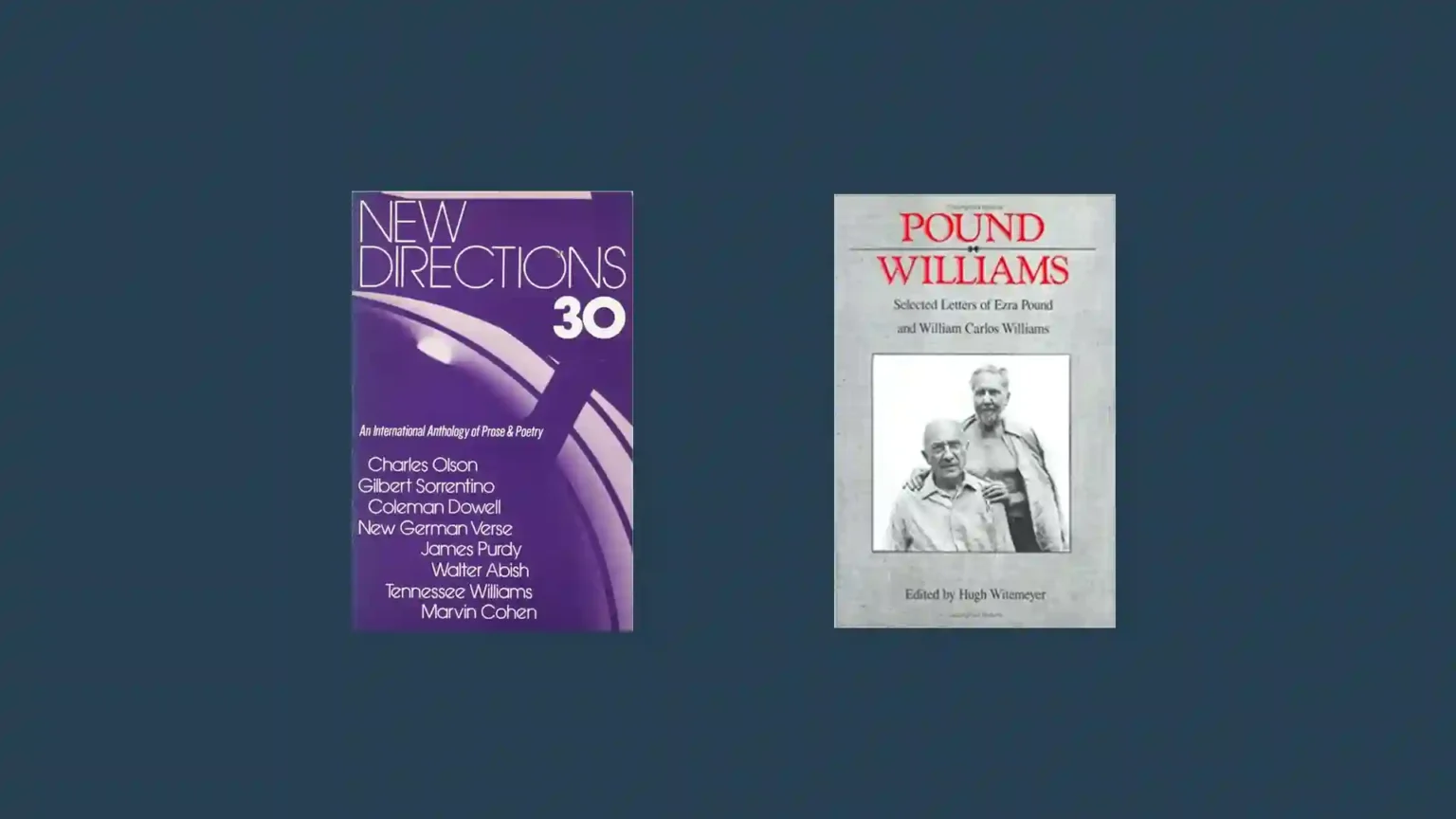
One mechanism is sustained author stewardship. The press’s current pages for Ezra Pound and William Carlos Williams show deep backlists rather than one-off publication events. The published Pound/Williams correspondence also documents the small-press and little-magazine ecology in which modernism grew. A modernist canon needs interpretation, but it also needs books that remain orderable, assignable, quotable, and reprintable over decades.
A second mechanism is rescue. New Directions’ history records the house reprinting writers and works other publishers had allowed to disappear, including restoring The Great Gatsby to print and publishing material by Fitzgerald, Henry James, E. M. Forster, and others. “Canonization” here is not the ceremonial declaration that a book is great. It is the prosaic decision to keep or return a book to circulation.
Where does the “international” part of the canon come from?
The press did not remain an American-modernist museum. The same publisher history emphasizes translation and international authors, while the New York Public Library’s cataloged Laughlin collection contains more than 1,200 New Directions imprints and documents the breadth of a house whose list reached from Pound and Ferlinghetti to Nabokov and later international writers. Translation rights, editorial selection, and continuity of editions are material routes by which “international modernism” becomes a reader’s shelf rather than a scholarly abstraction.
This is also why the phrase “modernist canon” should not be limited to a founding generation. New Directions still describes itself through a living editorial organization on its About page. A backlist can preserve the founder’s preferences, but a continuing press also revises its list—adding writers, translations, new editions, and newly legible traditions. Canon maintenance is always partly canon modification.
Does design count as canon formation?
It counts when design changes recognition and circulation. New Directions’ history singles out Alvin Lustig’s jackets and the distinctive black-and-white paperback identity that followed. The point is not that a cover makes a writer canonical. It is that series identity can make difficult books recognizable as members of a trustworthy editorial family. BookInLight’s analysis of Vintage Classics as a “moving canon” and its guide to Penguin Classics show the same mechanism at different scales: visual continuity and list architecture teach readers how to encounter a backlist.
What did the anthologies do that a backlist could not?
Anthologies supplied a provisional space before permanence. Later issues such as New Directions 30 retained the mixture of established and emerging writers, translation, excerpt, poetry, fiction, and experiment. This format makes the press’s canon-building role easier to see: the anthology does not merely certify; it samples, juxtaposes, and tests. Some names persist, others vanish, and the historical list records both outcomes.
Laughlin’s centenary materials on the New Directions site reinforce the dual role. He was a publisher closely identified with Pound and Williams, but the institution he built outlived the personal network that founded it. The distinction matters because a canon that depends only on one patron’s taste usually dies with the patron. A press becomes structurally influential when taste is converted into editorial procedures, contracts, archives, reprints, design systems, and a list other editors can inherit.
So did New Directions “build” the modernist canon?
Not by itself, and not from nothing. Universities, critics, prizes, libraries, estates, other publishers, translators, booksellers, and readers all participate. But New Directions supplied one of the infrastructures through which experimental and international writing could remain available long enough to acquire new readers and new institutional uses. The useful verb is not create but mediate: the press selected, preserved, imported, translated, packaged, revived, and recirculated.
A comparison with BookInLight’s Penguin Little Black Classics guide clarifies the category error to avoid. A low-cost sampler series, a scholarly classics line, and an independent modernist press do not canonize in the same way. New Directions’ particular force lies in the continuity between risky first publication and later backlist stewardship. That continuity joins discovery to memory.
Further reading
For primary institutional evidence, begin with the New Directions history, the Houghton Library production archive, and the Berg Collection overview at NYPL. Read those alongside author-specific backlists rather than treating publisher self-description as neutral literary history.
The next unavoidable question is therefore not whether New Directions belongs inside a history of modernism. It is how much of what later readers call “modernism” depends on the institutions that kept certain experimental works visible while other experiments disappeared. Answering that requires moving from a list of famous authors into contracts, proofs, reprints, translations, series designs, and the long life of the backlist.
What can the archive show that a publisher history cannot?
Publisher histories naturally emphasize continuity and achievement. Production archives preserve friction: edited manuscripts, corrected proofs, abandoned states, design decisions, and the ordinary labor between acceptance and a finished book. Houghton’s finding aid is especially valuable because the deposits become fairly complete from about 1960 through 1997. That allows researchers to test claims about house style and editorial continuity against production evidence rather than against retrospective branding alone.
The archive also reveals a category difference between publishing an author and sustaining an author. A first contract is a moment; decades of proofs, reissues, correspondence, permissions, new introductions, revised designs, and stock decisions form a system. The modernist canon New Directions helped mediate depended on the second kind of work.
Why is reprinting an editorial act rather than clerical maintenance?
A reprint changes the present tense of a book. It can restore availability, assign a new series identity, pair a work with a new introduction, alter cover language, change price and format, or reconnect a neglected title with an author’s better-known books. When the press brought works back into print, it was not only preserving paper. It was making a new claim about which past should remain readable now.
That is why backlist architecture belongs in a history of canon formation. A title repeatedly renewed has more opportunities to be reviewed, taught, translated, stocked, inherited by libraries, and encountered by later writers. The causal chain is indirect, but it is concrete. Canonical persistence requires cultural judgment; it also requires logistical persistence.
Cover artwork: credits and source records
- New Directions 30 — New Directions (source record)
- The Pound/Williams Selected Correspondence — New Directions (source record)