Davidson’s “Truth and Meaning” is easier to read after distinguishing compositional semantics from the stronger philosophical claims made for it.
“Preparation” is unstable in the case of Donald Davidson’s “Truth and Meaning.” It can mean learning symbolic logic, studying Tarski’s formal definition of truth, mastering Quine’s theory of translation, or reading Davidson’s later program of radical interpretation. Those are not equivalent prerequisites. The 1967 paper asks for less formal machinery than its reputation suggests, but more conceptual discipline: a reader must see why Davidson wants a theory that explains how the meanings of indefinitely many sentences depend on finite resources, and why he turns to a Tarskian truth theory without simply identifying meaning with truth.
Davidson states the generative ambition early: a theory of meaning should show “how the meanings of sentences depend upon the meanings of words.” The original article, “Truth and Meaning”, appeared in Synthese 17 (1967), pp. 304–323. A JSTOR stable record is also widely cited. The line is easy to quote and easy to misread. Its problem is not dictionary definition. It is compositionality: how can finite speakers understand and produce indefinitely many novel sentences?
The broader BookInLight guide to philosophy of language is a useful orientation because Davidson enters a conversation already shaped by Frege, Wittgenstein, Quine, and later developments in reference and use. Yet the decisive preparation for this paper is narrower than a survey course. Four contrasts organize the route: Tarski versus Davidson; translation versus interpretation; truth conditions versus meanings as entities; and formal adequacy versus empirical interpretation.
A truth theory borrowed for a different job
Tarski’s work supplies Davidson with a recursive formal model. A truth definition for a suitably regimented language yields T-sentences of the form: sentence s is true if and only if p. Tarski’s own project was not to construct a theory of natural-language meaning. In fact, the classical construction assumes enough semantic understanding in the metalanguage to state the right-hand side. The Stanford Encyclopedia of Philosophy entry on truth is the most efficient background because it separates semantic theories of truth from later philosophical uses made of them.
Davidson’s reversal is the historical hinge. Where Tarski can use understood translation to illuminate truth, Davidson asks whether a suitably constrained theory of truth can illuminate meaning. That reversal explains both the power and the danger of the program. The power is structural: recursive axioms can generate truth conditions for indefinitely many sentences. The danger is extensional looseness: many formally adequate truth theories could pair sentences with true conditions in ways that fail to capture what speakers mean. A reader prepared only with the slogan “meaning = truth conditions” misses the problem the article itself has to solve.
The SEP entry on theories of meaning helps locate this point. A theory of meaning must not only assign correct-looking outputs; it must explain linguistic competence in a way connected to what interpreters can recognize as correct. Davidson therefore needs constraints on the theory beyond mere truth. Later essays make those constraints more explicit through interpretation, evidence about speakers, and principles of rationality and charity. Reading those later developments backward into the 1967 paper can be illuminating, but it can also hide how provisional the original proposal is.
From Quine’s translation problem to Davidson’s interpreter
Quine supplies a different pressure. Radical translation asks how a linguist could determine meaning from publicly available behavior without presupposing a manual of translation. Davidson inherits the anti-inner-object lesson but changes the task. Instead of asking how to map an alien language onto a known one word by word, he asks what a theory an interpreter could use to understand a speaker’s sentences and attitudes together. The SEP entry on Donald Davidson traces this development from truth-theoretic semantics into radical interpretation.
The Quine–Davidson relation is therefore neither simple inheritance nor simple rejection. Quine’s indeterminacy makes meanings as hidden objects suspect; Davidson agrees that semantics should not depend on occult entities standing behind words. But Davidson is less willing to detach interpretation from norms of coherence and truth. Later radical interpretation asks an interpreter to assign beliefs and meanings together under constraints that make the speaker intelligible. The point of preparing with Quine is not to memorize “indeterminacy,” but to recognize why Davidson wants semantic evidence to be public and why a theory of meaning cannot simply cite an already understood meaning entity.
This also clarifies a frequent false start. Word meaning is not the foundational unit from which sentence meaning is mechanically assembled. Davidson’s compositional requirement constrains a whole theory: the semantic contribution of parts must support a recursive account of sentences. The SEP discussion of word meaning is useful precisely because contemporary lexical semantics has moved far beyond any simple picture in which each word carries a self-contained object called its meaning.
Truth conditions are evidence only inside an interpreted theory
The most important dispute in preparing for “Truth and Meaning” concerns what would make a T-sentence interpretive rather than accidentally true. “Snow is white” is true if and only if grass is green whenever both sides share a truth value, but such a biconditional obviously does not state what the English sentence means. Formal truth alone therefore cannot select the intended interpretation. Davidson’s project requires that the total theory be constrained by the structure and use of the language, not evaluated one theorem at a time.
This is why the article should not be read as a shortcut from truth to meaning. The theory’s recursive form explains how finite axioms can support infinitely many sentence-level consequences; interpretation determines which truth theory counts as a theory for these speakers. The later Davidsonian program makes this dependence on evidence clearer. A contemporary overview of Davidsonian metasemantics and radical interpretation shows how the interpretationist strand developed after the early paper.
There is also a historiographical disagreement about how much of the later program should be treated as already present in 1967. One reading treats “Truth and Meaning” as the first stage of a unified Davidsonian semantics whose empirical constraints are supplied in the 1970s. Another treats the early paper as a more exploratory proposal, with later radical interpretation altering the explanatory burden. The difference matters pedagogically: if the later theory is imported too early, the original article looks smoother and more complete than it actually was.
What formal background is actually necessary?
A reader does not need a full course in model theory. Four pieces are enough to keep the central moves visible. First, understand the object-language/metalanguage distinction. Second, understand why a recursive theory can cover infinitely many sentences from finite axioms. Third, recognize the function of a T-sentence without assuming that any true biconditional is semantically informative. Fourth, keep use and interpretation in view as the empirical constraint. The SEP overview of truth and the Davidson entry are sufficient preparatory references for those purposes.
The article can then be read historically rather than ceremonially. Davidson is trying to escape two unsatisfactory pictures at once: a lexicon of meaning entities that fails to explain productivity, and a purely formal truth theory that can be satisfied by the wrong interpretation. Tarski supplies the architecture; Quine supplies suspicion about hidden semantic facts; Davidson’s own later interpreter supplies the pressure that selects among formally possible theories.
Notes on what remains disputed
The original publication details are stable: Synthese 17 (1967), 304–323, DOI 10.1007/BF00485035. What remains less stable is philosophical reconstruction. Scholars disagree about whether Davidson should be classified primarily as a truth-conditional semanticist, an interpretationist metasemanticist, or as pursuing a program in which those roles cannot be cleanly separated. The textual evidence after 1967 matters to that classification, so the disagreement cannot be settled by the early paper alone.
The unresolved question is therefore exact: how much empirical structure must be added to a Tarskian truth theory before it ceases to be merely extensionally correct and becomes an interpretation of what speakers mean? “Truth and Meaning” provides the formal wager. Davidson’s subsequent work supplies competing answers about what licenses the wager.
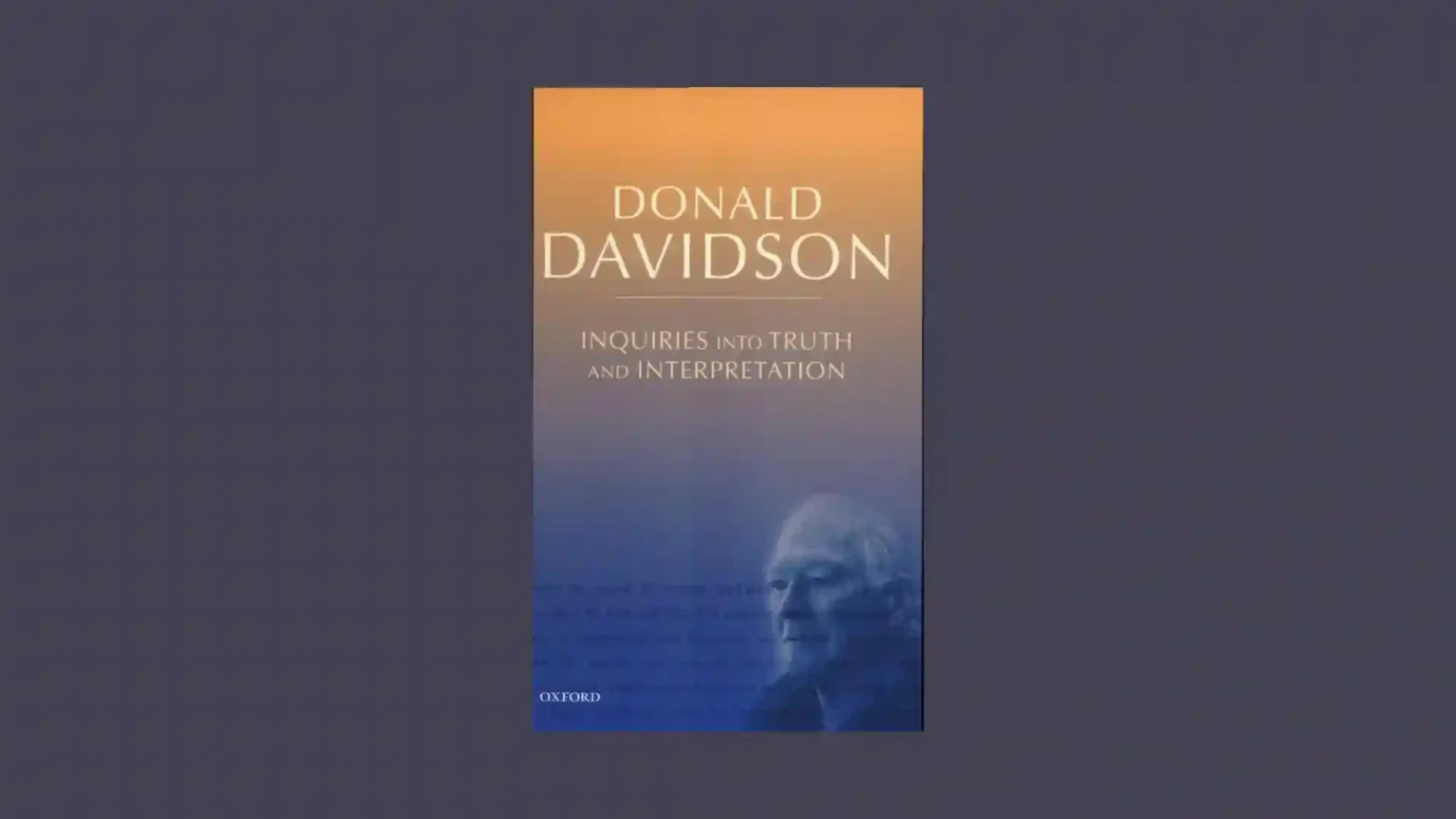
Cover artwork: credits and source records
- Inquiries into Truth and Interpretation — Oxford University Press (source record)