The best edition of Hamlet depends on whether you need textual variants, stage history, annotation, or a clear first reading.
“Which Hamlet is the real Hamlet?” is the wrong opening question. The Folger Shakespeare Library explains that the play survives in three early printed versions: the short 1603 First Quarto (Q1), the much fuller Second Quarto (Q2), and the 1623 First Folio (F1). Modern editions therefore make editorial decisions rather than simply reprint an untouched original. Your best edition depends on how much of that problem you want visible.
Quarto-date caution: the second quarto (Q2) of Hamlet is conventionally cited as 1604, although some surviving copies carry 1605 on their title pages. That is a dating variation within the second-quarto printing, not another independent canonical textual witness alongside Q1, Q2 and F1. Source: Folger Shakespeare Library textual introduction.
For a first reading: Folger
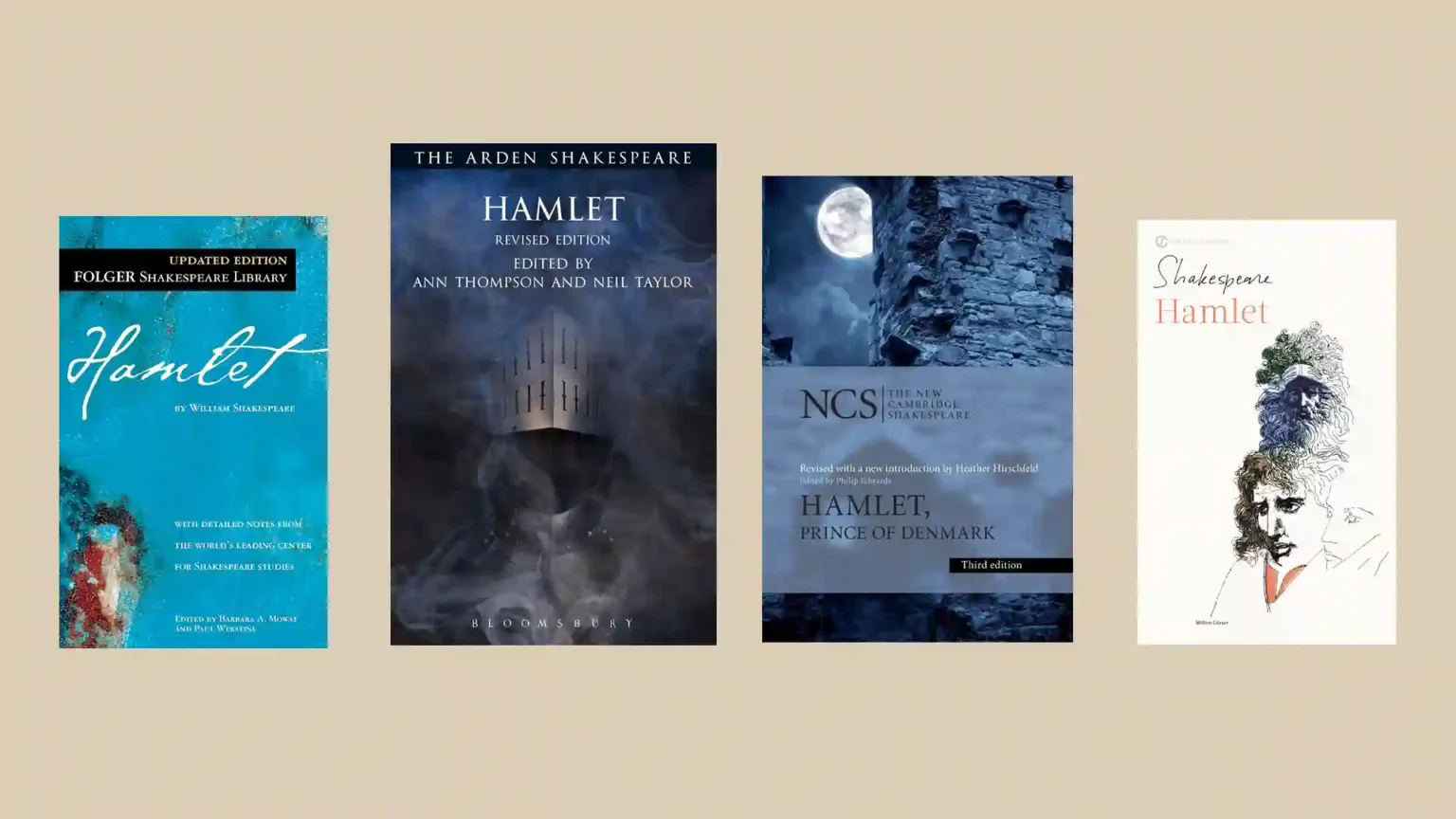
Folger Hamlet is the cleanest default for a first serious encounter. The text is free online, notes are accessible, and the Folger site makes the early-print history explicit without forcing a beginner to become a textual scholar before Act 1. It is especially strong when reading is combined with performance, quotation search, or classroom discussion.
For university-level close study: Arden
Arden Shakespeare Third Series: Hamlet is the choice when notes and textual argument are part of the work. Ann Thompson and Neil Taylor’s revised edition gives a modernized text based on Q2 with extensive introduction, commentary, appendices, and discussion of productions and criticism. Buy it if you expect to write papers in which the wording of a crux, staging possibility, or textual variant matters.
For a compact scholarly alternative: Cambridge
The New Cambridge Shakespeare Hamlet offers a substantial introduction, note on the text, reading list, and annotated play without quite the physical mass of Arden. It suits a reader who wants a scholarly classroom edition but prefers the apparatus to remain more visibly subordinate to the play.
For teaching on a budget: Signet
A cheaper edition can still be genuinely pedagogical. BookInLight’s Signet Classics review uses Sylvan Barnet’s Hamlet as a strong example: introduction, source discussion, explanatory notes, criticism, performance history, and further reading at a low price. It is not a specialist variorum, but it is unusually useful for a course.
For textual scholarship: do not buy only one
If your project is specifically Q1 versus Q2 versus F1, one normalized reading text is not enough. Start from the Folger account of the three witnesses, then use an edition or scholarly resource that prints or records variants. Arden is valuable here precisely because its editorial practice does not hide the instability behind a smooth classroom text.
The decision in five lines
First-time general reader: Folger. Free digital access, clear notes, and enough textual history to avoid false certainty.
Undergraduate or graduate seminar: Arden. The apparatus is part of the reason to own it.
Scholarly but more compact reading copy: New Cambridge Shakespeare.
Budget teaching copy: Signet, especially when criticism and performance context matter more than exhaustive textual apparatus.
Textual-variant project: compare witnesses and editorial principles; no single “best” reading edition answers that research question.
BookInLight’s beginner Shakespeare route deliberately places Hamlet after several shorter plays because its length, metatheatre, and textual complications make it a poor first teacher of Shakespearean basics. If Hamlet is already your target, however, the same principle applies at the edition level: buy the amount of apparatus your reading can actually use.
The decisive distinction is therefore not prestigious series versus cheap paperback. It is reading text versus teaching apparatus versus textual research tool. Once that distinction is made, the edition choice becomes much less mysterious.
Why the text problem changes the buying advice
The Folger’s textual notes make editorial intervention visible at the level of individual readings. That matters because Q2 and F1 are not merely the same play with spelling differences: each contains material absent from the other, and editors must decide whether to combine, separate, or privilege witnesses. A beginner does not need to master the apparatus, but should know why editions can disagree.
If you want to see the problem rather than read about it, Folger’s early-edition overview and its catalog record for The Three-Text Hamlet point toward parallel Q1/Q2/F1 comparison. That is a different task from ordinary reading. It is also the moment when a very large Arden volume stops looking excessive: the apparatus becomes the object of study.
What not to optimize for
Do not optimize for the longest introduction, the newest cover, or the edition a famous actor happens to use. Performance readers may want spacious pages and lighter annotation; literary students may want notes that explain syntax, sources, and critical history; textual scholars may need witnesses and variants. “Best Hamlet” is therefore a category error until the reader is specified.
For a first purchase, the decision rule is simple: Folger if access and clarity dominate; Arden if intensive scholarly annotation dominates; Cambridge if you want a compact academic balance. Once you know why those choices differ, later edition shopping becomes comparison rather than branding.
That is the purchase test: can you say what editorial problem this edition is solving for you? If not, start with Folger and let an actual reading problem justify the next edition.
Cover artwork: credits and source records
- Hamlet — Simon & Schuster (source record)
- Hamlet — Bloomsbury (source record)
- Hamlet — Cambridge University Press (source record)
- Hamlet — Signet (source record)