To read Sappho carefully, compare translation methods for fragments rather than relying on a single supposedly definitive voice.
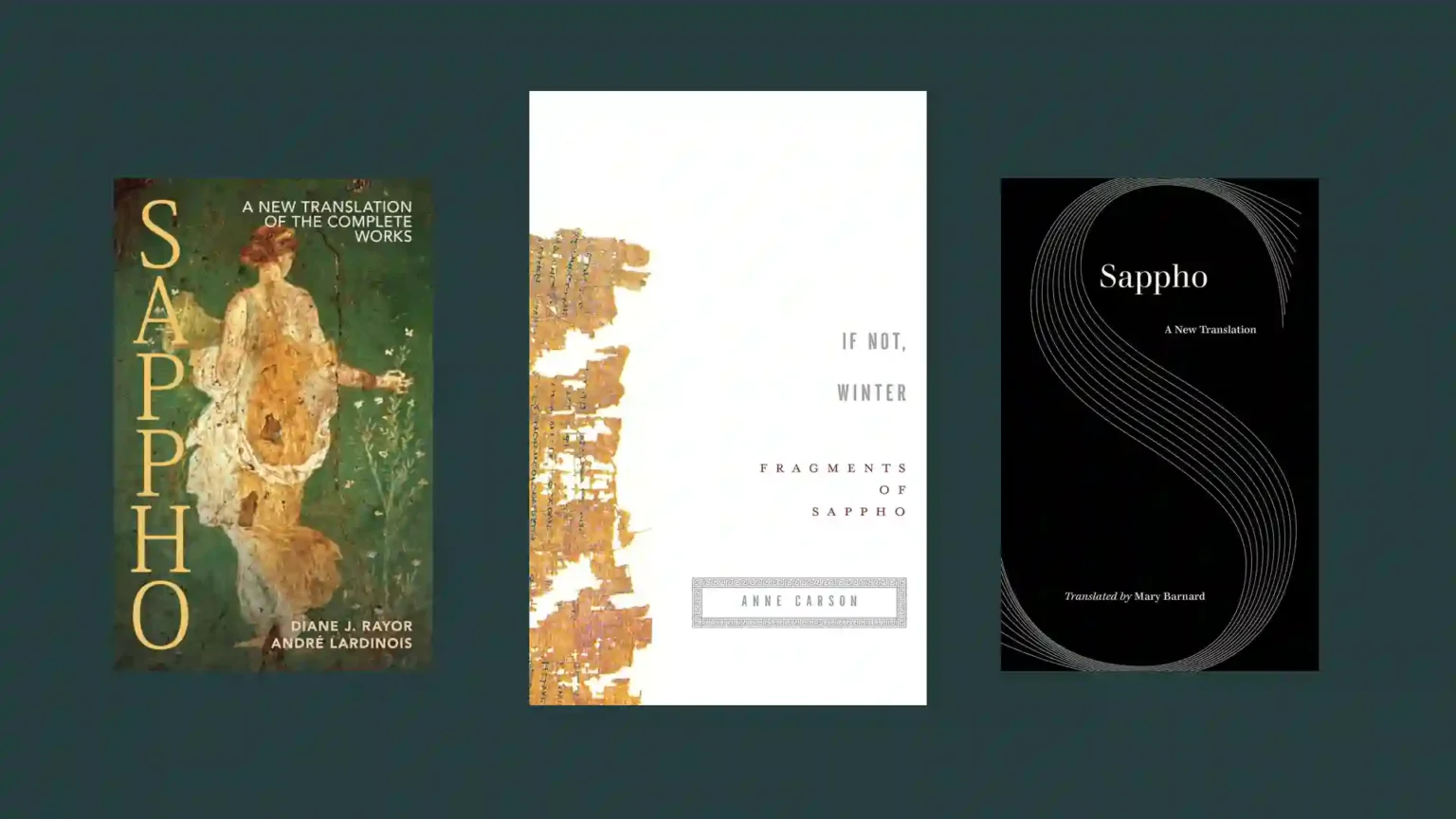
If you are reading Sappho seriously for the first time, begin with Diane J. Rayor and André Lardinois when your priority is the state of the surviving corpus; move to Anne Carson when your priority is the felt fact of fragmentation; use Mary Barnard when you want to hear how a twentieth-century English poet made Sappho sound newly immediate. That is not a ranking. It is a route built from three different editorial and translational problems.
Route one: establish what survives before you decide what Sappho “sounds like”
The safest first orientation is the current second edition of Sappho: A New Translation of the Complete Works, translated by Diane J. Rayor with introduction and notes by André Lardinois. Cambridge describes the volume as incorporating substantial poems, fragments, and discoveries from recent decades. For a beginner, that matters because “Sappho” is not a stable book transmitted intact from antiquity. It is a changing corpus assembled from papyri, quotations in ancient authors, and editorial reconstruction.
Edition check: Cambridge University Press dates the second edition of Rayor and Lardinois’s Sappho to February 2023 (online June 2023). This is a different book and publication history from University of California Press’s September 2026 collector’s edition of Mary Barnard’s translation. Source: Cambridge publisher edition data.
The practical advantage of Rayor/Lardinois is not only completeness. The edition tells you when a gap is a gap. Its note on translation makes visible the decisions required when damaged Greek, uncertain supplements, and performance context meet modern English. Read ten or fifteen fragments slowly, including at least one longer poem, before trying to infer a single “Sapphic voice.”
The numbering system is another reason to begin with a current scholarly edition. Sappho’s fragments are often cited by conventional numbers that derive from editorial traditions, and newly published papyri can add text to fragments already known or create new points of comparison. A translation that feels “complete” as a reading experience may therefore be historically incomplete as a reference tool. Before quoting a fragment in an essay, record the fragment number and the translator; otherwise two English versions can look like competing texts when they are actually translating different reconstructed states.
Route two: let the broken text remain broken
Anne Carson’s If Not, Winter is a different experience. Carson’s brackets and white space make absence visually present. The reader is not allowed to forget that much of Sappho arrives as damaged material. That can be liberating: instead of treating every missing word as an invitation to complete the poem psychologically, the page keeps the fragmentary condition in view.
But Carson’s 2003 book also provides a useful counterexample to the idea that the most artistically compelling translation must be the best first reference edition. It appeared before some later papyrus discoveries incorporated by newer scholarship. Read it for the intelligence of its restraint and for the way it stages lacunae; do not treat it as a fixed inventory of everything now attributed to Sappho.
Try a controlled comparison. Take one fragment that appears in Carson and Rayor. Read each translation aloud twice. Mark where one version uses a plain verb and the other chooses a more charged one; notice where syntax becomes smoother in English; notice whether the translator preserves or suppresses abruptness. The point is not to score the versions. It is to discover which features of “Sappho” belong to the surviving Greek and which belong to an English poetics of fragmentation.
Then make the comparison sonic. Sappho’s poetry was song, and even fragmentary English should be tested by the ear. Read one version at conversational speed and another with deliberate attention to stress. Where does one translator create a cadence by adding an article or connective? Where does another preserve abrupt juxtaposition? The comparison may show that a version you prefer silently completes a relation that the surviving Greek leaves open. Preference is still legitimate; it simply becomes an informed preference rather than an assumption about what the ancient text “really says.”
Route three: hear the modern English tradition that made Sappho intimate
Mary Barnard’s translation has had a long Anglophone afterlife because of its compression and directness. The University of California Press currently offers the familiar 2019 paperback, and in September 2026 released a collector’s edition that places Barnard’s English alongside the original Greek for the first time in that edition. UC Press’s recent account of “Sappho” through the decades is especially useful because it makes reception history visible: Barnard’s Sappho is not simply an ancient poet in English but also a mid-twentieth-century American poetic event.
The timing of the 2026 collector’s edition makes this route unusually instructive now. It does not erase Barnard’s mid-century history; it reframes it by placing Greek beside a translation that generations first encountered without that parallel visual apparatus. The new object lets readers see how a famous English Sappho was made, while the Rayor/Lardinois edition lets them see how the surviving corpus itself has changed. Those are different kinds of “newness”: one bibliographic and reception-historical, the other philological.
Barnard is therefore best read comparatively. Her economy can feel uncannily contemporary; that very success is a reason to ask what has been modernized. Put Barnard beside Rayor on the same fragment. If Barnard is cleaner or more aphoristic, ask whether the Greek supports that decisiveness or whether it is part of Barnard’s English craft.
When should you bring in a facing-text scholarly edition?
As soon as your question depends on one Greek word, a fragment number, or the exact extent of a lacuna, stop asking a literary translation to perform a critical edition’s job. A facing-text reference such as the Loeb Classical Library is designed for verification: Greek text, English translation, numbering, and editorial apparatus. Even readers without much Greek can use it to see lineation, repeated words, and where translators are working with uncertainty rather than abundance.
If you do not read Greek, the facing text is still useful because it slows down overconfidence. A repeated name or visible gap can be checked without grammar; a short Greek line facing a long English line raises an immediate question about expansion; two translators who choose radically different stanza shapes signal that form itself is under negotiation. You are not pretending to adjudicate the Greek. You are learning where an English poem contains more editorial decision than its fluency advertises.
This is also where beginners often benefit from refusing a false choice. You do not have to choose between “poetic” and “scholarly” Sappho. Use the scholarly edition to establish the object; use Carson, Barnard, or Rayor to test what an English poem can make of it. The disagreement among translations is not noise around the real poem. It is evidence about what the fragment permits and what each translator values.
One final safeguard is chronological. Do not infer Sappho’s biography directly from a lyric “I.” Ancient song can be personal, performative, ritual, competitive, or communal at once. Translation can intensify the illusion of private confession because modern English lyric conventions make first-person speech sound autobiographical. Keep speaker, poet, and historical Sappho distinct unless the evidence warrants joining them.
If you begin with Rayor/Lardinois, you know what kind of textual object you are handling. If you then read Carson, fragmentation becomes a formal experience rather than a footnote. If you add Barnard, you acquire a history of English Sappho as well as another voice. The opening recommendation therefore changes slightly: the route is not three competing books. It is three lenses, each correcting a temptation created by the previous one.
Cover artwork: credits and source records
- Sappho: A New Translation of the Complete Works — Cambridge University Press (source record)
- If Not, Winter — Vintage (source record)
- Sappho: A New Translation — University of California Press (source record)