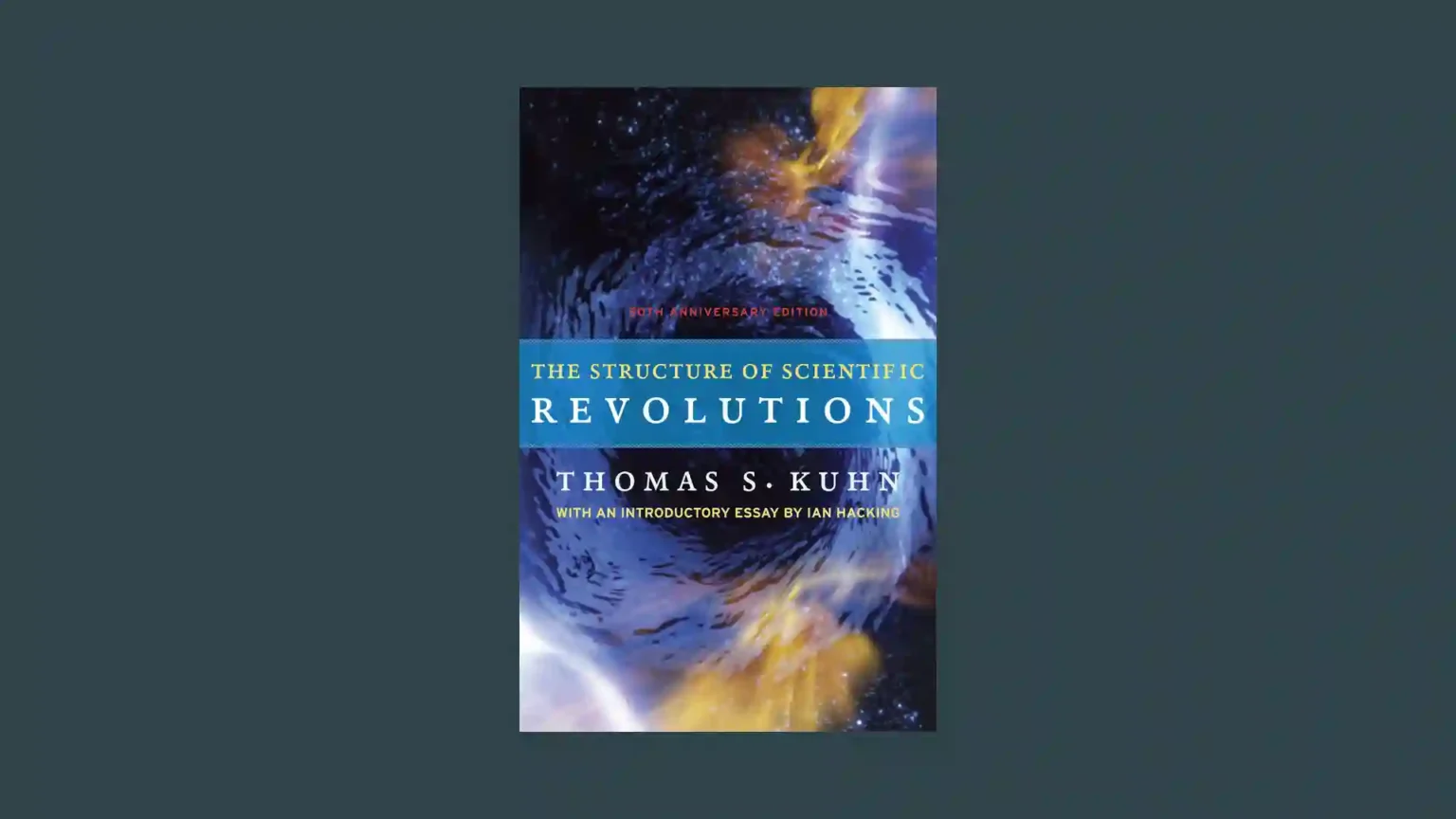
The Structure of Scientific Revolutions makes more sense when Kuhn’s historical examples, paradigms, and revisions are read in their publication context.
What exactly changed when Thomas Kuhn published The Structure of Scientific Revolutions in 1962? The easy answer—“he invented paradigms”—is too small. The harder answer requires staging the evidence: Kuhn changed which features of scientific life philosophy had to explain. Instead of beginning with isolated hypotheses and a timeless logic of confirmation, he made historically organized research communities, exemplary problem-solutions, normal puzzle-solving, anomalies, crisis, and conceptual change central to the philosophical picture. The current University of Chicago Press edition still presents the book as a challenge to linear accounts of scientific progress; the Stanford Encyclopedia entry on Kuhn shows why that challenge was methodological, semantic, and historical at once.
What problem was Kuhn entering?
Mid-century philosophy of science was dominated by questions about logical structure, explanation, confirmation, probability, and the relation between theoretical language and observation. Karl Popper’s rival program emphasized conjecture and refutation rather than verification. Kuhn did not simply choose one side. His training and historical work led him to ask a different question: what must a philosophy of science look like if it takes seriously the way successful scientific traditions actually develop over time?
That shift is why reading Kuhn as a sociologist who replaced reason with group psychology is inadequate. His historical cases are doing philosophical work. They challenge assumptions about stable standards, neutral observations, cumulative vocabulary, and the unit at which scientific achievement should be assessed. The result is not the claim that evidence is irrelevant. It is the claim that what counts as a good problem, a legitimate solution, a precise measurement, or an explanatory success is learned inside a scientific tradition.
When does “normal science” become philosophical?
Normal science is often caricatured as dull conformity. Kuhn’s point is sharper. A mature scientific community inherits exemplary achievements that define productive puzzles and acceptable solutions. Researchers do not normally reopen the deepest assumptions of the field every morning; they work within them. This gives science extraordinary puzzle-solving power, but it also means that anomalies are initially treated as local research problems rather than immediate refutations of the entire framework.
Here Kuhn presses against a simplified falsificationism. Popper’s philosophy had already distinguished logical falsifiability from actual methodological judgment, as the Stanford entry on Popper makes clear. Kuhn’s historical claim is nevertheless different in emphasis: persistent commitment to a paradigm is not merely a regrettable delay in criticism. It can be constitutive of the concentrated research that makes anomalies precise enough to become revolutionary.
How did the vocabulary evolve?
| Date | Kuhnian development | Why it matters |
|---|---|---|
| 1940s–50s | Historical work on scientific development | History becomes evidence for philosophy of science. |
| 1962 | First edition of Structure | Paradigm, normal science, anomaly, crisis, revolution become linked. |
| 1969 | Postscript to second edition | Kuhn clarifies “paradigm” through disciplinary matrices and exemplars. |
| 1970s–80s | Debates over incommensurability | The problem shifts toward language, taxonomy, and comparison. |
| 2000 | The Road Since Structure appears posthumously | Later essays show a more precise account of conceptual change. |
The 1969 Postscript matters because “paradigm” had begun to mean almost anything shared by a community. Kuhn narrowed the machinery by distinguishing a broader disciplinary matrix from concrete exemplars—successful problem-solutions through which scientists learn what counts as doing the field correctly. That clarification also explains why a paradigm is not merely an explicit list of beliefs. Much scientific competence is acquired through trained similarity judgments and worked examples.
Edition distinction: the 1969 Postscript belongs to Kuhn’s revision of The Structure of Scientific Revolutions, not to its original 1962 text. The later 50th-anniversary/fourth edition also adds Ian Hacking’s introductory essay. Treat those editorial layers separately when comparing versions. Source: University of Chicago Press edition and contents.
Why is incommensurability not “no comparison is possible”?
The term “incommensurability” generated the most durable controversy. The Stanford account of Kuhn explains that competing theories may lack a wholly neutral common measure because standards and conceptual taxonomies can change. But this is not equivalent to saying that rival theories cannot be compared at all. Scientists can argue across revolutions; they can cite accuracy, scope, simplicity, fruitfulness, and consistency. The difficulty is that these values need not function as an algorithm that forces the same weighting on every competent judge.
That point changes the philosophy of scientific rationality. If standards of assessment have histories, then rationality cannot simply be identified with rule-following under fixed criteria. Yet if scientists still give reasons, compare achievements, and learn from evidence, historical change does not reduce theory choice to arbitrary preference. Kuhn’s work occupies the uncomfortable middle: rational comparison without a timeless decision procedure.
What role does history play after Structure?
Kuhn’s influence helped make history of science a source of philosophical counterexamples rather than decorative context. Lakatos responded by trying to reconstruct historical sequences as progressive or degenerating research programmes; Feyerabend pushed historical counterexample even harder against universal method. The Cambridge volume Criticism and the Growth of Knowledge documents this confrontation, while the Stanford entry on Lakatos shows how one major response sought to preserve rational appraisal without returning to instantaneous falsification. For a closer account of his response, see the Lakatos research-programmes reading route.
The wider consequence is visible beyond Kuhn’s own vocabulary. Contemporary philosophy of science routinely asks how models represent, how experiments intervene, how theories change, how scientific communities coordinate standards, and how historical discontinuity affects realism. Ian Hacking’s Representing and Intervening is one later example: it redirects attention toward experimental practice, another domain that theory-centered philosophies had often treated as secondary.
Does Kuhn undermine scientific realism?
Not by simple implication. Scientific realism asks whether successful theories give approximately true accounts of a mind-independent world, including unobservable aspects. The SEP overview of scientific realism shows why historical theory change creates a serious problem: past theories were successful while containing claims later abandoned. Kuhn supplies material for that pressure, but he does not turn every historical replacement into proof that truth is inaccessible. The realism debate after Kuhn becomes more selective, asking what survives theory change—entities, structures, explanatory relations, or something else.
BookInLight’s essay on Darwin, morality, and human exceptionalism provides a useful internal example of a different kind of conceptual transformation: Darwinian explanation did not merely add facts; it altered what counted as an acceptable origin story for mind and morality. The analogy should not be overdrawn, but it shows why philosophy of science must sometimes track changes in explanatory categories rather than only changes in isolated propositions.
How should theory choice be understood?
Kuhn’s critics worried that if shared rules cannot force a unique choice between paradigms, theory change collapses into subjectivity. Kuhn’s later work answered by distinguishing shared scientific values from an algorithm. Accuracy, consistency, scope, simplicity, and fruitfulness can be common values even when scientists weight them differently or disagree about how a theory realizes them. This is not an absence of reasons. It is a claim about the structure of judgment: competent agents can share evaluative vocabulary without a mechanical procedure that guarantees convergence at the same moment.
That model helps explain why revolutionary transitions can contain persuasion without becoming mere propaganda. Scientists argue over problems, standards, exemplars, and future promise. Some reasons are retrospective; others concern what a research tradition may make possible. The consequence for philosophy of science is substantial. Rationality must be able to include judgment under changing standards, not only deduction under fixed rules.
Why “paradigm” became too successful a word
The popular afterlife of “paradigm shift” has obscured Kuhn’s later precision. In ordinary speech almost any change in fashion, software, management, or political messaging can be called a paradigm shift. In Structure the term is tied to scientific communities and exemplary achievements that organize puzzle-solving. The 1969 Postscript was partly an attempt to repair the ambiguity by separating the broader disciplinary matrix from exemplars learned through practice. Reading that clarification after the main text prevents the word from becoming a mystical force that “controls” scientists.
What should a reader carry into the book?
Carry five distinctions: normal science is productive rather than merely conservative; anomaly is not automatically falsification; crisis is historical and disciplinary rather than a formal threshold; revolution changes problems and standards as well as answers; incommensurability complicates comparison without abolishing reasons. Read the 1969 Postscript after the main text, not before, so you can see what Kuhn is correcting in his own terminology.
The practical result is a more demanding notion of scientific change: continuity of community and practice can coexist with discontinuity in concepts, standards, and exemplary problems. “Revolution” names that conjunction, not merely a dramatic discovery.
Sources consulted
The primary reference edition is the University of Chicago Press 50th-anniversary edition. Interpretive checks used the Stanford Encyclopedia entry on Thomas Kuhn, the Stanford overview of scientific realism, and the historical debate preserved in Criticism and the Growth of Knowledge. For the experimental turn after Kuhn, see Hacking’s Representing and Intervening.
The next question Kuhn makes unavoidable is not whether paradigms “control” scientists. It is whether a philosophy of science can explain both the discipline that makes normal research powerful and the conceptual flexibility that makes revolutionary change possible without turning either one into irrationality.
Cover artwork: credits and source records
- The Structure of Scientific Revolutions — University of Chicago Press (source record)