Nagel’s “The Absurd” is a short philosophical essay with a specific publication and reprint trail worth distinguishing.
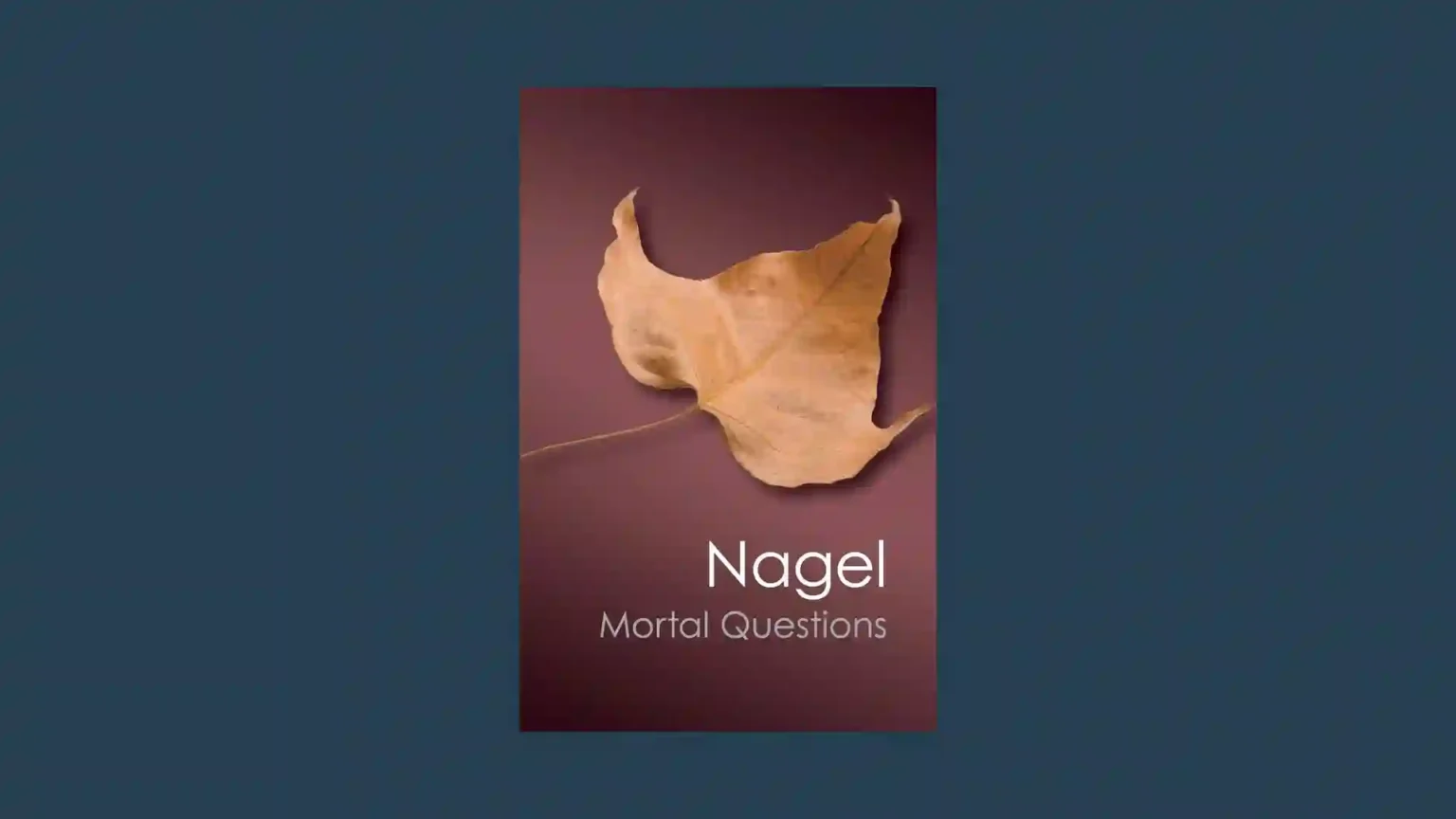
“The absurd” is less stable than it looks. In Camus it names a confrontation between the human demand for meaning and an indifferent world; in Thomas Nagel it emerges from the possibility of stepping back from the seriousness with which we conduct our lives. Before interpreting the term, locate the text: Nagel’s essay is collected as Chapter 2 of Mortal Questions, immediately after “Death.”
The collected text
Cambridge University Press lists “The Absurd” as pages 11–23 in Mortal Questions. The collection is the easiest stable place to read the essay because it also shows its conceptual neighborhood: “Death,” “Moral Luck,” “Brain Bisection and the Unity of Consciousness,” “What Is It Like to Be a Bat?”, and “Subjective and Objective.” Those neighboring essays reveal a recurring Nagelian problem: how first-person seriousness changes when viewed from a more detached standpoint.
The bibliographic point changes interpretation. Read alone, “The Absurd” can look like one more essay about whether life has meaning. Read inside Mortal Questions, it becomes part of a larger inquiry into the friction between subjective involvement and objective detachment.
Nagel is not simply repeating Camus
The word encourages an easy conflation. The Stanford Encyclopedia entry on Camus describes absurdity as the tension between our drive for intelligibility and the world’s silence. Nagel, by contrast, attacks several conventional arguments for absurdity—such as the thought that our actions will not matter in a million years—and locates absurdity in our capacity to treat our own commitments both seriously and skeptically. The Cambridge chapter page summarizes that reversal.
This difference does not make one account “correct” and the other obsolete. It makes the noun absurd a useful warning against lexical laziness. Similar vocabulary can organize different arguments. That is why a text-locator article should link the reader to the actual essay before supplying thematic labels.
A compact publication map
| Route | What it gives you | Why choose it |
|---|---|---|
| Mortal Questions — Chapter 2 | Canonical collected placement | Best for reading Nagel’s essay among related problems |
| Cambridge chapter page | Verified chapter title, pages, DOI, summary | Best for citation and fast confirmation |
| Camus scholarship | A contrasting concept of absurdity | Best for preventing false equivalence |
| Personal identity / subjective-objective debates | Nagel’s broader concern with standpoint | Best for seeing why detachment matters |
How much context is enough?
You do not need to read the whole collection first. Read “Death” if you want to see Nagel dismantle a familiar intuition by changing the frame of evaluation. Read “Subjective and Objective” later if you want the broader philosophical architecture behind the essay’s self-distancing maneuver. The collection page at Cambridge Core makes that route visible without requiring you to infer the sequence from citations elsewhere.
If your interest is existentialism, pair Nagel with Camus rather than labeling Nagel an existentialist. If your interest is analytical philosophy of life’s meaning, focus on the structure of Nagel’s argument: ordinary reasons for calling life absurd fail, yet the sense of absurdity survives because we can always question from a detached standpoint the reasons that organize our engaged standpoint.
The next question made unavoidable by the evidence is not “Which philosopher believes life is meaningless?” It is “What kind of distance from our own reasons generates the judgment of absurdity?” That question connects the essay more naturally to Nagel’s work on subjectivity and objectivity than to a generic shelf called pessimism.
The original publication history is worth tracking because it shows that “The Absurd” did not originate as a chapter conceived for Mortal Questions. Nagel’s essays circulated individually before being gathered. Collection therefore creates a retrospective conceptual neighborhood. That is not a reason to ignore the book context; it is a reason to distinguish original occasion from later arrangement.
Nagel’s argumentative method is also unlike Camus’s literary-philosophical procedure. He begins by testing standard reasons for absurdity and shows why they fail: temporal insignificance does not establish insignificance simpliciter, smallness in the universe does not by itself make commitments absurd, and the fact that justifications end somewhere applies to many practices without discrediting them. The Cambridge summary makes this negative strategy visible.
What remains is the collision between engagement and reflection. We cannot live without taking projects seriously, yet we can adopt a standpoint from which any ultimate justification can be questioned. The absurdity lies in continuing both attitudes. That structure helps explain why Nagel does not recommend despair or a final philosophical cure. Irony becomes more appropriate than heroic revolt.
This is precisely where the Camus comparison becomes clarifying rather than ornamental. Camus asks how to live without appeal once the world refuses ultimate intelligibility; Nagel asks what follows from our ability to place our own reasons at skeptical distance. The SEP Camus entry shows the first structure, while Nagel’s own chapter shows the second.
The collection also rewards lateral reading. “Death” challenges ordinary assumptions about what makes death bad; “Moral Luck” exposes tensions between responsibility and factors beyond control; “Subjective and Objective” generalizes the conflict of standpoints. Together they show why Mortal Questions is a better home for “The Absurd” than an anthology devoted only to existential themes.
For citation, the Cambridge chapter page is preferable to an unsourced transcript because it supplies the collected pagination and DOI. For interpretation, however, always distinguish bibliographic certainty from philosophical consensus. Knowing exactly where the essay sits does not settle whether its account of absurdity is persuasive; it merely gives the disagreement a stable text.
Nagel’s conclusion also has a tonal precision that summaries often lose. The appropriate response to absurdity is not necessarily tragedy. Because the reflective standpoint is itself part of human life, a degree of irony becomes possible: we can continue to care while recognizing that our reasons can be questioned from outside their local frame. That is different from proving that nothing matters.
This point helps distinguish “meaninglessness” from “absurdity.” A life could contain love, achievement, obligation, pleasure, and suffering and still be absurd in Nagel’s sense, because absurdity concerns the relation between seriousness and reflective doubt. Conversely, a life that feels empty is not automatically philosophically absurd in the same way.
The bibliographic map therefore has one final use: it protects conceptual precision. The chapter title, collected context, and neighboring essays tell you what problem family Nagel is working in. The Mortal Questions contents are not metadata outside philosophy; they are evidence about how a philosopher chose to stage relations among death, luck, consciousness, subjectivity, and the absurd.
If you cite the essay in discussion of Camus, make the comparison explicit rather than letting a shared title do the work. Link readers to Nagel’s chapter and to serious Camus scholarship so that they can inspect both structures. Good hyperlinking here functions like a footnote-sized argument against false equivalence.
Cover artwork: credits and source records
- Mortal Questions — Cambridge University Press (source record)