
Penguin Classics, founded by Penguin Books in 1946, solved a durable publishing problem: how to place serious texts, usable translations, and enough scholarly guidance inside inexpensive books for a mass readership. This Penguin Classics guide finds a series whose authority comes less from uniform editorial perfection than from scale, recognisability, repeated retranslation, and an unusually powerful capacity to turn neglected writing into public culture. It also explains why the black spine cannot guarantee the same textual standard in every volume.

The Series That Made “Classic” a Mass-Market Category
Penguin Classics is often described as a shelf of canonical books. That is accurate but inadequate. Its deeper achievement is architectural: it built a repeatable system through which texts from radically different languages, periods, genres, and intellectual traditions could enter the same commercial and visual environment. Homer, Sei Shōnagon, Ibn Khaldun, Jane Austen, Frederick Douglass, Sigmund Freud, Rabindranath Tagore, Clarice Lispector, and Marvel comics can all be presented as members of one publishing family. The family resemblance is partly material—the black spine, the Penguin mark, the standardised paratext—but principally institutional. Penguin declares that these works should remain available, interpretable, and purchasable by non-specialists.
The official Penguin Classics profile describes a list approaching 3,000 works, while the publisher’s 2026 catalogue advertises 3,500 entries. These are not necessarily contradictory figures: publishers may count works, editions, formats, regional products, and subseries differently. The discrepancy itself is revealing. Penguin Classics is now too large and internally layered to be described by a single stable total.
That scale produces a paradox. The brand is one of the strongest assurances in trade publishing, but it is not a guarantee that every volume has been prepared to the same scholarly level. A recent commissioned translation with extensive notes and a clearly identified source text may sit beside an older translation whose language, bibliography, or interpretive assumptions have aged. A British paperback may differ from an American Deluxe Edition. A work may migrate between Penguin Classics, Penguin Modern Classics, the Penguin English Library, Clothbound Classics, or another related format without acquiring a wholly new text. The imprint promises seriousness and accessibility; the individual volume still requires bibliographic inspection. The practical rule of this Penguin Classics guide is therefore simple: trust the programme, then verify the edition.
1946: E. V. Rieu Turns Translation into Access
The founding event is unusually clear. Penguin launched the series in 1946 with E. V. Rieu’s prose translation of Homer’s Odyssey; Rieu became its first editor. Penguin’s company timeline identifies the publication as the formal beginning of Penguin Classics, and later publisher histories emphasise its extraordinary commercial success. The decisive innovation was not the discovery that Homer mattered. It was the proposition that a newly translated ancient epic, written in contemporary English and sold as an inexpensive paperback, could reach the same broad public that Penguin had created for modern fiction and nonfiction.
Rieu’s approach placed readability before archaeological imitation. His Odyssey was prose, narratively direct, and deliberately resistant to the stiff “translationese” that had made many school and library versions feel remote. That choice helped establish the earliest Penguin Classics as translations for intelligent general readers rather than miniature critical editions. The translator’s task was to restore a work’s movement in English, not to reproduce every formal property of the source. The policy was never wholly uniform, but the preference for living English shaped the list’s public identity.
This founding model carried genuine intellectual consequences. Translation became a mechanism of canon formation. When Penguin commissioned a work, kept it in print, attached an introduction, and distributed it internationally, the series did more than respond to an existing canon: it stabilised a particular English version as the version encountered by schools, book clubs, libraries, and private readers. Cathy McAteer’s research on Penguin’s Russian Classics shows how editorial selection, translator recruitment, and house expectations helped create the English-language afterlife of Russian literature. The process could broaden access while also narrowing plurality: a commercially dominant translation may eclipse alternatives, even when later scholarship exposes its omissions or stylistic distortions.
Rieu’s founding success therefore established both the great strength and the permanent risk of the series. Penguin Classics could make difficult literature socially available on an unprecedented scale. The same scale could make one editorial solution appear definitive when it was only one historically situated solution.
From Rieu to Betty Radice: The Rise of the Apparatus
Penguin Classics did not remain a plain-text translation library. Betty Radice, who became joint editor in 1964 and later sole editor, pushed the series toward a more explicit accommodation between scholarship and popular reading. Her significance lies not merely in the number of books she translated or supervised, but in a changed conception of what an affordable classic should contain. Bibliographies, line references, maps, explanatory notes, indexes, and more substantial introductions became increasingly normal rather than exceptional.
Radice’s model was scholarly without aspiring to reproduce the full machinery of a critical edition. That distinction remains central. A Penguin Classic may identify manuscripts, editions, variants, historical contexts, and translation problems, but its governing purpose is usually to support reading rather than to document every stage of textual transmission. A specialist edition of a classical, medieval, or early modern text may print an original-language text, a stemma of manuscripts, extensive variant readings, and a formal critical apparatus. Penguin usually selects, translates, or edits a readable text and provides enough mediation to make the work intelligible.
The shift also changed the authority of the introduction. In the best volumes, the introducer is not a celebrity attached to a familiar title but a scholar capable of explaining composition, textual history, reception, political context, and interpretive controversy without pre-empting the reader. In weaker cases, the introduction becomes dated sooner than the text, reflects a once-dominant critical fashion, or offers literary appreciation without enough bibliographic clarity. Recent reissues sometimes add a new foreword while leaving an older text or translation in place, producing a layered paratext rather than a fully revised edition.
This is why the black spine should be read as a platform, not a certification mark. The platform sets expectations: a complete or responsibly described text, named editorial contributors, contextual guidance, and a price below specialist academic editions. Fulfilment varies by period and title. The best Penguin volumes make serious scholarship feel proportionate to the reader’s needs. The weakest inherit the prestige of the system without receiving enough renewal.
How Penguin Classics Defines a Classic
The list began with translated antiquity, but it no longer observes a narrow definition based on age, European origin, or settled literary prestige. Penguin’s own account of its current publishing programme presents the classics list as an evolving project and points to additions by Audre Lorde, Angela Davis, James Baldwin, and Ishmael Reed. Recent catalogues include oral traditions, political documents, letters, autobiography, ethnography, genre fiction, comics, and thematic anthologies alongside Greek drama and the nineteenth-century European novel.
This expansion is intellectually defensible because “classic” has never been a neutral description. It can mean enduring formal achievement, civilisational influence, historical representativeness, political importance, pedagogical usefulness, or belated recognition after exclusion. Penguin uses all of these meanings. A canonical European novel may enter because its status is secure; an anthology of migration writing may enter because the series seeks to name an emergent field; a suppressed or neglected work may enter because republication changes the history readers are able to perceive.
Yet breadth should not be confused with parity. The catalogue’s historical density remains greatest in European antiquity, European literatures, and the anglophone tradition. Asian, African, Middle Eastern, Latin American, and Indigenous literatures are present in important numbers, but often through a smaller set of internationally legible masterpieces, national anthologies, sacred texts, or works already validated by academic and metropolitan reception. M. Lynx Qualey’s critique of the series’ relationship to Arabic and world literature usefully asks not only whether non-European texts are included, but how they are framed and which traditions acquire multiple authors, genres, periods, and competing translations.
Penguin’s recent canon-expanding work is nevertheless substantial. The Penguin Book of Migration Literature, edited by Dohra Ahmad, groups writing by movement rather than nation. The Japanese, Korean, Indian, African, and Latin American anthology programmes give readers routes into traditions that cannot be represented by a single monumental novel. The inclusion of radical political writing and Black modernism also changes the implied reader: the classic is no longer only an inherited masterpiece to be admired, but a document through which institutions, exclusions, and historical violence can be contested.
Translation Policy Exists—Consistency Does Not
No responsible Penguin Classics guide can assign one translation quality to thousands of books. The series has commissioned prose and verse, literal and adaptive versions, scholar-translations and poet-translations, bilingual selections and monolingual reading editions. It has retained older translations, revised them, replaced them, and sometimes kept multiple translations of the same work in different markets or formats. The relevant question is not “Are Penguin translations good?” but “Which translation, prepared when, from which source text, for which reader?”
Rieu’s Odyssey exemplifies lucid modern prose. Robert Fagles’s Homer pursues amplitude, pace, and dramatic force in verse. Royall Tyler’s Tale of Genji combines a complete translation with extensive aids for names, court ranks, chronology, and the work’s unusually intricate social world. Stephanie McCarter’s recent Metamorphoses makes questions of gendered power and sexual violence explicit within the translator’s account of accuracy. These are incompatible strategies, and the series is stronger for allowing them to remain incompatible.
Replacement is one of Penguin’s most valuable editorial functions. Languages change; scholarship advances; expectations concerning dialect, race, gender, sexuality, empire, religious terminology, and the representation of violence alter. A translation once praised for smoothness may later seem euphemistic or domesticated. A newer version may restore obscenity, repetition, syntactic difficulty, or culturally specific terms that an older translator suppressed. The publisher’s willingness to commission again prevents the canon from becoming identical with one mid-century English voice.
The limitation is discoverability. Readers can easily buy a familiar title without noticing that Penguin offers another translation in a different territory, a revised Rieu, a Deluxe Edition, an older standard paperback, or an audiobook using a separate text. The Bookinlight comparison of the best translations of the Iliad shows why edition-level comparison matters: Fagles is powerful and pedagogically well supported, but readers prioritising closer line correspondence, contemporary metrical discipline, or bilingual reference may rationally choose another publisher.
Reliable Reading Texts, Uneven Textual Transparency
For ordinary reading and most undergraduate work, current Penguin Classics are generally dependable when the edition page clearly names the translator or editor and the front matter explains the textual basis. Dependability does not mean uniform suitability for advanced citation. A modern English novel may be based on one authorial edition while a competitor selects another. A medieval text may modernise spelling. An ancient text may follow a named critical edition but suppress most variants. A translated philosophical work may privilege readable terminology over the lexical consistency required in a specialist seminar.
Penguin’s Frankenstein, edited by Maurice Hindle, illustrates strong trade-edition transparency: it identifies the 1831 text as its basis, includes Mary Shelley’s 1831 introduction and Percy Shelley’s preface, and supplies a selective collation with the 1818 version. That is more useful than an unlabelled public-domain reprint, but it does not eliminate the reason a course might assign the 1818 text or a dedicated scholarly edition. Similarly, David Womersley’s complete three-volume Gibbon offers a serious modern editorial framework, while the existence of abridged Penguin versions means that title and publisher alone cannot establish completeness. Bookinlight’s guide to editions of The Decline and Fall of the Roman Empire demonstrates the practical consequences.
Oxford World’s Classics often makes the editorial problem more conspicuous. In an account of editing Oxford World’s Classics, OUP foregrounds decisions about copy-text, authorial revision, spelling, and punctuation. Penguin volumes can be equally intelligent, but the visibility of those decisions depends more heavily on the individual editor and the age of the edition. Readers doing textual research should therefore inspect the copyright page, note on the text, contents, and appendices before treating any Penguin as the citation standard.
What the Black Spine Makes Possible
The physical identity of Penguin Classics is not incidental packaging. It converts heterogeneous works into a visible library. The decisive historical design came in 1963, when Penguin Classics adopted black covers under the art direction of Germano Facetti, using art and photography within a more assertive visual system. Later redesigns altered typography and image placement, but black retained its function: seriousness without the expense or ceremonial weight of a hardback set.
The current trade paperbacks balance portability, shelf recognition, and low unit cost. Their weaknesses follow from the same economics. Very long texts become thick, dense objects; notes may be set in small type; margins can feel constrained; and a book built for broad circulation will not offer the paper, binding, or generous page architecture of a premium library edition. The material experience also varies between UK and US editions, standard and Deluxe paperbacks, compact hardbacks, and special collections.
Penguin has responded by turning the classic into several material propositions. Clothbound Classics use patterned cloth cases, foil stamping, coloured endpapers, and ribbon markers. Deluxe Editions may use French flaps, deckled edges, commissioned illustration, or larger trim sizes. Little Black Classics and pocket formats make brevity and price part of the concept. The publisher’s account of Penguin Classics design shows how the imprint uses art direction to keep old texts commercially visible without abandoning series recognition.
This design pluralism can attract readers to texts they might otherwise ignore, but it also separates collectability from editorial renewal. A beautiful new cover does not necessarily indicate a new translation, revised notes, or a different source text. Conversely, the plain black-spine paperback may contain the intellectually strongest edition. Serious buyers should treat cover, format, and textual contents as separate bibliographic questions. A useful Penguin Classics guide must keep those three identities apart.
Affordable Books, but Not a Single Price Tier
At the time of writing, current UK list prices for ordinary Penguin and Penguin Modern Classics paperbacks often cluster around £8.99 to £16.99. Large translated works rise higher: the official pages list John D. Smith’s 912-page abridged Mahabharata at £20 and Royall Tyler’s 1,216-page Tale of Genji at £26. Deluxe paperbacks, clothbound editions, and hardbacks occupy separate tiers. Retail discounts and multibuy promotions should not be mistaken for the series’ normal price position.
Value depends on apparatus. A £12.99 paperback containing a recent translation, scholarly introduction, chronology, maps, and notes can be an exceptional intellectual bargain. The same price is less persuasive when the text is freely available in the public domain and the Penguin edition adds little beyond branding. The purchaser is paying not for the words alone but for editorial selection, textual preparation, translation rights, paratext, design, distribution, and the likelihood that the edition will remain obtainable.
Academic usefulness is strongest at undergraduate level. Penguin Random House maintains higher-education catalogues, examination-copy systems, teaching resources, and subject classifications for literature, history, philosophy, political thought, religion, anthropology, and comparative studies. Its partnership with #DisruptTexts produced educator materials designed to question inherited canons and support works such as Passing, Monkey King, Ceremony, and The Penguin Book of Migration Literature; the education partnership announcement makes the pedagogical strategy explicit.
For graduate work, suitability becomes title-specific. A Penguin translation may be the seminar’s chosen English text, but students working in the source language may need Loeb, Oxford Classical Texts, Cambridge Greek and Latin Classics, or another critical edition. In literary studies, Norton Critical Editions may be preferable when a course requires contemporary documents and a substantial anthology of criticism in the same book. Penguin is usually the better reading library; it is not always the most complete teaching dossier. For students, this Penguin Classics guide recommends comparison by course purpose rather than by brand reputation.
The Volumes That Best Explain the Project
Representative volumes should reveal different functions of the series rather than supply a list of famous books. The following editions show Penguin Classics operating as literary translator, cultural mediator, pedagogical institution, and canon-building publisher.

Exemplary Literary Translation
The Iliad
Author: Homer
Translator or editor: Robert Fagles; introduction and notes by Bernard Knox
Publisher and year: Penguin Classics, this edition 1999; ISBN 9780140275360
Why it matters: Fagles and Knox demonstrate Penguin’s ability to unite a forceful English poem with substantial historical and literary framing. It is authoritative for reading and teaching without pretending to be the closest possible line-by-line rendering.
Best suited to: First-time epic readers, literature courses, book groups, and readers who value dramatic momentum.
Strongest Cultural Apparatus
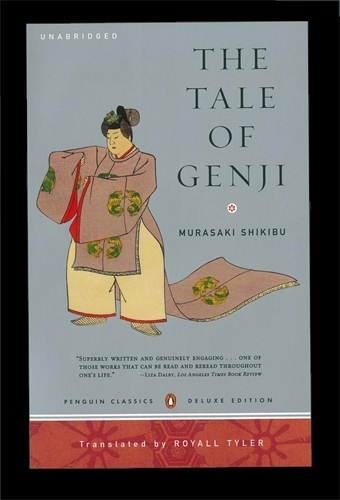
The Tale of Genji
Author: Murasaki Shikibu
Translator or editor: Royall Tyler
Publisher and year: Penguin Classics, 2003; ISBN 9780142437148
Why it matters: A complete translation is supported by notes, glossaries, character lists, and chronology. The edition recognises that accessibility sometimes requires more mediation, not simpler prose alone.
Best suited to: Serious general readers, world-literature courses, and readers prepared for a large book with a demanding social and cultural system.
Canon-Expanding but Abridged
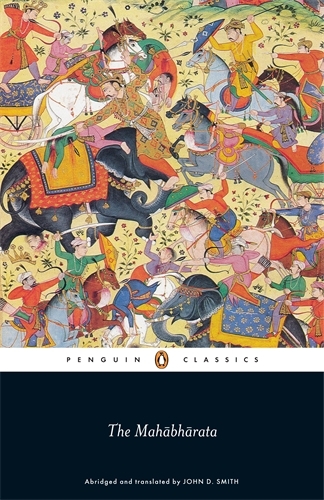
The Mahabharata
Author: Anonymous; traditionally attributed to Vyasa
Translator or editor: Abridged, translated, and introduced by John D. Smith
Publisher and year: Penguin Classics, 2009; ISBN 9780140446814
Why it matters: The volume makes a vast Sanskrit epic manageable within one trade paperback, but its usefulness depends on the reader noticing the abridgment. It embodies both Penguin’s access mission and the danger of confusing accessibility with textual completeness.
Best suited to: First encounters and survey courses; not research requiring the complete epic.
Other revealing volumes include Stephanie McCarter’s Metamorphoses, whose translation commentary revisits gender and violence; The Penguin Book of Migration Literature, which constructs a transnational thematic canon; Maurice Hindle’s Frankenstein, with its selective 1818–1831 collation; and Womersley’s Gibbon, which demonstrates that a trade paperback series can sustain a major multi-volume scholarly undertaking.
Where Oxford or Norton Outperforms Penguin
Penguin’s nearest competitor is Oxford World’s Classics, but the two lists are not interchangeable. Oxford more consistently foregrounds the edition as a scholarly object: introductions, notes, chronology, bibliography, appendices, and textual decisions are central to the brand’s promise. Penguin often wins on literary presentation, translation variety, catalogue imagination, and cultural visibility. Oxford often wins when a student needs an economical edition whose editorial apparatus follows a more regular template.
The Oxford World’s Classics programme explicitly promises continuous revision, comprehensive introductions, explanatory notes, chronologies, and bibliographies. Norton Critical Editions go further in a different direction, combining an annotated text with contexts and a selection of critical essays. Everyman’s Library, by contrast, is principally a durable hardback library: its publishing history defines the revived series as a permanent library of record.
| Criterion | Penguin Classics | Oxford World’s Classics | Norton Critical Editions |
|---|---|---|---|
| Primary aim | Mass reading library | Consistent scholarly reading edition | Course dossier |
| Best feature | Range and translation commissioning | Regular apparatus and textual framing | Contexts and criticism |
| Main weakness | Volume-level inconsistency | Less visually and commercially expansive | Narrower list; denser classroom focus |
| Choose it for | Reading, collecting, translation choice | Study, annotation, editorial clarity | Seminars requiring critical reception |
No series wins every comparison. For Homer, Penguin may offer the most compelling literary translation for a given reader while Oxford offers more economical guidance and another translation strategy. For a nineteenth-century English novel, Oxford’s note on the text and explanatory annotation may be more useful. For a course on a single work’s reception, Norton may eliminate the need for a separate criticism anthology. For a permanent home library, Everyman’s sewn hardbacks and acid-free paper may justify their higher price even when Penguin has the stronger modern editor.
What the Uniform Covers Conceal
The first recurring limitation is editorial age. A primary text may remain indispensable while its introduction, bibliography, terminology, or assumptions become dated. Penguin’s enormous backlist makes simultaneous revision impossible. Commercially secure titles can support new translations and anniversary editions; less visible works may remain available only in an older form or disappear.
The second is uneven disclosure. Some volumes clearly explain source text, abridgment, revision, and editorial procedure. Others require close reading of the copyright page to determine what has changed. The Smith Mahabharata is responsibly identified as abridged on authoritative publisher records, yet casual buyers encountering a cover and title alone may assume completeness. Series prestige can discourage the very checking that large, complex texts require.
The third is the ambiguity of expansion. Adding formerly excluded writers changes the canon, but the method can become episodic: one national anthology, one recovered novel, one political anniversary, one marketable rediscovery. A genuinely global classics programme requires depth within traditions—multiple periods, genres, authors, and translation debates—not symbolic representation. Penguin has moved far beyond its European beginnings, but its catalogue still records the unequal history of anglophone translation and bookselling.
The fourth is the proliferation of formats. Clothbound, Deluxe, English Library, Modern Classics, Little Black Classics, hardbacks, audio, and regional editions give readers choice but blur bibliographic identity. A redesigned object may preserve the old text. A newer translation may appear first in one market. An ebook product page may not display the same front matter as the paperback. Collectors who buy by series appearance can end with duplicates that are editorially identical; students who buy by title can end with the wrong translation.
None of these problems invalidates the imprint. They follow from the attempt to operate simultaneously as a literary institution, global trade list, educational supplier, design brand, rights platform, and backlist-management system. The useful critical response is not distrust but discrimination.
Who Should Actually Buy Penguin Classics?
Penguin Classics remains the strongest general-purpose classics library in English for readers who value range, availability, translation choice, recognisable design, and prices that usually remain below specialist editions. Its reputed strengths are real: it has commissioned major translations, kept difficult works commercially present, widened the category of the classic, and made editorial mediation part of ordinary reading. Its finest volumes are not compromises. They are expertly conceived trade editions that scholars can respect and non-specialists can finish.
The exaggerated claim is uniform authority. “Penguin Classics” does not answer which text, translation, edition, or apparatus a reader should use. Confidence should be highest in recent volumes that identify their contributors, textual basis, completeness, and supporting materials; in landmark commissioned translations whose strategies are openly explained; and in major scholarly projects such as Tyler’s Genji or Womersley’s Gibbon. Caution is most necessary with older unrevised translations, ambiguous abridgments, public-domain English texts with minimal added value, and attractive reissues whose covers have changed more than their contents.
General readers should begin with Penguin when they want a well-framed route into a work and do not need a source-language apparatus. Students should use the assigned edition, because pagination, translation, and notes affect classroom discussion. Independent students should compare Penguin with Oxford when annotation and textual explanation matter. Graduate researchers should verify whether a Penguin is the field’s citation standard rather than assuming it. Collectors should distinguish the editorial edition from the physical format and choose Clothbound or Deluxe books for design, not because decoration establishes textual superiority.
The final judgment of this Penguin Classics guide is that the series remains necessary because no competitor combines its breadth, public visibility, translation programme, and capacity for canon revision. Oxford is often more systematically scholarly; Norton is more deliberately pedagogical; Everyman’s is materially more durable. Penguin’s distinctive contribution is to keep the border between the university, the bookshop, and the private reader unusually permeable.
The catalogue finally reveals a capacious but contested conception of intellectual value: a classic is a work that a publisher is prepared to translate, frame, redesign, recirculate, and expose to renewed judgment. Penguin Classics matters not because every black-spine volume is definitive, but because the series has made revision, access, and argument part of what a public classic can be.
Sources
Series history and editorial mission
- Penguin Classics, Penguin Books UK — supports the founding history, official mission, approximate list scale, and current imprint positioning.
- Our Timeline, Penguin Books UK — confirms the 1946 launch with Rieu’s Odyssey and his appointment as first editor.
- Penguin Classics at 75: Five Landmark Books That Shaped the Series, Penguin Books UK — supports the early commercial and editorial context.
- Betty Radice, Penguin Random House — confirms Radice’s role from 1964 and her work as editor and translator.
- Betty Radice (1912–1985) and the Survival of Classics, Rowena Fowler / classical reception research — supports the account of Radice’s scholarly-popular editorial model.
Catalogue, canon, and education
- Catalogue, Penguin Classics, 2026 — supports the 3,500-entry figure and current bibliographic scope.
- Our Publishing, Penguin Books UK — supports the claim that the classics list is an evolving project with recent canon expansion.
- Penguin Classics vs. the World, ArabLit Quarterly — informs the critique of global representation and the framing of Arabic literature.
- Penguin Random House Education Announces #DisruptTexts and Penguin Classics Partnership, Penguin Random House Higher Education — supports claims about educator resources and canon revision in classrooms.
Translation, design, and representative editions
- Introduction: Creating Penguin’s Russian Classics, Inverse Journal / Cathy McAteer — supports analysis of translator recruitment, editorial mediation, and canon formation.
- Penguin Books, Design Museum — confirms the 1963 black-cover redesign under Germano Facetti.
- Penguin Classics: The Art of Redefining Classic Literature Design, Penguin Random House — supports the discussion of design as a continuing commercial and editorial strategy.
- The Iliad, Penguin Classics — verifies the 1999 Fagles/Knox edition, ISBN, format, and UK list price.
- The Tale of Genji, Penguin Classics — verifies Tyler’s translation, publication date, ISBN, length, apparatus, and UK list price.
- The Mahabharata, Penguin Random House — verifies that John D. Smith’s edition is abridged as well as translated and introduced by him.
Competing series
- Oxford World’s Classics, Oxford University Press — supports the comparison of apparatus, revision policy, and academic orientation.
- Norton Critical Editions, W. W. Norton — supports the description of annotated text, contexts, and criticism.
- Everyman’s Library: History, Everyman’s Library — supports the comparison with a durable hardback library model.
Image Credits
- Catalogue, Penguin Classics 2026 hardback cover: Penguin Books UK official edition page.
- The Iliad, Robert Fagles translation, Penguin Classics 1999 edition cover: Penguin Books UK official edition page.
- The Tale of Genji, Royall Tyler translation, Penguin Classics 2003 edition cover: Penguin Books UK official edition page.
- The Mahabharata, John D. Smith abridgment and translation, Penguin Classics 2009 edition cover: Penguin Random House official edition page.