
Where to Start with Stoicism is less obvious than the familiar quotations suggest. Begin with a lucid modern orientation, then move into Epictetus, Marcus Aurelius, and Seneca: a sequence that teaches the system’s basic claims before asking you to interpret three very different forms of Stoic practice.
Introduction
Stoicism survives in fragments, reports, lecture notes, letters, and private reflections rather than in a single intact textbook written by one of the school’s founders. That accident of transmission matters. The works most beginners encounter belong largely to Roman imperial Stoicism, while the earlier Greek system joined ethics to logic, physics, psychology, and theology. The Stanford Encyclopedia of Philosophy’s account of Stoicism is useful precisely because it restores that systematic background.
The second obstacle is modern language. “Stoic” often means emotionally blank, silently enduring, or indifferent to other people. Ancient Stoicism is instead a demanding form of virtue ethics: it asks which judgments make a life good, how desire can be educated, and what rational agency looks like in a world we do not control. The Internet Encyclopedia of Philosophy overview helps separate the philosophy from the everyday adjective.
Where to Start with Stoicism requires an order of intellectual dependence rather than a ranking of famous Stoic books. Pigliucci supplies orientation and modern vocabulary; Epictetus gives the clearest surviving classroom encounter with Stoic training; Marcus Aurelius shows that training turned inward; Seneca widens the field into friendship, mortality, wealth, public life, literary style, and sustained moral progress.
The shortest honest answer
Begin with Massimo Pigliucci’s How to Be a Stoic. Then read Epictetus’s complete Discourses, Fragments, Handbook, Marcus Aurelius’s Meditations in Gregory Hays’s translation, and Seneca’s complete Letters on Ethics. This order moves from orientation to instruction, self-examination, and finally the broad social texture of a philosophical life.
For readers asking Where to Start with Stoicism, the essential warning is simple: do not postpone the primary texts until you have mastered every doctrine of Hellenistic philosophy. Learn the distinction between what depends on us and what does not, the Stoic claim that virtue alone is good, and the role of judgments in emotion; let the books teach the rest through repetition and practice.
Before you start: how to approach Stoicism
Where to Start with Stoicism becomes clearer once the central beginner mistake is avoided: treating Stoicism as a box of coping techniques detached from its account of the good. Negative visualization, attention to control, and reflection on mortality are not neutral productivity tools. They make sense within the claim that character and rational choice are more decisive for flourishing than status, comfort, reputation, or luck. Without that ethical center, Stoic exercises can become methods for tolerating bad priorities more efficiently.
Chronology is not the best entry route. Beginning with surviving fragments of Zeno, Cleanthes, and Chrysippus would provide historical priority but poor pedagogical continuity. Begin instead with a reliable map, then enter a Roman classroom. Epictetus is particularly valuable because the Stanford Encyclopedia’s Epictetus entry clarifies his recurring vocabulary of volition, impressions, integrity, and freedom. You need working definitions, not philological mastery.
Read slowly enough to notice arguments. “Some things are up to us” is not a slogan that divides events into controllable and uncontrollable piles; it is a claim about where moral responsibility is located. “Indifferents” are not things about which a person must feel nothing; they are things that do not determine virtue or vice, though many remain naturally preferred or dispreferred. Likewise, Stoic criticism of passions concerns evaluative judgments and excessive impulses, not a command to abolish affection.
A notebook helps, but keep it analytical. Record the situation, the judgment you made, the value you assigned to an external thing, and the alternative judgment proposed by the text. This converts quotation collecting into philosophical examination. Concepts such as providence, determinism, oikeiosis, and cosmopolitanism can be learned as they arise. The first task is to see how judgment, desire, action, and character fit together.
The best first book on Stoicism
Start with: How to Be a Stoic by Massimo Pigliucci
Pigliucci is the best first author here because he explains enough of the ancient architecture to prevent a purely motivational reading while keeping the beginner close to practical questions. His organizing dialogue with Epictetus gives the book a recognizable voice and prepares the transition to the primary text. It also distinguishes modern adaptation from historical reconstruction more clearly than many popular introductions.
The recommended Basic Books paperback is readable, available, and bibliographically straightforward. Its limitation is precisely what makes it useful: it presents one contemporary philosopher’s reconstruction, not an exhaustive history of the Stoa. Readers should not treat Pigliucci’s preferences as the final word on ancient doctrine, nor expect full treatment of Stoic logic or physics. Read it for orientation, terminology, and the shape of practice. Then go directly to Epictetus, whose rougher exchanges reveal how much discipline and resistance disappear when Stoicism is summarized too smoothly.
The core reading sequence
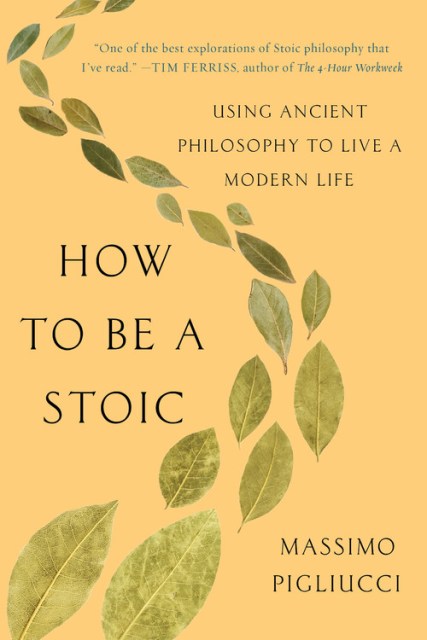
Book 1
How to Be a Stoic by Massimo Pigliucci
Edition shown: Basic Books, trade paperback, 2018, ISBN 9781541644533
Place in the sequence: Contemporary orientation and conceptual map
This book earns first place by answering the question a modern beginner actually has: what would it mean to adopt Stoic philosophy without pretending to live in imperial Rome? Pigliucci uses an imagined conversation with Epictetus to move between ancient doctrine and contemporary cases. The device is more than a friendly frame. It lets the reader see that application requires interpretation: no ancient text can simply issue instructions for modern work, family, politics, medicine, or grief without mediating judgment.
Look especially for the relation among the dichotomy of control, virtue, role ethics, and deliberate practice. The point is not to retreat into a private zone of calm. A Stoic still acts, prefers some outcomes, fulfills responsibilities, and attempts to improve institutions; the distinction concerns where moral worth finally lies. Pigliucci also helps correct the assumption that Stoicism demands emotional anesthesia. His treatment of exercises shows how attention can interrupt premature assent to an impression before it hardens into fear, anger, vanity, or despair.
The book should be read completely, but briskly. Do not stop to build a personal system from every exercise. Its role is to supply a map against which later texts can push back. Pigliucci’s voice is orderly and modern; Epictetus will be harsher, Marcus more compressed, and Seneca more expansive and literary. Those differences are philosophically valuable because they reveal that Stoicism was never one uniform prose style or temperament.
The main limitation is historical compression. Early Stoic logic, materialist physics, providence, and debates about determinism remain in the background. That is acceptable at this stage, provided the reader does not mistake a modern practical reconstruction for the whole system. Finish the book, write a one-page account of virtue and control in your own words, and move immediately to the complete Epictetus. That written summary will expose any confusion before the ancient terminology becomes denser.
Difficulty: Beginner
“One of the best explorations of Stoic philosophy that I’ve read.”
— Timothy Ferriss • Basic Books
Book 2
Discourses, Fragments, Handbook by Epictetus
Edition shown: Oxford World’s Classics, translated by Robin Hard, introduction and notes by Christopher Gill, paperback, 2014, ISBN 9780199595181
Place in the sequence: Foundational primary encounter with Stoic instruction
Epictetus should come before Marcus Aurelius because Marcus repeatedly works with an Epictetan framework that he does not stop to explain. The Discourses, recorded by Arrian, preserve the pressure of a classroom: objections, sarcasm, failed answers, imaginary conversations, and abrupt returns to first principles. The reader encounters philosophy as training rather than polished doctrine. This is where “up to us” becomes an exacting claim about the use of impressions, not a comforting division between things we can and cannot manage.
Pay attention to prohairesis, often rendered as volition, choice, or moral purpose. Epictetus locates freedom in the rational faculty that evaluates impressions and forms intentions. External events can constrain the body, property, office, or reputation; they cannot by themselves make the faculty of choice vicious. That claim is radical and sometimes severe. It should not be softened into the idea that every hardship is psychologically easy. Epictetus is describing the locus of ethical responsibility, not denying pain, bereavement, oppression, or material dependence.
Read the first two books of the Discourses continuously. Thereafter, shorter sessions work well, but resist skipping straight to the Handbook. The handbook is a compressed later digest, powerful only when its formulations have acquired context. Robin Hard’s complete modern translation keeps the fragments and handbook beside the full surviving discourses, while Christopher Gill’s introduction and notes orient readers without turning the volume into a specialist commentary.
The difficulty is tonal as much as conceptual. Epictetus can sound contemptuous toward weakness, and his examples belong to a world structured by slavery, patriarchy, and imperial hierarchy. Read critically, not defensively. His account of freedom emerged from that world and cannot be detached from it, but neither should biography be used to sanctify every claim. The reward is a disciplined vocabulary for assent, desire, aversion, role, and responsibility—the grammar Marcus Aurelius will soon use in private.
Difficulty: Moderate
“The only complete modern translation of Epictetus’s Discourses, together with the Handbook and fragments.”
— Oxford University Press • Oxford World’s Classics
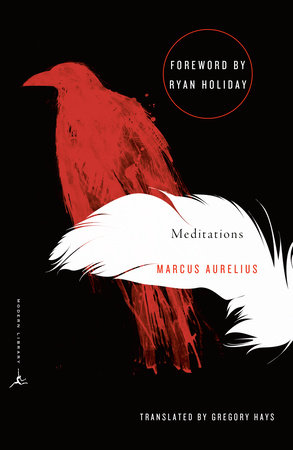
Book 3
Meditations by Marcus Aurelius
Edition shown: Modern Library, translated by Gregory Hays, paperback first published 2003; current printing with foreword by Ryan Holiday, ISBN 9780812968255
Place in the sequence: Stoic exercises turned into private self-correction
The fame of Meditations makes it look like an obvious first book, but its fragments are reminders written by someone already formed by philosophical study. Marcus rarely defines a term or lays out an argument from the beginning. He rebukes, redirects, condenses, and rehearses. Read after Epictetus, those repetitions become legible: attention to impressions, acceptance of what does not depend on choice, fulfillment of social roles, and the effort to align one’s judgments with nature.
The Internet Encyclopedia of Philosophy’s study of Marcus Aurelius usefully describes the work as a series of practical philosophical exercises. That is the right reading stance. Do not extract isolated sentences as universal maxims before asking what weakness Marcus is answering. A note about death may discipline vanity in one passage, impatience in another, and attachment to reputation elsewhere. Repetition is not redundancy; it reveals the instability of moral attention.
Gregory Hays’s translation is direct, rhythmic, and unusually approachable. Its contemporary cadence makes a first complete reading possible, though readers doing close scholarly work should later compare a translation with fuller notes and, where relevant, the Greek. The current cover shown belongs to the same Modern Library ISBN and adds a foreword by Ryan Holiday. Treat the foreword as optional framing; the translation itself is the reason to choose the edition.
Read all twelve books, but in small units. After each session, identify one repeated command and reconstruct the doctrine behind it from Epictetus. The limitation is that a private notebook can encourage an overly private Stoicism. Marcus’s language of the common good, kinship, duty, and the rational city must remain visible beside his inward discipline. His composure is not withdrawal from others; it is preparation to act without resentment, vanity, or self-deception. Keep a list of passages where social duty corrects the stereotype of isolated self-mastery.
Difficulty: Moderate
“Here, for our age, is [Marcus’s] great work presented in its entirety, strongly introduced and freshly, elegantly translated.”
— Robert Fagles • Penguin Random House

Book 4
Letters on Ethics by Seneca
Edition shown: University of Chicago Press, translated with introduction and commentary by Margaret Graver and A. A. Long, hardcover, 2015, ISBN 9780226265179
Place in the sequence: Ethical breadth, literary complexity, and sustained moral progress
Seneca comes last not because he is less accessible sentence by sentence, but because the complete letters range farther than the selections most beginners know. They move from time, friendship, reading, wealth, and mortality into technical questions about causation, emotion, propositions, moral development, and the nature of the good. After Epictetus and Marcus, the reader can recognize common Stoic commitments while also seeing a writer who tests them through correspondence, literary performance, Roman social life, and dialogue with Epicurus.
The Stanford Encyclopedia’s account of Seneca is particularly helpful on his place within Roman Stoicism and on the mistake of reducing him to a dispenser of moral sayings. Watch how the letters alter their reader. Early maxims attract attention, but Seneca later criticizes dependence on memorable excerpts and asks for coherent philosophical understanding. The sequence stages progress from borrowed wisdom toward judgment.
Graver and Long provide the first complete English translation in nearly a century, with an introduction and notes that preserve the work’s philosophical and historical density. Read Letters 1–29 continuously to grasp the educational design. After that, selective pacing is reasonable, but do not substitute a short anthology for the complete work if your goal is to understand Seneca rather than collect his most portable advice. Letters 63, 71, 85, 90, 94–95, and 116–124 deserve especially slow reading.
Seneca’s limitation is also his productive difficulty: the cultivated wealthy statesman advising simplicity raises unavoidable questions about consistency, privilege, and compromise. Do not resolve those tensions through either hero worship or easy dismissal. His philosophy repeatedly asks what progress looks like among people who are not sages. The letters make Stoicism social, rhetorical, and unfinished. They end this beginner path by replacing the fantasy of instant invulnerability with a long practice of correction, friendship, argument, and accountability. That slower conception of progress is the most durable lesson in the sequence.
Difficulty: Demanding
“An accurate, readable and well-annotated translation of Seneca’s letters.”
— Maarten van Houte • Bryn Mawr Classical Review
How these books fit together
The sequence narrows before it widens. Pigliucci supplies a contemporary map. Epictetus then concentrates attention on assent, desire, action, and the faculty of choice. Marcus converts that teaching into repeated self-address under political, bodily, and emotional pressure. Seneca finally expands the practice into friendship, wealth, illness, study, grief, literature, and public responsibility.
Where to Start with Stoicism is also a question of avoiding two distortions. Reading only modern introductions can make Stoicism look smoother and more settled than the primary texts. Reading only Meditations can make it look solitary. Pierre Hadot’s work on ancient philosophy as a practiced way of life, introduced in the Internet Encyclopedia of Philosophy’s account of Hadot, helps explain why arguments, exercises, genres, and forms of attention belong together. The four books move from explanation to discipline, rehearsal, and ethical relation.
Common beginner mistakes
Using Where to Start with Stoicism as a search for quotations instead of arguments. A sentence detached from its educational setting can sound profound while supporting almost any conclusion. Reconstruct the judgment, value claim, and practical problem behind the maxim.
Equating virtue with passive endurance. Stoicism concerns rational action and responsibility, not merely tolerating discomfort. The distinction between what depends on us and what does not never excuses neglect of what action, protest, care, or preparation genuinely requires.
Treating emotion as an enemy. Stoic moral psychology analyzes passions as judgments and impulses; it does not reduce a good life to numbness. Affection, caution, joy, and humane concern remain central questions.
Reading Marcus before learning his vocabulary. Meditations becomes clearer after Epictetus. Otherwise, private reminders are easily mistaken for a complete exposition of the school.
Trying to become a sage in a week. The surviving texts repeatedly describe progress, relapse, correction, and practice. Use them to improve judgment, not to manufacture a flawless philosophical identity.
Optional paths depending on your interest
If you are interested in practical decision-making, prioritize Discourses, Fragments, Handbook. Epictetus gives the sharpest account of impressions, assent, roles, and the boundary of moral agency.
If you are interested in journaling and self-examination, prioritize Meditations. Read it as evidence of repeated training rather than as a collection of finished doctrines.
If you are interested in friendship, grief, wealth, and public life, prioritize Letters on Ethics. Seneca’s epistolary form keeps philosophy close to changing circumstances and imperfect relationships.
For a more advanced path, continue with Letters on Ethics in full. Pair its later technical letters with a scholarly overview of Stoic logic, physics, and moral psychology.
FAQ
Is the Gregory Hays translation of Meditations the best edition for a beginner?
It is the most fluent first translation in this sequence. Its compact modern English encourages completion. For research, compare it later with an edition offering fuller notes and closer discussion of the Greek.
Should beginners read Seneca’s complete letters or a selection?
A selection is acceptable for a first taste, but the complete Graver–Long edition reveals the collection’s educational development and its later technical range. Read the opening letters continuously, then slow down.
How much Greek and Roman history is needed?
Only a basic chronology at first: the school’s Hellenistic origins, its fragmentary early sources, and the Roman imperial settings of Seneca, Epictetus, and Marcus. Add historical detail when a passage depends on office, slavery, exile, or court politics.
Does Where to Start with Stoicism require reading every book cover to cover?
Read Pigliucci and Marcus completely, and read at least the first two books of Epictetus continuously. For Seneca, complete the early sequence before moving selectively through the longer technical letters.
Related BookInLight Reading Guides
Best Books on Philosophy of Death: Five Essential Works extends the Stoic treatment of mortality into a wider philosophical debate.
Six Best Books on the Philosophy of Friendship provides useful context for Seneca’s account of friendship, self-sufficiency, and mutual moral formation.
Six Best Books on MacIntyre Virtue Ethics shows how a modern virtue tradition differs from, inherits, and criticizes ancient ethical models.
This article was researched and written by the BookInLight Department of Philosophy and Intellectual History, with bibliographical review, source verification, quotation verification, link verification, and editorial fact-checking. We welcome factual corrections, overlooked sources, edition suggestions, interpretive observations, and constructive ideas that can improve the guide.
The BookInLight Art Department is credited for editorial art direction, visual composition, cover selection, and image presentation. Rights in third-party covers remain with their publishers, artists, designers, and other rights holders. Complete republication, reproduction, translation, or reuse of this article requires prior written authorization from BookInLight.
Sources and Further Reading
Primary Texts and Editions
Massimo Pigliucci, How to Be a Stoic, Basic Books. Supports edition data, the modern orientation, and the publisher quotation.
Epictetus, Discourses, Fragments, Handbook, Oxford World’s Classics, trans. Robin Hard, intro. and notes Christopher Gill. Supports edition and completeness claims.
The Open Library record for the 2014 Epictetus edition. Supports ISBN, format, translator, editor, and exact cover correspondence.
Marcus Aurelius, Meditations, Modern Library, trans. Gregory Hays. Supports edition data, current printing, and translation description.
Seneca, Letters on Ethics, University of Chicago Press, trans. Margaret Graver and A. A. Long. Supports edition, completeness, contents, and sequence claims.
Reference and Historical Context
“Stoicism,” Stanford Encyclopedia of Philosophy. Supports the school’s history, systematic structure, sources, logic, physics, and ethics.
“Stoicism,” Internet Encyclopedia of Philosophy. Supports the account of Stoicism as eudaimonic virtue ethics and its Roman development.
“Epictetus,” Stanford Encyclopedia of Philosophy. Supports the discussion of volition, impressions, freedom, and pedagogical method.
“Marcus Aurelius,” Internet Encyclopedia of Philosophy. Supports the interpretation of Meditations as practical exercises shaped by Epictetus.
“Seneca,” Stanford Encyclopedia of Philosophy. Supports Seneca’s philosophical position and relation to Roman Stoicism.
Maarten van Houte, review of Letters on Ethics, Bryn Mawr Classical Review. Supports evaluation of the Graver–Long translation and apparatus.
Scholarly Studies and Advanced Continuations
Brad Inwood, Stoicism: A Very Short Introduction, Oxford University Press. A concise scholarly overview of doctrine, history, and modern reception.
Brad Inwood, ed., The Cambridge Companion to the Stoics. Supports the broader account of logic, physics, ethics, and historical development.
Margaret Graver, Stoicism and Emotion, University of Chicago Press. Supports the correction of emotional-suppression readings.
John Sellars, Stoicism, second edition, Routledge. A current systematic continuation covering logic, physics, ethics, and reception.
“Pierre Hadot,” Internet Encyclopedia of Philosophy. Supports the account of ancient philosophy as argument joined to spiritual exercise and a way of life.
Image Credits
How to Be a Stoic, Basic Books trade paperback, 2018. Cover image hosted by Hachette Book Group; exact edition documented on the Basic Books edition page.
Discourses, Fragments, Handbook, Oxford World’s Classics paperback, 2014. Cover image supplied through Open Library’s exact-edition record; edition documented on the Oxford University Press edition page.
Meditations, Modern Library paperback, Gregory Hays translation, current printing under ISBN 9780812968255. Cover image hosted by Penguin Random House; exact edition documented on the Penguin Random House edition page.
Letters on Ethics, University of Chicago Press hardcover, 2015. Cover image hosted by the University of Chicago Press; exact edition documented on the publisher edition page.