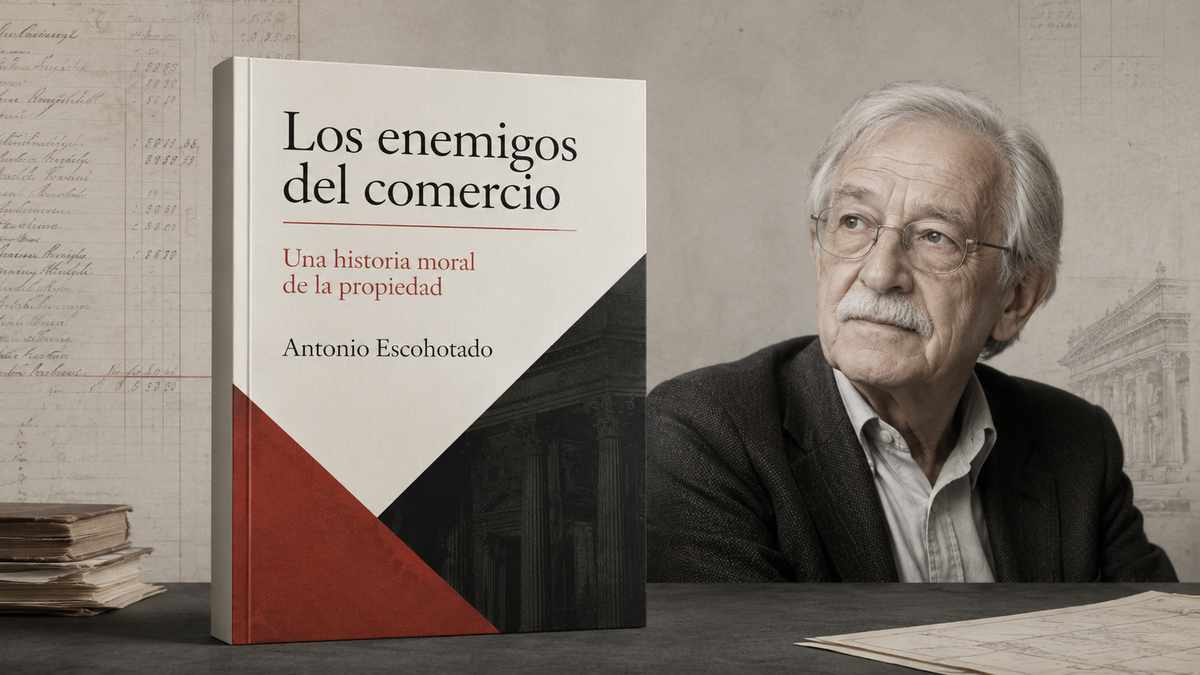
Antonio Escohotado’s three-volume history of hostility to property and exchange appeared in Spain between 2008 and 2016, provoking admiration for its scale and argument over its liberal architecture. No complete Los enemigos del comercio English Translation was located in the publisher, rights, library, and exact-edition sources checked as of 26 July 2026, and no forthcoming English edition was officially confirmed.
Book at a Glance
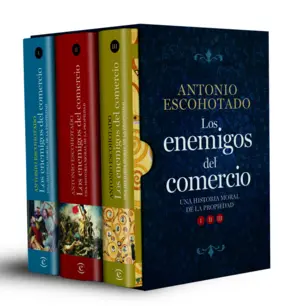
Book at a glance
Original title: Los enemigos del comercio: Una historia moral de la propiedad
Author: Antonio Escohotado
Original language: Spanish
Country: Spain
Original publisher: Espasa-Calpe
First published: 2008; trilogy completed in 2016
Current edition: Trilogía Los enemigos del comercio, Espasa, 2019, ISBN 978-84-670-5762-1
Format and length: Three-volume pack, 15 × 23 cm, 2,056 pages
Current price: €75.00 from PlanetadeLibros, checked 26 July 2026
Introducing the Book
Los enemigos del comercio is not a conventional history of communism. It is a genealogy of the moral suspicion directed at trade, money, private property, profit, and material difference. Escohotado asks how arguments against commerce changed as they moved from ancient ascetic communities and Christian poverty doctrines into modern socialism, Marxism, revolutionary government, and twentieth-century party states.
The project arrived in three stages: volume I in 2008, volume II in 2013, and volume III in 2016. Espasa later gathered them in the 2019 boxed edition. The intended reader is prepared for intellectual history on an unusually large scale—and for an author who does not hide his preference for voluntary exchange over coercive redistribution.
That combination explains the continuing search for a Los enemigos del comercio English Translation: the trilogy is at once a storehouse of historical material, a sustained liberal interpretation, and a target rich enough to invite serious disagreement.
What the Book Is About
The first volume reaches back before industrial capitalism. Sparta, Plato, the Essenes, early Christian communities, monastic discipline, millenarian revolt, the Reformation, and the French Revolution enter a long argument about poverty and possession. Escohotado’s governing claim is that anti-commercial thought cannot be explained solely as a reaction to factories or wage labor: it draws on much older moral languages that identify purity with renunciation and inequality with corruption.
The second volume moves through the nineteenth century and the birth of modern socialism. Saint-Simon, Fourier, Proudhon, Marx, industrialization, labor organization, business enterprise, and changing legal institutions are read together. The third follows revolutionary doctrine into Leninism, Bolshevik rule, the Soviet system, later communist regimes, and post-Soviet political afterlives. Across all three volumes, Escohotado repeatedly tests promises of collective emancipation against institutional results.
Its method is cumulative rather than narrowly disciplinary. Theology, philosophy, biography, law, economic history, and political events are made to illuminate one another. This produces the trilogy’s strength—unexpected continuities across two millennia—and its principal risk. Asceticism, egalitarian reform, democratic socialism, and totalitarian communism do not always belong to one explanatory family merely because each criticizes property or exchange.
Escohotado’s most consequential wager is historical: hostility to commerce is not a modern episode but a recurring moral tradition. The book’s value depends on testing that continuity rather than accepting or dismissing it as a slogan.
About the Author

Antonio Escohotado (Madrid, 1941–Ibiza, 2021) was a Spanish jurist, philosopher, sociologist, essayist, and translator. His publisher biography records translations of Hobbes, Newton, and Jefferson and a body of work spanning Hegel, social-science methodology, drugs, sexual morality, and political freedom.
His international reputation rests largely on drug history and anti-prohibitionist argument, but the trilogy belongs to a later liberal turn explored in a substantial Letras Libres intellectual portrait. An El País obituary likewise situated him as a provocative public intellectual whose independence mattered as much as any stable ideological label.
Why the Book Matters
The trilogy matters first because it changed the scale of a familiar debate. Instead of beginning with Marx or the Industrial Revolution, Escohotado makes the moral status of exchange a problem extending from antiquity to contemporary politics. Readers are forced to ask whether modern anti-capitalism inherits older structures of sacrifice, purity, resentment, or redemptive reversal—or whether the comparison obscures decisive historical differences.
It also restores institutions to ideological history. Property, contracts, guilds, companies, unions, welfare arrangements, and state planning appear not as background but as tests of doctrine. That insistence is valuable even where the interpretation is contestable: ideas about equality acquire consequences only through law, administration, incentives, and power.
Finally, the book is an important Spanish-language intervention in a field Anglophone readers often approach through Marxist histories, histories of capitalism, or Anglo-American liberal criticism. Its asymmetry is part of its significance. The trilogy does not offer neutral synthesis; it offers a learned, combative thesis whose evidence and categories deserve independent scrutiny.
How the Book Was Received
Spanish reception converged on the trilogy’s extraordinary ambition and divided over its organizing categories. Admirers emphasized erudition, lucidity, and courage; critics questioned the claimed neutrality, the breadth of “anti-commerce” as a category, and the tendency to read diverse egalitarian traditions through a liberal opposition between voluntary exchange and coercion. The strongest responses treated the work as an argument to be tested, not a warehouse of facts to be merely praised.
REVISTA DE LIBROS
Reviewer: Nieves San Emeterio
Assessment: “Propiedad: historia e ideas” (1 October 2009) approaches volume I through the changing legal and conceptual meanings of property. Its framing directs attention to a basic pressure point: whether one term can carry the trilogy’s very long chronology without flattening distinct institutions.
REVISTA DE LETRAS
Reviewer: Anna Maria Iglesia
Assessment: In “Escohotado sin límites” (20 November 2013), Iglesia respects the project’s reach but rejects the author’s presentation of value-neutral inquiry. She reads volume II as an essay openly defending private property and liberalism, making its standpoint part of the critical evidence.
EL ESTADO MENTAL
Reviewer: César Rendueles and Antonio Escohotado
Assessment: Their June 2014 correspondence stages the dispute directly. Rendueles grants the market’s capacity to coordinate plural lives without deep consensus, then presses the costs for justice and democratic deliberation; Escohotado answers from the priority of voluntary relations over imposed collective purpose.
REVISTA DE LIBROS
Reviewer: Juan Antonio Rivera
Assessment: “La propiedad y sus enemigos” (25 October 2017) describes the completed work as anomalous in both its virtues and shortcomings. Rivera admires its scale, erudition, lucid intelligence, and prose while preserving reservations about the disciplinary and argumentative stretches demanded by so encompassing a history.
EL PAÍS
Reviewer: Fernando Savater
Assessment: In “El sepulcro vacío” (7 July 2009), Savater describes the first volume as enormously erudite and intellectually combative. His reservation is philosophical: beliefs rooted in moral feeling and redemptive hope may survive even the most patient historical refutation.
Why It Should Be Translated into English
No complete English edition was located under the Spanish title, the renderings The Enemies of Commerce or A Moral History of Property, the author’s name variants, or the identified ISBNs. Planeta’s Book & Film Rights catalogue supplies English descriptive titles for the three volumes, but those listings are not published translations. The Open Library author record likewise identifies Spanish editions without establishing a complete English one.
A Los enemigos del comercio English Translation would not matter because Escohotado settled the history of communism. It would matter because he framed a large, disputable problem that English-language scholarship should be able to examine at first hand. Historians of religion could test the genealogy of poverty; economic historians could inspect the institutional evidence; political theorists could challenge the treatment of equality, coercion, and voluntary exchange.
The obvious difficulty is scale. At 2,056 pages, a complete edition would demand a committed translator, rigorous scholarly editing, and probably publication in three volumes or coordinated print and digital formats. Yet abridgment should not become silent substitution. The argumentative architecture depends on accumulation, and any shortened edition would need to identify its cuts plainly.
The case for a Los enemigos del comercio English Translation is a case for contestability: a major Spanish argument about property, commerce, communism, and coercion should be available to readers able to verify, resist, revise, or extend it.
English-Language Publishers That Should Consider It
These are editorial fits, not claims about rights availability or publisher interest. Each has a catalogue capable of placing a long, polemical history before readers who expect argument as well as documentation.

Candidate 1
Princeton University Press
Why it fits: Its economic and world-history lists accommodate large comparative arguments linking institutions, inequality, and political change.
Relevant catalogue comparison: Walter Scheidel’s The Great Leveler, another sweeping and deliberately provocative history of inequality.
Best edition type: Complete three-volume scholarly trade edition with translator’s introduction, notes, and unified index.
Likely readership: Intellectual historians, economic historians, and scholars of capitalism and communism.
Possible limitation: The translation and editorial cost would be exceptional even for a major university press.

Candidate 2
Yale University Press
Why it fits: The Margellos World Republic of Letters explicitly brings culturally consequential writing overlooked in translation into English.
Relevant catalogue comparison: The Margellos series’ translated literary and intellectual nonfiction, where argument and style both matter.
Best edition type: Complete multi-volume translation with a substantial historical introduction and bibliographic apparatus.
Likely readership: Readers of European ideas, political thought, comparative literature, and translation studies.
Possible limitation: The trilogy is far longer and more disciplinary than the series’ typical literary-scale project.

Candidate 3
Liberty Fund
Why it fits: Its programme joins political thought, economics, law, liberty, and the institutional conditions of a free society.
Relevant catalogue comparison: Michael Polanyi’s The Logic of Liberty, which connects spontaneous coordination to intellectual and political freedom.
Best edition type: Complete volume-by-volume print and digital edition with scholarly introductions.
Likely readership: Historians of liberalism, political economists, and readers of classical-liberal institutions.
Possible limitation: A new, enormous translation would be less typical than the organization’s established-text editions.
Editorial research and authorship: This article was researched and written by the BookInLight Department of Economics and Political Economy, with bibliographical review, multilingual source verification, English-translation-status checking, and editorial fact-checking by the BookInLight research team. Readers who identify a factual correction, overlooked source, documented translation, or valuable interpretive possibility are warmly invited to share comments and constructive suggestions.
Art direction and rights: The editorial art direction, visual composition, cover selection, portrait presentation, and publisher-logo presentation were developed by the BookInLight Art Department. Individual covers, photographs, portraits, logos, and related visual materials remain the property of their respective publishers, photographers, designers, institutions, and rights holders and are credited below. Complete republication, reproduction, translation, or reuse of this article, in print or digital form, requires prior written authorization from BookInLight.
Sources and Further Reading
Bibliographic and Edition Sources
- Espasa, Trilogía Los enemigos del comercio — boxed-edition date, format, ISBN, pagination, price, and cover.
- Espasa, volume I — 2008 first-volume publication and bibliographic record.
- Espasa, volume II — 2013 edition details and scope.
- Espasa, volume III — 2016 completion date and edition details.
- Google Books boxed-set record — exact-edition catalogue corroboration.
- Amazon Spain exact product page — current product identity and availability.
Author and Intellectual Context
- PlanetadeLibros author profile — verified biography, bibliography, and portrait.
- Manuel Morales, “Muere el filósofo Antonio Escohotado,” El País — career and public significance.
- “Antonio Escohotado: viaje al liberalismo,” Letras Libres — intellectual development and later liberal turn.
Reviews and Critical Reception
- Nieves San Emeterio, “Propiedad: historia e ideas,” Revista de Libros — volume I review.
- Anna Maria Iglesia, “Escohotado sin límites,” Revista de Letras — critique of neutrality and liberal framing.
- César Rendueles and Antonio Escohotado, “Sobre los enemigos del comercio,” El Estado Mental — direct debate.
- Juan Antonio Rivera, “La propiedad y sus enemigos,” Revista de Libros — assessment of the completed trilogy.
- Fernando Savater, “El sepulcro vacío,” El País — early appraisal of volume I.
Translation and Publisher-Fit Sources
- Planeta Book & Film Rights author catalogue — English descriptive rights titles, not proof of publication.
- Open Library author record — edition and language cross-check.
- Princeton University Press seasonal catalogue — The Great Leveler comparison.
- Yale’s Margellos World Republic of Letters — translation-series remit.
- Liberty Fund history and publishing mission — catalogue scope in liberty, law, economics, and political thought.
- Michael Polanyi, The Logic of Liberty, Liberty Fund — relevant catalogue comparison.
Image Credits
- Trilogía Los enemigos del comercio, Espasa 2019 pack cover — PlanetadeLibros exact-edition page.
- Antonio Escohotado portrait — PlanetadeLibros author page; photographer not identified on the source page.
- Princeton University Press logo — Wikimedia Commons file-description page.
- Yale University Press 2009 logo — Wikimedia Commons file-description page.
- Liberty Fund 2020 logo — Wikimedia Commons file-description page