To prepare for Naming and Necessity, learn the roles of names, descriptions, rigidity, and possible worlds before opening Kripke’s lectures.
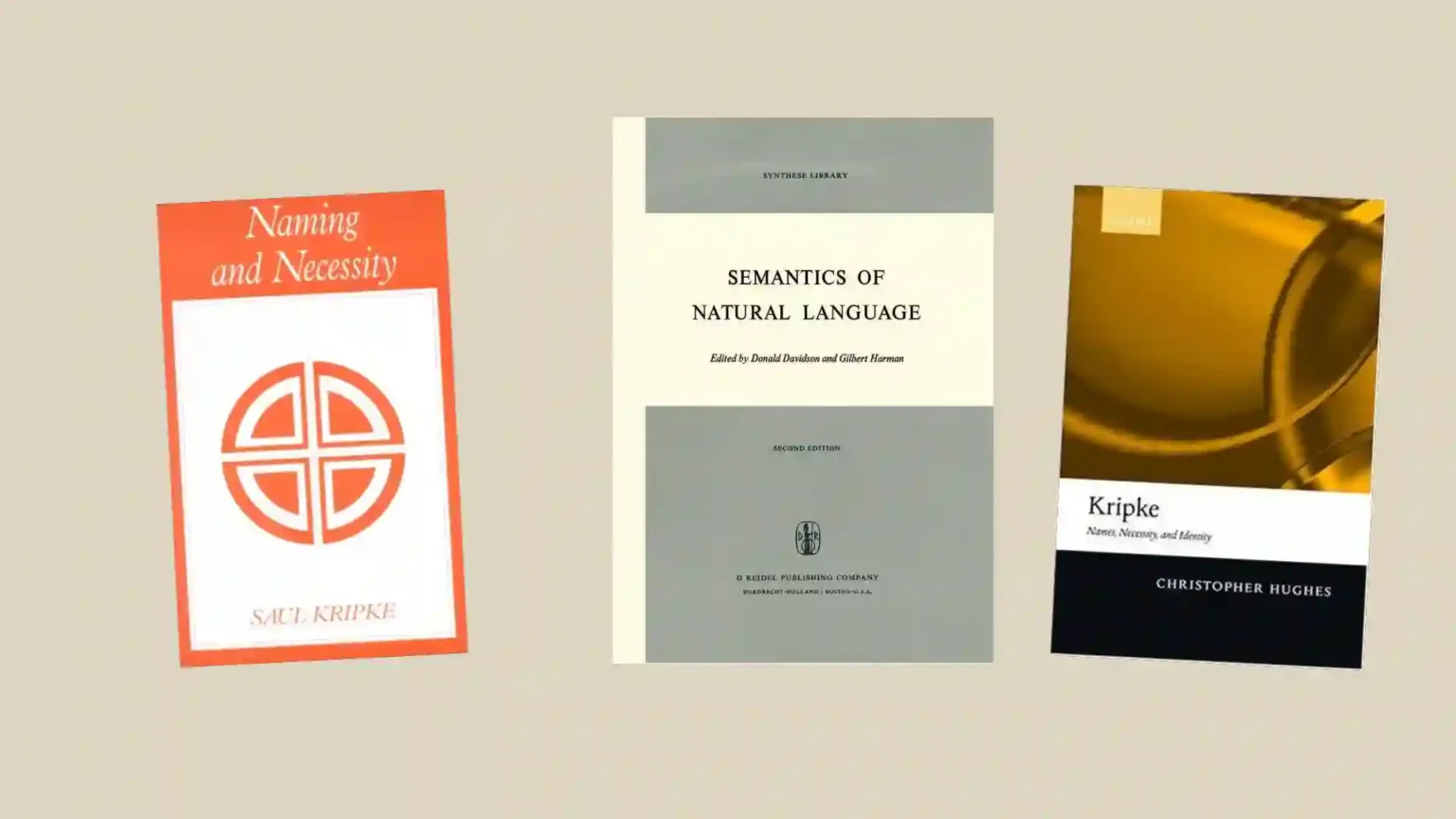
A striking fact about Naming and Necessity is that the book is downstream from speech. Kripke delivered the three lectures at Princeton in January 1970; they were reworked for publication in 1972 in Donald Davidson and Gilbert Harman’s Semantics of Natural Language, where Springer now lists “Naming and Necessity” at pages 253–355. A separate book followed in 1980 with a preface and addenda. The Springer volume record and Cambridge’s historical account of the lectures make that chronology explicit.
That oral origin matters. Kripke’s book often proceeds by examples, objections, reformulations, and conversational insistence rather than by textbook definitions. Preparation should therefore give you a map, not a substitute. The goal is to know exactly which inherited theories he is pushing against and which modal distinctions he refuses to collapse.
The Dependency Map for Naming and Necessity
| Before Kripke, be able to… | Best preparation | Why it matters in the lectures |
|---|---|---|
| Distinguish sense from reference | Frege overview | Kripke inherits and attacks a descriptivist background about names. |
| Recognize Russellian descriptions | Theory of descriptions overview | Names and definite descriptions must not be silently treated as the same kind of expression. |
| Use possible-world talk modestly | Possible Worlds overview | Kripke uses counterfactual situations to test designation and necessity. |
| Separate necessity from a priori knowledge | Varieties of Modality | The necessary a posteriori is unintelligible if these dimensions are merged. |
| Recognize rigidity | Rigid Designators overview | Rigidity is the central tool connecting reference to modal claims. |
| Track the 1970/1972/1980 text history | Springer + Cambridge records | The book is a revised lecture text, not a treatise written in one pass. |
Names Before Worlds
Start with Frege, but only with the problem Kripke needs. The Stanford entry on Frege explains why co-referring expressions can differ in cognitive significance: “morning star” and “evening star” can refer to the same object while presenting it differently. You do not need Frege’s whole logical system. You need the pressure that motivates an intermediary notion such as sense.
Then learn Russell’s theory of descriptions from the Stanford entry on descriptions. A phrase of the form “the F” can be analyzed quantificationally rather than as a simple name. This matters because a descriptivist theory of proper names can treat a name as shorthand for, or associated with, identifying descriptions. Kripke’s attack is much easier to follow if you can state that proposal in a charitable form before watching him test it.
At this point you should be able to distinguish three questions: what an expression refers to; what information a competent speaker associates with it; and how its referent is fixed. If those are blurred, Kripke’s causal-historical suggestions about reference will look like a rejection of every role for descriptive information, which is too crude.
Worlds Without Metaphysical Overload
Next learn just enough modality to read counterfactual examples. The Stanford “Possible Worlds” entry explains possible-world semantics and the idea that modal claims concern how things might have been. Do not begin by deciding whether possible worlds are concrete entities, abstract objects, or useful representational devices. Kripke’s central tests of names do not require you to settle the ontology of worlds first.
Practice with one ordinary counterfactual: Aristotle might not have taught Alexander. When considering that possibility, are you using “Aristotle” to pick out the same man and changing what is true of him, or are you searching each world for whoever satisfies a description such as “the teacher of Alexander”? The difference is the doorway to rigidity.
Rigidity
Now read the first sections of the Stanford entry on rigid designators. A rigid designator picks out the same object across the relevant possible worlds in which that object exists; an ordinary definite description can pick out different objects in different counterfactual circumstances. The Hesperus/Phosphorus case then becomes more than a puzzle about astronomy. If both names rigidly designate Venus, a true identity between them is necessary even though discovering that identity required empirical investigation.
Do not memorize “names rigid, descriptions non-rigid” as an exceptionless slogan. The philosophical work lies in how expressions are used and in the distinction between fixing a reference and giving a synonymous description. Kripke repeatedly exploits cases in which a description helps someone identify or introduce a name without becoming the meaning of the name.
Two Axes, Not One
Before the second and third lectures, draw a two-by-two grid. One axis is modal: necessary versus contingent. The other is epistemic: a priori versus a posteriori. The Stanford entry on varieties of modality explains why Kripke’s work helped break the assumption that necessity and apriority line up automatically.
This grid is indispensable for the examples. “Hesperus is Phosphorus,” if true and if both are rigid designators of Venus, can be necessary while known a posteriori. Conversely, Kripke uses the standard meter example to motivate a route to the contingent a priori: a reference-fixing stipulation can let someone know a contingent fact without empirical measurement in the usual sense. Whether every detail of these cases succeeds is less important on a first reading than seeing that two classifications are in play.
A Publication Timeline
| Date | Textual event | Reading implication |
|---|---|---|
| January 1970 | Three Princeton lectures | Expect spoken examples, recaps, and argumentative improvisation. |
| 1972 | Published in Semantics of Natural Language | This is the first published lecture text; Springer records it at pp. 253–355. |
| 1980 | Separate book with preface/addenda | The familiar book is not simply a facsimile of the original lecture occasion. |
| 2004 | Christopher Hughes, Kripke: Names, Necessity, and Identity | Useful secondary analysis after a first encounter with Kripke, not before every page. |
For a reliable modern secondary guide after your first pass, Christopher Hughes’s Kripke: Names, Necessity, and Identity is unusually well matched to the book’s three pressure points: names, necessity, and identity. Oxford notes that it treats rigid designation, causal reference, the necessary/contingent and a priori/a posteriori distinctions, natural kinds, essentialism, and the mind–body application.
How to Read the Book Itself
On Lecture I, mark every case in which Kripke distinguishes a description used to fix reference from a description proposed as meaning. On Lecture II, mark every move from reference to modality: which expression is being held fixed across counterfactual circumstances? On Lecture III, slow down. Natural-kind terms, theoretical identities, essential properties, and the mind–body argument depend on distinctions built earlier; they are not a fresh topic.
BookInLight’s broader philosophy of language reading guide places Naming and Necessity after Frege, Wittgenstein, Austin, Quine, and Grice. That sequence is useful if you want a field-wide route. For this book alone, however, the dependency map above is leaner: Fregean sense/reference, Russellian descriptions, possible worlds, rigidity, and the modal/epistemic two-axis grid.
The Preparation Test
You are ready when you can answer four questions without using Kripke’s conclusion as your premise. What is the difference between a name and a definite description? What does it mean to evaluate an expression across counterfactual situations? Why are necessity and apriority different kinds of status? How can a description fix a referent without giving the meaning of the name?
If those distinctions are stable, Naming and Necessity stops looking like a collection of famous examples—Aristotle, Hesperus, heat, gold, the meter stick—and becomes a connected argument about how reference constrains modal reasoning. That is the point of preparation: not to make Kripke easy, but to make the exact site of each disagreement visible.
Further reading
After the primary text, use the Stanford entries on rigid designation, possible worlds, and Frege to separate later terminology from Kripke’s own presentation. Hughes’s Oxford monograph is the best next sustained commentary in this roadmap.
Cover artwork: credits and source records
- Naming and Necessity — Harvard University Press (source record)
- Semantics of Natural Language — Springer (source record)
- Kripke: Names, Necessity, and Identity — Oxford University Press (source record)